The Quiz Question
At the Battle of Messines in June 1917, British tunnellers detonated how many underground mines beneath German positions in an explosion reportedly heard as far away as London?
- A. 32
- B. 6
- C. 19
- D. 2
The answer is C. 19. Here is the full story.
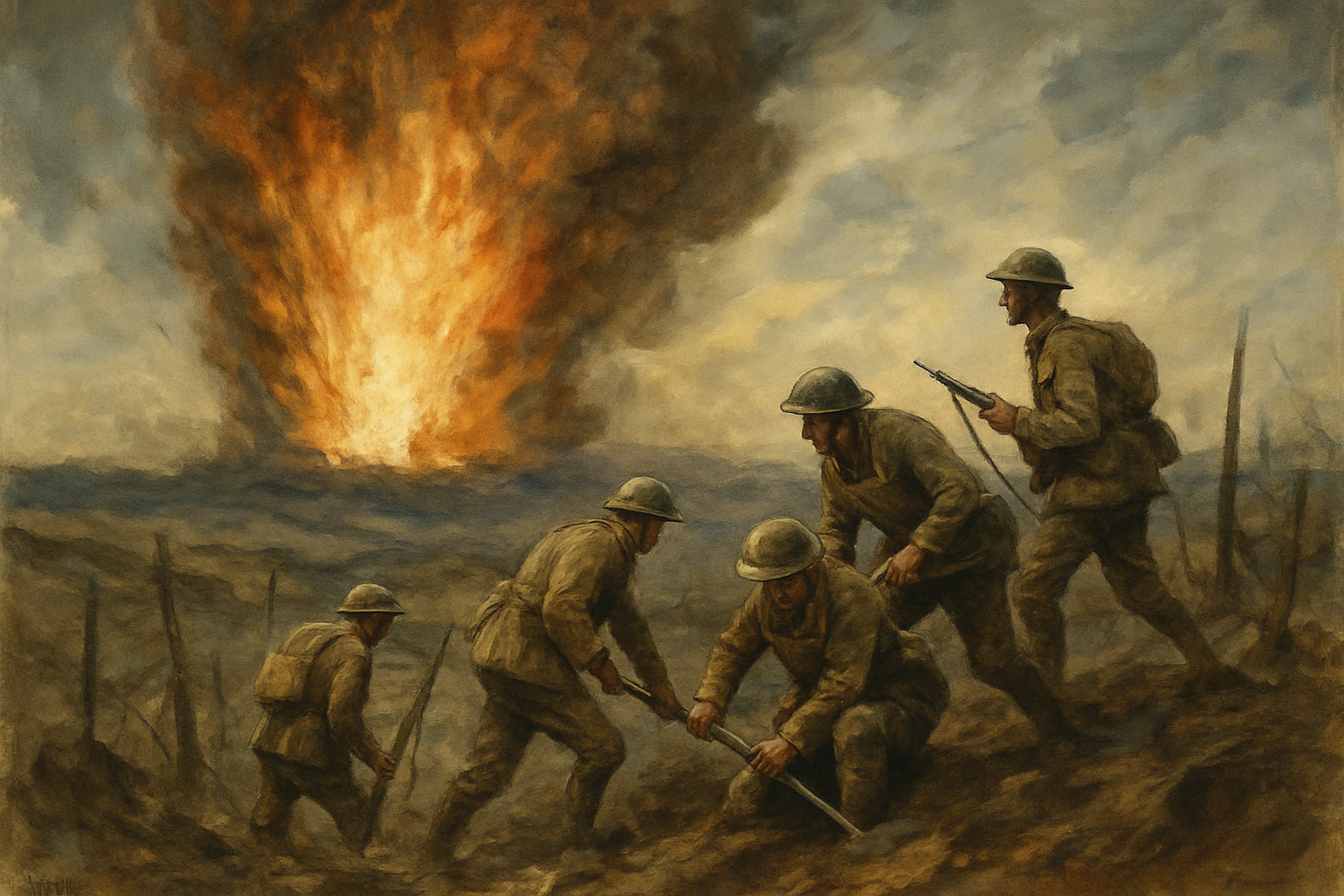
Just after three o'clock on a June morning in 1917, the ground beneath the Messines Ridge in Belgium ceased to be solid. Nineteen massive underground mines detonated almost simultaneously, triggering an explosion so vast it was reportedly heard in London — over 200 miles away. Some accounts place it as far as Dublin. It remains one of the loudest man-made explosions in history, and it announced one of the most meticulously planned and tactically successful British operations of the entire First World War.
The Loudest Bang in History: A Morning That Shook Two Countries
At 3:10 AM on 7 June 1917, the earth along a ten-mile stretch of the Western Front erupted in a chain of colossal blasts. Columns of fire and debris rose hundreds of feet into the air. The shock wave rolled across the Belgian landscape and kept rolling — across the Channel, across southern England, all the way to Downing Street, where British Prime Minister David Lloyd George is said to have felt the detonation.
The human cost in those first seconds was staggering. An estimated 10,000 German soldiers were killed almost instantly — buried alive, incinerated, or thrown into the air by blasts of unimaginable force. It was one of the single deadliest moments of the entire war, measured in seconds rather than days.
The night before the attack, General Sir Herbert Plumer, commanding the British Second Army, reportedly told his staff: "Gentlemen, we may not make history tomorrow, but we shall certainly change the geography." He was not wrong on either count.
Why Messines Mattered: The Ridge That Dominated Flanders
The Messines-Wytschaete Ridge curves south of the city of Ypres, and since late 1914 it had been firmly in German hands. It did not look like much — a modest elevation in an otherwise flat landscape — but in Flanders, even modest high ground was everything.
From the ridge, German artillery observers had a commanding view across the entire Ypres Salient, allowing them to direct fire onto Allied positions with deadly precision. British troops in the salient below lived under constant, accurate bombardment. Every movement, every supply column, every concentration of men was visible to observers on the heights.
Capturing the ridge was also a tactical prerequisite for the broader Third Battle of Ypres — the campaign history would later call Passchendaele — planned by Field Marshal Haig for later in 1917. A frontal assault up the slopes had been tried before and had failed at terrible cost. General Plumer and his staff began exploring a radically different approach as early as 1915: instead of going over the ridge, they would go beneath it.
Going Underground: The Tunnelling Companies of the Royal Engineers
The British Army established specialist Tunnelling Companies within the Royal Engineers in February 1915, drawing on the deep civilian expertise of professional miners from coalfields across Britain, Canada, Australia, and New Zealand. These were men who already understood how to work in confined, dangerous underground spaces — they simply transferred those skills to a far more lethal environment.
At Messines, around 8,000 tunnellers laboured for nearly two years beneath the ridge. Units including the 1st, 2nd, and 3rd Australian Tunnelling Companies and multiple Canadian Tunnelling Companies drove galleries down to depths of 50 to 100 feet — deep enough to evade German acoustic listening devices, which both sides used to monitor underground activity.
The work was done in conditions almost beyond imagining. Picks, bayonets, and bare hands were used in the tightest sections to minimise noise. Men whispered rather than spoke. Candles were used sparingly to conserve oxygen. A single accidental sound could betray a tunnel's location and bring a German counter-mine down on the crew.
German counter-tunnelling was relentless. Both sides used camouflets — small explosive charges designed to collapse enemy galleries without breaking the surface — and men on both sides died in these subterranean duels, far from the light, with no witnesses and no markers.
The Men Who Dug in the Dark
Brigadier-General Robert Harvey oversaw a significant portion of the mining operations and played a central role in coordinating what became the most ambitious tunnelling project in military history. The logistical challenge alone was extraordinary — thousands of men, millions of tons of excavated spoil disposed of secretly, and enough explosives to level a small town, all positioned without the Germans above knowing.
The tunnellers came largely from civilian mining communities — men from the Durham, Yorkshire, and South Wales coalfields who knew the sounds a tunnel makes before it collapses. The Australian contingent played a particularly important role, completing several of the deepest and most technically demanding galleries beneath the ridge.
The casualty rate among tunnellers was disproportionately high. They died from German counter-mines, from asphyxiation when ventilation failed, from tunnel collapse, and occasionally from direct underground encounters with German miners who had broken through into the same space. Their sacrifice was largely invisible — there was no wire to go over, no ground to gain. There was only the dark, the silence, and the work.
Ammonal and Guncotton: The Science of the Mines
Each mine chamber at the end of the tunnels was packed with either ammonal — a mixture of ammonium nitrate and aluminium powder — or guncotton, both chosen for their stability in the damp underground conditions beneath Flanders clay. The combined explosive load across all nineteen mines totalled approximately 450 tonnes, or nearly one million pounds of high explosive.
The largest single mine, positioned beneath the German strongpoint at Spanbroekmolen, contained around 91,000 lbs of ammonal. When it detonated, it created a crater approximately 250 feet wide and 40 feet deep. That crater still exists today, filled with water and preserved as the Pool of Peace — a silent, still monument in the Belgian countryside.
All nineteen mines were connected to electrical firing circuits running back to the British front lines, allowing near-simultaneous detonation across the entire front. The precision required was extraordinary — too early and the infantry could not follow up; any significant delay between detonations and the infantry assault would allow German survivors to recover.
Two mines failed to detonate that morning. One exploded accidentally in 1955, struck by lightning during a thunderstorm — it killed a cow and startled a generation of Belgian farmers. The other remains undetonated beneath agricultural land in Belgium to this day, its exact position monitored periodically by Belgian authorities.
Zero Hour: The Attack on 7 June 1917
General Plumer's Second Army committed nine divisions to the assault, supported by 2,266 artillery pieces and 72 tanks. It was a combined-arms operation of the first order, built around achievable, clearly defined objectives rather than the ambitious and vague territorial goals that had doomed earlier offensives.
Infantry from British, Australian, New Zealand, and South African units advanced behind a creeping artillery barrage seconds after the mines detonated. German positions that had not been physically destroyed were occupied by men too stunned, too disoriented, or too overwhelmed by shock to mount coherent resistance. Survivors described a complete collapse of situational awareness — men who had been trained soldiers moments before the explosions were, in many cases, simply unable to function.
By 7:00 AM — barely four hours after zero hour — British and Dominion troops had captured virtually all of their primary objectives along the ridge. The speed and completeness of the advance was almost without parallel in the Western Front experience to that point in the war.
The Battle of Messines stands today as one of the most tactically successful British operations of the entire conflict — a clean, well-executed victory achieved through preparation, precision, and the courage of men who had spent two years digging in the dark.
The Cost of Victory: Casualties on Both Sides
The full battle ran from 7 to 14 June 1917 as British forces consolidated and extended their gains. Over that period, British and Dominion forces suffered approximately 17,000 casualties — killed, wounded, and missing. Measured against the strategic prize and compared to other major operations of 1917, this was considered an acceptable cost by the standards of the time.
German losses were considerably heavier — an estimated 25,000 casualties in total, with thousands killed in the mine explosions themselves and a further 7,200 taken prisoner, many in a condition of severe shock. German official accounts acknowledged the mines had caused a breakdown of defensive cohesion that no amount of tactical skill could have remedied.
The New Zealand Division, attacking on the left of the assault, achieved all its objectives within hours but paid a heavy price: over 3,700 casualties on a single day. In a country of New Zealand's population, that figure carried an enormous weight. The 7th of June remains a date of particular solemnity in New Zealand's national war memory.
Plumer's insistence on limited, achievable objectives — what military historians sometimes call the "bite and hold" approach — prevented the exploitation phase from overreaching and turning victory into another grinding disaster. It was a lesson the broader BEF was still struggling to absorb.
What Became of the Craters: The Landscape After Messines
The mine explosions reshaped the physical landscape of the Messines Ridge permanently. Enormous craters opened across the ridge, many of which filled with groundwater and became ponds. Some survive today as quiet, unremarkable features of the Belgian countryside — until you know what made them.
The Spanbroekmolen crater was purchased in 1929 by Toc H, a British Christian service movement founded during the war, and preserved as the Pool of Peace. It can still be visited today, ringed by trees, its still surface giving no indication of the violence that formed it. Several other craters — at Caterpillar, Ontario Farm, and Peckham — have also survived near the village of Wijtschate.
The village of Messines itself — now known by its Flemish name, Mesen — was almost entirely destroyed during the battle and suffered further destruction when German forces recaptured it briefly in April 1918. Post-war reconstruction left little of the original village standing. Today it is home to a small but deeply moving museum, the New Zealand Memorial Park, and the Messines Ridge British Cemetery.
Legacy and Memory: Why Messines Still Resonates
Messines is studied in military academies as a model of what meticulous planning, realistic objective-setting, and the effective use of surprise can achieve — a deliberate, disciplined alternative to the attritional nightmare of the Somme and Passchendaele. The contrast with those campaigns is stark and instructive.
General Plumer's reputation as one of Britain's most effective and humane commanders rests substantially on this battle. His troops called him "Daddy Plumer" — not a nickname given to distant or callous commanders. He was known for refusing to commit his men to operations he did not believe were adequately prepared, a rarer quality on the Western Front than it should have been.
The two undetonated mines are perhaps the most striking physical reminder of the war's unfinished business. The Western Front's legacy is not merely commemorated — in a very literal sense, it remains buried beneath European soil, and will for the foreseeable future.
The tunnellers themselves remain among the least celebrated soldiers of the First World War. Their names appear rarely in mainstream histories, their actions invisible by definition. But the ground shook on 7 June 1917 because of what they built in the dark, over two years, in silence and constant danger. The explosion heard in London was the sound of their work.
If this story moved you, we'd love to hear from you in the comments below — share your thoughts, family connections to the Western Front, or what you find most remarkable about the tunnellers' achievement. And if you know someone who would appreciate this history, please pass it on.
Further Reading
- Imperial War Museum (IWM), London — extensive collections on the Western Front, tunnelling operations, and the Battle of Messines
- The National Archives, Kew — official British Army war diaries and Royal Engineers Tunnelling Company records from the First World War
- Australian War Memorial, Canberra — records and personal accounts relating to the Australian Tunnelling Companies at Messines
- New Zealand History (New Zealand Ministry for Culture and Heritage) — detailed national records on the New Zealand Division's role at Messines
- In Flanders Fields Museum, Ieper (Ypres), Belgium — dedicated to the history of the Ypres Salient, including the Messines mining operation