The Quiz Question
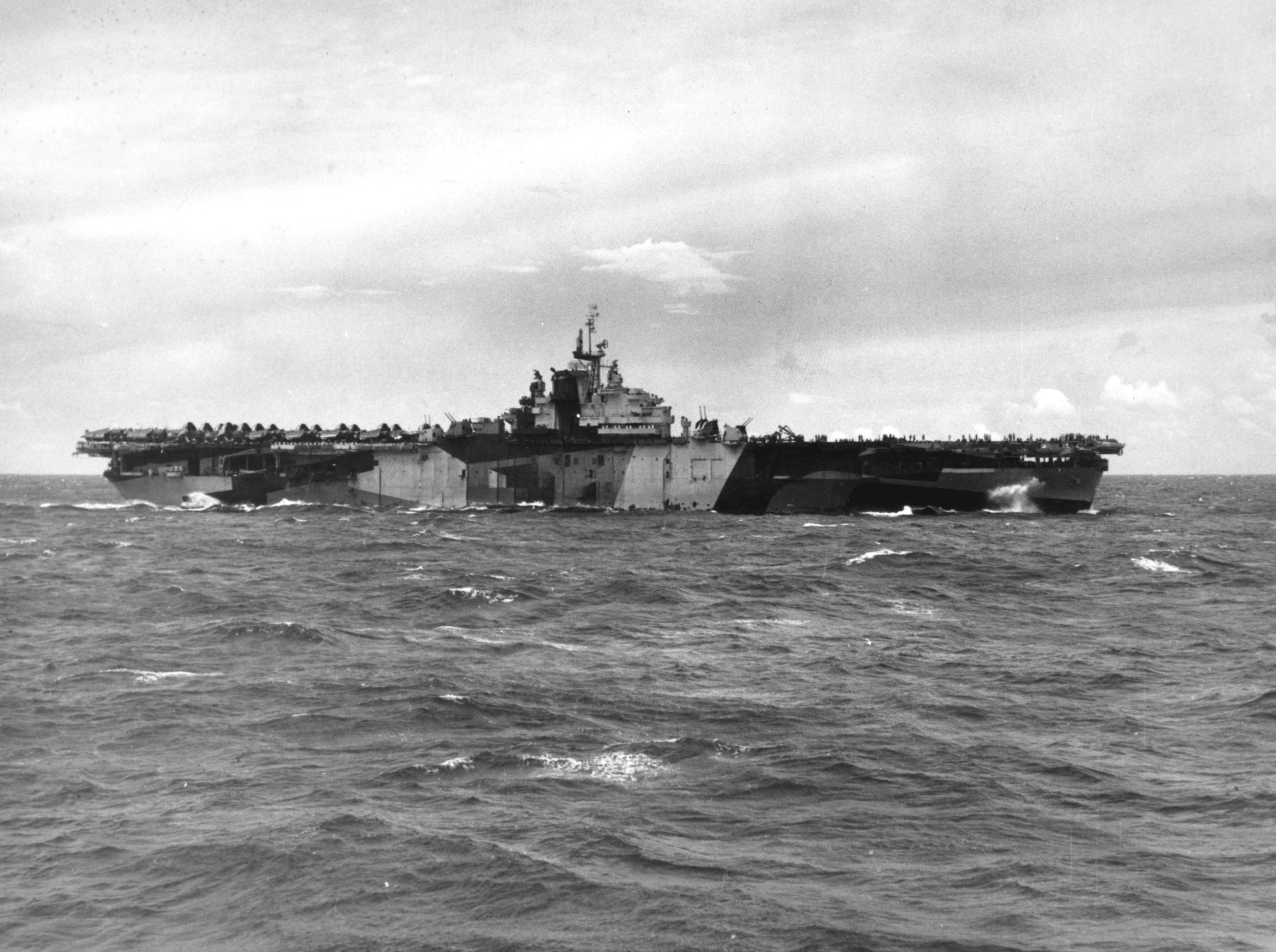
Which US aircraft carrier survived being hit by two bombs off Japan in March 1945 to become the most heavily damaged carrier to make it home in World War 2?
- A. USS Yorktown
- B. USS Franklin
- C. USS Hornet
- D. USS Wasp
The answer is B. USS Franklin. Here is the full story.
On the morning of 19 March 1945, USS Franklin was closer to the Japanese home islands than any American aircraft carrier had been during the entire war. Within minutes of dawn, she would be transformed into a floating inferno. By rights, she should have sunk. That she didn't is one of the most extraordinary survival stories in naval history.
The Ship That Should Have Gone Down
Operating just 50 miles off the coast of Kyushu, Franklin was well inside the range of land-based Japanese aircraft — a calculated risk that would nearly prove fatal. A single Japanese D4Y 'Judy' dive bomber broke through the overcast and released two semi-armour-piercing bombs that punched through her flight deck and set off a catastrophe that no damage control manual had prepared anyone for.
The resulting fires and secondary explosions killed 807 men and wounded another 487, making it the single deadliest disaster suffered by a US Navy ship that survived the war. Of her crew of approximately 3,448, nearly one in four were casualties within the first hour. Yet Franklin never sank. Her survival against those odds made her — and the men who refused to leave her — a symbol of something the US Navy would talk about for generations.
Big Ben: The Making of a Fighting Carrier
USS Franklin (CV-13) was laid down at Newport News Shipbuilding in Virginia on 7 December 1942 — exactly one year after the attack on Pearl Harbor. She was commissioned on 31 January 1944, the fifth US Navy vessel to bear the name, honouring Founding Father Benjamin Franklin. That heritage gave her the nickname that stayed with her throughout the war: Big Ben.
As an Essex-class carrier, Franklin was 872 feet long and capable of carrying 90 to 100 aircraft. The Essex class represented the most powerful and capable carrier design the US Navy had ever produced, and by early 1945 these ships were the tip of the Pacific offensive's spear. Franklin was assigned to Task Force 58 under Vice Admiral Marc Mitscher — the fast carrier strike force that had been punching deep into Japanese-controlled waters since 1944.
Her air group, Air Group 5, flew F4U Corsairs, SB2C Helldivers, and TBF Avengers. These were battle-hardened aircraft flown by experienced crews, and by March 1945 Franklin had already earned a combat record to be proud of — surviving a kamikaze strike off Leyte Gulf in October 1944 that had forced months of repairs. She had come back. She would need to again.
Operation Jamboree: Striking the Japanese Home Islands
In March 1945, Task Force 58 launched Operation Jamboree, a series of aggressive strikes against Japanese airfields and naval assets on Kyushu, the southernmost of Japan's home islands. The objective was to neutralise Japanese air power ahead of Operation Iceberg — the invasion of Okinawa scheduled for 1 April 1945.
The raids required the carriers to operate in waters they had never entered before. Fifty miles from Kyushu was extraordinarily close — close enough that land-based aircraft could scramble, attack, and return to base. Franklin's commanding officer, Captain Leslie Gehres, understood the risk. Task Force 58's commanders accepted it as the price of effective pre-invasion suppression.
At dawn on 19 March, Franklin's flight deck was packed with fully armed and fully fuelled aircraft being prepared for a second wave of strikes. Corsairs loaded with rockets, Helldivers carrying bombs, Avengers heavy with torpedoes — a volatile concentration of ordnance that turned the ship into a potential powder keg. The morning fog lifted. And then the radar operators saw something coming in fast and low.
19 March 1945: Two Bombs, a Ship on Fire
At approximately 07:05, a single Yokosuka D4Y3 'Judy' — likely from the 601st Air Group — broke through low cloud cover and released two 550-lb semi-armour-piercing bombs in a near-vertical attack. The first bomb penetrated the flight deck and exploded in the hangar bay below, where fuelled and armed aircraft were packed together. The second struck the aft flight deck, detonating directly among aircraft preparing for launch.
Within seconds, the ship became a vision of hell. Tiny Tim rockets — large unguided air-to-surface weapons — began cooking off and screaming across the deck. Bombs in the hangar detonated in sequence. Fuel tanks ruptured and ignited. The explosions were so violent that sections of the flight deck were hurled into the air. Franklin lost all power, all steering, and all communications almost simultaneously.
Hundreds of men died in the initial blasts. Others were flung overboard by the concussive force. Hundreds more were trapped below decks in compartments filling with smoke, cut off from escape by collapsed passageways and spreading fire. The ship began listing 13 degrees to starboard. To observers on nearby vessels, Franklin appeared finished.
The Men Who Saved Her: Heroes in the Smoke
When Captain Gehres became isolated on the bridge, it was Commander Joseph Taylor, the executive officer, who took effective command of the damage control effort. Taylor moved through the chaos coordinating firefighting teams, making decisions under conditions that included continuous explosions and the ever-present threat that the entire ship might go up at once.
Navy chaplain Lieutenant Commander Joseph O'Callahan did not stand aside and pray. He ran into the fire. O'Callahan administered last rites to the dying, organised impromptu firefighting parties, and physically helped to manhandle live and burning ordnance over the side. His Medal of Honor citation, recorded in official Navy records, describes a man who seemed to be everywhere at once — a priest turned damage control officer in the worst emergency any of them had ever seen. He became the first Navy chaplain to receive the Medal of Honor in the Second World War.
Lieutenant (jg) Donald Gary performed a feat that defies easy description. While fighting his way through the ship, he discovered approximately 300 men trapped in a smoke-filled mess compartment below decks, with no obvious route of escape. Gary made three separate trips through darkness, smoke, and fire to guide every single one of those men out to safety. He too received the Medal of Honor. Two Medals of Honor from a single incident — an almost unparalleled concentration of recognised heroism.
Behind these celebrated names were hundreds of unnamed enlisted men — damage controlmen, firemen, machinists, and ordinary sailors — who fought fires with hoses and buckets while ammunition exploded around them, knowing at every moment that the ship might simply blow apart beneath their feet.
A Cruiser Throws a Lifeline: USS Santa Fe Alongside
With Franklin dead in the water and still burning, heavy cruiser USS Santa Fe (CL-60) made one of the most daring seamanship decisions of the Pacific War. Captain Harold Fitz brought his ship alongside the stricken carrier — close enough to touch — while secondary explosions continued erupting across Franklin's decks.
Santa Fe held station for hours, absorbing the risk to herself and her crew, while approximately 1,700 of Franklin's men were transferred across. The manoeuvre required extraordinary ship-handling in difficult seas, with the ever-present danger that a major explosion could damage or sink the cruiser as well. Destroyers USS Miller and USS Marshall also came alongside, helping to fight fires and pulling men from the water who had jumped overboard to escape the flames.
The rescue operation saved hundreds of lives. It also set the stage for one of the most bitter controversies to emerge from the Franklin disaster. Captain Gehres, who had remained aboard throughout, later ordered that the 704 men who had gone over the side or transferred to other vessels be listed as deserters. The charge was that they had abandoned ship without orders. For many survivors — men who had jumped into the Pacific to avoid being burned alive — it was an accusation that would take years to fight.
The Long Road Home: 12,000 Miles Under Her Own Power
What happened next bordered on the miraculous. By late morning on 19 March, Franklin's engineering crew had restored partial power. A ship that had been written off as lost was moving again — slowly, painfully, but under her own steam. The heavy cruiser USS Pittsburgh took her under tow initially, but Franklin's engineers kept her propulsion systems running well enough that she was able to proceed largely independently through much of the journey home.
The route took her through the Philippine Sea to Ulithi Atoll, where emergency repairs were carried out. From Ulithi she made for Pearl Harbor, and from Pearl Harbor she continued to the Brooklyn Navy Yard in New York. She arrived on 28 April 1945, having covered roughly 12,000 miles from the position where she had been struck. The crowds that gathered to meet her were enormous.
Damage assessments at Brooklyn confirmed what everyone already knew: Franklin had sustained more severe structural damage than any US carrier to survive the war. Her keel was warped. Her flight deck was destroyed across vast sections. Internal decks had collapsed. The yard workers who inspected her were reportedly astonished she had floated at all.
Aftermath: The Survivors, the Controversy, and the Court of Opinion
The desertion controversy refused to die quietly. Most of the 704 men charged were eventually exonerated, but the process was slow, painful, and deeply humiliating for veterans who believed they had done what any rational person would do to survive. Captain Gehres's reputation never fully recovered, though he was initially awarded the Navy Cross for his conduct during the disaster.
Japan, for its part, had claimed Franklin sunk on multiple occasions. She appeared on Japanese war loss assessments as a confirmed carrier kill — a claim that made her eventual arrival in New York, still afloat, all the more pointed. The US Navy was not slow to recognise the propaganda value of a ship that the enemy had declared dead sailing home under her own power. Newsreel footage of the burning Franklin was screened in cinemas across America in 1945.
Survivor associations kept the Franklin's memory alive long after the war ended, with veterans giving testimony that frequently contradicted the official record. Their accounts — of men who fought for hours in conditions that should have killed them — represent some of the most vivid first-hand narratives of naval combat in the entire Pacific War.
Legacy: Big Ben's Place in Naval History
USS Franklin was decommissioned on 17 February 1947. She was struck from the Naval Vessel Register in 1964 and sold for scrapping in 1966, never having returned to active service. The damage she had sustained in March 1945 had been too catastrophic, and by the time repairs might have been completed, the war was over and the Navy had carriers to spare.
Her ordeal directly influenced post-war US Navy damage control doctrine. The catastrophic chain reaction triggered by armed and fuelled aircraft packed onto a flight deck in a combat zone led to significant changes in how carriers managed ordnance handling and aircraft staging during operations — changes that almost certainly saved lives in later conflicts.
The comparison with the four US carriers actually sunk during the war — Lexington, Yorktown, Hornet, and Wasp — puts Franklin's survival in its sharpest relief. Those ships went down in circumstances arguably less catastrophic than what Franklin endured on 19 March 1945. That she did not join them is a testament not to luck alone, but to the decisions made by men in smoke and fire who simply refused to accept that their ship was going to die.
Chaplain O'Callahan's Medal of Honor, Lieutenant Gary's Medal of Honor, and the countless undecorated acts of courage that kept Big Ben afloat add up to something that goes beyond a single ship's survival. Franklin's story is about what human beings are capable of when everything around them is burning and there is no rational reason left to keep fighting. They kept fighting anyway.
If the story of USS Franklin moved you, share it with someone who loves naval history — and tell us in the comments: which act of courage from that terrible morning stands out most to you? We'd love to hear your thoughts.
Further reading
- National Museum of the United States Navy, Washington Navy Yard
- National World War II Museum, New Orleans
- Naval History and Heritage Command, United States Navy
- National Archives and Records Administration (NARA), United States
- Imperial War Museum, London