The Quiz Question
After defeating a British squadron on Lake Erie on September 10, 1813, which American naval commander sent the message 'We have met the enemy and they are ours'?
- A. Oliver Hazard Perry
- B. Isaac Hull
- C. Stephen Decatur
- D. Thomas Macdonough
The answer is A. Oliver Hazard Perry. Here is the full story.
On the morning of 10 September 1813, a 27-year-old American naval officer climbed aboard a battered rowboat under enemy fire and made one of the most dramatic decisions in the history of naval warfare. By afternoon, he had won a victory so complete that he scrawled his report to a waiting general on the back of an old envelope. Nine words would echo through American history for two centuries: "We have met the enemy and they are ours."
A Scrap of Paper That Changed the War
Master Commandant Oliver Hazard Perry penned his famous dispatch immediately after the last British vessel struck her colours on Lake Erie. The note was rushed ashore to General William Henry Harrison, who had 7,000 soldiers standing by on the Ohio shore, poised to invade Canada — but unable to move without control of the lake.
Perry had fought the battle half-blinded by smoke and grief, watching his flagship torn apart around him. Of the 103 men aboard USS Lawrence, 83 were killed or wounded before the fight was even halfway through. That he prevailed at all was extraordinary. That he did so without losing a single vessel made it a triumph without equal in the young republic's short naval history.
The dispatch electrified the United States. Newspapers printed it in full. Church bells rang from Boston to Kentucky. For a nation still reeling from the humiliation of 1812, Perry's nine words arrived like a thunderclap of redemption.
Why Lake Erie Mattered: The Strategic Picture
Lake Erie stretches roughly 240 miles between the Ohio shore and Upper Canada, and in 1813 it was the strategic spine of the entire western frontier. Whoever controlled it could move troops, artillery, and provisions at speed — a decisive advantage in a theatre where roads were little better than muddy tracks through dense forest.
Britain had seized the initiative early. In August 1812, Major General Isaac Brock captured Detroit with a force that was numerically inferior — a catastrophic humiliation for the United States that surrendered the entire northwest frontier at a stroke. Recovering it meant retaking Detroit, and retaking Detroit meant first winning Lake Erie.
General Harrison's Army of the Northwest was a capable force, but it was tethered to the shore until American ships could guarantee safe passage and supply. Perry's mission was not simply to fight a naval battle — it was to unlock an entire land campaign that could not begin without him.
Building a Fleet From Scratch: Erie, Pennsylvania, 1813
The logistical challenge Perry faced was almost comical in its difficulty. When he arrived at Presque Isle — today's Erie, Pennsylvania — in March 1813, he found a muddy shipyard with scarce timber, barely any skilled craftsmen, and shortages of virtually everything a fighting navy required. Navy Secretary William Jones had ordered a fleet built there the previous September, but the work had barely begun.
Perry's two principal warships, USS Lawrence and USS Niagara, each displaced around 480 tons and carried twenty guns apiece. They were built in roughly 100 days — a remarkable feat of improvised industrial effort on the American frontier. Local blacksmiths, carpenters, and pressed volunteers worked alongside a handful of trained shipwrights.
A sandbar at the harbour mouth presented a near-fatal obstacle. At just four feet deep, it was too shallow for the completed brigs to cross under their own weight. Perry solved the problem by using hollow wooden floats called "camels," lashed to the hulls to raise the vessels just enough to drag them over the bar — a tense operation carried out in full view of a watching British schooner.
Crew shortages were equally desperate. Perry wrote repeated letters to Commodore Isaac Chauncey on Lake Ontario, begging for experienced seamen. Chauncey sent men he could spare — which meant largely the sick and the green. Perry supplemented his crews with soldiers borrowed from Harrison's army, men who had never set foot on a warship in their lives.
The British Commander: Captain Robert Heriot Barclay
Perry's opponent was no amateur. Captain Robert Barclay, Royal Navy, had served at Trafalgar in 1805 under Admiral Collingwood and had lost his left arm in a later action — a credential that earned him considerable respect among his men. At 27, he was Perry's exact contemporary in both age and the pressure of command.
Barclay's flagship, HMS Detroit, was newly built and entered the battle still missing some of its intended guns, which had never arrived from Kingston. His ammunition was mismatched to many of his cannon, forcing his crews to improvise. Promised Royal Navy reinforcements from Commodore Sir James Yeo on Lake Ontario never materialised — a failure of command that would later become central to Barclay's court martial defence.
His six-vessel squadron was a patchwork of Royal Navy regulars, Provincial Marine veterans, and Canadian militia, and the cohesion problems this created were real. More urgently, the British garrison at Fort Malden near Amherstburg was close to starvation by early September. Barclay was not choosing to fight Perry — he was compelled to. Without control of the lake, Fort Malden would have to be abandoned without a shot.
10 September 1813: The Battle Hour by Hour
At 10:00 am, Perry's nine vessels cleared Put-in-Bay on South Bass Island, Ohio, and sailed northwest toward the British squadron hovering near the mouth of the Detroit River. Before leaving his cabin, Perry hoisted a large battle flag — hand-sewn by the women of Erie — bearing the words "DON'T GIVE UP THE SHIP," the dying command of his friend Captain James Lawrence, killed aboard USS Chesapeake only months earlier.
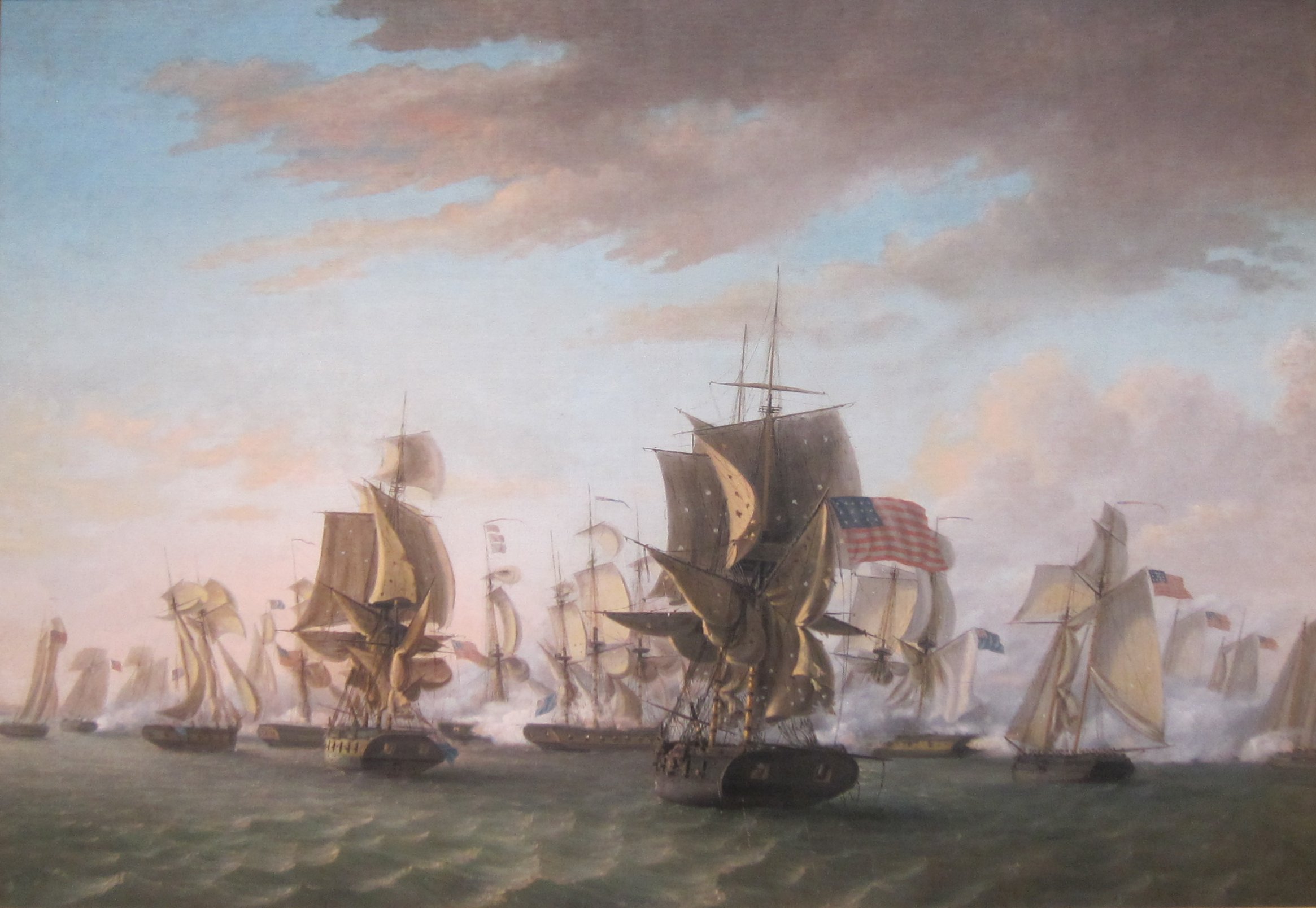
Barclay opened fire at 11:45 am, deliberately at long range. His long guns outranged the American carronades, and he intended to batter the American fleet before it could close the distance. The tactic worked savagely on USS Lawrence. For two hours, Perry's flagship absorbed concentrated British fire with nowhere to hide, her crew falling in clusters around their guns.
By roughly 2:00 pm, Lawrence was finished as a fighting vessel. Eighty-three of her 103-man crew were dead or wounded. Every gun was out of action. Perry gathered his battle flag, stepped into a small rowboat with four men, and was rowed for ten agonising minutes through musket fire and roundshot to reach USS Niagara, which had hung back under the questionable leadership of Jesse Elliott and remained relatively undamaged.
Perry took command of Niagara and drove her straight through the British line at close range. At that distance, his carronades — short-barrelled guns throwing enormous shot — were devastating. The engagement that followed lasted barely fifteen minutes. By approximately 2:30 pm, all six British vessels had struck their colours. Barclay himself had been wounded twice; every one of his officers was also either killed or wounded, a casualty rate among officers that shocked the Royal Navy when the dispatches reached London.
Oliver Hazard Perry: The Man Behind the Legend
Born on 23 August 1785 in South Kingstown, Rhode Island, Perry came from a naval family — his father, Christopher Raymond Perry, had served in the Continental Navy. Oliver entered the United States Navy as a midshipman at the age of thirteen, seeing service in the Caribbean and the Mediterranean during the quasi-wars and early republic period.
He was intensely ambitious and possessed a sense of personal honour that bordered on the combustible — he had actually requested transfer from a comfortable shore posting specifically to seek active command. The Lake Erie assignment was not glamorous, but Perry recognised its importance and drove himself and everyone around him with relentless energy to meet it.
After the battle, Congress awarded him a gold medal and promoted him to Captain. Towns, counties, and warships were named in his honour across the United States. The victory made him one of the most celebrated Americans of his generation. Yet his life was short. On 23 August 1819 — his thirty-fourth birthday — Perry died of yellow fever aboard ship during a diplomatic mission to Venezuela, never living to see the full measure of the fame that would attach itself to his name.
Aftermath: Harrison's March and the Battle of the Thames
Perry's victory unlocked Harrison's campaign within days. On 27 September 1813, Harrison ferried approximately 4,500 American troops across Lake Erie to the Canadian shore — an amphibious operation that would have been impossible without naval control of the water. The British, under General Henry Procter, immediately abandoned both Fort Malden and Detroit, retreating northeast up the Thames River with Tecumseh's Shawnee warriors covering the withdrawal.
Harrison caught the retreating force on 5 October 1813 at the Battle of the Thames, near present-day Moraviantown, Ontario. The British regulars collapsed quickly under a mounted American charge. Tecumseh, who had held the line with fierce determination, was killed in the fighting — the circumstances of his death remain contested, though the consequences were not.
Tecumseh's death effectively ended organised pan-tribal resistance on the western frontier. British influence among the Native nations of the northwest, carefully cultivated over decades, disintegrated almost overnight. The United States recovered Detroit and secured the entire northwest — a cascade of strategic consequences triggered by one afternoon's fighting on the lake.
The British Perspective: Barclay's Court Martial and Vindication
Royal Navy tradition demanded that any officer who lost his ship face a court martial, regardless of circumstance. Barclay appeared before the court at Portsmouth in September 1814, still bearing the wounds of the action. What followed was as much an indictment of the British command structure as it was a trial of the man.
The court heard in detail how Commodore Sir James Yeo had failed to provide the seamen, guns, and supplies that Barclay had repeatedly requested. The testimony painted a picture of a commander sent to fight an impossible battle with inadequate resources by superiors who prioritised Lake Ontario and simply hoped Erie would manage. Barclay was fully acquitted and received the court's formal highest praise for his conduct.
Despite that vindication, Barclay received no further sea commands. He lived quietly until his death in 1837, his name known in naval circles but scarcely beyond — a bitter contrast to the celebrity that followed Perry across the Atlantic. British historians have consistently noted that Lake Erie was lost in Kingston long before the first shot was fired on the lake.
Legacy: One Battle, Two Centuries of Echoes
Perry's dispatch became one of the most quoted military messages in American history. It entered popular culture so thoroughly that when cartoonist Walt Kelly wanted to make a sardonic environmental point in 1971, he reworked it into the now-famous line: "We have met the enemy and he is us." The original had enough cultural weight to make the parody land.
The Perry's Victory and International Peace Memorial, completed in 1915 on South Bass Island, Ohio, stands 107 metres tall and remains one of the tallest monuments in the entire US National Park System. It commemorates not only the battle but also the lasting peace between the United States, Britain, and Canada that followed — an irony worth savouring, given the ferocity of the fighting that preceded it.
For students of military logistics, Lake Erie remains a textbook case in the consequences of supply-chain failure. Barclay's defeat was as much a product of mismanagement in Kingston as of anything Perry did on the water — a lesson that resonates in later British colonial campaigns fought on shoestring resources in distant theatres.
The wreck of USS Lawrence was raised and publicly exhibited after the war, but was lost to fire in 1875. Artefacts from the battle, including Perry's famous battle flag, are preserved and displayed at institutions including the Erie Maritime Museum in Pennsylvania, where visitors can step aboard a reconstruction of USS Niagara to this day.
If this story of courage under fire — and the improvised genius of a young commander who simply refused to lose — struck a chord with you, we'd love to hear your thoughts in the comments below. Share this article with a fellow history enthusiast and keep the story of Lake Erie alive.
Further Reading
- Erie Maritime Museum, Erie, Pennsylvania — home to Perry's battle flag and USS Niagara reconstruction
- Perry's Victory and International Peace Memorial, National Park Service, South Bass Island, Ohio
- The Naval History and Heritage Command, Washington, D.C. — official US Navy historical records and primary sources
- The National Archives, Washington, D.C. — War of 1812 naval records and court martial documents
- Library and Archives Canada, Ottawa — British and Canadian perspectives on the Lake Erie campaign and the War of 1812