The Quiz Question
Which Royal Navy destroyer was struck by an unexploded bomb that tore straight through her hull near the waterline on 12 May 1982, without a single fatality on board?
- A. HMS Sheffield
- B. HMS Exeter
- C. HMS Coventry
- D. HMS Glasgow
The answer is D. HMS Glasgow. Here is the full story.
On 12 May 1982, a 1,000 lb bomb tore straight through the hull of HMS Glasgow — entering one side of the ship and exiting the other without detonating. It should have killed her. It should have sent 280 men to the bottom of the South Atlantic. Instead, not a single crew member died. What happened that afternoon off the Falkland Islands remains one of the most extraordinary survival stories in modern British naval history.
A Miracle in the South Atlantic: 12 May 1982
The date fell just days into the amphibious landings phase of Operation Corporate — the British campaign to retake the Falkland Islands from Argentina. San Carlos Water was being used as the main landing area, and the task force was stretched thin, exposed, and under constant air threat.
HMS Glasgow was stationed on radar picket duty in the approaches north of the Falklands, part of the outer defensive screen designed to intercept Argentine aircraft before they could reach the troop ships and amphibious vessels. It was dangerous, exposed work. The ship's crew knew it.
When Argentine jets swept in at ultra-low level that afternoon, a bomb punched clean through Glasgow's hull near the waterline, passing through the machinery spaces and out the other side. The two ragged holes it left behind flooded compartments and crippled her propulsion. But the bomb never went off. That single mechanical failure — an unarmed fuse — was the difference between a damaged warship and a catastrophe.
The Ship and Her Role: Who Was HMS Glasgow?
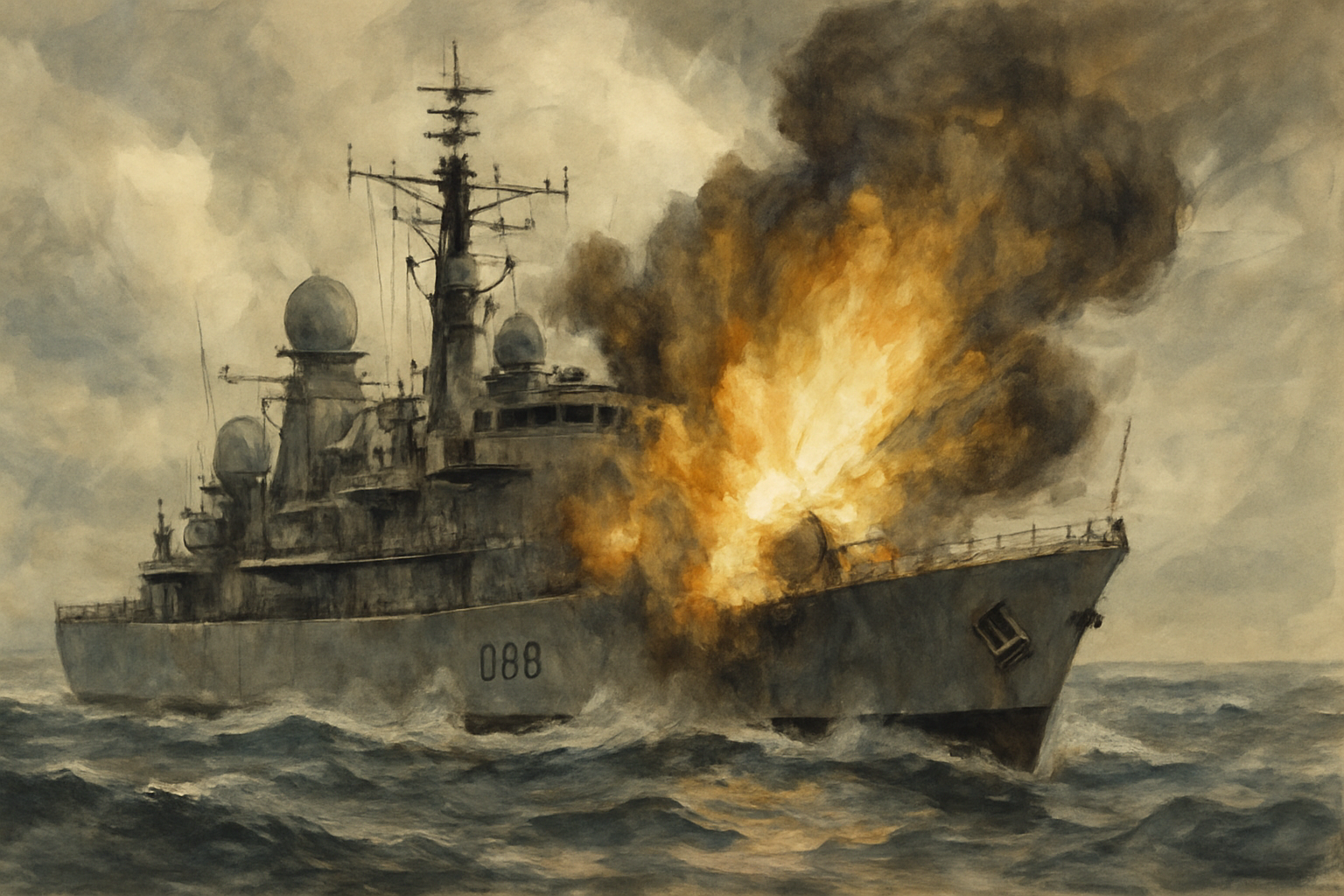
HMS Glasgow (D88) was a Type 42 destroyer, commissioned into the Royal Navy in 1979. Displacing around 3,500 tons, she was built for one primary purpose: air defence. Her principal weapon was the Sea Dart surface-to-air missile system, supported by a 4.5-inch gun, torpedoes, and a Lynx helicopter.
Type 42s were the Royal Navy's air defence shield — the ships expected to protect the fleet from aircraft and missile attack. Losing one wasn't just a blow to morale; it potentially unravelled the entire fleet's defensive architecture. Captain Paul Hoddinott commanded Glasgow throughout the deployment.
By 12 May, Glasgow had already seen action. She had fired Sea Dart missiles during earlier operations around the Falklands and had been at sea for weeks in deteriorating South Atlantic conditions. Her crew was experienced but stretched. The news that HMS Sheffield had been sunk by an Argentine Exocet missile on 4 May had removed any illusions about the threat they faced.
The Argentine Air Threat: What the Task Force Was Up Against
Argentina's Fuerza Aérea Sur — the Southern Air Force — flew A-4 Skyhawk and IAI Dagger jets in coordinated, low-level attack profiles specifically designed to neutralise British air defences. Their pilots were brave, skilled, and flying into extraordinarily dangerous conditions.
The tactic was to come in at wave-top height — sometimes just 50 feet above the sea — to get beneath the radar coverage and below Sea Dart's minimum engagement altitude. Sea Dart was an effective missile at medium and high altitudes, but it struggled against targets hugging the surface. The Argentines had identified this weakness and exploited it with disciplined aggression.
What Argentina's air planners had not fully resolved, however, was the knock-on effect of those low-level profiles on their bombs. Standard bomb fuses require a minimum fall distance — enough air time — to arm before impact. Dropped from 50 to 150 feet at high speed, many bombs simply didn't travel far enough through the air to complete their arming sequence. It was a technical oversight that would prove decisive.
12 May 1982: The Attack Unfolds
Glasgow and HMS Brilliant were operating together as a coordinated team north of the Falklands. The pairing was deliberate: Glasgow carried Sea Dart for longer-range threats; Brilliant carried Sea Wolf, a close-in missile system effective against fast, low-flying targets. Together, they formed what planners called a 'missile trap' — bait and defence rolled into one.
At approximately 14:00 local time, a flight of A-4 Skyhawks from Grupo 5 of the Argentine Air Force was detected approaching at ultra-low level. HMS Brilliant's Sea Wolf system performed impressively, shooting down two of the attacking aircraft. It was one of the first successful Sea Wolf engagements of the war.
A third Skyhawk, piloted by Lieutenant Mariano Velasco, pressed home its attack through cannon fire and released its bomb. The aircraft strafed Glasgow's upper deck as it came in — injuring four crew members — before the bomb was released. It was a British-manufactured 1,000 lb Mk 17, part of a batch supplied to Argentina years before the conflict.
The bomb entered the port side of Glasgow's hull near the waterline, passed through the machinery spaces, and exited through the starboard side. Two large, ragged holes were left in the hull. Seawater began flooding in immediately. The bomb had not detonated.
Inside the Hull: The Crew's Fight for Survival
Below decks, the impact would have been terrifying — a sudden, enormous blow, followed by the rush of cold South Atlantic water and total disorientation. Crew members later described the sound as a 'sledgehammer blow'. Those working in the machinery spaces had no warning whatsoever.
Damage control teams moved immediately. Royal Navy training drills for exactly this kind of emergency — flooding, hull breach, loss of power — kicked in with the discipline that comes only from relentless repetition. Plugging the entry and exit holes while managing flooding was the priority. Getting it wrong meant sinking.
The bomb's passage had severely damaged Glasgow's propulsion systems, leaving her without power to one shaft. Four sailors had been injured by the cannon fire during the attack run, but there were no fatalities. That outcome, given the bomb's trajectory through the heart of the ship's engineering spaces, was remarkable.
Glasgow's engineers managed to restore limited propulsion. The ship was able to withdraw from the combat zone under her own power — a testament to both the crew's composure and the training that had prepared them for exactly this scenario.
The Unexploded Bomb Problem: A Flaw That Saved British Lives
The failure of Glasgow's bomb to detonate was not an isolated incident. The same fusing problem affected Argentine attacks on HMS Ardent, HMS Antrim, HMS Argonaut, and RFA Sir Galahad, among others. Multiple British warships and auxiliary vessels survived that would almost certainly have been lost had Argentine bombs exploded on impact.
The mechanics were straightforward. Standard bomb fuses of the type used by Argentina incorporate an arming mechanism activated by the spin or travel of the bomb through air. Dropped from very low altitude at high speed, the bomb strikes its target before the mechanism completes its cycle. The bomb hits. It does not arm. It does not detonate.
Argentine ordnance crews could, in theory, have reconfigured their fuses for low-level delivery — a standard option available on many bomb types. That they did not do so consistently has been identified by British military analysts and historians as one of the decisive technical failures of the Falklands air war. Had Argentine bombs detonated reliably, the Royal Navy's losses would have been catastrophic, and the outcome of the entire campaign could have been different.
It is a sobering thought: the survival of HMS Glasgow, and potentially the success of Operation Corporate itself, owed something to an Argentine oversight in a pre-flight arming sequence.
The Men Behind the Mission: Crew and Commander
Captain Paul Hoddinott's leadership throughout the strike and its immediate aftermath was credited with maintaining discipline and effective damage control across the ship. In a crisis of that speed and violence, command presence matters enormously — and Hoddinott's crew held together.
Glasgow's damage control officer and engineering teams worked with improvised equipment in flooded, darkened spaces to keep the ship afloat and mobile. This is unglamorous work — cold, frightening, and physically exhausting — but it is exactly the work that determines whether a warship lives or dies.
The four injured sailors were treated aboard ship by Glasgow's medical team. The men working below decks during the attack — those closest to the bomb's path — survived through a combination of structural resilience and extraordinarily good fortune. Many of them would have had no idea what had happened until the water started rising.
Veterans of Glasgow's Falklands deployment have spoken in interviews over the years about the profound bond formed in those moments — the shared understanding that every man aboard had come within millimetres of death, and the quiet pride in having kept the ship alive.
Aftermath: Glasgow's Withdrawal and Return to Britain
HMS Glasgow was assessed as too severely damaged to remain in the combat zone and was ordered to withdraw. She made her way south and eventually sailed home to the United Kingdom, arriving at Rosyth Dockyard in Scotland in late June 1982.
Naval engineers at Rosyth documented the entry and exit holes in detail. The structural damage to her hull and engineering systems was significant, and repairs took several months. The documented evidence of the bomb's path through the ship became valuable reference material for naval architects and survivability specialists working on future warship design.
Glasgow returned to Royal Navy service after repairs and continued her career until she was decommissioned in 2005 — over two decades after the South Atlantic tested her to destruction and found her standing. Lieutenant Mariano Velasco, the Argentine pilot who delivered the strike, survived the war. Several of the other Argentine pilots involved in the 12 May attacks were killed in subsequent missions.
Legacy: What HMS Glasgow's Story Teaches Us
The Glasgow incident became a case study at Dartmouth and other naval staff colleges — examined for lessons in damage control doctrine, crew training, redundant engineering systems, and the psychology of command under fire. It remains relevant curriculum today.
The Type 42's vulnerabilities, cruelly exposed during the Falklands, directly accelerated the development and procurement of improved close-in weapon systems for Royal Navy ships. The lessons were written in experience rather than theory, and the Royal Navy took them seriously.
HMS Glasgow's bell and battle honours are preserved, and veterans of her Falklands service continue to hold reunions, keeping the memory of 12 May 1982 — and the men who lived through it — firmly in the public record. Their story deserves to be remembered not as a footnote to Sheffield's loss or Coventry's sinking, but as a remarkable episode in its own right.
A 1,000 lb bomb passed through a Royal Navy warship and killed nobody. That fact sits at the intersection of extraordinary fortune, Argentine technical failure, and the hard-won professionalism of a crew who refused to let their ship die. It is one of the most dramatic survival stories the South Atlantic produced — and the South Atlantic produced many.
If this story resonates with you, share it with someone who loves naval history — and leave a comment below telling us which Falklands ship story you'd most like us to cover next. There are many more extraordinary tales waiting to be told.
Further Reading
- Imperial War Museum — Collections and research resources on the Falklands War, including crew testimonies and ship histories
- The National Archives (Kew) — Official Royal Navy operational records and Ministry of Defence papers from Operation Corporate
- National Museum of the Royal Navy (Portsmouth) — Falklands War material, Type 42 destroyer history, and naval warfare exhibitions
- Royal Navy Historical Branch — Official naval historical records and published analyses of the 1982 campaign
- Fleet Air Arm Museum (Yeovilton) — South Atlantic air war documentation, Argentine and British aircraft records from the Falklands conflict