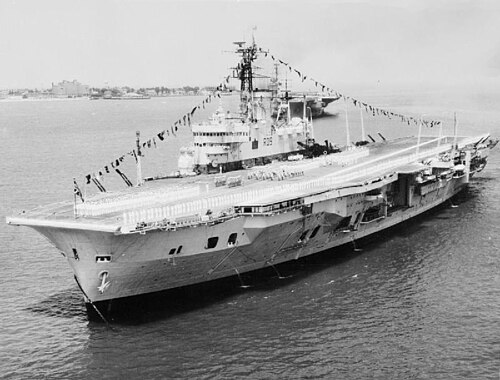
The Quiz Question
Which German U-boat torpedoed and sank the aircraft carrier HMS Ark Royal off Gibraltar in November 1941?
- A. U-47
- B. U-331
- C. U-29
- D. U-99
The answer is E. U-81 -- U-81 torpedoed HMS Ark Royal on 13 November 1941 near Gibraltar and she sank the next day. U-47 sank HMS Royal Oak, U-331 sank HMS Barham, so none of A to D are correct.. Here is the full story.
On the morning of 14 November 1941, Winston Churchill woke to devastating news. The night before, he had gone to bed believing that HMS Ark Royal — Britain's most famous warship, the ship German propaganda had claimed to have sunk three times over — was safely under tow toward Gibraltar. Instead, she was on the bottom of the Mediterranean, lying in 900 metres of water. She had capsized just after six in the morning. One torpedo had done what years of Axis bombing and torpedo attacks had failed to achieve. The Royal Navy had lost its most celebrated fleet carrier, and the war in the Mediterranean would never be quite the same again.
The Ship the Nazis Claimed to Have Sunk Three Times
From the very opening weeks of the Second World War, German propaganda latched onto HMS Ark Royal as a prize target. The Luftwaffe and the Kriegsmarine each announced her sinking with considerable fanfare — in 1939, again in 1940, and once more before November 1941. Each time, the claims were false. Each time, photographs of Ark Royal steaming defiantly into harbour were circulated to prove it.
The phrase "Where is the Ark Royal?" became a darkly humorous national catchphrase. The BBC leaned into it, the press ran with it, and the British public adopted the carrier as something of a national mascot — a symbol of resilience in the darkest years of the war. She had survived Junkers Ju 88 attacks during the Norwegian Campaign, near-misses in the Atlantic, and repeated dive-bombing raids in the Mediterranean. She seemed, to many, genuinely charmed.
When the real news came, the shock was profound. A nation that had convinced itself Ark Royal was unsinkable discovered, in a single morning, that no ship is. And the circumstances — the minimal loss of life set against the total loss of the vessel — made the grief all the more complicated. Only one man of her 1,488 crew was killed. The ship herself was gone forever.
HMS Ark Royal: Britain's Most Celebrated Carrier
HMS Ark Royal (pennant number 91) was launched at the Cammell Laird shipyard in Birkenhead on 13 April 1937, the first British aircraft carrier designed and built from the keel up as a carrier, rather than converted from a battleship or cruiser hull. She displaced approximately 22,000 tons and could operate up to 72 aircraft. At the outbreak of war, she was widely considered the most capable fleet carrier in Royal Navy service.
Her war record before November 1941 was extraordinary. She had participated in the Norwegian Campaign of 1940, conducted Atlantic patrols hunting German commerce raiders, and made repeated dangerous runs to deliver crated Hurricanes to the besieged island of Malta. Her aircrew flew in conditions that would have tested any naval aviator in the world.
Her most famous hour came on 26 May 1941. Swordfish torpedo bombers of 825 Naval Air Squadron, flying from Ark Royal's pitching flight deck in heavy Atlantic weather, delivered a crippling strike on the German battleship Bismarck. One torpedo jammed Bismarck's rudder hard to port, leaving her unable to manoeuvre. The next morning, the Royal Navy closed in and sank her. Without Ark Royal's aircrew, Bismarck would almost certainly have reached the safety of a French port. It was one of the most consequential air strikes in naval history.
By autumn 1941, she was operating with Force H out of Gibraltar — a vital command under Vice-Admiral Sir James Somerville, responsible for controlling the western Mediterranean and the eastern Atlantic approaches. Force H was, in many respects, the hinge on which Britain's entire Mediterranean strategy turned.
The Hunters: U-81 and the German U-boat War in the Mediterranean
Grand Admiral Karl Dönitz had not initially wanted his U-boats in the Mediterranean. The strong Atlantic currents flowing through the Strait of Gibraltar made the transit perilous and one-way — boats that got in often could not get back out again. But Hitler, alarmed by heavy Axis shipping losses to British naval forces, personally insisted on a significant U-boat deployment to the theatre by autumn 1941.
U-81 was a Type VIIC submarine, the standard workhorse of the Kriegsmarine's underwater fleet. Sixty-seven metres long, crewed by around 44 men, and armed with four bow torpedo tubes, the Type VIIC was the submarine that fought the Battle of the Atlantic. U-81's commanding officer was Kapitänleutnant Friedrich Guggenberger, 27 years old, already decorated with the Iron Cross First Class for earlier patrols, and a thoroughly professional naval officer.
On 12 November 1941, U-81 made the extraordinarily dangerous submerged transit through the Strait of Gibraltar, fighting the Atlantic current that perpetually flows eastward into the Mediterranean. British anti-submarine patrols were active and alert. Guggenberger brought his boat through and took up a patrol position east of Gibraltar, operating alongside U-205 and other boats tasked with disrupting Force H.
13 November 1941: The Torpedo That Changed Everything
Force H had been at sea escorting a Malta convoy operation and was returning to Gibraltar on the afternoon of 13 November 1941. The group comprised Ark Royal, the battlecruiser HMS Malaya, and a screen of destroyers. The sea state was moderate, visibility reasonable. It appeared, on the surface, to be a routine return passage.
At approximately 15:41, roughly 25 miles east of Gibraltar, Guggenberger fired a spread of torpedoes. He was targeting what he believed to be a battleship — he could not clearly identify the carrier from his periscope depth. One torpedo struck Ark Royal on her starboard side amidships, detonating with enormous force and blowing a hole estimated at approximately 30 metres wide in her hull.
The ship immediately listed to 18 degrees to starboard. The explosion ruptured aviation fuel lines, flooded several boiler rooms, and knocked out main electrical power — the systems that drove the damage control pumps essential to her survival. British destroyers, including HMS Legion, Laforey, Lightning, and Genista, immediately raced to depth-charge the attacker while simultaneously turning to assist Ark Royal. U-81 escaped, damaged but intact. Guggenberger would not learn which ship he had struck until after the war.
The Desperate Fight to Save Her — and Why It Failed
The evacuation of Ark Royal was, by any measure, an impressive piece of seamanship. HMS Legion pulled alongside and lifted off non-essential crew within the first hour. Nearly 1,400 men were taken off in good order, without panic. A skeleton crew of around 250 officers and men remained aboard, fighting to save the ship with portable pumps rushed out from Gibraltar.
The fundamental problem was power. Without working pumps, the damage control party could not counter-flood compartments on the port side to correct the list — and seawater continued pouring in through the torpedo hole unchecked. The fleet salvage tug HMS Saucy and the destroyer HMS Hermione took Ark Royal under tow, and for a time it appeared she might be dragged the 25 miles to the safety of Gibraltar harbour. She was actually making headway.
But the flooding could not be stopped. At 06:13 on 14 November 1941, the list suddenly and catastrophically worsened. The last men scrambled off seconds before she rolled. HMS Ark Royal capsized and disappeared beneath the surface, taking with her the hopes of those watching from the destroyers circling nearby. She had fought for nearly 14 hours. It had not been enough.
One Man Lost: The Human Story of Ark Royal's Final Hours
Of 1,488 crew, one man died. Acting Captain of the Engine Room E.E. Mitchell was killed in the initial explosion below decks on the afternoon of 13 November. Every other member of her company survived.
The calm conduct of the evacuation was widely attributed to Captain Loben Maund, though Maund would subsequently face a Board of Inquiry. The inquiry's principal criticism was that he had ordered too many men off the ship too early, weakening the damage control effort at the critical moment when more hands might have made the difference. The Board's findings were a significant blow to Maund's reputation.
Survivors described watching the ship die over 14 long hours — a slow agony rather than sudden catastrophe. Many had served aboard since she commissioned in 1938. One petty officer, quoted in post-war accounts held at the Imperial War Museum, described the experience as like watching your own house burn down and being unable to stop it.
The single death toll gains an even more sobering dimension in context. Just 12 days later, on 25 November 1941, HMS Barham was torpedoed by U-331 off the Egyptian coast and exploded catastrophically. Eight hundred and sixty-one men died. Against that horror, Ark Royal's loss seemed — in terms of human life alone — close to miraculous. It was little comfort for a navy that had lost its finest carrier.
Friedrich Guggenberger: The Man Who Did It
On 10 December 1941, Kapitänleutnant Friedrich Guggenberger was awarded the Knight's Cross of the Iron Cross, specifically in recognition of the sinking of HMS Ark Royal. It was one of the most prestigious individual U-boat achievements of the entire war — a single torpedo that had eliminated Britain's most famous warship.
Guggenberger survived the war, later commanding U-847 and serving in senior Kriegsmarine staff positions. He died in Munich in 1988. By all postwar accounts he was a professional naval officer rather than a committed ideologue, and contemporaries noted that he spoke with genuine respect for the Royal Navy's conduct during Ark Royal's evacuation.
U-81 herself never returned to the Atlantic. She remained in the Mediterranean and was sunk on 9 January 1944 by USAAF bombing while berthed in Pola harbour — modern Pula, on the Croatian coast. The submarine that sank Britain's most celebrated carrier ended her days far from the open ocean, destroyed by air power in a harbour.
The Wider Consequences: Force H Weakened at a Critical Moment
The operational consequences of Ark Royal's loss were severe. Force H was left without carrier aviation at precisely the moment when Malta convoys faced their most intense Axis opposition. Fighter cover for those runs depended on carrier-based aircraft, and without Ark Royal, that cover simply did not exist. The Royal Navy would not have a fleet carrier operational in the western Mediterranean until HMS Eagle arrived in early 1942 — a gap of several dangerous months.
A Board of Inquiry chaired by Vice-Admiral Sir Geoffrey Layton examined not just the conduct of the loss, but the broader lessons for damage control across the fleet. Its findings were significant: better compartmentalisation, improved damage control training, and enhanced pump capacity might have saved her. These conclusions directly influenced post-loss modifications to HMS Illustrious, Victorious, and Indomitable, improving fire and flood containment systems across the surviving carrier fleet.
Churchill's own reaction was characteristically personal. He had been briefed on the evening of 13 November that the tow was holding and that Ark Royal had a fighting chance. He went to bed believing she would make Gibraltar. The news of her sinking reached him the following morning. By all contemporary accounts, he was furious — and deeply shaken.
Legacy: A Name That Would Never Be Forgotten
The wreck of HMS Ark Royal was located in 2002 by the American maritime researcher David Mearns, lying in approximately 900 metres of water off Gibraltar. The survey confirmed that she had capsized and broken apart on the seabed — physical evidence that settled decades of post-war debate about the precise sequence of her sinking, and that vindicated the accounts of the survivors who had watched her roll.
The name Ark Royal has been carried by five Royal Navy ships across the centuries. A fifth HMS Ark Royal, an Invincible-class carrier, served until her controversial early decommissioning in 2011 — a decision that drew pointed comparisons in the press to the losses of 1941, and reignited public debate about Britain's commitment to carrier aviation.
The 1941 Ark Royal is remembered above all for the Bismarck strike. The Fleet Air Arm Museum at Yeovilton, Somerset, commemorates the aircrew of 825 Naval Air Squadron whose Swordfish biplanes — slow, fabric-covered, and impossibly brave — delivered the blow that sealed Bismarck's fate. It is a reminder that Ark Royal's legacy is not one of defeat, but of extraordinary achievement cut tragically short.
Her story endures as one of the most compelling in British naval history: a ship that survived everything her enemies threw at her across two years of war, that became a national symbol of resilience, and that was finally lost to a single torpedo fired by a single young commander on a cold November afternoon. It took one hit, in the right place, at the right moment. That is the nature of war at sea.
If this story of courage, seamanship, and the cruel fortunes of war resonated with you, we'd love to hear your thoughts in the comments below — and if you know someone who shares a passion for naval history, please pass this article along to them.
Further Reading
- Imperial War Museum, London — holds extensive collections on HMS Ark Royal, Force H operations, and Royal Navy Mediterranean campaigns 1939–1943
- The National Archives, Kew — contains Admiralty records, Board of Inquiry papers, and operational logs relating to Force H and the loss of HMS Ark Royal
- Fleet Air Arm Museum, Yeovilton, Somerset — dedicated to the history of British naval aviation, including the Swordfish crews of 825 Naval Air Squadron
- Deutsches U-Boot-Museum, Cuxhaven — holds records and archives relating to U-boat operations, including Type VIIC submarines and Mediterranean deployments
- National Museum of the Royal Navy, Portsmouth — maintains collections and research resources covering Royal Navy warships, carriers, and the Second World War at sea