The Quiz Question
On 12 November 1944, RAF Lancasters of Nos. 9 and 617 Squadrons finally sank which German battleship at anchor in a Norwegian fjord, using 12,000lb Tallboy bombs?
- A. Tirpitz
- B. Scharnhorst
- C. Admiral Graf Spee
- D. Bismarck
The answer is A. Tirpitz. Here is the full story.
On the morning of 12 November 1944, thirty Avro Lancasters lifted off from RAF Lossiemouth on Scotland's Moray Firth and turned toward Norway. Their mission was to finish a job that had consumed three years, ten major operations, and enormous Allied resources. Before the morning was out, the most feared warship in the German Navy would be lying on the bottom of a Norwegian fjord.
The Beast in the Fjord: Why the Tirpitz Terrified the Allies
At 52,600 tons fully loaded, Tirpitz was the heaviest battleship ever built by a European navy. Winston Churchill called her 'the Beast' — and the nickname was entirely apt. Armed with eight 15-inch guns and protected by armour plating up to 320mm thick, she was a vessel that could theoretically destroy any convoy escort afloat.
From early 1942, Tirpitz lurked in the deep-water fjords of Norway, and her mere existence tied down enormous Allied naval resources. This strategy — known as a 'fleet in being' — meant she didn't need to fight to cause damage. The Royal Navy was forced to keep multiple capital ships and fleet carriers in home waters, unable to deploy them to the Pacific or Mediterranean where they were desperately needed.
The consequences were not merely theoretical. In July 1942, when intelligence suggested Tirpitz might be putting to sea, the Admiralty ordered Convoy PQ17 to scatter. It was a catastrophic decision. Of 35 merchant ships, 24 were sunk by U-boats and Luftwaffe aircraft, with the loss of nearly 3,350 vehicles, 430 tanks, and 210 aircraft bound for the Soviet Union. Tirpitz never fired a single shell that day.
Churchill personally prioritised her destruction, telling the Admiralty in 1942 that 'the destruction or even the crippling of this ship is the greatest event at sea at the present time.' That was not rhetoric. It was a frank assessment of strategic reality.
Three Years of Trying: The Long Hunt Before Operation Catechism
Between January 1942 and November 1944, the British mounted at least ten major operations to destroy or disable Tirpitz. Each came agonisingly close. None finished the job.
Operation Title in October 1942 attempted to tow human torpedoes — known as 'chariots' — to Tirpitz's anchorage at Fættenfjord. The tow lines snapped in heavy seas before the weapons could be deployed. In September 1943, Operation Source sent Royal Navy X-craft midget submarines into Kåfjord. X6 and X7 successfully placed explosive charges beneath Tirpitz's keel. The detonations damaged her engines and fire-control systems so severely that she was out of action for six months — a significant achievement, though not the kill the Admiralty wanted.
Operation Tungsten in April 1944 came closer still. Barracuda dive-bombers from HMS Victorious and HMS Furious scored fourteen direct hits, killing 122 men. But Tirpitz's armoured deck simply absorbed the punishment. She was repaired and back in service within months. The message was becoming painfully clear: conventional bombs could not sink this ship.
Barnes Wallis and the Tallboy: The Weapon Built to Kill a Battleship
The answer lay with a brilliant, methodical engineer named Barnes Wallis. Already famous for the bouncing bomb that had destroyed the Ruhr dams in May 1943, Wallis had been working on a fundamentally different concept: the 'earthquake bomb.'
The 12,000lb Tallboy was not designed to hit a ship directly and detonate on contact — that approach had already failed repeatedly against Tirpitz's heavy armour. Instead, Wallis engineered a bomb that would reach near-supersonic speed during its fall, punch through virtually any surface, and detonate deep below — creating a massive shockwave capable of breaking a ship's keel from beneath.
The engineering was extraordinary. Each Tallboy was machined to remarkably tight tolerances, cast from a special high-tensile steel alloy and fitted with offset tail fins that caused the bomb to spin-stabilise in flight — dramatically improving accuracy. Dropped from between 14,000 and 18,000 feet, a Tallboy could penetrate more than 16 feet of reinforced concrete. Tirpitz's armoured deck was formidable, but it was not concrete.
617 Squadron had already proven the weapon in combat. In June 1944 they collapsed the Saumur railway tunnel in a single raid, and Tallboys had been used with devastating effect against hardened German U-boat pens along the French Atlantic coast. The weapon worked. Now it needed the right target.
Operation Catechism: The Plan to Finish the Job
By autumn 1944, Tirpitz had been moved south to Håkøya island near Tromsø. The damage from Operation Source and subsequent attacks had left her unable to sail under her own power. The Kriegsmarine had settled her onto a sandbank and was using her as a floating gun battery — a last-ditch deterrent against an Allied landing in Norway.
Air Vice-Marshal Sir Ralph Cochrane of 5 Group RAF ordered a combined strike by No. 617 Squadron and No. 9 Squadron. Both units flew Avro Lancasters that had been specially modified: mid-upper gun turrets removed to save weight, additional fuel tanks fitted to allow the 2,250-mile round trip from Lossiemouth. It was at the very edge of the Lancaster's operational range.
A previous attempt, Operation Obviate on 29 October 1944, had fallen agonisingly short. One Tallboy had struck Tirpitz but failed to detonate, and thick cloud cover had obscured the target before most of the attacking force could bomb. The ship survived, though the hit caused further flooding and structural damage.
For Operation Catechism, 30 Lancasters were prepared: 18 from 617 Squadron and 12 from No. 9 Squadron. The man leading the mission was Wing Commander James 'Willie' Tait — one of the most decorated bomber pilots in the RAF.
12 November 1944: The Day Tirpitz Died
The Lancasters took off from Lossiemouth in the darkness of the early hours, flying low over the North Sea to duck beneath German radar coverage before climbing to bombing altitude over Norwegian territory. It was a gruelling transit — cold, long, and conducted largely in radio silence.
What greeted them over Tromsø that morning was something the Germans had not planned for: clear skies. There was no cloud cover. Tirpitz lay fully exposed in the sharp Arctic light, her enormous hull unmistakable even from 15,000 feet. Crucially, the smoke-screen generators that were supposed to hide her failed to respond in time. The ship was naked to the sky.
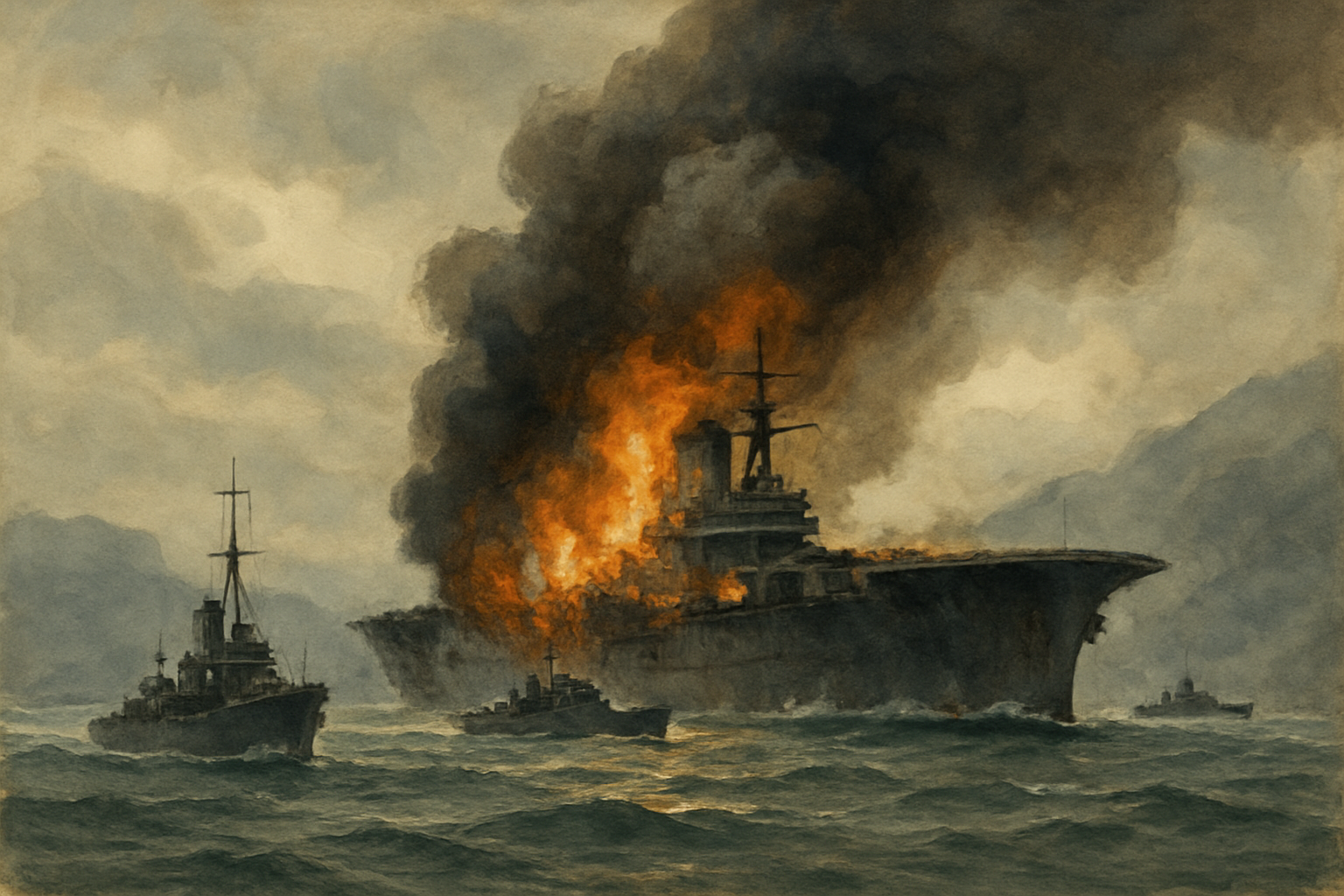
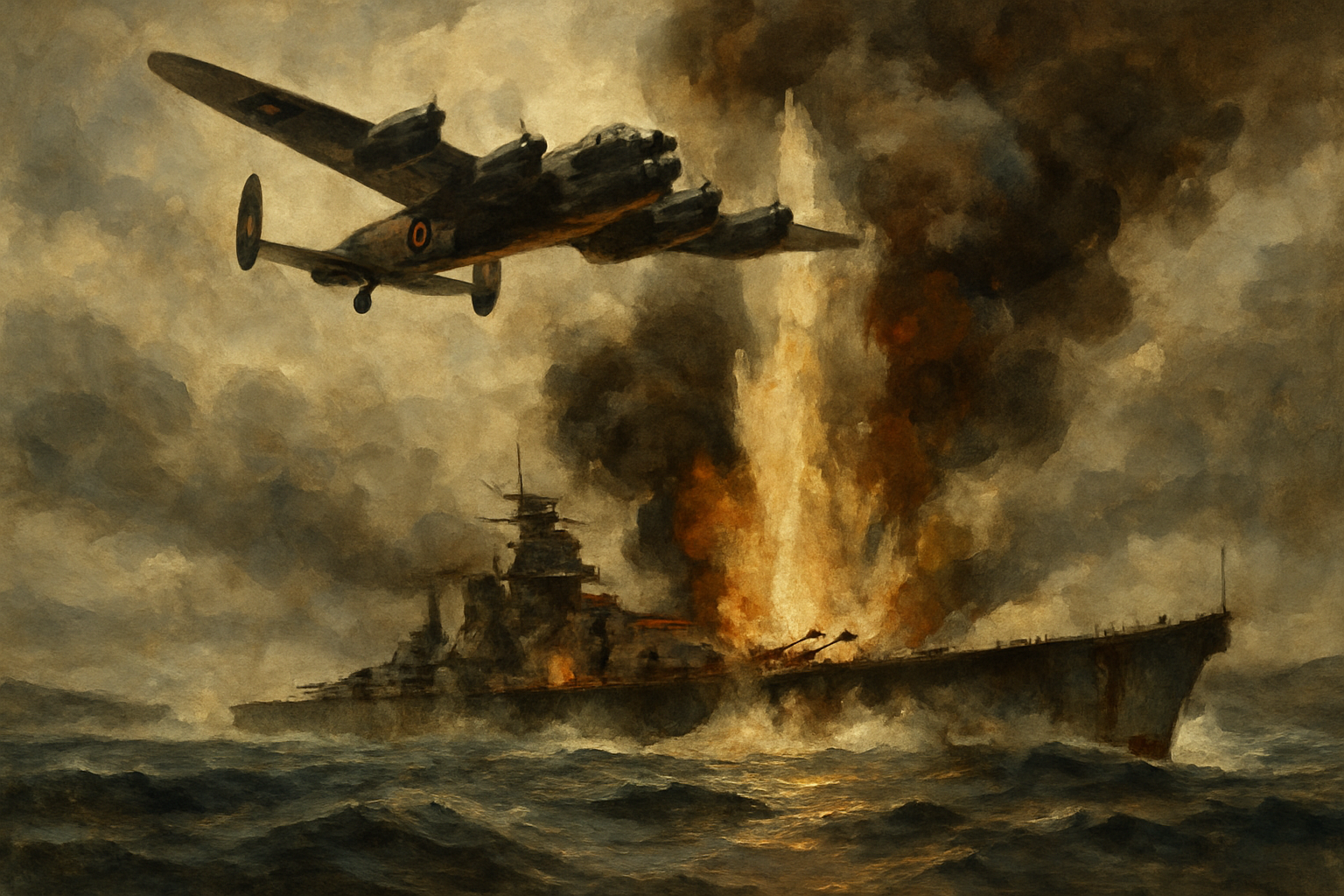
Wing Commander Tait's aircraft was first over the target at approximately 09:41. Within minutes, Tallboys were falling in a tight, disciplined pattern. At least two bombs struck Tirpitz directly. One penetrated the forward magazine — the resulting explosion was catastrophic, felt and heard across the entire Tromsø region. A near-miss created exactly the underwater shockwave Wallis had designed the Tallboy to produce, delivering a brutal hydraulic blow to the ship's keel.
Tirpitz began to capsize to port. Within ten to fifteen minutes, she had rolled completely over. Her hull turned turtle on the shallow seabed, trapping hundreds of men inside. Of a crew of approximately 1,700, between 950 and 1,000 men lost their lives. Norwegian rescue workers later cut holes in the upturned hull with hand tools, working for days guided by the sound of men knocking from within. They saved 87 survivors.
The Men Who Did It: 617 and 9 Squadron's Finest Hour
Wing Commander James 'Willie' Tait held the DSO and three Bars and the DFC and Bar — a remarkable tally even by the standards of Bomber Command's finest. He had taken command of 617 Squadron after both Guy Gibson and Leonard Cheshire, maintaining the unit's extraordinary standards of precision and discipline.
Tait was not a man given to theatrics. He led by calm example, personally flying the lead aircraft on Operation Catechism and placing his Tallboy with the accuracy that 617's intensive training demanded. His crews trusted him completely, and on 12 November 1944 that trust was well placed.
No. 9 Squadron brought a different kind of pedigree to the operation. One of the RAF's oldest bombing units, with a combat record stretching back to 1914, they had been working alongside 617 on Tallboy operations since mid-1944. The two squadrons made a formidable combination.
The round trip lasted approximately thirteen hours, flown at altitude in bitterly cold conditions with no fighter escort for the majority of the route. Remarkably, not one Lancaster was lost. The Luftwaffe scrambled Focke-Wulf 190s in response, but the Lancasters had already turned for home long before the German fighters reached the fjord.
On Board the Tirpitz: The German Perspective
Captain Robert Weber commanded Tirpitz on her final morning. His crew were a mixed force of experienced Kriegsmarine sailors and younger replacements, many of whom had spent months in the bleak isolation of a Norwegian fjord with little prospect of meaningful action. Morale, by all accounts, had been steadily eroding.
A radar warning of approaching aircraft was received with enough time to attempt a response, but the smoke-screen generators were painfully slow. By the time smoke began to rise, the Lancasters were already overhead and committed to their bombing runs. The window had closed.
When the forward magazine detonated, the blast shook buildings in Tromsø. Norwegian civilians on the surrounding hillsides watched as the great ship rolled over with terrifying speed. The men trapped inside as she capsized faced a death that no amount of naval training could prepare a sailor for. Their knocking against the upturned hull, audible for days afterward, drove the urgency of the Norwegian rescue effort.
Aftermath: What the Sinking of Tirpitz Meant for the War
The strategic consequences were immediate and significant. With Tirpitz gone, the Royal Navy no longer needed to maintain a heavy covering force in northern home waters. Capital ships and fleet carriers were freed for redeployment to the British Pacific Fleet, arriving in theatre in time for the final campaigns against Japan in 1945.
The threat to Allied Arctic convoys — the lifeline supplying the Soviet Union with war materiel — was eliminated at a stroke. Those convoys had been running under the shadow of Tirpitz for nearly three years. That shadow simply vanished on the morning of 12 November 1944.
Churchill announced the sinking to the House of Commons with barely concealed relief. For Germany, the loss was irreplaceable. Tirpitz had been Hitler's primary instrument for holding Norway as a strategic fortress. With her gone, that vision collapsed.
The wreck remained at Håkøya after the war. Between 1948 and 1957, a Norwegian-German salvage consortium broke up most of the hull and sold it as scrap metal — a prosaic end for a ship that had shaped Allied strategy for three years.
Legacy: Operation Catechism in History and Memory
Operation Catechism is widely regarded as one of the most precisely executed heavy bombing raids of the entire Second World War. It vindicated Barnes Wallis's revolutionary thinking about deep-penetration weaponry and demonstrated what could be achieved when exceptional engineering met exceptional airmanship.
Wing Commander Tait received no additional decoration for leading the raid — an oversight that many historians have noted, given the enormous strategic significance of what he and his crews accomplished that morning. His four DSOs remain among the most distinguished records of any RAF officer in the war.
The wreck site at Håkøya island is today a designated war grave. A modest memorial marks the location where nearly a thousand German sailors lost their lives — men who, whatever the justice of the cause they served, died in circumstances of particular horror. It is a place that deserves quiet reflection.
617 Squadron — the Dambusters — went on to become the RAF's premier precision-strike unit. That lineage is unbroken: the squadron today operates F-35B Lightning IIs from RAF Marham, carrying forward a tradition of technical excellence and precision that Barnes Wallis would have recognised. His Tallboy, meanwhile, directly influenced the bunker-busting munitions that Western air forces use to this day. The principles he worked out in wartime have never really gone away.
If this story of determination, engineering genius, and extraordinary airmanship moved you, we'd love to hear your thoughts in the comments below. Share this article with anyone who loves real military history — the kind where the details matter and the human cost is never forgotten.
Further Reading
- Imperial War Museum, London — holds extensive collections on RAF Bomber Command, 617 Squadron, and the campaign against Tirpitz
- The National Archives, Kew — official RAF operational records, squadron diaries, and Air Ministry papers covering Operations Obviate and Catechism
- Fleet Air Arm Museum, Yeovilton — records and exhibits relating to earlier naval operations against Tirpitz, including Operations Tungsten and Source
- Riksarkivet (National Archives of Norway), Oslo — Norwegian government and civilian records relating to the Tirpitz wreck site and postwar salvage operations
- RAF Museum, Hendon — collections covering Avro Lancaster operations, Barnes Wallis's weapon designs, and 617 Squadron's wartime history