The Quiz Question
The Lochnagar Crater, still visible near La Boisselle today, was blasted into the Somme battlefield at 7:28am on 1 July 1916 by a mine containing how much ammonal explosive?
- A. Over 25 tons
- B. Over 100 tons
- C. Around 2 tons
- D. Half a ton
The answer is A. Over 25 tons. Here is the full story.
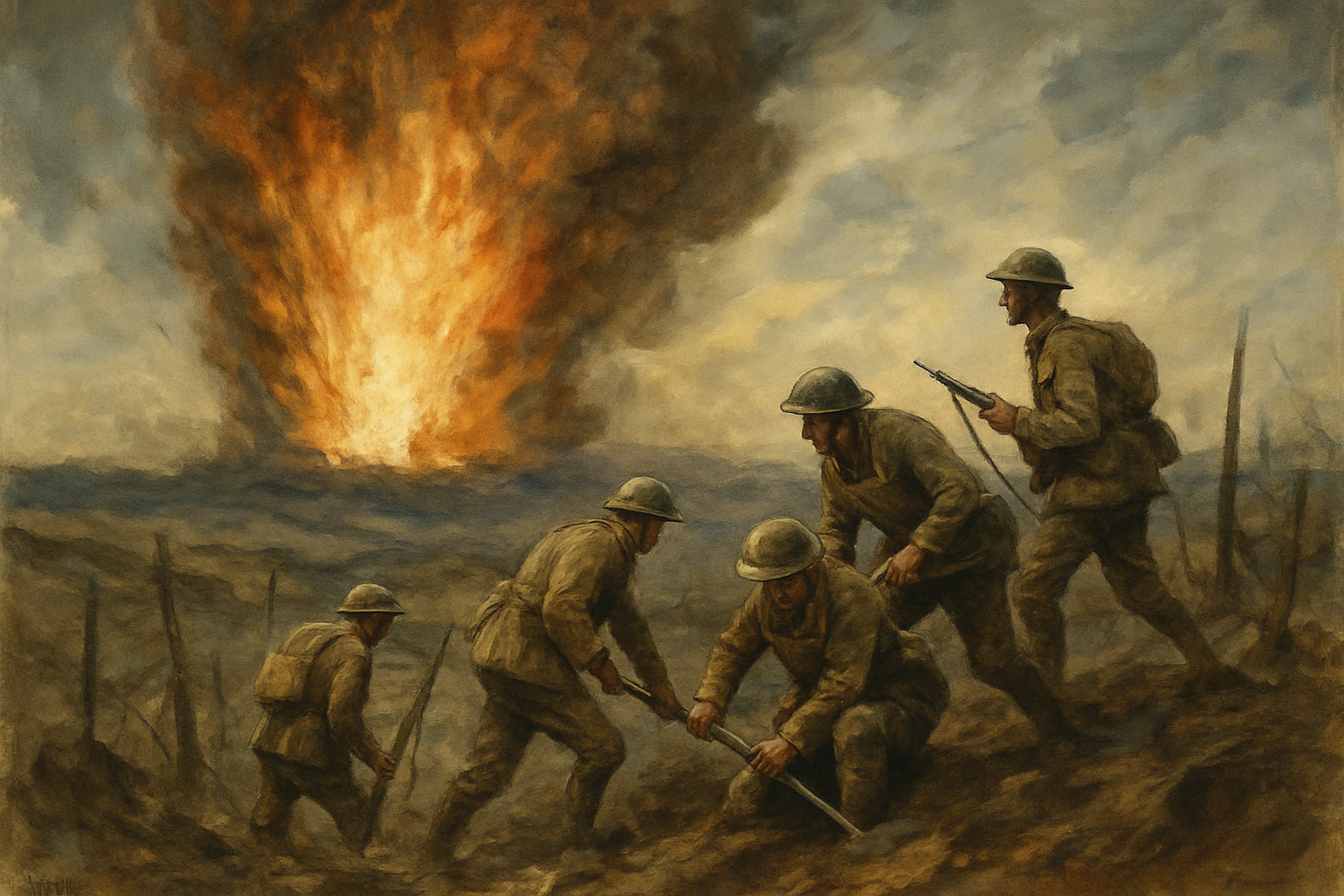
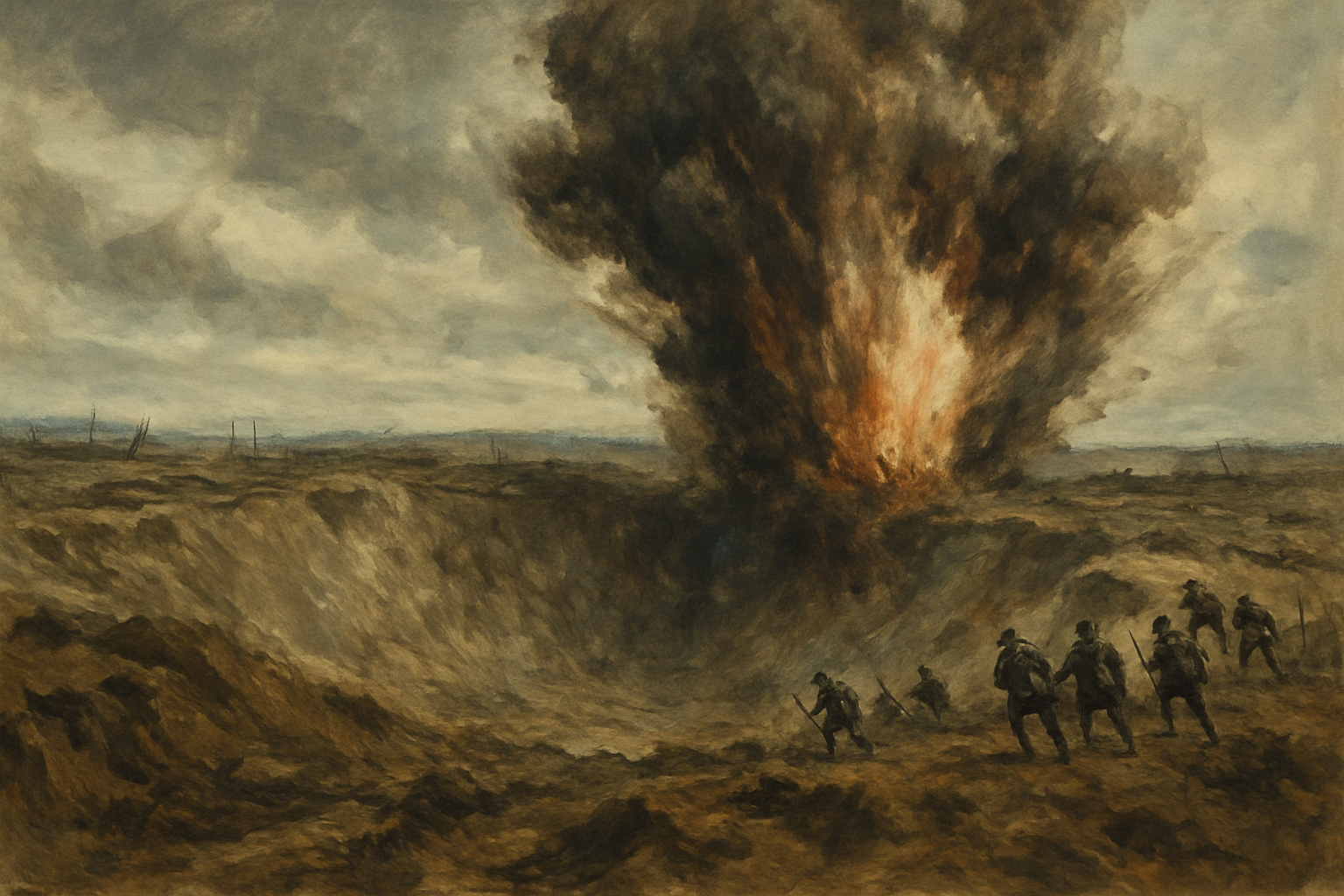
At precisely 7:28am on 1 July 1916, the earth near the village of La Boisselle on the Somme tore itself apart. A column of chalk, soil, and debris roared an estimated 1,200 metres into the sky. The blast was so powerful it was reportedly felt as far away as London. What it left behind — a crater roughly 91 metres wide and 21 metres deep — still marks the French countryside today, more than a century later. The Lochnagar Crater is not merely a geological curiosity. It is one of the most profound monuments to the ambition, courage, and tragedy of the First World War.
An Explosion That Changed the Landscape Forever
The detonation at La Boisselle was among the largest man-made explosions the world had ever witnessed up to that point. The crater it produced was large enough to swallow several full-sized houses. Soldiers who survived the blast described the ground lurching beneath them like a wave, followed by a shock of heat and a roar that seemed to come from the centre of the earth.
Over a century on, nothing has filled the void. The Lochnagar Crater endures as a raw, unhealed scar in the landscape — silent, enormous, and deeply unsettling to anyone who stands at its edge. It is the most visible physical remnant of the first day of the Battle of the Somme, and it speaks volumes without a single word.
Why La Boisselle? The Strategic Importance of the Village
La Boisselle sat directly astride the Albert-to-Bapaume road — the main arterial route through the German lines and a critical axis for any successful British push eastward. Whoever controlled La Boisselle controlled the road. By the summer of 1916, the Germans had held the village for nearly two years, transforming it into a fortress of deep bunkers, interlocking tunnels, and well-placed machine-gun positions.
British troops called the ground immediately around La Boisselle "the Glory Hole" — a scarred, cratered no-man's-land sometimes less than 50 metres wide, where both sides had been detonating small mines beneath each other's positions for months. It was already one of the most dangerous stretches of the entire Western Front before the big offensive even began.
The task of capturing La Boisselle on the first day of the Somme fell to the 34th Division — a New Army formation composed largely of Kitchener volunteers, many of whom had never experienced full-scale combat. The weight placed on these men was immense.
The Tunnellers: 179th Tunnelling Company, Royal Engineers
The Lochnagar mine was the work of the 179th Tunnelling Company, Royal Engineers. These were not conventional soldiers. They were miners, clay-kickers, and engineers — men recruited from the collieries and construction sites of Britain specifically because they knew how to work underground in silence and at speed.
Work on the main gallery began in late 1915. The tunnellers dug by hand, advancing centimetre by careful centimetre, using candles and primitive listening devices — essentially microphones pressed to the tunnel walls — to detect the sound of German counter-tunnellers working toward them. Discovery meant instant death, from a German mine detonated directly beneath them.
The main Lochnagar gallery ran approximately 300 metres from the British front line, passing deep beneath the German trench complex known as "Schwaben Höhe." A second, parallel tunnel — the "Y Sap" gallery — ran toward a separate German position. Both were prepared for simultaneous detonation as part of the same opening blow.
The Explosive: Over 25 Tons of Ammonal Beneath the Somme
The Lochnagar charge comprised approximately 27 tonnes — around 60,000 pounds — of ammonal explosive. Ammonal is a mixture of ammonium nitrate, TNT, and aluminium powder. It was chosen partly for its relative stability during the long process of being carried underground in sections, and partly for its enormous destructive yield when detonated in a confined space.
The charge was packed into two chambers at the end of the main gallery and connected by electrical firing wire running back through the tunnel to the British lines. A second charge at the Y Sap position contained a further 40,500 pounds of explosive. Detonated together, the two La Boisselle mines represented a concentration of explosive power that was, for 1916, almost beyond comprehension.
The La Boisselle detonations were not isolated events. That same morning, 17 other mines were blown along the Somme front as part of the same opening bombardment — a coordinated underground assault designed to shatter German positions from below before the infantry even left their trenches.
7:28am, 1 July 1916: The Moment of Detonation
British High Command set the mines to detonate at 7:28am — two full minutes before zero hour at 7:30am. The intention was logical enough: destroy the German positions in the immediate blast area, and give the debris time to fall before the infantry advanced. In theory, the craters would also provide ready-made cover for the attacking troops.
In the moment of detonation, German soldiers directly above the Lochnagar charge were killed instantly. Those in adjacent positions were stunned, deafened, and in many cases buried alive under cascades of collapsing chalk and earth. Witnesses on the British side described the sky going dark with flying debris.
But the machine-gunners on the flanks — positioned in deep concrete bunkers beyond the immediate blast radius — survived. They were at their weapons within minutes. When the British infantry of the 34th Division climbed over their parapets at 7:30am and began walking forward in ordered lines, those machine-guns opened fire with devastating effect.
The Tragedy of the 34th Division: The Bloodiest Day
The 34th Division suffered approximately 6,380 casualties on 1 July 1916 — more than any other British division on that single day. Among the dead and wounded were men of the Tyneside Scottish and Tyneside Irish Brigades, who had marched from their billets to the front in broad daylight, advancing in waves across open ground that offered virtually no cover.
The crater itself, rather than serving as the protective asset it was intended to be, became an obstacle. Its sheer size broke up the momentum of the advance, channelling men around its edges and into the interlocking arcs of German machine-gun fire. The ground around La Boisselle became a killing field within minutes of zero hour.
La Boisselle itself was not fully in British hands until 4 July — three days of brutal close-quarters fighting after the initial assault. The first day of the Battle of the Somme as a whole resulted in approximately 57,470 British casualties, including around 19,240 men killed. It remains the worst single day in British military history.
What Happened After: The Somme Battlefield and Its Dead
The Lochnagar Crater did not become a piece of quiet history after its creation. Both British and German forces struggled to hold its rim, and the site became yet another scene of close-quarters fighting in the days and weeks that followed. The Battle of the Somme continued until 18 November 1916, ultimately resulting in over one million casualties across all sides — for advances measured in a handful of miles.
La Boisselle itself was so utterly destroyed that it was designated one of the "Villages That Died" — a category of French settlements so completely obliterated during the war that they were never rebuilt on their original sites. The new village of La Boisselle was rebuilt slightly away from the original location after the Armistice.
Thousands of the men who fell on and around 1 July 1916 were never identified, or their remains were never recovered. Their names are inscribed on the Thiepval Memorial to the Missing, which records over 72,000 British and South African soldiers who died on the Somme and have no known grave. It is the largest British war memorial in the world.
Richard Dunning and the Rescue of the Crater
By the 1970s, the Lochnagar Crater faced an unglamorous fate. Agriculture had steadily reclaimed much of the Somme battlefield, and the crater — privately owned farmland — was at genuine risk of being ploughed over and erased from the landscape entirely, as had happened to dozens of other significant sites.
In 1978, a young Englishman named Richard Dunning purchased the crater for £1 with one clear purpose: to preserve it permanently as a memorial. It was a remarkable act of personal dedication. Dunning spent decades maintaining the site, and a simple wooden cross was installed at the crater's rim — replaced annually — bearing the words: "Here the young men of two nations were sacrificed."
The crater is now owned and managed by the La Boisselle Study Group, which has worked to extend protection and interpretation to the wider battlefield. Ongoing archaeological excavations in the La Boisselle area have uncovered preserved tunnels, personal equipment, and the remains of soldiers from both sides still lying where they fell more than a century ago.
Visiting the Lochnagar Crater Today: A Place of Pilgrimage
The Lochnagar Crater is open to visitors year-round, free of charge. It sits just off the D929 road between Albert and Bapaume in the Somme département of northern France — easy to reach and impossible to forget once you have seen it.
Every year on 1 July, a commemorative ceremony is held at the crater at exactly 7:28am — the precise moment of detonation. Families of men who served in the battle, historians, and visitors from across Britain, Australia, Canada, New Zealand, and South Africa gather at the rim in the early morning light to mark the moment. It is a ceremony of extraordinary quiet power.
Nearby, the Ovillers Military Cemetery holds over 3,400 burials, the majority of them unidentified. The wider La Boisselle area contains numerous Commonwealth War Graves Commission cemeteries, each one a reminder of how saturated with loss this small corner of France remains.
Standing at the edge of the Lochnagar Crater, looking down into that vast hollow, the numbers — 27 tonnes of explosive, 6,380 casualties in a single division, 57,470 losses in a single day — become something more than statistics. The crater makes the scale of 1 July 1916 physical, tangible, and undeniable.
If this story has moved you, or if you have a family connection to the Somme or to La Boisselle, we'd love to hear from you in the comments below. Share this article with anyone who cares about preserving the memory of the men who fought and died here — their story deserves to be told and retold.
Further Reading
- Imperial War Museum (IWM), London — extensive collections on the Battle of the Somme, tunnelling operations, and the 34th Division
- The National Archives, Kew — War Office records including unit diaries of the 179th Tunnelling Company, Royal Engineers
- Commonwealth War Graves Commission — records of all Commonwealth casualties from the Somme, including those commemorated at Thiepval
- Historial de la Grande Guerre, Péronne, France — dedicated First World War museum on the Somme battlefield with primary source collections
- La Boisselle Study Group — the organisation responsible for the ongoing archaeological investigation and preservation of the La Boisselle battlefield