The Quiz Question
Which German U-boat sank the liner RMS Lusitania off Ireland on 7 May 1915, killing nearly 1,200 people?
- A. U-9
- B. U-20
- C. U-47
- D. U-boat U-331
The answer is B. U-20. Here is the full story.
At 2:10 pm on 7 May 1915, a single torpedo tore into the starboard side of RMS Lusitania off the coast of County Cork, Ireland. Eighteen minutes later, one of the most celebrated ocean liners in the world was gone — and nearly 1,200 people with her. The U-boat responsible was U-20, commanded by a 29-year-old Berliner named Walther Schwieger. What happened in those eighteen minutes would shake the world and help set the course of the First World War.
The Queen of the Atlantic: What Was the Lusitania?
RMS Lusitania was built by John Brown & Co. at Clydebank, Scotland, and launched in 1906 for the Cunard Line. She entered service in September 1907 and immediately captured the Blue Riband — the coveted award for the fastest Atlantic crossing — completing the voyage in just under five days.
At 31,550 gross tons and 787 feet in length, she was among the largest ships afloat, capable of carrying over 2,000 passengers in three classes. She was fast, luxurious, and unmistakably British — which made her, by 1915, a target.
As war tightened its grip on Europe, many wealthy passengers had cancelled transatlantic travel. Even so, the May 1915 voyage from New York carried 1,959 souls. Chillingly, the German Embassy in Washington had taken out newspaper advertisements warning Americans not to sail on Allied ships in the designated war zone. Most passengers ignored the warnings and boarded at New York on 1 May 1915.
The Hunters Beneath the Waves: Germany's U-Boat Campaign
In February 1915, Germany declared the waters around the British Isles a war zone and authorised unrestricted submarine warfare against Allied and neutral shipping. It was a calculated act of desperation — an attempt to strangle Britain's supply lines before German resources gave out.
U-20 was a Type U 19-class submarine, 210 feet long, crewed by 35 men, and armed with four torpedo tubes and a deck gun. Despite the popular image of submarines lurking silently in the deep, U-boats of this era operated primarily on the surface, diving only to attack or evade. The technology was still raw, the risks enormous.
The British Admiralty had intercepted signals indicating significant U-boat activity along the southern Irish coast in early May 1915. Despite this intelligence, they failed to reroute the Lusitania or issue adequate warnings to her captain. That failure would become one of the great controversies of the entire war.
The Man Behind the Periscope: Kapitänleutnant Walther Schwieger
Walther Schwieger was born in Berlin in 1885 and was just 29 years old when he commanded U-20 on its May 1915 patrol. He was no novice — he had already sunk multiple vessels and had a reputation as a methodical, effective U-boat commander.
His war diary, the Kriegstagebuch, recorded the attack on the Lusitania in precise, dispassionate language. He noted the torpedo strike, the rapid list to starboard, the great confusion visible on deck, and the ship's swift disappearance beneath the waves. There is no recorded attempt to surface and assist survivors.
Schwieger survived the carnage of the U-boat war for two more years. In September 1917, his new command, U-88, struck a British mine off the Danish coast and sank with all hands. The man who sent nearly 1,200 people to the bottom off Kinsale met his own end the same way — suddenly, violently, without warning.
Eighteen Minutes: The Day the Lusitania Died
U-20 had been on patrol since 30 April 1915, already sinking three smaller vessels before she spotted the Lusitania south of Ireland on 7 May. Schwieger fired a single G-type torpedo from approximately 700 metres. It struck the starboard side just forward of the bridge.
Then came the second explosion — far larger than the torpedo strike, and still debated by historians today. It may have been caused by coal dust igniting in an empty bunker, a steam pipe rupturing, or the detonation of munitions cargo. Whatever the cause, it accelerated the ship's destruction catastrophically.
The rapid list to starboard made launching lifeboats on the port side virtually impossible. Of 48 lifeboats, only 6 were successfully launched. The sea temperature off Kinsale was around 52°F (11°C) — cold enough that many survivors who reached the water died of hypothermia before rescue vessels arrived. Eighteen minutes after the torpedo hit, the Lusitania was gone.
The Dead and the Saved: Faces Behind the Numbers
Of the 1,959 people aboard, approximately 1,195 perished — including 94 children. Around 764 survived, rescued by fishing vessels, local boats, and eventually naval ships, many landing at Kinsale and Queenstown, now known as Cobh.
Among the dead were 128 American citizens — a fact that sent shockwaves through Washington and the American public. Alfred Gwynne Vanderbilt, the American millionaire sportsman, was reportedly seen calmly helping women and children into lifeboats as the ship went under. His body was never recovered.
Elbert Hubbard, the celebrated American writer and philosopher, also perished, and was never found. Charles Frohman, the theatrical producer who had made careers for some of Broadway's greatest stars, went down with the ship. He was said to have quoted J.M. Barrie's Peter Pan in his final moments: "Why fear death? It is the most beautiful adventure in life." Whether those were truly his last words, no one can say with certainty — but the story endured.
The Aftermath: Outrage, Diplomacy, and Unanswered Questions
Bodies washed ashore along the Cork coastline for weeks. Queenstown became both a rescue hub and a place of mourning, as the grim work of identifying the dead went on in makeshift morgues. The images shocked a world that was already two years into industrial-scale slaughter — but somehow, this felt different. These were civilians. These were children.
The British government convened a formal inquiry under Lord Mersey in 1915. It blamed Germany and, controversially, Captain William Turner for failing to follow Admiralty instructions regarding speed and zigzagging. Turner, who survived the sinking, was largely exonerated by subsequent historical assessment. Many historians have argued the Mersey inquiry was shaped as much by political necessity as by the evidence — a way of deflecting scrutiny from the Admiralty's own intelligence failures.
In Washington, President Woodrow Wilson sent three increasingly stern diplomatic notes to Germany demanding accountability. Secretary of State William Jennings Bryan resigned rather than sign the second note, believing it would inevitably draw the United States into the war. His fears, it turned out, were not unfounded.
Munitions, Myths, and the Secret Cargo Debate
Germany's justification for the attack rested partly on the Lusitania's cargo. The ship's manifest — a matter of public record — listed 4.2 million rounds of Remington .303 rifle ammunition, 1,248 cases of shrapnel shells, and 18 cases of fuses, all bound for the British war effort. Germany argued the Lusitania was therefore a legitimate military target under international law.
Britain denied it for decades. Declassified Admiralty files released in the 1980s confirmed the ammunition cargo, though debate continues over whether additional, more sensitive materials were also aboard. The British government's long-standing restrictions on diving the wreck only deepened public suspicion that something more was being hidden.
Oceanographer Robert Ballard — who had already found the Titanic — led a survey of the Lusitania wreck in 1993. He and subsequent dive teams found the ship in poor condition, badly deteriorated and partially collapsed, making any definitive assessment of the cargo holds extremely difficult. The wreck lies 300 feet down, 11 miles off the Irish coast, and it is still classified as a protected site under Ireland's National Monuments (Amendment) Act 1987 — recognised in law as the grave of 1,195 people.
Legacy: How the Lusitania Changed the War — and the World
The sinking of the Lusitania is widely regarded as a decisive turning point in American public opinion toward the First World War. It did not bring the United States into the conflict immediately — that would not happen until April 1917 — but it fundamentally altered how ordinary Americans viewed Germany. The emotional wound did not heal.
Under intense American diplomatic pressure, Germany temporarily suspended unrestricted submarine warfare after the Lusitania. But in February 1917, they resumed it — a decision that proved strategically fatal. Within weeks, America declared war. The admirals who had championed the U-boat campaign had gambled that Britain could be starved into submission before American troops arrived in force. They were wrong.
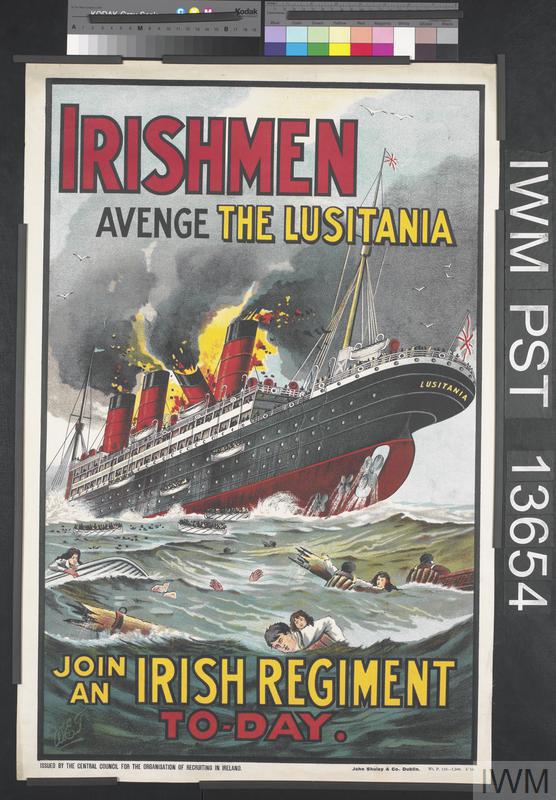
At home in Britain, the Lusitania became a powerful propaganda tool. Recruitment posters bearing the image of the sinking ship and the slogan "Take Up the Sword of Justice" became some of the most potent imagery of the entire war. Anger, grief, and national pride were weaponised — as they always are in wartime.
More than a century on, the Lusitania remains a symbol of the civilian cost of modern warfare — and of the dangerously blurred line between military necessity and atrocity. The questions it raised about neutral shipping, secret cargo, intelligence failures, and government accountability are not abstract historical puzzles. They are questions nations still wrestle with today.
If the story of U-20 and the Lusitania moved you, we'd love to hear your thoughts in the comments below. Do you think Germany was justified under the laws of war at the time — or was the sinking simply an act of mass murder? Share this article with a fellow history lover and keep the conversation going.
Further Reading
- Imperial War Museum (London) — holds extensive records, photographs, and personal testimonies relating to the Lusitania and the First World War U-boat campaign
- The National Archives (Kew, London) — holds declassified Admiralty files, the Mersey Inquiry records, and cargo manifests relating to the Lusitania
- National Maritime Museum (Greenwich, London) — collections covering British ocean liner history and the naval war of 1914–1918
- Cobh Museum (Cobh, County Cork, Ireland) — dedicated to the local history of the Lusitania disaster, rescue operations, and the victims who came ashore on the Cork coast
- Library of Congress (Washington D.C.) — holds American diplomatic correspondence, newspaper archives, and photographic records from the Lusitania crisis and its aftermath