The Quiz Question
Which US Air Force pilot became the world's first jet-versus-jet ace, downing his fifth MiG-15 while flying the F-86 Sabre over Korea in 1951?
- A. Chuck Yeager
- B. James Jabara
- C. Robin Olds
- D. Joseph McConnell
The answer is B. James Jabara. Here is the full story.
On a clear morning in May 1951, a young captain from Oklahoma climbed into his F-86 Sabre, flew north toward the Yalu River, and did something no pilot in history had ever done before. What happened next didn't just make James Jabara famous — it changed the way the world understood air warfare forever.
The Day Everything Changed: A New Kind of Air War
On 20 May 1951, the skies above northwest Korea — a stretch of airspace pilots had already started calling "MiG Alley" — became the stage for a moment that aviation historians still talk about today. Captain James Jabara of the 334th Fighter-Interceptor Squadron, 4th Fighter-Interceptor Wing, shot down his fifth MiG-15, becoming the world's first jet-versus-jet ace.
No pilot in history had ever claimed five confirmed aerial kills entirely in jet-powered combat before that day. The record could never be broken — only matched. Jabara's fifth kill was an absolute first, the kind that only happens once.
The feat was the culmination of a new era of warfare that had begun when jet fighters first clashed over the Korean Peninsula in November 1950. Within six months, one American pilot had already mastered it. The news sent shockwaves through the US Air Force, the Pentagon, and the watching world, rewriting the rulebook on what air combat in the atomic age could look like.
Who Was James Jabara? The Man Behind the Legend
James Jabara was born on 10 October 1923 in Muskogee, Oklahoma, the son of Lebanese immigrant parents who had settled in the American heartland. He enlisted in the US Army Air Forces in 1943, trained as a fighter pilot, and went to war flying P-51 Mustangs over Europe with the 8th Air Force.
In World War II he claimed 1.5 aerial kills — enough to hint at real talent, but hardly the stuff of legend yet. What his WWII service did give him was combat experience, situational awareness under pressure, and a feel for aggressive close-range gunnery that would later prove decisive over Korea.
Colleagues nicknamed him "Little Jabara" — he stood just 5 feet 6 inches tall. He was known for natural flying ability, a competitive fire that bordered on relentless, and an instinct for closing to dangerously short ranges before pulling the trigger. The nickname would soon become deeply ironic. In the skies over MiG Alley, there was nothing small about what James Jabara achieved.
MiG Alley: The Most Dangerous Airspace in the World
MiG Alley was the nickname given to the narrow corridor of northwest Korea between the Chongchon River and the Yalu River — the border with China. It was here that Soviet-supplied MiG-15s operated in large numbers from late 1950, often flown by experienced Soviet pilots flying under Chinese and North Korean markings.
When the MiG-15 first appeared in November 1950, it shocked UN air commanders. It was faster than anything the US had in-theatre at the time, climbed more steeply, and could disengage from combat at will by simply zooming to altitudes where UN fighters couldn't follow. The technological advantage the Americans had enjoyed in World War II had, at a stroke, evaporated.
Washington's response was swift. The US Air Force rushed the F-86 Sabre to Korea specifically to counter the MiG threat, and the 4th Fighter-Interceptor Wing arrived at Kimpo Air Base — designated K-14 — in December 1950. Even with the Sabre in theatre, entering MiG Alley remained a serious proposition. The MiG-15 held advantages in service ceiling and rate of climb; the Sabre excelled in diving speed and low-altitude manoeuvrability. Every engagement was a careful, dangerous calculation.
The F-86 Sabre vs the MiG-15: A Clash of Cold War Steel
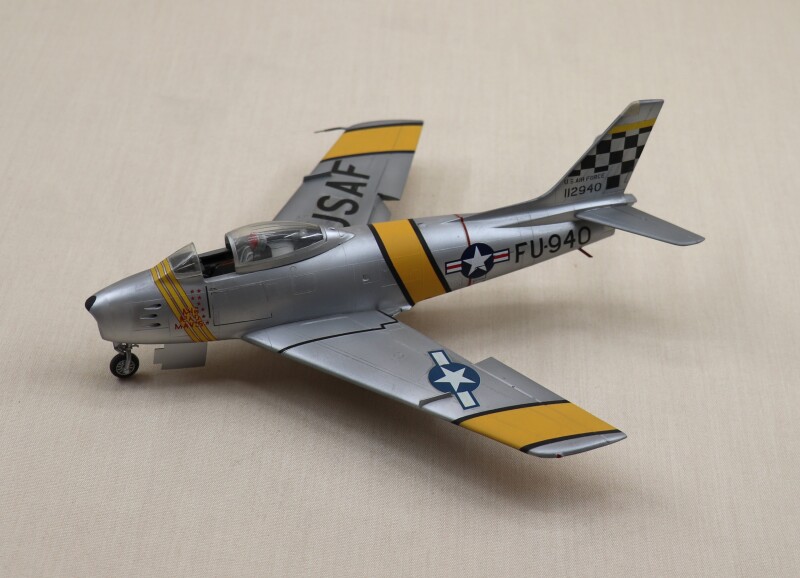
The North American F-86 Sabre was the West's premier swept-wing jet fighter of the early 1950s, capable of speeds approaching 685 mph at altitude. Its lines were elegant, its handling responsive — and in the hands of a skilled pilot, it was a formidable weapons platform.
The Soviet Mikoyan-Gurevich MiG-15 was armed with one 37mm cannon and two 23mm cannons — a battery capable of tearing apart a bomber or a fighter with a single accurate burst. Against that, the Sabre carried six .50-calibre machine guns, which required more hits to achieve a kill but offered a higher rate of fire and greater accuracy at deflection angles.
The MiG-15 had a service ceiling of around 50,000 feet versus the Sabre's approximately 47,000 feet, giving Soviet-bloc pilots a tactical high-ground advantage they regularly exploited. But the F-86 featured a radar-ranging gunsight — a significant technological edge that improved gunnery accuracy during the high-speed, high-deflection engagements that defined MiG Alley combat. American pilots were also, as a general rule, better trained and more combat-experienced than their North Korean and Chinese counterparts. Soviet "advisors" flying MiGs were a different matter entirely — and everyone in the cockpit knew it.
Building Toward History: Jabara's First Four Kills
Jabara opened his Korean War account on 3 April 1951, scoring two MiG-15 kills in a single engagement during a large-scale clash over MiG Alley. Two kills in one mission was exceptional; it announced to the 4th Wing that something special was happening.
He added two more kills on 10 May 1951, bringing his tally to four and placing him on the cusp of ace status. The whole Air Force was watching. Jabara was one kill away from a place in the history books, and the pressure was immense.
A near-disaster almost ended the story before it reached its climax. On one mission during this period, Jabara's drop tanks failed to release properly, saddling him with the drag of full external fuel tanks in the middle of a combat engagement. A more cautious pilot might have broken off. Jabara pressed the attack and downed a MiG anyway — a moment that illustrated, as clearly as anything could, the temperament of the man.
By mid-May 1951, Jabara had flown well over 100 combat missions — a figure that speaks to both his endurance and the confidence his commanders placed in him. His hallmark remained the same: close aggressively, fire late, fire accurately, and trust the Sabre's manoeuvrability to keep him alive.
20 May 1951: The Fifth Kill and a Place in History
On the morning of 20 May 1951, Jabara flew as part of a routine fighter sweep over MiG Alley. A large formation of MiG-15s was engaged — the kind of swirling, high-speed melee that MiG Alley produced almost daily at the height of the air war.
In the turning fight that followed, Jabara manoeuvred onto the tail of a MiG-15 and opened fire at close range. The MiG went down in flames. Confirmation of the kill made him the first pilot in human history to achieve ace status exclusively in jet-versus-jet combat — a record that, by its very nature, can never be taken away or broken, only equalled.
News of the achievement was rapidly communicated back to 4th Wing HQ at Kimpo. Jabara was reportedly pulled from the flight roster immediately and returned to the United States as a national hero. President Harry S. Truman personally congratulated him. In Wichita, Kansas — the city Jabara called home — he was paraded through the streets to enormous public celebration. For a moment, the whole country stopped to acknowledge what one young pilot had accomplished over a remote river valley in Korea.
Return to Korea: Jabara Goes Back for More
A hero's welcome was never going to be enough for James Jabara. After his return to the United States, he lobbied hard for a second combat tour — and eventually got it.
He returned to Korea in 1953 for a second deployment with the 4th Fighter-Interceptor Wing, flying as the war ground toward its exhausting, bitter conclusion. During this second tour he shot down an additional 10 MiG-15s, bringing his final Korean War tally to 15 confirmed kills.
That total made Jabara the second-highest scoring American ace of the Korean War, behind only Captain Joseph McConnell Jr., who finished the conflict with 16 kills. The distinction between the two men matters: McConnell was the top scorer, a record earned through ferocious aerial combat in the war's final months. But Jabara was the first ace — the man who crossed the threshold before anyone else — and that title belongs to him alone, permanently and without qualification.
Legacy and Aftermath: What Jabara's Achievement Meant for Air Power
Jabara's success validated the F-86 Sabre programme at a moment when the Air Force needed proof that it could compete with Soviet technology. More broadly, it demonstrated that well-trained Western pilots could hold their own — and more — against Soviet-supplied jets flown by capable adversaries.
The overall kill ratio of F-86s against MiG-15s in Korea was reported at approximately 10:1 in favour of American pilots, though modern historians and defence analysts continue to debate the exact figures, with some arguing the true ratio was closer to 2:1 when accounting for Soviet-flown MiGs and incomplete loss records. What is not in dispute is that pilot quality, training, and tactics proved decisive — perhaps more so than any hardware advantage.
The Korean air war accelerated the US Air Force's investment in jet technology, aerial training doctrine, and the development of air-to-air missiles throughout the 1950s. MiG Alley became a proving ground whose lessons shaped NATO air strategy for the entire Cold War period. The message was clear: in the jet age, the man in the cockpit still mattered more than the machine around him.
Jabara was promoted to Major and later to Colonel. Tragically, he never lived to see the full flowering of the legacy he helped create. On 17 January 1966, Colonel James Jabara was killed in a car accident in Delray Beach, Florida. He was 42 years old. A hero who had survived hundreds of combat missions over two wars died on an ordinary road, far from any battlefield.
Remembering Jabara: A Hero Who Rewrote Aviation History
Jabara Air and Space Port in Wichita, Kansas, bears his name today — a lasting tribute from the city that claimed him as its own. It is a fitting memorial for a man whose career spanned two great eras of air combat: propeller-driven fighters over wartime Europe, and swept-wing jets over the frozen valleys of Korea.
Across his career, Jabara received the Distinguished Service Cross, the Silver Star with two Oak Leaf Clusters, and numerous other decorations. His record speaks to a level of sustained aerial combat achievement that very few pilots in any air force have ever matched.
He remains a central figure in any serious study of Korean War air combat — essential context for understanding not just how that conflict was fought in the skies, but how the Cold War itself was shaped by the lessons learned above the Yalu River. For anyone passionate about military aviation history, Jabara's story is a reminder that in warfare, individual skill, courage, and sheer determination can still define the outcome of a technological duel between superpowers.
If James Jabara's story moved you, share this article with a fellow aviation enthusiast — and let us know in the comments which aspect of the Korean air war you'd like us to explore next. There are plenty more remarkable stories from MiG Alley still waiting to be told.
Further Reading
- National Museum of the United States Air Force, Dayton, Ohio
- Smithsonian National Air and Space Museum, Washington D.C.
- The National Archives, College Park, Maryland (US military records)
- Korean War Veterans Memorial Foundation
- Air Force Historical Research Agency, Maxwell Air Force Base, Alabama