The Quiz Question
Which Native American group developed and transmitted an unbreakable code based on their own language for the US Marine Corps during the Pacific War?
- A. Navajo Code Talkers
- B. Cherokee Code Talkers
- C. Comanche Code Talkers
- D. Choctaw Code Talkers
The answer is A. Navajo Code Talkers. Here is the full story.
By 1942, Japanese codebreakers had cracked nearly every Allied cipher in use across the Pacific. American commanders were transmitting orders they knew might already be compromised. The situation was desperate — and the solution, when it came, arrived from a place no one in Washington had expected.
It came from the high desert of the American Southwest. From a language spoken by fewer than 30 non-Navajo people on Earth. And it would become the most secure battlefield communication system of the entire war.
The Secret Weapon Japan Never Cracked
American signals security in the early Pacific War was in crisis. Sophisticated Japanese intelligence operations had compromised Allied radio traffic repeatedly, feeding enemy commanders advance knowledge of American movements and intentions.
The answer, when it emerged, was rooted not in technology but in culture — specifically, in the ancient, complex, and almost entirely unrecorded language of the Navajo people. The code built from that language was never broken. Not once. Not by one of the most capable signals intelligence operations in the world.
Major General Howard Connor, who served as signal officer of the 5th Marine Division at Iwo Jima, left no room for ambiguity in his assessment: "Were it not for the Navajos, the Marines would never have taken Iwo Jima." The full programme remained classified by the US government until 1968 — kept secret even from the men who had built and operated it.
A People With Every Reason to Say No
To understand why the Navajo Code Talkers' service is so extraordinary, you have to understand what the United States had done to their people. In 1864, the US Army forced thousands of Navajo men, women, and children on the Long Walk — a brutal forced march to Fort Sumner, New Mexico, where they were imprisoned for four years. Hundreds died on the march itself.
By 1940, the Navajo Nation occupied roughly 25,000 square miles across Arizona, Utah, and New Mexico — land their ancestors had called the Dinétah — and lived in widespread poverty. Federal Indian boarding schools had spent decades punishing Navajo children for speaking their own language. The tongue that would save the Marines had been systematically suppressed by the very government now desperate to use it.
Despite all of this, more than 3,600 Navajo men and women served in the US armed forces during World War Two. Their decision to serve was grounded in a warrior tradition stretching back centuries, and in a profound connection to their ancestral homeland — a connection that transcended the government's long record of betrayal.
Philip Johnston's Bold Idea
The programme began with a civilian: Philip Johnston, a civil engineer and the son of a Protestant missionary who had grown up on the Navajo reservation. He was one of very few non-Navajo people in the world with genuine fluency in the language — a fluency acquired over years of childhood immersion.
In January 1942, just weeks after the attack on Pearl Harbor, Johnston approached Marine Corps officers at Camp Elliott near San Diego with his proposal. He demonstrated the concept live, using four Navajo men. A message was encoded in Navajo, transmitted by radio, and decoded at the other end — in under 20 seconds. The same task using existing cipher machines took approximately 30 minutes.
Marine Corps Commandant Major General Clayton Vogel was convinced. On 6 May 1942, he authorised the recruitment of 29 Navajo men to form an initial pilot programme. These men — subsequently honoured as the "Original 29" — were tasked with something remarkable: building an entirely new military code from scratch, using their own language as the raw material.
Building the Code: How It Worked
The Navajo language was almost uniquely suited to the task. Its tonal qualities, intricate syntax, and highly complex verb structures made it virtually impossible for an outsider to learn without years of deep immersion. There was no written form, no published grammar, and no relationship to any European or Asian language family.
The Original 29 constructed a two-part system during intensive secret sessions at Camp Pendleton, California. The first part was a military vocabulary: Navajo words assigned to military concepts, chosen for intuitive logic. A submarine became besh-lo — "iron fish." A tank became chay-da-gahi — "turtle." A fighter plane became da-he-tih-hi — "hummingbird."
The second part was a phonetic alphabet. Each letter of the English alphabet was represented by a Navajo word. A was wol-la-chee (ant), B was shush (bear), C was moasi (cat). To defeat pattern analysis — the technique most codebreakers relied on — certain high-frequency letters were given multiple Navajo equivalents. The letter A alone had three possible substitutions.
The codebook launched with 274 terms. As the war expanded and new military situations arose, it grew to over 600 entries. Every addition was memorised, not written down. The code existed entirely in the minds of the men who carried it.
Into the Fire: The Code Talkers in Combat
The first Code Talkers were deployed to Guadalcanal in August 1942, attached to the 1st Marine Division. Guadalcanal was among the most brutal campaigns of the Pacific War, fought in stifling jungle heat against a determined enemy — and the Code Talkers performed flawlessly under conditions that would test any soldier.
By the war's end, approximately 420 Navajo men had served as Code Talkers across all six Marine divisions, Marine Raider battalions, and Marine parachute units. They operated in pairs — one transmitting, one receiving — frequently from exposed forward positions, often under direct enemy fire.
At Iwo Jima in February and March of 1945, Major Howard Connor deployed six Code Talkers continuously around the clock. The seamless communications they maintained allowed Marine commanders to coordinate a grinding 36-day battle across some of the most contested terrain of the Pacific theatre. Code Talkers were present at Bougainville in 1943, Guam and Peleliu in 1944, the Philippines through 1944 and into 1945, and Okinawa in 1945. They were, in effect, at every major Pacific engagement the Marines fought.
The Men Behind the Code: Personal Stories
Chester Nez was born in 1921 in Chi Chil Tah, New Mexico. As a boy, he had been punished for speaking Navajo at a federal boarding school. As a Marine, that same language made him irreplaceable. He was among the Original 29, helped build the system from nothing, and carried the code in his memory through the Pacific campaign.
Samuel Sandoval enlisted at 15 after lying about his age. He served at Iwo Jima and lived to the age of 98, spending much of his later life as a tireless public advocate for the recognition his fellow Code Talkers deserved. William McCabe, another Original 29 member, played a central role in designing both the phonetic alphabet and the military vocabulary at Camp Pendleton in 1942 — work carried out under strict secrecy.
Many Code Talkers returned home carrying a painful burden. Bound by their security oath, they could not explain their wartime service to their own families. They could not receive the recognition their fellow veterans enjoyed. Some could not even confirm they had served in a meaningful capacity.
There was another grim dimension to their service. Several Code Talkers were assigned personal bodyguards — fellow Marines with explicit orders. If capture was imminent and unavoidable, those Marines were to ensure the Code Talker could not be taken alive. The code was considered too valuable to risk falling into Japanese hands under interrogation.
Why Japan Could Never Break It
Japanese signals intelligence was genuinely formidable. By 1941, Japanese cryptanalysts had compromised both US Army and Navy codes. They understood the mechanics of code systems. They had skilled, experienced professionals. And they failed completely against the Navajo transmissions.
The reason was structural. Navajo bore no relationship to any language family familiar to Japanese analysts. It had no written tradition they could study, no linguistic relatives they could use as a reference point. The tonal shifts and unfamiliar phoneme patterns led Japanese signals officers to describe the transmissions as sounding like "a strange noise" — not a language at all, simply unrecognisable sound.
In one documented case, a captured Navajo soldier named Joe Kieyoomie was forced by Japanese interrogators to listen to recorded Code Talker transmissions. Kieyoomie confirmed he could identify the speech as Navajo — but stated clearly that he could not understand the specific military vocabulary the Code Talkers had invented. The invented terms were opaque even to a native speaker who hadn't been trained in them.
Post-war analysis confirmed what the Code Talkers had always known: the code was never broken. It remains one of the only field codes in modern military history never to have been compromised during active operational use.
Coming Home: The Long Wait for Recognition
When the Code Talkers came home after 1945, they came home in silence — by order of the United States government. The programme remained classified. They could not speak of what they had done, could not attend veteran gatherings as Code Talkers, and could not claim the full recognition their service warranted. The military kept the code classified because it considered the system potentially valuable in future conflicts.
That classification was not lifted until 1968 — more than two decades after the war ended. Even then, public awareness was slow to follow. In 1982, President Ronald Reagan designated 14 August as National Navajo Code Talkers Day, offering the first formal federal acknowledgement of the programme's existence and importance.
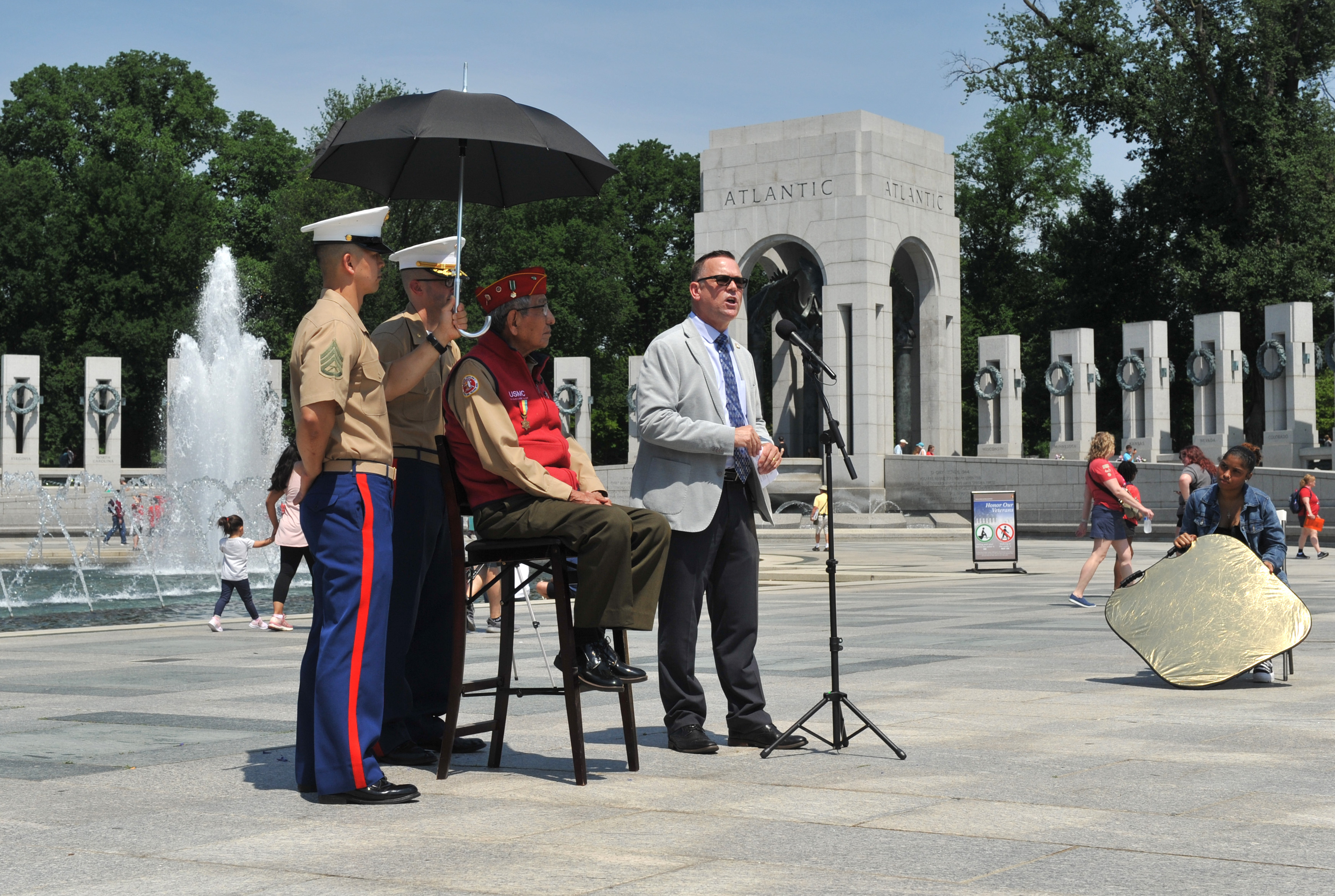
The most significant honour came on 26 July 2001. President George W. Bush awarded the Congressional Gold Medal — the highest civilian honour the United States can bestow — to the surviving members of the Original 29 in a ceremony at the US Capitol. It was a moment long overdue, and for many, it came too late. Most of the Original 29 had already died.
Chester Nez, the last surviving member of the Original 29, died on 4 June 2014, aged 93. He had lived long enough to see his contribution written into history — and to know that the language once beaten out of him in a federal boarding school had helped save the Pacific War.
Legacy: What the Code Talkers Mean Today
The Navajo Code Talkers' story carries a deep and uncomfortable irony. The US government spent generations trying to destroy the Navajo language — and in doing so, inadvertently preserved the most secure communication tool of the Second World War. The very act of suppression had kept the language inaccessible to the outside world, making it uncrackable.
Their service reframes the entire narrative of Native American involvement in American history. These were not passive subjects of historical forces. They were active agents who shaped one of the most consequential conflicts in human history, using knowledge and culture the US government had tried to erase.
The National Navajo Code Talkers Museum in Window Rock, Arizona, preserves artefacts, personal testimonies, and recordings for future generations. Their example prompted other nations to consider Indigenous languages as potential secure communication tools — Australia explored similar concepts with Aboriginal languages during the Cold War era.
Today, the Navajo Code Talkers are commemorated on the Navajo Nation flag itself — an image that binds their warrior heritage to a living, sovereign identity. The code may have been declassified. But the courage of the men who built and carried it has never needed any government's permission to be remarkable.
If this story moved you, share it with someone who deserves to know it. And if you have a connection to Native American history or the Pacific War, we'd love to hear your thoughts in the comments below.
Further Reading
- National Museum of the American Indian, Smithsonian Institution
- The National WWII Museum, New Orleans
- National Archives and Records Administration (NARA), United States
- Library of Congress, American Memory and Veterans History Project
- Naval History and Heritage Command, United States Navy