The Quiz Question
The SS Atlantic Conveyor was struck by two Exocet missiles on 25 May 1982, taking vital Chinook helicopters down with her. Her master, Captain Ian North, died trying to reach a life raft , what was he posthumously awarded?
- A. The Victoria Cross
- B. The George Medal
- C. The Distinguished Service Cross
- D. The Albert Medal
The answer is C. The Distinguished Service Cross. Here is the full story.
On the afternoon of 25 May 1982 — Argentina's National Day — two Exocet missiles tore into the side of a civilian container ship in the South Atlantic and changed the entire character of the Falklands War. The vessel was the SS Atlantic Conveyor. The men aboard her were not Royal Navy sailors. They were merchant mariners, most of whom had spent their careers moving cargo between ports in peacetime. Within minutes of those strikes, twelve of them were dead or dying, irreplaceable military equipment was gone, and a 57-year-old Yorkshireman named Captain Ian North had disappeared into the freezing ocean.
His story — and the story of his ship — deserves to be told in full.
A Merchant Ship Answers the Call
The Atlantic Conveyor was a container ship operated by the Cunard Line, built in 1969 and displacing 14,946 tonnes. She was a workhorse of peacetime trade — functional, unglamorous, entirely unprepared for war. In April 1982, within days of the Argentine invasion of the Falkland Islands, the British Ministry of Defence requisitioned her under the emergency STUFT programme: Ships Taken Up From Trade.
She was taken to Devonport Dockyard and converted at extraordinary speed. Mechanics and engineers fitted her to carry Harrier jets on her flight deck, along with Chinook and Wessex helicopters, aviation fuel, ammunition, prefabricated airstrip matting, and thousands of tonnes of military stores. The conversion took less than a fortnight. The Royal Navy, working alongside Cunard engineers, essentially turned a cargo ship into a floating forward supply base.
Her crew were not conscripted. They were merchant mariners who volunteered to remain aboard and sail her into an active war zone in the South Atlantic — among the most hostile waters on earth. That choice deserves to be recognised for exactly what it was: an act of quiet, deliberate courage.
Captain Ian North: The Man at the Helm
Ian North was born in 1925 in Yorkshire and spent virtually his entire working life at sea. By 1982 he had risen through the Cunard merchant fleet to become one of its most experienced and respected masters. He was 57 years old — eligible, had he chosen, to step aside when his ship was requisitioned for military service.
He refused. North insisted on commanding the Atlantic Conveyor himself, and on staying with his crew throughout the voyage south. By every account left by survivors, he was calm, methodical, and deeply attentive to the welfare of the men around him — a commander who led by presence rather than by rank.
Aboard the converted ship, North worked closely with the embarked Royal Navy and Royal Air Force personnel, helping to manage the complex integration of military operations onto a civilian vessel that had never been designed for any of it. Survivors would later describe his composure in the final hours of the ship's life as the thing they remembered most clearly — a steadiness that held frightened men together when everything around them was burning.
What the Atlantic Conveyor Carried: The Stakes Could Not Have Been Higher
The cargo the Atlantic Conveyor carried south was not incidental to the British war effort. It was central to it. She transported four Boeing Chinook HC1 helicopters — heavy-lift aircraft capable of carrying 55 fully equipped troops or up to ten tonnes of cargo each. Military planners had identified these Chinooks as absolutely critical to moving troops and supplies across the rugged, roadless terrain of East Falkland.
She also carried six Westland Wessex HU5 helicopters, additional Harrier GR3 ground-attack jets, vast quantities of aviation fuel and ammunition, and prefabricated aluminium airstrip matting intended to create a forward operating base capable of sustaining fixed-wing air operations over the islands.
Lose the Chinooks, and the British Army would have to walk. Military planners understood that clearly. Without heavy-lift capacity, 3 Commando Brigade and 5 Infantry Brigade would have to march across some of the most punishing terrain in the Southern Hemisphere, carrying everything on their backs, in the depths of a South Atlantic winter. The Atlantic Conveyor's cargo was not a supplement to the British plan. In many respects, it was the plan.
25 May 1982: The Exocets Strike
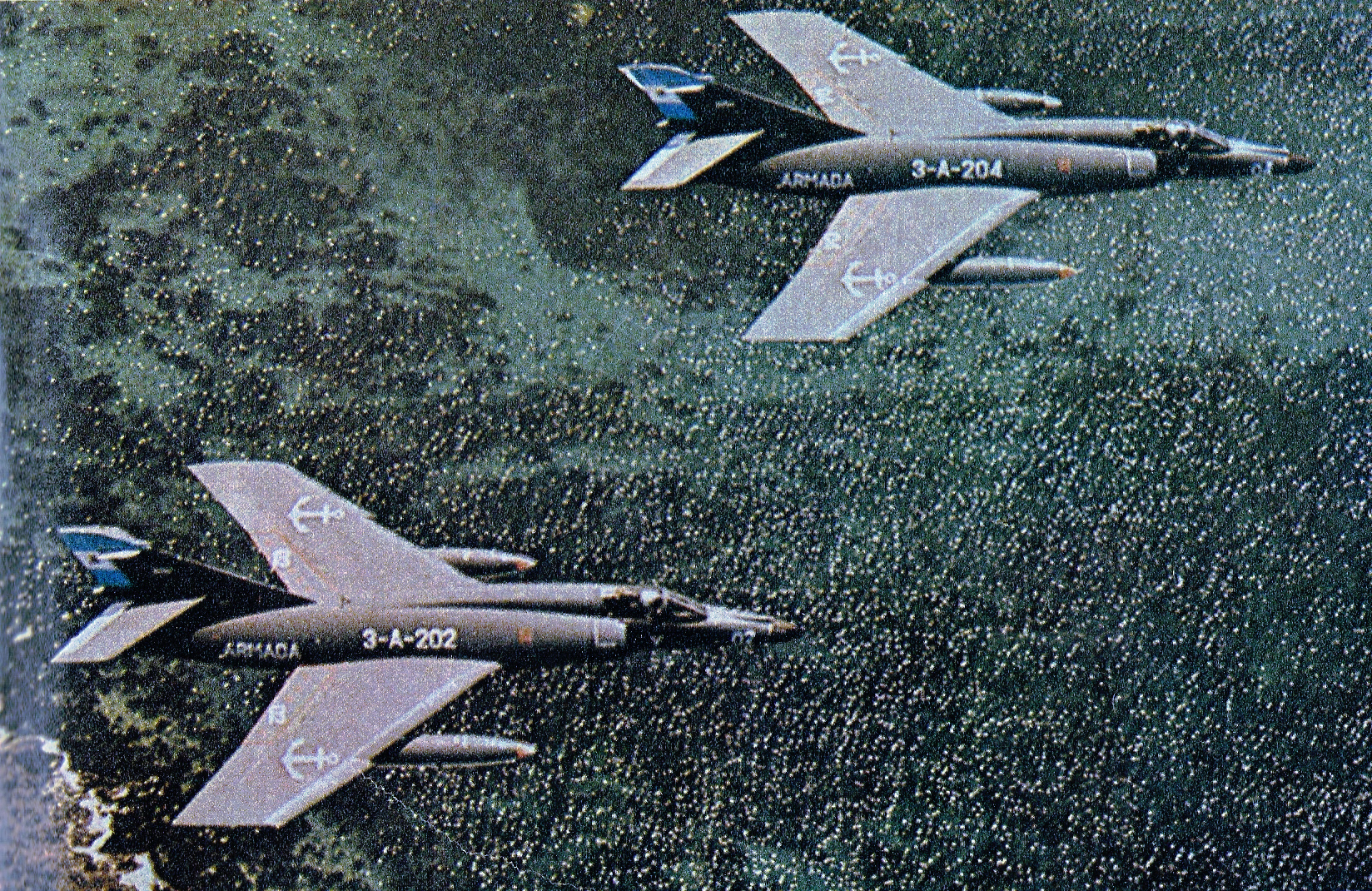
Argentina's 25 May — its National Day — saw an intensified campaign of air attacks against British shipping. Argentine Super Étendard jets from the 2nd Naval Fighter and Attack Escuadrilla had already demonstrated the devastating capability of the AM39 Exocet air-launched missile when HMS Sheffield was struck and sunk on 4 May. Now, with two missiles remaining in their inventory, the Argentines launched again.
The two Exocets were fired at the British carrier group, targeting HMS Hermes and HMS Invincible. Both warships deployed chaff — clouds of metallic strips designed to seduce radar-guided missiles away from their intended targets. It worked. The Exocets were decoyed — but they did not simply fall into the sea. They re-acquired a new target: the Atlantic Conveyor, which lacked the defensive systems of the warships she was sailing alongside.
Both missiles struck the port side of the ship at approximately 18:32 local time on 25 May 1982. The warheads detonated inside the hull, igniting a catastrophic fire fed by aviation fuel, ammunition, and the acres of military stores packed into the ship's holds. Within minutes, it was clear she could not be saved. The order to abandon ship was given.
The Abandon Ship: Chaos, Courage, and Loss
The South Atlantic in May is brutal. The swells are heavy, the water temperature is around four to six degrees Celsius, and survival time in the water without immersion equipment is measured in minutes. The crew and embarked military personnel scrambled for life rafts in these conditions as the ship burned around them.
Captain Ian North was last seen in the water. He had, by every account that survives, ensured that others boarded the life rafts before him — consistent with every description given of the man throughout his career. He was never recovered. His body was lost to the South Atlantic, along with eleven other men: merchant crew and military personnel alike.
Survivors were rescued by HMS Alacrity and HMS Arrow. Many were in severe condition — burned, hypothermic, and in shock after extended exposure in the icy water. The twelve men who died that day represented the largest single loss of life to a British vessel in the entire Falklands conflict.
Three Chinooks Lost — One Survived to Carry an Army
Of the four Chinook HC1 helicopters aboard the Atlantic Conveyor, three were destroyed in the fire. Only one had been offloaded prior to the attack. That aircraft — Bravo November, serialled ZA718 — was airborne at the time the missiles struck and survived.
What followed became one of the most extraordinary chapters in British aviation history. Bravo November flew continuously throughout the remainder of the land campaign, operating far beyond its designed limits, sustained by ground crews working around the clock with minimal spare parts and no proper support infrastructure. On a single sortie on 30 May 1982, she carried 81 fully equipped troops in a single lift — roughly three times her normal operational load — to support the British advance toward Stanley.
But Bravo November alone could not replace four Chinooks. Without that heavy-lift capacity, 3 Commando Brigade and 5 Infantry Brigade were forced to march across East Falkland on foot, carrying everything they needed on their backs. For the Royal Marines, it became the 'yomp.' For the Parachute Regiment, it became the 'tab.' Both words entered the language of the British military — and of British popular memory — as shorthand for extraordinary physical endurance under almost unbearable conditions.
The loss of the Atlantic Conveyor's Chinooks directly extended the duration of the land campaign and placed demands on British soldiers that few had anticipated when the task force sailed. The men who walked across those hills did so, in part, because of what happened to a merchant ship on an autumn afternoon in the South Atlantic.
The Atlantic Conveyor's Final Hours and Sinking
The Atlantic Conveyor did not sink immediately. She burned for three days — her fires visible for miles across the open ocean — as the task force continued its operations around her. Attempts to contain the blaze failed; the fire was simply too fierce and too well-fuelled to be brought under control.
She finally sank on 28 May 1982, going down approximately 188 miles northeast of Port Stanley. She now lies at a depth of around 4,200 metres — far beyond the reach of salvage — on the floor of the South Atlantic. She is the grave of the men whose bodies were never recovered, Captain North among them.
The Atlantic Conveyor was one of only two British ships sunk by Exocet missiles during the entire conflict, alongside HMS Sheffield. Her loss represented the largest single destruction of British merchant shipping since the Second World War — a sobering measure of the cost paid by men who wore no uniform.
A Posthumous Honour: Captain North and the Distinguished Service Cross
Captain Ian North was posthumously awarded the Distinguished Service Cross. The DSC is traditionally an honour for Royal Navy and Royal Marines officers — but it was extended to North in recognition of his extraordinary leadership, his selfless conduct during the abandonment of his ship, and his death in service of his country while ensuring the safety of others.
The award placed North in rare company. It was an explicit acknowledgement, at the level of official recognition, that merchant mariners sailing in STUFT vessels were not peripheral figures in the Falklands War. They were in the front line, bearing front-line risks, with front-line courage.
The DSC was presented to his family. North had a daughter, Jillian, and the posthumous recognition brought some measure of formal acknowledgement to a loss that those who knew him found almost impossible to articulate. Cunard and the Merchant Navy Association both honoured his memory, and his name appears on the Falklands memorial — a seafarer recorded alongside the soldiers, sailors, and airmen who gave their lives in the same campaign.
Legacy: What the Atlantic Conveyor Means Today
The sinking of the Atlantic Conveyor did not simply alter the course of the 1982 campaign. It changed how the British military thought about logistics and support shipping for a generation. The vulnerability of STUFT vessels — civilian ships pressed into military service without the defensive systems of warships — became a central lesson of the conflict, and directly accelerated the development and procurement of improved anti-missile defence systems for the Royal Navy.
The story of the Atlantic Conveyor also revived a debate that had run since the Second World War: about the status, recognition, and protection of merchant mariners serving in combat zones. The men who sailed her south were civilians. They had no military rank, no combat training, no wartime naval pay. Yet they sailed into one of the most dangerous operational environments of the late twentieth century because their country needed them to.
Every year on 25 May, survivors, veterans, and families gather to remember the twelve men who did not come home. They were from different backgrounds, different roles, different services — but they shared a ship, a mission, and a fate. Captain Ian North stands at the centre of that memory: steady and selfless to the last, true to a tradition of British maritime courage that stretches back centuries.
If the story of Captain Ian North and the Atlantic Conveyor moved you, please share it with someone who should know it — and tell us in the comments what you think of the merchant mariners who answered the call in 1982. Their sacrifice deserves to be remembered.
Further Reading
- Imperial War Museum — collections and oral history archives relating to the Falklands War
- The National Archives, Kew — official Ministry of Defence records and operational files from the 1982 campaign
- National Museum of the Royal Navy, Portsmouth — Falklands conflict exhibits and documentary holdings
- Merseyside Maritime Museum — Merchant Navy heritage collections and records of the STUFT programme
- Fleet Air Arm Museum, Yeovilton — records and exhibits relating to helicopter operations during the Falklands War, including Bravo November