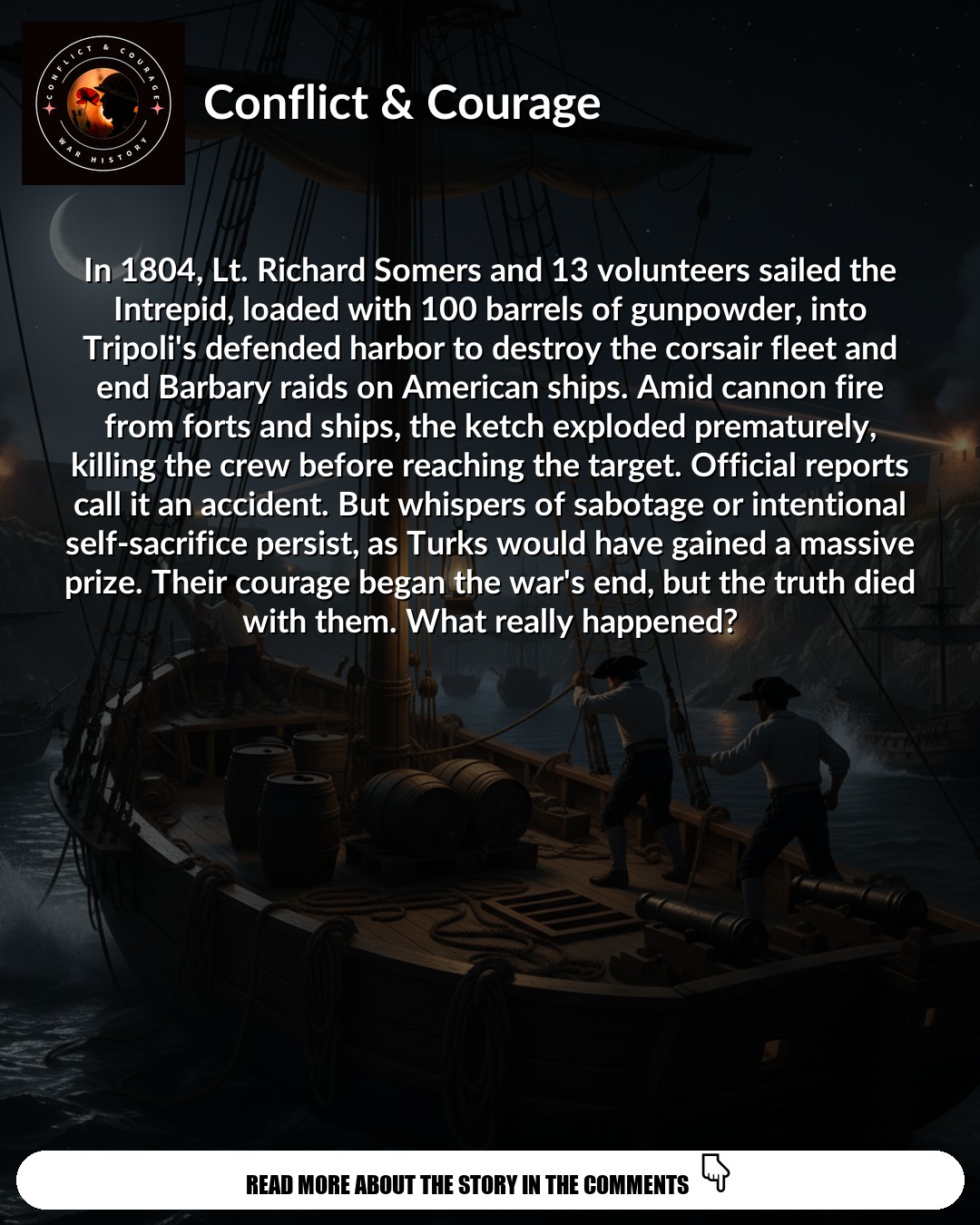
Every military history enthusiast knows Stephen Decatur's name from the Barbary Wars, but few remember Lieutenant Richard Somers, whose desperate fire ship mission three months earlier exemplified the same fearless courage. While Decatur successfully burned the captured USS Philadelphia in Tripoli harbor, Somers led an equally daring operation that cost fourteen American lives—including his own.
In 1804, the young American Navy faced its greatest test against the Barbary pirates of North Africa. These weren't just tales of adventure on the high seas; this was a fight for national survival and respect on the world stage.
The Forgotten Hero of the Barbary Coast
Lieutenant Richard Somers deserves to stand alongside Stephen Decatur in the pantheon of early American naval heroes. Both men risked everything in Tripoli's treacherous waters, but only one lived to see glory.
By September 1804, Commodore Edward Preble's American squadron was trapped in a desperate situation. The USS Philadelphia's capture had handed the Tripolitans their most powerful warship, while the shallow harbor made conventional naval attacks nearly impossible. Shore batteries commanded every approach, and the enemy fleet lay protected behind a maze of reefs and sandbars.
The Philadelphia's loss was more than a military disaster—it was a national humiliation. For a young republic trying to establish itself among world powers, losing a frigate to North African pirates sent exactly the wrong message. Something dramatic had to be done, and it would take extraordinary courage to do it.
A Mission Born of Desperation
Preble understood that destroying the Tripolitan fleet was crucial to American success, but traditional tactics wouldn't work. The enemy ships lay too well-protected in the shallow inner harbor, surrounded by defensive positions that could annihilate any attacking force.
The commodore's solution was as radical as it was dangerous: convert a captured vessel into a floating bomb and sail it directly into the enemy fleet. This wasn't just another naval mission—it was a suicide run disguised as strategy.
When Preble called for volunteers, he didn't hide the odds. The crew would have to navigate past shore batteries, dodge patrol boats, position their explosive ship precisely, then escape in small boats while under heavy fire. Most understood they probably wouldn't return, yet the volunteers stepped forward anyway.
The USS Intrepid: Death Ship in Disguise
The vessel chosen for this desperate mission was the Intrepid, a captured Tripolitan ketch that could blend in with local shipping. American shipwrights transformed her into a floating arsenal, packing her hold with one hundred barrels of gunpowder and 150 fixed shells.
Lieutenant Somers planned every detail meticulously. He handpicked thirteen volunteers who understood the mission's grim reality. These weren't glory-seekers but seasoned sailors who recognized duty when they saw it.
The crew included men like Midshipman Henry Wadsworth (uncle of the poet), Sergeant Jonathan Meredith of the Marines, and ordinary seamen whose names history barely remembers. Each man knew that capture meant torture and probable death—yet they climbed aboard anyway.
Into the Lion's Den: September 4th, 1804
On a moonless night that provided perfect cover, the Intrepid slipped past American lines toward the enemy harbor. The darkness that concealed their approach also made navigation treacherous among the reefs and shoals.
As they penetrated deeper into Tripolitan waters, shore batteries opened fire. Musket flashes lit up the night as patrol boats challenged the mysterious vessel. The tension must have been unbearable—one stray shot into their powder magazine would end everything instantly.
Historical accounts suggest the mission nearly succeeded. The Intrepid had navigated the outer defenses and was approaching the anchored Tripolitan fleet when disaster struck. What happened next remains one of the Barbary Wars' greatest mysteries.
Explosion and Mystery: What Really Happened?
At 9:47 PM, a massive explosion lit up Tripoli harbor. The blast was so powerful it shattered windows throughout the city and could be heard for miles. But the Intrepid had detonated short of its target—the Tripolitan fleet remained intact.
Three theories emerged to explain the premature explosion. Perhaps enemy fire struck the powder magazine by chance. Maybe mechanical failure or human error triggered the blast accidentally. Or, most intriguingly, did Somers deliberately ignite the charges to prevent capture?
The evidence supports the third theory. Somers had sworn he would never be taken alive, and contemporary accounts suggest the explosion occurred just as enemy boats were closing in. Like the heroes in William Cushing's later torpedo raid, Somers may have chosen death over dishonor.
The Aftermath: Victory Through Sacrifice
Though the Intrepid missed its primary target, the psychological impact was devastating to Tripolitan morale. The massive explosion proved American determination and capability, terrifying defenders who realized they weren't safe even in their own harbor.
Three months later, Stephen Decatur's successful mission to burn the Philadelphia built on the foundation Somers had laid. The earlier fire ship attack had already shaken Tripolitan confidence and demonstrated American willingness to take extraordinary risks.
Yet history remembers Decatur as the hero while Somers faded into obscurity. Perhaps success makes better stories than sacrifice, but both men embodied the same courage that built the American Navy.
Remembering the Intrepid Fourteen
The fourteen men who died aboard the Intrepid deserve more than footnotes in history books. Besides Somers and Wadsworth, the crew included sailors like John Downes, Thomas Tompkins, and John Williams—ordinary Americans who died doing extraordinary things.
Their sacrifice helped establish American naval traditions of courage and determination that continue today. Like other forgotten heroes such as Marcelino Serna in World War I, these men proved that heroism isn't always rewarded with fame.
Modern memorials in Portsmouth, New Hampshire, and Somerville, New Jersey, honor their memory. But perhaps the greatest tribute is remembering that American naval dominance began with men willing to sail explosive ships into enemy harbors on moonless nights.
What do you think really happened aboard the Intrepid that September night? Share your thoughts about these forgotten heroes and help keep their memory alive for future generations who need to understand the price of freedom.