The Quiz Question
On 13 August 1940, the Luftwaffe launched 'Adlertag' (Eagle Day), the opening of a major assault meant to cripple the RAF. Which force was the primary target of this phase of the Battle of Britain?
- A. The Royal Navy's Home Fleet at Scapa Flow
- B. RAF Fighter Command's airfields and radar stations
- C. London's docks and warehouses
- D. British aircraft factories in the Midlands
The answer is B. RAF Fighter Command's airfields and radar stations. Here is the full story.
On the morning of 13 August 1940, the skies above southern England became the stage for one of the most consequential battles in modern history. The Luftwaffe had given it a dramatic name — Adlertag, Eagle Day — and Reichsmarschall Hermann Göring had promised his Führer it would be the beginning of the end for the Royal Air Force. What actually unfolded that day, and in the weeks that followed, would determine whether Britain survived as a free nation.
The Day the Eagles Flew: A Battle That Would Decide Britain's Fate
By the summer of 1940, Nazi Germany had swept through Poland, Denmark, Norway, the Low Countries, and France with terrifying speed. Britain stood virtually alone, the last major democracy in Western Europe still fighting. Hitler's planned invasion, Operation Sea Lion, was already drawn up — but it could not proceed without one essential precondition: the destruction of the Royal Air Force.
Göring, ever confident and ever theatrical, assured Hitler his Luftwaffe could bring Fighter Command to its knees within four weeks. Adlertag was the name chosen for the opening blow of this decisive campaign. What followed was not a quick knockout — it was one of the most intense, complex, and consequential air battles in the history of warfare, fought in clear summer skies above the fields and towns of southern England.
The Strategic Logic: Why the Luftwaffe Targeted Airfields and Radar
RAF Fighter Command, under the quiet, methodical leadership of Air Chief Marshal Sir Hugh Dowding, was the only shield standing between Britain and invasion. The Luftwaffe's campaign plan — formally called Adlerangriff, Attack of the Eagles — was built around a logical, if ultimately flawed, premise: destroy the infrastructure of Fighter Command and it cannot fight.
The primary targets were the RAF's sector stations, the nerve centres from which ground controllers directed fighter squadrons onto incoming raids. Equally important were the Chain Home radar stations strung along the British coastline — a revolutionary early-warning network that could detect incoming raids at distances of up to 100 miles, giving Fighter Command time to scramble and position its fighters before the enemy arrived.
German planners believed that without radar and without functioning airfields, Fighter Command would be blind and grounded within days. It was a coherent theory. The execution, however, would prove another matter entirely.
Göring's Grand Plan: The Forces Assembled Against Britain
The Luftwaffe arrayed against Britain in August 1940 was formidable by any measure. Three air fleets — Luftflotten — were deployed: Luftflotte 2, operating from the Low Countries; Luftflotte 3, based in France; and Luftflotte 5, flying from bases in Norway and Denmark. In total, Germany could field approximately 2,600 aircraft.
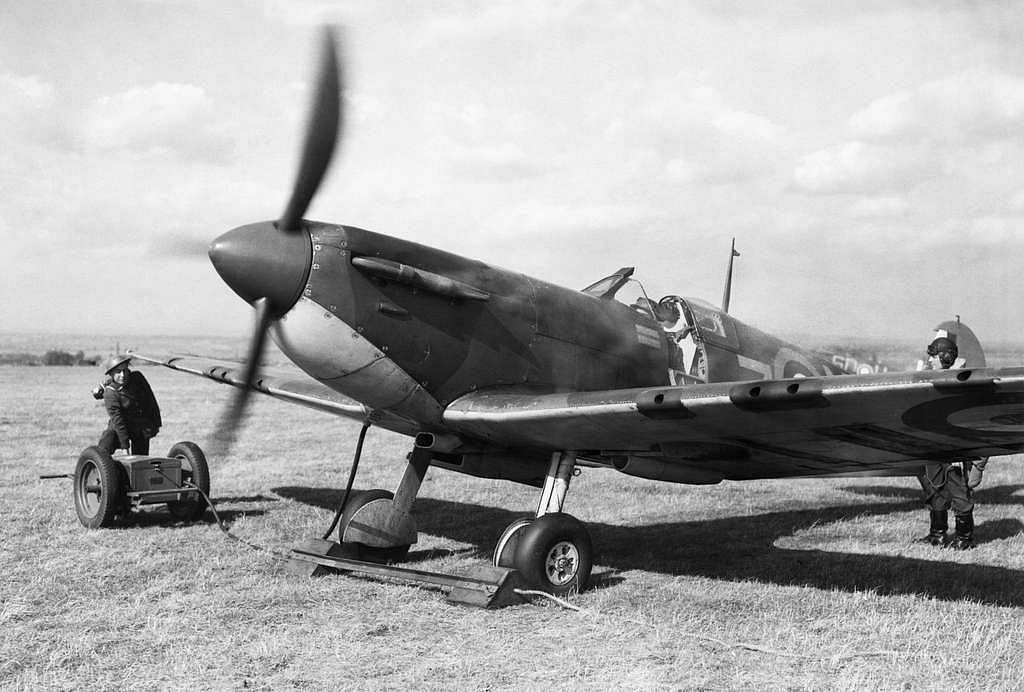
The fighter arm included the excellent Messerschmitt Bf 109, arguably the finest single-engine fighter of its day, alongside the twin-engine Bf 110 heavy fighter. The bomber force comprised Heinkel He 111s, Dornier Do 17s, and Junkers Ju 88s — capable of reaching targets deep into southern and central England.
On 6 August, Göring convened a commanders' conference formally announcing Eagle Day and ordering a maximum effort. But even at this early stage, German intelligence was badly miscalculating Fighter Command's strength. German estimates consistently underestimated the number of serviceable RAF aircraft and the remarkable output of British aircraft factories. These errors would prove costly.
Britain's Defences: The System That Would Blunt the Eagle
What Göring's planners failed to fully appreciate was the sophistication of what Dowding had built. The British air defence system was not simply a collection of fighter squadrons — it was an integrated network of radar, the Royal Observer Corps, telephone communications, and operations rooms that together formed something the world had never seen before.
The Chain Home network — stretching from the Orkney Islands in the north to Cornwall in the southwest — fed continuous information into Fighter Command's headquarters at Bentley Priory and then down through Group and Sector operations rooms. Air Vice-Marshal Keith Park's 11 Group, covering London and the South-East, was the critical front line of this defence.
On 13 August, Fighter Command had around 700 serviceable fighters, including the famous Supermarine Spitfire and the rugged, reliable Hawker Hurricane. The sector station network — Biggin Hill, Kenley, Hornchurch, Northolt, and others — allowed ground controllers to vector squadrons with remarkable precision directly onto incoming raids. It was this system that Göring needed to destroy. It was also this system that proved far harder to kill than he imagined.
Eagle Day Dawns: What Actually Happened on 13 August 1940
The morning of Eagle Day did not begin well for the Luftwaffe. Poor weather prompted Göring to postpone the main attack — but the cancellation order failed to reach all units in time. Kampfgeschwader 2, flying Dornier Do 17s, launched its morning raid without fighter escort, unaware the mission had been called off.
The result was a costly blunder. RAF squadrons including No. 111 Squadron and No. 74 Squadron intercepted the unescorted bombers and inflicted serious losses. It was an inauspicious start for Eagle Day's grand ambitions.
The afternoon saw the assault intensify. Over 1,500 Luftwaffe sorties were flown across the day, striking airfields including Detling, Eastchurch, and Andover. Significant damage was caused — but here the campaign's central intelligence failure emerged with painful clarity. Several of the airfields struck most heavily, including Detling and Eastchurch, belonged not to RAF Fighter Command but to RAF Coastal Command. They were operationally irrelevant to the defence of Britain's skies. The vital sector stations — the real targets — remained largely intact.
The Pilots: Men Who Flew for Britain's Survival
Churchill would later call them 'The Few', and the phrase has stuck for more than 80 years. But 'The Few' were a remarkably diverse group. Fighter Command's pilots came from Britain, Poland, Czechoslovakia, Canada, New Zealand, Australia, South Africa, and more than a dozen other nations — over 20 nationalities in total flew in defence of Britain that summer.
Polish pilots deserve particular mention. Many had already fought in the desperate campaign against Germany in September 1939, retreating across Europe before reaching Britain and re-forming under RAF command. No. 303 (Polish) Squadron would go on to become the highest-scoring Fighter Command unit of the entire Battle of Britain — a remarkable achievement by men fighting for a country not their own, driven by the rawest of motivations.
On the German side, Luftwaffe pilots were by no means amateurs. Many were veterans of the Condor Legion in Spain, of the Polish campaign, and of the devastating victories in France. They were experienced, well-trained, and confident. The contest was between two genuine air forces at the peak of their powers.
Air Vice-Marshal Keith Park's tactical handling of 11 Group was itself a quiet masterpiece. Rather than committing squadrons in large, unwieldy formations, Park sent them up in pairs — intercepting German raids repeatedly, preserving his force, and denying the Luftwaffe the decisive engagements they sought.
The Cost: Losses on Both Sides and the Battle's Shifting Tide
On Eagle Day itself, the Luftwaffe lost 45 aircraft against Fighter Command's 13 — a poor return for the enormous scale of effort. The losses would mount steadily in the days that followed.
On 15 August — quickly dubbed 'The Hardest Day' — Luftflotte 5 launched a major raid from Norway, gambling that 11 Group's fighters would be fully committed further south. They were wrong. Fighter Command's northern groups, 12 and 13, were ready and waiting. The raiders suffered catastrophic losses — around 75 German aircraft destroyed in a single day — and Luftflotte 5 never mounted a significant daylight raid against Britain again.
Yet by late August, the cumulative pressure was beginning to tell on Fighter Command. Sector stations were being bombed repeatedly; pilots were flying four and five sorties a day; trained replacement aircrew were running dangerously short. The battle was entering its most critical phase.
Then came a fateful accident. On the night of 24 August, Luftwaffe bombers strayed off course and dropped bombs on central London. Churchill ordered immediate retaliatory raids on Berlin. Hitler was furious. On 7 September 1940, in a decision now considered one of the great strategic blunders of the war, the Luftwaffe switched its primary attacks away from RAF airfields to London. Fighter Command's battered sector stations were given the time they desperately needed to recover.
The Turning Point: How the Battle of Britain Was Won
The official period of the Battle of Britain runs from 10 July to 31 October 1940. Its defining moment came on 15 September — now commemorated annually as Battle of Britain Day. Two massive Luftwaffe assaults were intercepted and repelled with heavy German losses, and the scale of Fighter Command's resistance finally convinced the German high command that the RAF was far from broken.
On 17 September 1940, Hitler postponed Operation Sea Lion indefinitely. Britain would not be invaded. The moment marked the first significant failure of Hitler's war machine — and it had been achieved in the skies above English fields and seaside towns by young men in Spitfires and Hurricanes.
Göring's fundamental errors were multiple: underestimating Dowding's system, misidentifying targets, overestimating his own bombers' durability without proper fighter escort, and failing to understand that British aircraft production was outpacing German losses throughout the battle. Fighter Command flew some 55,000 sorties during the campaign. The Luftwaffe lost around 1,887 aircraft; the RAF lost around 1,023 fighters.
Why Adlertag Still Matters: The Legacy of the Battle of Britain
Churchill's words of 20 August 1940 — 'Never in the field of human conflict was so much owed by so many to so few' — remain among the most quoted sentences in the English language. They were spoken at the height of the battle, when the outcome was still genuinely uncertain, and they carry an authenticity that later tributes rarely match.
The Battle of Britain demonstrated for the first time in history that air power alone could not achieve a strategic objective — a lesson that profoundly shaped military doctrine for the remainder of the twentieth century. Dowding's integrated air defence system was a forerunner of modern command-and-control warfare; its core principles — networked sensors, centralised coordination, distributed response — are still studied in military academies around the world.
And the strategic consequences were immense. By surviving the summer of 1940, Britain remained available as the platform from which the Allied liberation of Western Europe was eventually launched on 6 June 1944. Had Eagle Day succeeded — had Fighter Command been destroyed — that liberation might never have come, or might have come far later and at far greater cost.
Every year on 15 September, Battle of Britain Day is marked across the United Kingdom with flypasts, memorial services, and ceremonies. The faces change, the aircraft now fly in museums rather than combat, but the memory of that summer endures: a small number of pilots, in an outnumbered air force, held the line for the rest of the free world.
If this story moved you, we'd love to hear from you in the comments below — share your memories, your family connections to the Battle of Britain, or simply pass this article on to someone who would value knowing it. These stories deserve to be kept alive.
Further Reading
- Imperial War Museum — extensive Battle of Britain collections, pilot testimonies, and archive material
- The National Archives (United Kingdom) — official RAF operational records and Air Ministry documents from 1940
- RAF Museum, London and Cosford — dedicated Battle of Britain exhibition and aircraft collections
- National Army Museum — broader Second World War context and British home defence records
- Smithsonian National Air and Space Museum — international air power history including the Battle of Britain era