The Quiz Question
At which January 1944 amphibious landing in Italy did Allied forces get pinned down on the beachhead for months by determined German counterattacks, despite achieving initial surprise?
- A. Battle of Anzio
- B. Battle of Salerno
- C. Battle of Monte Cassino
- D. Battle of Rome
The answer is A. Battle of Anzio. Here is the full story.
On the night of 22 January 1944, thousands of Allied soldiers waded ashore at the Italian seaside town of Anzio with almost no resistance. The Germans were caught completely off guard. For a brief, shining moment, the road to Rome lay open. What happened next became one of the most haunting episodes of the entire Second World War.
A Daring Plan That Should Have Changed Everything
By late 1943, the Allied advance up the Italian peninsula had ground to a halt against the German Winter Line — a brutal series of fortified positions anchored by the monastery-crowned heights of Monte Cassino. Every frontal assault had failed. The cost in lives was staggering.
General Sir Harold Alexander and U.S. General Mark Clark conceived Operation Shingle as a bold solution: an amphibious end-run behind German lines that would cut off Field Marshal Albert Kesselring's forces and unlock the road to Rome. The landing site chosen was Anzio — just 37 miles south of the Italian capital — close enough that planners believed the city could fall within days.
Winston Churchill was among the operation's most passionate champions. He famously wanted to "hurl a wildcat ashore" rather than produce "a stranded whale" — a colourful metaphor that would prove bitterly ironic before long. Speed and boldness after the landings were considered the absolute keys to success. Without them, the whole concept unravelled.
Setting the Scene: Italy's Long, Bloody Road North
Allied forces had invaded Sicily in July 1943 and mainland Italy in September, expecting Italy's surrender to accelerate their advance northward. Instead, Kesselring conducted one of the war's most skilful defensive campaigns, trading ground slowly and making every mile cost dearly.
The Gustav Line, centred on Monte Cassino and the Liri Valley, had blocked the road to Rome since November 1943. British, American, Indian, and New Zealand troops had all thrown themselves against it and been repulsed with heavy losses. By January 1944, the stalemate was complete.
Anzio was conceived to break that deadlock by landing VI Corps behind German lines, threatening Kesselring's supply routes and forcing him to either withdraw or face encirclement. It was a sound idea in theory. But Italy's terrain — mountains, swollen rivers, and boggy coastal plains — had a way of punishing bold theories with grim reality.
D-Day at Anzio: Surprise Achieved, Opportunity Missed
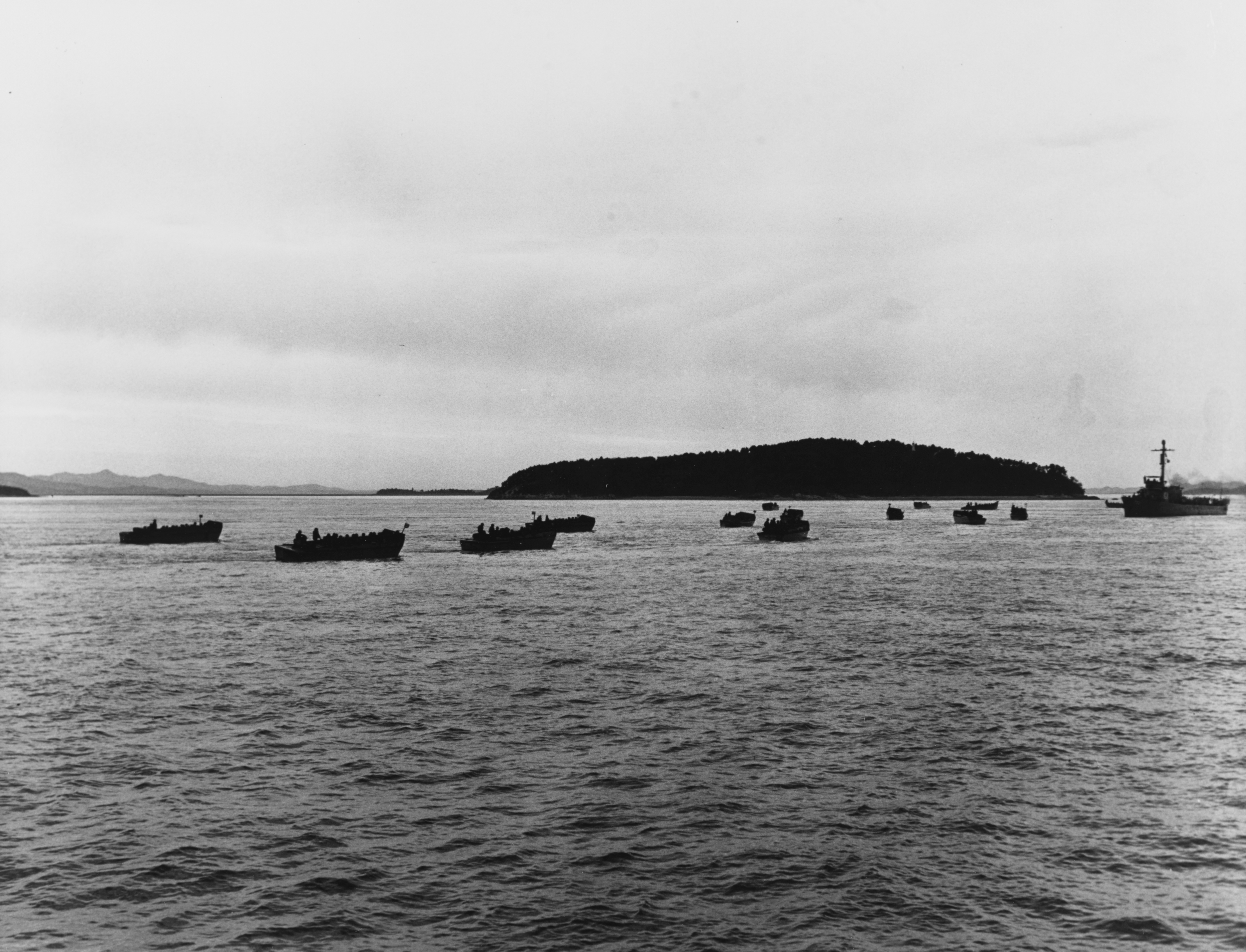
At 2:00 a.m. on 22 January 1944, the first landing craft ground onto the beaches near Anzio and Nettuno. German resistance was almost nonexistent. Allied forces had achieved total tactical surprise — one of the cleanest amphibious landings of the entire war.
Major General John P. Lucas commanded VI Corps: the U.S. 3rd Infantry Division landing to the south, the British 1st Infantry Division to the north, with supporting units totalling around 36,000 men and 3,200 vehicles in the initial wave. By nightfall on D-Day, the beachhead was secure with fewer than 100 Allied casualties. Even Allied commanders were stunned by their own success.
And yet Lucas chose to consolidate rather than drive immediately inland toward the Alban Hills — the high ground that commanded both the road to Rome and the main German supply arteries. Critics, including Churchill, would later argue that those first 24 to 48 hours were the golden window. Lucas's caution gave Kesselring exactly the time he needed to react.
Kesselring Strikes Back: The German Response
Field Marshal Albert Kesselring was one of the most gifted defensive commanders of the entire war, and his response to the Anzio landing was a masterclass in improvisation. Within hours of the first reports, he was pulling units from as far away as France and Yugoslavia, funnelling them toward the beachhead at maximum speed.
Within 48 hours of the landings, eight German divisions had been ordered toward Anzio. Kesselring created the 14th Army under General Eberhard von Mackensen specifically to contain and destroy the Allied bridgehead. By 25 January — just three days after the landings — a solid German defensive ring had formed around the beachhead perimeter.
Churchill's wildcat had become the stranded whale he had feared. German artillery, including the notorious "Anzio Annie" — actually two massive K5 280mm railway guns nicknamed Robert and Leopold — could shell virtually the entire beachhead at will. Far from operating behind enemy lines, VI Corps was imprisoned in a coastal strip roughly 15 miles wide and 7 miles deep, under constant fire.
The Battles for the Beachhead: Blood in the Mud
The fighting that followed was some of the most savage and claustrophobic of the entire Italian campaign. The British 1st Infantry Division fought a brutal struggle for the "Factory" — the Aprilia industrial complex — in late January and early February, with the position changing hands multiple times at terrible cost.
On 3–4 February, German forces launched a heavy counterattack down the Albano Road, threatening to slice the beachhead in two. The 1st Division and U.S. Rangers held the line by the narrowest of margins. The Battles of Carroceto and Aprilia in early February left the British 1st Division with over 3,000 casualties in a single week of fighting.
Germany's major counteroffensive — Operation Fischfang ("Fish Catch") — was launched on 16 February with 12 divisions aimed at driving the Allies into the sea. Ferocious Allied artillery concentrations and determined infantry resistance stopped the German advance just short of the breaking point. The killing ground around the road bridge at the Mussolini Canal, known to the men as "the Flyover," became a symbol of the whole grinding stalemate.
On 30 January, the U.S. 1st and 3rd Ranger Battalions were virtually annihilated in a disastrously compromised attempt to infiltrate the town of Cisterna. Of the 767 Rangers who set out, only 6 returned to Allied lines. It was one of the worst single-day losses ever suffered by American Ranger forces.
The Men Who Lived It: Faces of Anzio
General John P. Lucas was relieved of command on 22 February 1944, replaced by the more aggressive Major General Lucian Truscott. Whether Lucas was a scapegoat for a fundamentally flawed strategic concept or genuinely responsible for squandering the initial opportunity remains one of the Italian campaign's most contested debates.
Ranger James Altieri survived the Cisterna disaster and later wrote about the experience, helping preserve the memory of those 761 Rangers killed or captured in a single night. Their sacrifice illustrated the brutal calculus of the beachhead — bold action was costly, but hesitation had created the trap in the first place.
British nurse Winifred Beaumont served at a Casualty Clearing Station near the beachhead and later wrote vividly about treating the shattered men carried in from the front each night, often under shellfire herself. Her account is a reminder that the courage at Anzio was not confined to the infantry trenches.
Private Raleigh Trevelyan, a young British officer who served in the Anzio lines, kept a diary throughout the campaign that was later published as The Fortress — widely regarded as one of the most powerful personal accounts of the Italian campaign and a primary source that historians continue to draw upon today.
Life on the Beachhead: War Without Escape
Anzio was unlike almost any other battlefront in the European theatre. There was no rear area. German artillery could reach the docks, the hospital tents, and the beaches themselves. Wounded men were shelled in their hospital beds. Supply ships ran a gauntlet of air attack and shellfire simply to keep the beachhead alive.
The town of Anzio was reduced to rubble. Civilians who had not fled sheltered in cellars alongside Allied soldiers, creating a strange cohabitation of war and survival. Allied psychiatrists noted that combat exhaustion and "shell shock" cases mounted at rates higher than almost any other theatre — the unrelenting nature of the shelling, with literally nowhere to escape it, broke men in ways that conventional front lines did not.
Soldiers described a twilight existence: sleeping by day in dugouts hacked from clay, moving and fighting by night, the permanent smell of mud, cordite, and death their only constant. For four months, this was their entire world. The beachhead was 15 miles wide. There was nowhere else to go.
The Breakout: Anzio Finally Delivers — But at a Price
The long-awaited breakout, coordinated as part of Operation Diadem, came on 23 May 1944. VI Corps, now under Truscott, exploded out of the beachhead in coordination with a massive Allied offensive on the main front to the south. After four months of static misery, the advance finally began.
Truscott's original orders directed VI Corps northeast toward Valmontone, to cut Highway 6 — the main escape route for the German 10th Army retreating before the southern offensive. Had the plan been executed, an entire German army might have been trapped and destroyed. It would have been the decisive blow the operation had always promised.
Instead, General Mark Clark controversially redirected VI Corps northwest toward Rome. The German 10th Army escaped the trap, slipped northward, and fought on for another year. Clark's decision to prioritise the symbolic capture of Rome over the destruction of the German army remains one of the most debated Allied command choices of the entire war.
Rome fell on 4 June 1944 — the first Axis capital to be liberated — and Clark had his triumphant entry. The triumph lasted barely 48 hours in the headlines. On 6 June, the Normandy landings swept Italy entirely off the front pages. Total Allied casualties at Anzio from January to June 1944 ran to approximately 29,200 Americans and 9,200 British killed, wounded, or missing. German casualties were estimated at around 27,500.
Legacy of Anzio: What Did It All Mean?
Anzio demonstrated with brutal clarity that surprise and initial success in an amphibious operation count for nothing without the will and the resources to exploit them immediately. The window at Anzio was real. It closed within 48 hours and never reopened.
The lessons were studied intensively before Operation Dragoon — the August 1944 landing in southern France — which was executed with significantly greater speed and boldness, achieving the strategic exploitation that Anzio had failed to deliver. The beachhead had become a textbook example of what not to do, and Allied commanders took careful notes.
Kesselring's performance at Anzio cemented his reputation as one of the outstanding defensive commanders of the Second World War. His ability to improvise, concentrate forces, and contain a surprise landing within days was studied in military academies for decades after the war.
The Anzio American Cemetery and Memorial, maintained by the American Battle Monuments Commission, contains 7,860 graves — a quiet, sobering measure of what those four months truly cost. For the men who fought there, Anzio was never a footnote to D-Day. It was four months of hell, fought by ordinary men with extraordinary courage, that deserves its own permanent place in the history of how the war was won.
If you found this story moving, we'd love to hear from you — share your thoughts in the comments below, or pass this article on to someone who loves the real history behind the headlines. And if you're interested in the wider Italian campaign, take a look at our article on the Battle of Monte Cassino.
Further Reading
- The National World War II Museum, New Orleans
- Imperial War Museum, London
- American Battle Monuments Commission
- The National Archives, Kew (United Kingdom)
- U.S. Army Center of Military History