The Quiz Question
At the Battle of Tannenberg in August 1914, German forces under Hindenburg and Ludendorff destroyed which army, taking around 92,000 Russian prisoners in the process?
- A. The Russian First Army
- B. The Russian Second Army
- C. The Russian Imperial Guard
- D. The Siberian Corps
The answer is B. The Russian Second Army. Here is the full story.
In just five days at the end of August 1914, an entire Russian army was swallowed up by the forests and lakes of East Prussia. The Russian Second Army — over 150,000 men — was encircled, shattered, and effectively erased from the order of battle. Around 92,000 soldiers were marched into captivity, 30,000 more were killed or wounded, and only a handful escaped the closing German net. The battle's name became a byword for military catastrophe: Tannenberg.
A Catastrophe in the Forests of East Prussia
The encirclement at Tannenberg, fought between 26 and 30 August 1914, stands alongside Cannae — Hannibal's destruction of a Roman army in 216 BC — as one of the most complete double envelopments in military history. An entire field army, with its guns, its transport, and its men, simply ceased to exist in less than a week.
For Germany, it was an almost miraculous deliverance. East Prussia had been threatened with invasion; within days, the invaders had been annihilated. The names Hindenburg and Ludendorff became household words almost overnight, printed on postcards and celebrated in newspapers across the Reich.
For Russia, the scale of the humiliation was almost beyond comprehension. The Russian commander, General Alexander Samsonov, could not face reporting the disaster to Tsar Nicholas II. He walked alone into the dark pine forest near Willenberg in the early hours of 30 August and shot himself.
Why Russia Marched Into East Prussia So Quickly
To understand why Tannenberg happened, you have to look west — to France. By late August 1914, German forces were driving deep into France and Belgium under the Schlieffen Plan, and the French were in desperate straits. Paris appealed urgently to its Russian ally to open an eastern front and draw German forces away.
Russia mobilised faster than German planners had anticipated — but speed came at a crippling cost. The Tsar's army was enormous on paper, but its rail network was sparse, its logistics were primitive, and its officer corps was dangerously uneven in quality.
Two armies were ordered into East Prussia simultaneously. The Russian First Army, under General Paul von Rennenkampf, would advance from the north-east. The Second Army, under General Alexander Samsonov, would sweep in from the south. Together they were meant to encircle the German Eighth Army in a classic pincer movement — bold in conception, but fatally dependent on coordination the Russians simply could not deliver.
The German Commanders: Hindenburg and Ludendorff
On 22 August 1914, as the situation in East Prussia grew critical, the German high command recalled 66-year-old General Paul von Hindenburg from retirement. He was appointed commander of the Eighth Army — a steady, patrician figurehead whose calm inspired confidence at a moment of near-panic.
The operational brain was his newly appointed Chief of Staff, General Erich Ludendorff, 49 years old and already celebrated for his audacious storming of the Belgian fortress of Liège earlier that month. Ludendorff was aggressive, brilliant, and utterly focused on destruction of the enemy. Together, they formed one of the war's most formidable command partnerships.
But there was a crucial third figure who has sometimes been overshadowed in the legend: Colonel Max Hoffmann, the Eighth Army's senior operations officer. Hoffmann had already begun repositioning German troops before Hindenburg and Ludendorff even arrived at headquarters. And Hoffmann carried a piece of personal knowledge that would prove strategically priceless — he knew from his own observation at the post-war celebrations following the Russo-Japanese War that Rennenkampf and Samsonov despised each other with a bitter personal hatred. The two Russian commanders would not rush to each other's aid.
Russia's Fatal Weakness: The Radio Messages
Of all the factors that made Tannenberg a German victory, perhaps none was more decisive than this: the Russian armies transmitted their operational orders by wireless radio in plain, unencoded text. Apparently lacking the cipher capacity to encode messages for both armies simultaneously, Russian signals officers sent their orders in clear — readable by anyone with a receiver.
German signals units intercepted these messages and delivered the Russian operational plans directly to Ludendorff's headquarters, often in near real-time. The Germans knew exactly where Samsonov's corps were marching, what orders each commander carried, and — most critically — that Rennenkampf's First Army was not moving south to support him.
At one point the German commanders debated whether the unencoded messages might be deliberate deception — they seemed almost too useful to be genuine. Hoffmann confirmed they were authentic. This signals intelligence failure ranks among the most consequential in military history, handing Germany a decisive advantage before the main battle had even begun.
The Battle Unfolds: Encirclement in Five Days
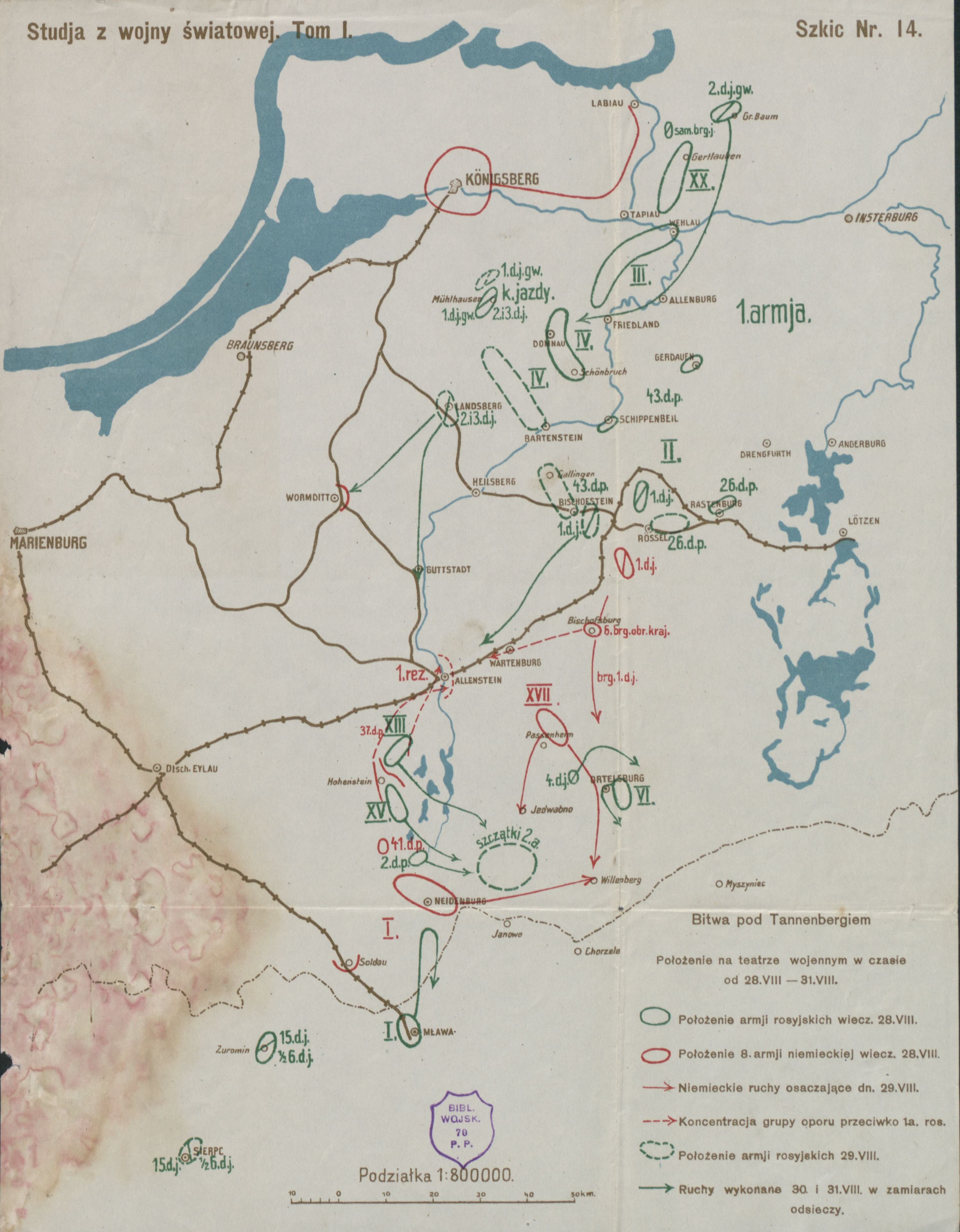
On 26 August, the German assault fell on the flanks of Samsonov's advancing army. General Hermann von François struck from the south-west, cutting towards the Russian rear. General August von Mackensen drove in from the north-east. It was a textbook double envelopment — and Samsonov had no idea the trap was closing.
Samsonov's central corps — the XIII and XV — pushed forward confidently, believing they were pressing a retreating enemy. They were walking deeper into the pocket. On 28 August, German units began linking up south of the town of Neidenburg, sealing the ring. The escape routes were closing.
Samsonov's communications collapsed entirely. He lost contact with his corps commanders and rode forward into the battle zone himself, desperately trying to understand what was happening. What he found was a catastrophe already beyond rescue.
By 30 August it was over. The XIII Corps, the XV Corps, and most of the XXIII Corps were surrounded in the Grünfließ and Willenberg forests — out of ammunition, out of food, and surrendering in their tens of thousands. Around 92,000 Russian soldiers began the long march into German captivity. Five hundred artillery pieces were abandoned or captured. An army of over 150,000 men had effectively ceased to exist.
General Samsonov's Last Hours
On the night of 29–30 August, as the full scale of the catastrophe became undeniable, Samsonov told the staff officers still with him: "The Tsar trusted me. How can I face him after such a disaster?" He dismissed his escort and walked alone into the pine forest near Willenberg.
A single gunshot was heard in the darkness. His body was later recovered by the Germans, who gave him a military funeral with full honours — a gesture of soldier's respect that says something about the professional culture of the time.
Samsonov was 55 years old, a veteran of the Russo-Japanese War and an experienced cavalry commander. He had been handed an infantry army too large, too poorly supplied, and too poorly coordinated for any commander to have managed well in those circumstances. His widow was eventually permitted by the German authorities to retrieve his remains. He is buried in Russia — a tragic emblem of the entire campaign's failure.
The Aftermath: Prisoners, Plunder, and Propaganda
German tallies recorded approximately 92,000 Russian prisoners taken, 500 artillery pieces captured, and the near-total destruction of five Russian corps. German casualties across the entire battle were relatively modest — estimates range between 10,000 and 15,000 killed and wounded, a stark and sobering asymmetry.
The victory's name was chosen deliberately. Ludendorff named it "Tannenberg" — a conscious historical echo of the 1410 Battle of Grunwald (also known as Tannenberg), where Slavic and Lithuanian forces had defeated the Teutonic Knights. In 1914, the symbolism was reversed, and Germany's propagandists made the most of it.
Hindenburg was transformed into a national hero almost overnight. His image appeared on recruiting posters, commemorative postcards, and monument campaigns within weeks. The captured Russian artillery pieces were eventually melted down and recast as church bells across Germany — a powerful, resonant symbol of victory that embedded itself in German cultural memory.
The Russian prisoners flooded into German detention camps, many of them improvised and wholly inadequate for the numbers involved. Through the winter of 1914–15, thousands suffered terribly from cold, disease, and hunger.
What Tannenberg Meant for the Eastern Front
Despite the catastrophic defeat, Russia's intervention had achieved something important. German forces had been pulled east at a critical moment, easing the pressure on France just as the Battle of the Marne in September 1914 halted the German advance in the west. The Schlieffen Plan's assumptions had been upset — in part because of the very Russian offensive that ended in disaster at Tannenberg.
Rennenkampf's First Army was subsequently defeated at the First Battle of the Masurian Lakes in September 1914, completing Germany's clearance of East Prussia. Russia replaced its staggering losses with fresh conscripts, but Tannenberg had exposed deep structural weaknesses — in command, communications, logistics, and equipment — that would haunt the Tsar's armies for the rest of the war.
The defeat also stoked political tensions inside Russia. The humiliation fed the resentment and discontent that would eventually fuel the revolutionary movements of 1917. Tannenberg was not the only cause of revolution — but it was an early and damaging wound to the regime's credibility.
For Germany, the partnership of Hindenburg and Ludendorff was cemented at Tannenberg. By 1916, as the war ground on, the two men would effectively run the entire German war effort as the Supreme Command — the OHL — wielding power that went far beyond any military role.
Why Tannenberg Still Matters Over a Century Later
Tannenberg remains a case study in military staff colleges to this day — a masterclass in the use of signals intelligence, interior lines, and bold manoeuvre to destroy a numerically superior enemy. The lesson that communications security can be as decisive as firepower has never lost its relevance.
The battle's propaganda legacy shaped German national identity throughout the Weimar years. Hindenburg was elected German President in 1925, trading heavily on the Tannenberg myth. In 1927, a vast Tannenberg Memorial was built near the battlefield. Hitler used it for major ceremonies; Hindenburg was buried there in 1934. The monument was destroyed by retreating German forces in 1945.
More broadly, Tannenberg is a vivid reminder that wars are won and lost not just on the battlefield but in the signals tent, the supply depot, and the relationships — and feuds — between generals. Rennenkampf's failure to march south, Samsonov's inability to communicate with his corps, and the catastrophic decision to send radio orders in plain text all contributed as decisively as any German bayonet.
One hundred and ten years on, the forests of what is now north-eastern Poland still hold the memory of those five August days — and of the 92,000 men who marched into captivity, and the general who walked alone into the trees.
If you found this article compelling, we'd love to hear your thoughts in the comments below. Do you think the outcome at Tannenberg was inevitable given Russia's structural weaknesses — or did individual decisions by commanders on both sides tip the balance? Share this piece with a fellow history enthusiast and keep the conversation going.
Further Reading
- Imperial War Museum (IWM), London — extensive collections on the Eastern Front and the First World War
- The National Archives, Kew — British official records and intelligence documents from the First World War period
- Bundesarchiv (German Federal Archives), Freiburg — German military records including Eighth Army operational files
- The Library of Congress, Washington D.C. — broad holdings on the First World War including Eastern Front materials and photographic archives
- Hoover Institution Library and Archives, Stanford University — significant collections on Imperial Russia, the First World War, and the revolutionary period