The Quiz Question
What was the name of the Argentine submarine that British helicopters disabled with depth charges near South Georgia on 25 April 1982, forcing her crew to surrender at Grytviken?
- A. ARA Santiago del Estero
- B. ARA San Luis
- C. ARA Salta
- D. ARA Santa Fe
The answer is D. ARA Santa Fe. Here is the full story.
On the morning of 25 April 1982, a single Argentine submarine limping toward a remote South Atlantic harbour became the target of one of the most improvised and effective naval air attacks of the modern era. What happened next sent a clear signal to Buenos Aires: Britain's Task Force was not coming to negotiate.
A Cold Morning Off South Georgia — The Shot That Opened the Falklands War at Sea
Just 24 days after Argentina invaded the Falkland Islands, Britain was already striking back 8,000 miles from home. South Georgia — a windswept, glacier-scarred island with no permanent civilian population — became the scene of the first major British naval action of the entire conflict.
The attack on ARA Santa Fe was not simply a tactical success. It was a statement of intent. Four helicopters from three different ships converged on a single submarine in a remarkably improvised but devastating coordinated assault. By afternoon, the Union Jack flew once again over Grytviken — the same whaling station where the great explorer Ernest Shackleton lies buried — lending the moment an almost cinematic quality that the press back home seized upon immediately.
Background: Argentina Seizes South Georgia on 3 April 1982
Argentine forces occupied South Georgia on 3 April 1982, one day after seizing the Falkland Islands themselves. The island's defenders — a Royal Marines detachment of just 22 men from Naval Party 8901 — were overwhelmed after putting up fierce resistance at Grytviken, wounding several Argentine attackers before being forced to surrender.
South Georgia sits roughly 800 miles south-east of the Falklands. Strategically, it mattered as a potential staging post; symbolically, its loss was an affront that the Thatcher government could not allow to stand unanswered. Operation Paraquet was the codename assigned to its retaking — a politically urgent mission designed to demonstrate British resolve at the earliest possible moment in the conflict.
Argentine planners moved quickly to reinforce their new garrison. ARA Santa Fe was dispatched to South Georgia carrying around 40 additional troops and vital military supplies, making her destruction all the more significant.
ARA Santa Fe: Argentina's Ageing but Dangerous Submarine
ARA Santa Fe (S-21) began her life as USS Catfish, a Balao-class submarine built for the United States Navy in 1944. Transferred to Argentina in 1971, she was by 1982 already a relic of another era — diesel-electric, slow to dive, and showing her age. She displaced around 1,525 tons surfaced and carried a crew of approximately 70 officers and ratings.
She was not without capability. Balao-class boats had proven their worth in the Second World War, and Santa Fe could still deliver troops, lay mines, and fire torpedoes. But her maintenance record gave Argentine commanders reason for concern. She had known problems with her diving systems — a critical vulnerability that would prove fatal on 25 April.
Santa Fe had already completed one supply run to South Georgia earlier in April before setting out on her second and final mission. Her crew had no way of knowing that British forces were already closing in.
The British Hunter: Task Group 317.9 Closes In
The British naval group tasked with retaking South Georgia was built around HMS Antrim, a County-class guided-missile destroyer, alongside HMS Plymouth (a Rothesay-class frigate), HMS Endurance — the ice patrol ship already familiar in those waters — and the nuclear submarine HMS Conqueror. HMS Brilliant and the Royal Fleet Auxiliary tanker RFA Tidespring also formed part of the group, carrying D Squadron SAS and elements of 42 Commando Royal Marines.
Rear Admiral John 'Sandy' Woodward commanded the broader Task Force from HMS Hermes. Day-to-day command of Operation Paraquet on the spot fell to Captain Brian Young aboard HMS Antrim — a man who would soon face one of the tightest decisions of the entire campaign.
British forces had already endured a terrifying near-disaster on 21–22 April, when SAS reconnaissance teams were stranded on the Fortuna Glacier in lethal blizzard conditions. Two Wessex helicopters were lost in the attempt to rescue them. Commander Ian Stanley, flying Humphrey — the sole surviving Wessex HAS.3 from HMS Antrim — performed a near-miraculous rescue, extracting all the men in conditions that most pilots would have considered impossible.
By the morning of 25 April, with Santa Fe known to be resupplying the Argentine garrison, British commanders were under pressure to act immediately before the island's defences grew any stronger.
The Attack: Four Helicopters, One Submarine, No Mercy
At approximately 09:45 local time on 25 April 1982, Humphrey — the Westland Wessex HAS.3 from HMS Antrim, crewed by Commander Ian Stanley — spotted Santa Fe running on the surface approximately five miles from Grytviken. The submarine was approaching harbour to offload her cargo, and her compromised diving ability meant she could not simply crash-dive to safety as a healthy boat might have done.
Stanley attacked without hesitation. Humphrey dropped Mk 11 depth charges alongside the submarine, blowing open her ballast tanks and guaranteeing she could not submerge. Santa Fe was now trapped on the surface in waters patrolled by hostile helicopters — the worst possible situation for any submarine commander.
A Westland Lynx from HMS Brilliant, flown by Lieutenant Commander Tony Ellerbeck, pressed in next, firing AS.12 wire-guided missiles into Santa Fe's fin — the conning tower — at dangerously close range. The missiles tore into the structure, causing further catastrophic damage and wounding several crew members including the submarine's commanding officer, Commander Horacio Bicain.
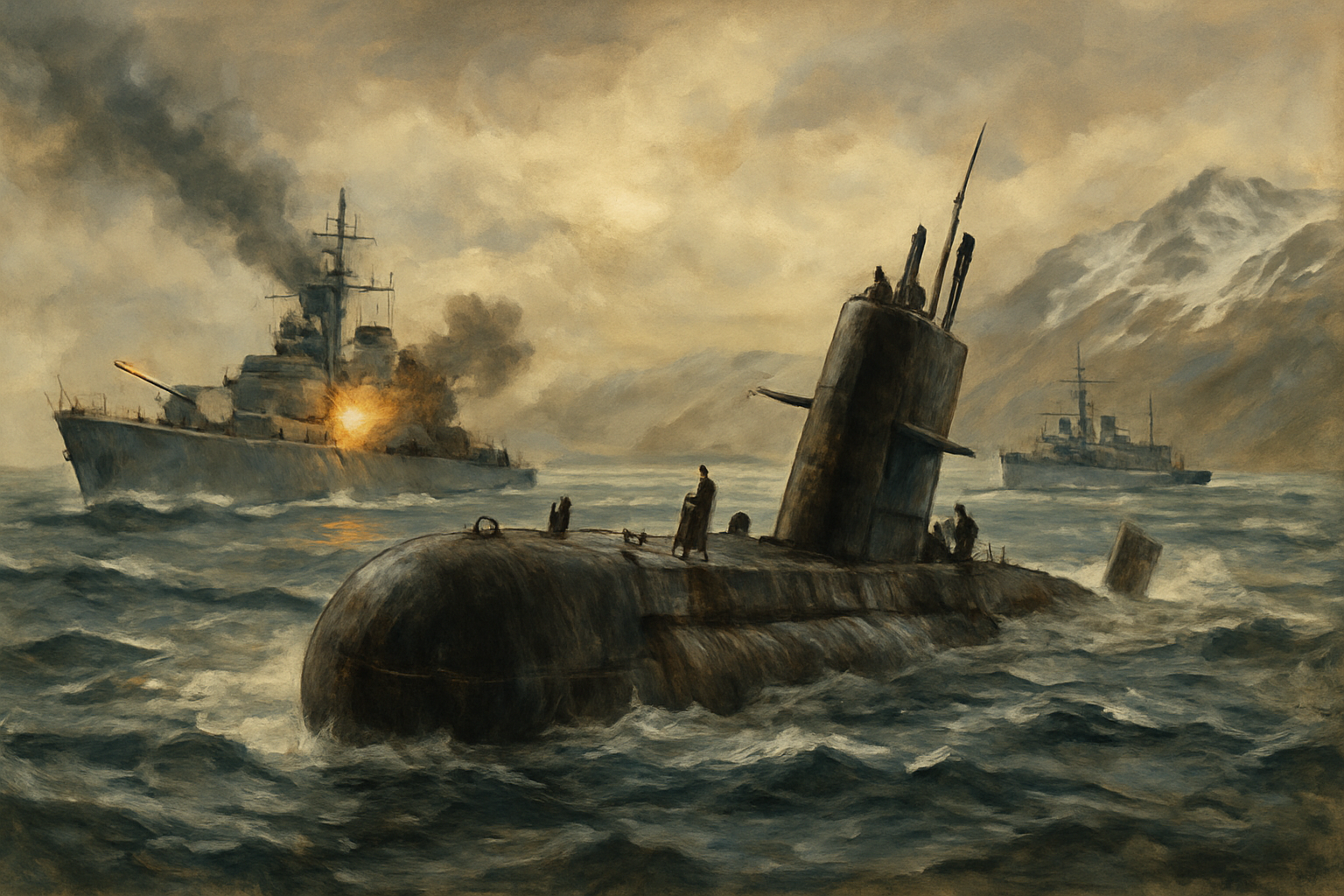
Two Wasp helicopters — one from HMS Endurance and one from HMS Plymouth — then joined the attack, each firing additional AS.12 missiles into the stricken boat. It was, by any measure, an almost unprecedented coordinated multi-helicopter assault on a submarine in actual combat. Burning, flooding, and completely unable to dive, Santa Fe staggered the remaining distance to Grytviken and was beached alongside the old British Antarctic Survey jetty, her crew scrambling ashore to surrender.
The Men Behind the Mission: Crews and Commanders
Commander Horacio Bicain, Santa Fe's captain, deserves acknowledgement even in defeat. Wounded and facing the destruction of his vessel, he chose to steer her to the jetty rather than allow her to sink with his crew still aboard. His decision saved lives on both sides — a sinking submarine fighting to the last in a confined harbour could have complicated the British assault significantly.
Commander Ian Stanley had already become something of a legend within the Task Force after the Fortuna Glacier rescues. His attack on Santa Fe that same morning added yet another chapter to an extraordinary few days of flying. He was subsequently awarded the Distinguished Service Order, one of the highest honours available to a serving officer short of the Victoria Cross.
Lieutenant Commander Alfredo Astiz commanded the Argentine garrison at Grytviken and was the officer who formally signed the surrender document. His subsequent history cast a long shadow: Astiz was later convicted in Argentina of crimes committed during the country's Dirty War of the 1970s, when he had worked as an agent of the military junta responsible for the forced disappearance of thousands of civilians.
Roughly 70 Argentine submarine crew and the South Georgia garrison — approximately 156 men in total — surrendered to British forces that afternoon.
Grytviken Falls: The Retaking of South Georgia, 25 April 1982
With Santa Fe crippled and the garrison visibly shaken, Captain Brian Young made a bold and arguably risky decision: assault Grytviken immediately with the troops already on hand rather than wait for additional reinforcements from RFA Tidespring, which was still some distance away.
A scratch landing force composed of SAS, SBS, and Royal Marines — fewer than 100 men in total — went ashore under naval gunfire support from HMS Antrim and HMS Plymouth. The Argentine garrison, their morale broken by the morning's events and their submarine burning at the jetty, raised the white flag within hours. The Union Jack flew once more over Grytviken by the afternoon of 25 April 1982.
Margaret Thatcher appeared on the steps of 10 Downing Street that evening to announce the news to the press. When a reporter suggested there might be cause for concern over wider events, she delivered one of the most quoted lines of the entire war: 'Rejoice! Just rejoice!' It was a moment that crystallised both the public mood and the political stakes of the campaign.
The entire Operation Paraquet cost no British lives — a remarkable outcome given the chaos of the Fortuna Glacier disaster just three days earlier.
What Happened to ARA Santa Fe After the Battle?
ARA Santa Fe remained beached and slowly flooding at Grytviken for years after the war ended — a rusting, highly visible monument to the Argentine defeat at South Georgia. Efforts to refloat or formally scuttle her in deeper water were considered but proved difficult given the island's extreme remoteness and harsh conditions.
She eventually capsized and sank at her moorings at Grytviken in 1985, where her wreck remains on the seabed to this day. The loss of Santa Fe deprived Argentina of one of its most operationally capable — if elderly — submarines at a critical early stage of the war, and the psychological impact on Argentine naval planning was considerable.
Today her wreck is a recognised diver attraction, a silent and corroded relic of a brief but intense conflict, visible beneath the cold, clear South Georgian waters near the same jetty where her crew surrendered over four decades ago.
Legacy: Why the Attack on ARA Santa Fe Still Matters
The action against Santa Fe demonstrated with brutal clarity the effectiveness of ship-borne helicopters operating against submarines in confined coastal waters. It was one of the very few occasions in the post-Second World War era that a submarine was disabled in actual combat by helicopter-delivered weapons, and the lesson was not lost on NATO naval planners studying the conflict.
For Argentina, the fall of South Georgia had consequences far beyond the loss of one old submarine. The psychological blow contributed to a wider caution within the Argentine Navy that became strategically decisive. After the nuclear submarine HMS Conqueror sank ARA General Belgrano on 2 May 1982 — an action you can read about in our coverage of the broader Falklands War — the Argentine surface fleet returned to port and did not venture out again in force for the remainder of the conflict. The pattern of restraint began, arguably, on the morning of 25 April off Grytviken.
The swift retaking of South Georgia also provided a crucial propaganda victory for Britain at home, arriving at a moment when public and parliamentary support for the full Task Force needed bolstering. The news that British forces had already won their first engagement, with no lives lost, transformed the political atmosphere at Westminster and gave Thatcher's government the confidence to press forward.
Commander Ian Stanley's Wessex HAS.3 — Humphrey — is preserved today at the Fleet Air Arm Museum at Yeovilton in Somerset. She is one of the most evocative surviving artefacts of the Falklands conflict: a battered, workhorse helicopter that rescued stranded soldiers from a glacier and then crippled an enemy submarine, all within the space of three extraordinary days.
If you found this story as gripping as we did, share it with a fellow history enthusiast or leave a comment below — we'd love to hear your thoughts on Operation Paraquet and the remarkable men who carried it out.
Further Reading
- Fleet Air Arm Museum, Yeovilton, Somerset — home to Wessex HAS.3 'Humphrey' and extensive Falklands War aviation records
- Imperial War Museum, London — holds significant collections of documents, photographs, and oral histories relating to the Falklands War
- The National Archives, Kew — official British government and military records from the 1982 conflict, including operational dispatches
- Royal Navy Historical Branch — maintains primary source records relating to Royal Navy operations during the Falklands campaign
- National Museum of the Royal Navy, Portsmouth — collections covering Royal Navy operations from the Second World War through to the Falklands and beyond