The Quiz Question
September 17, 1862 remains the single bloodiest day in American history, with about 22,700 men killed, wounded, or missing at which Civil War battle in Maryland?
- A. Antietam
- B. Fredericksburg
- C. Chancellorsville
- D. South Mountain
The answer is A. Antietam. Here is the full story.
On the morning of 17 September 1862, a 30-acre cornfield in western Maryland became one of the most violent patches of ground in American history. Before the sun set, roughly 22,726 Union and Confederate soldiers had been killed, wounded, or gone missing — more than on D-Day, more than at Iwo Jima, more than any other single day of combat this nation has ever produced. The Battle of Antietam lasted less than twelve hours. Its consequences lasted generations.
One Day, 22,700 Men: Why Antietam Still Shocks
The numbers alone are almost impossible to absorb. Approximately 22,726 combined casualties in a single day of fighting — a figure confirmed by the official records held by the National Archives and Records Administration. To put that in context, American forces suffered around 6,600 casualties on D-Day, 6 June 1944.
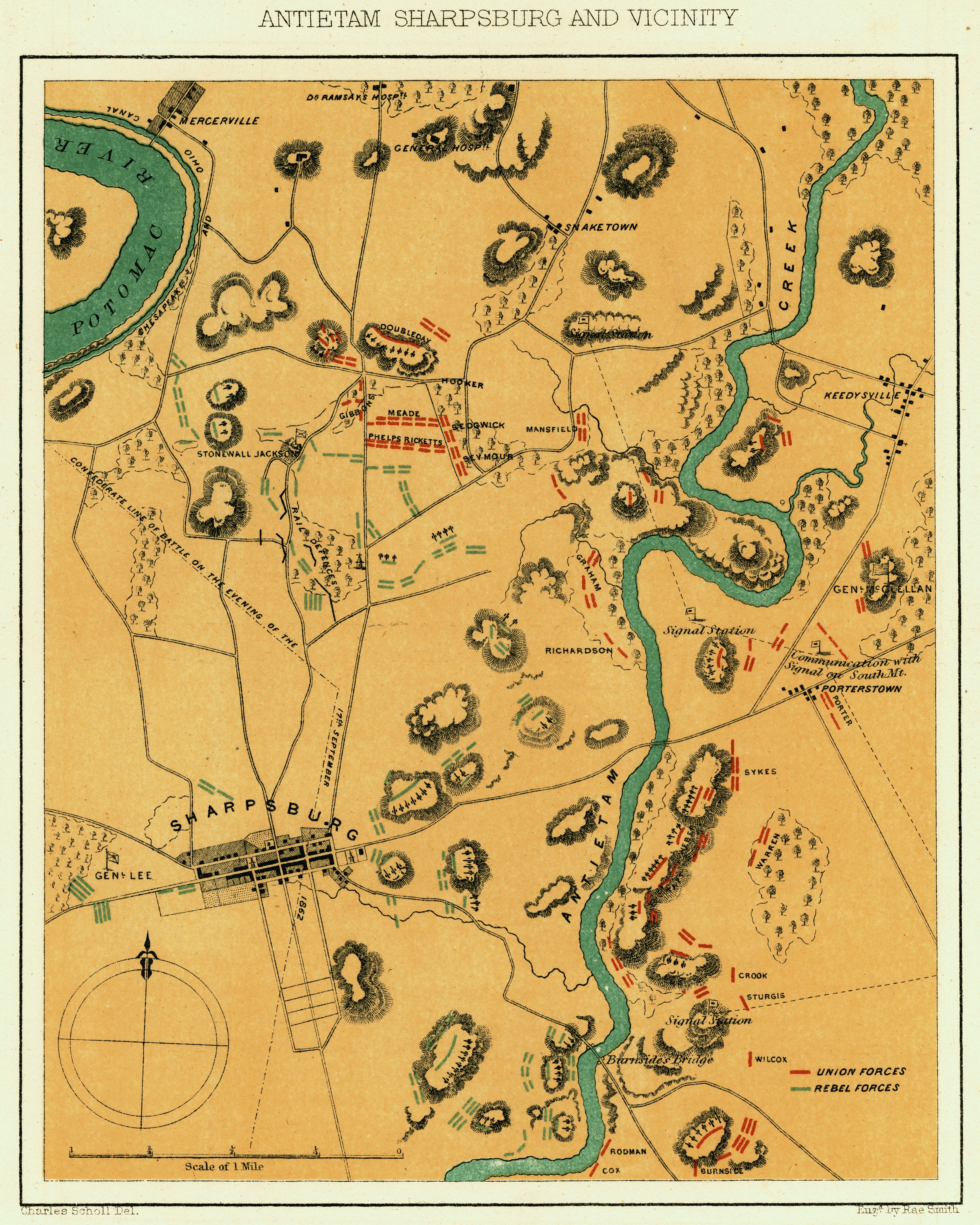
The battle unfolded across three distinct killing grounds: the Cornfield in the north, the Sunken Road at the centre, and Burnside Bridge to the south. Each phase was, in its own right, a catastrophe. Yet when the guns finally fell silent, both armies were still standing. Antietam ended in a tactical stalemate — and that stalemate would reshape the entire Civil War.
Robert E. Lee's Gamble: The Road to Maryland
In late August 1862, Confederate General Robert E. Lee was riding a wave of momentum. His Army of Northern Virginia had just delivered a crushing blow to Union forces at Second Bull Run on 29–30 August, and Lee chose to press that advantage by marching north into Maryland on 4 September.
His goals were ambitious. He wanted to relieve war-ravaged Virginia of the burden of supporting his army, to encourage Maryland — a slave state that had stayed in the Union — to join the Confederacy, and, crucially, to convince Britain and France to grant the Confederate States diplomatic recognition. A major victory on Northern soil might achieve all three.
Lee split his 45,000-strong force, sending General Thomas "Stonewall" Jackson to seize the Union garrison at Harpers Ferry, which fell on 15 September with 12,500 prisoners — the largest surrender of U.S. troops until Bataan in 1942. Then came the stroke of luck that should have ended Lee's campaign before it truly began.
On 13 September, Union soldiers near Frederick, Maryland found a copy of Lee's operational orders — Special Order 191 — wrapped around three cigars in a field. Union General George B. McClellan now held his opponent's exact battle plan. "Here is a paper with which, if I cannot whip Bobbie Lee, I will be willing to go home," McClellan reportedly told an aide. But McClellan was McClellan. He delayed his advance by nearly eighteen hours, giving Lee just enough time to concentrate his scattered divisions near the small town of Sharpsburg.
The Armies Face Each Other: Sharpsburg, 16 September
Lee chose his ground carefully — and dangerously. He positioned his 38,000 men along a four-mile defensive line west of Antietam Creek, with the Potomac River directly behind him. There was almost no viable line of retreat. Lee was betting everything on holding his position.
McClellan's Army of the Potomac numbered roughly 75,000 men — nearly double Lee's force — yet McClellan would never fully exploit that advantage. He planned a three-pronged attack: Major General Joseph Hooker's I Corps would strike the Confederate left at dawn, followed by hammer blows at the centre and south. It was a sound plan on paper, but coordination would prove elusive.
The landscape itself shaped the violence to come. Rolling farmland, a sunken farm road worn deep by decades of wagon traffic, a narrow stone bridge over Antietam Creek, and David Miller's 30-acre cornfield would each become synonymous with catastrophe. Both sides spent the night of 16 September in grim anticipation, Confederate troops listening to the distant thunder of Union artillery registering its targets in the darkness.
The Cornfield: Dawn's Slaughter on the Northern Flank
At 5:30 a.m. on 17 September, Hooker's corps advanced into Miller's Cornfield under heavy Confederate artillery fire. The corn stood shoulder-high, concealing thousands of men until they were almost on top of each other. The field changed hands at least fifteen times during the day.
Confederate General John Bell Hood launched a ferocious counterattack that briefly drove the Union forces back in disarray. When asked later where his division was, Hood replied with grim simplicity: "Dead on the field." Brigadier General Abner Doubleday's division suffered over 30 per cent casualties in under an hour. Major General Joseph Mansfield, commanding the Union XII Corps, was mortally wounded leading his men into the fight at around 7:30 a.m.
By 9 a.m., roughly 8,000 men had become casualties in the northern sector alone. One Union soldier later described the cornfield as resembling "a mown meadow of human bodies." The phrase captures something no casualty figure alone can convey.
Bloody Lane: The Sunken Road Becomes a Trench of Death
As the fighting in the Cornfield ground toward exhaustion, the battle shifted to the centre. Confederate troops under General D.H. Hill had occupied a farm lane worn so deeply into the earth by generations of wagon wheels that it formed a natural trench, roughly four feet deep. From behind this ready-made fortification, they could fire almost with impunity.
From approximately 9:30 a.m., Union brigades under Generals William French and Israel Richardson launched repeated frontal assaults across open ground into the face of that withering fire. For nearly four hours, men fell in waves and the Union line could not break through. Then a miscommunicated order caused a Confederate regiment to inadvertently expose the entire flank of the position. Union troops poured flanking fire the length of the lane.
When Union soldiers finally overran the position at around 1 p.m., the Sunken Road was filled so completely with Confederate dead that it was renamed Bloody Lane almost on the spot — a name it carries to this day. Among the Union units that charged it was the Irish Brigade, largely composed of Irish immigrants serving in the 63rd, 69th, and 88th New York regiments. They went in reciting Catholic prayers. The three regiments lost over 500 men in minutes.
Burnside Bridge: A Crossing That Came Too Late
On the Confederate right, Union General Ambrose Burnside faced what should have been a straightforward assignment: cross a narrow stone bridge over Antietam Creek and strike Lee's vulnerable flank. What followed was one of the most frustrating episodes of the entire battle.
Just 400 Georgia sharpshooters under Brigadier General Robert Toombs held that 125-foot bridge for nearly three hours against repeated assaults by forces that vastly outnumbered them. The approach to the bridge funnelled attackers into a murderously narrow front. Burnside's 12,500 men finally seized the crossing at around 1 p.m. — and then spent two more hours reorganising and resupplying ammunition.
By 3:30 p.m., Burnside's corps was finally advancing and threatening to cut off Lee's only route of retreat to the Potomac ford. The Confederate army was saved at the last possible moment by the arrival of General A.P. Hill's division, which had marched 17 miles from Harpers Ferry in under eight hours. Hill's men struck Burnside's exposed flank just before dark and halted the Union advance. The battle was over.
The Men Behind the Battle: Leaders and Ordinary Soldiers
George B. McClellan — just 35 years old and beloved by his troops as "Little Mac" — held approximately 20,000 men in reserve throughout the battle and never delivered the killing blow that Lee's battered lines invited. His caution would cost him his command two months later.
Robert E. Lee, by contrast, personally directed his defence from near Sharpsburg's main street, calm under pressure that would have broken lesser commanders, fully aware that the destruction of his army and the Confederate cause were separated by a very thin margin.
Clara Barton — who would later found the American Red Cross — arrived at Antietam with a wagon of medical supplies and worked under fire among the wounded near the Cornfield, earning the nickname "Angel of the Battlefield." Sergeant William McKinley, the future 25th President of the United States, served as a commissary sergeant that day, driving a mule-drawn wagon of hot food to troops under fire along Bloody Lane.
Private soldiers on both sides wrote letters home describing the same overwhelming sensory experience: the shriek of incoming artillery, the acrid smell of black powder, and the eerie, ringing silence after the guns finally stopped.
The Emancipation Proclamation: Antietam's Greatest Consequence
Abraham Lincoln had drafted his Emancipation Proclamation months earlier, but his Secretary of State, William Seward, had counselled him to wait for a Union military victory before issuing it. Without one, it would look like the desperate act of a losing government. Antietam gave Lincoln what he needed.
Although the battle was technically a tactical draw, Lee's retreat back into Virginia allowed Lincoln to frame it as a strategic Union victory. On 22 September 1862 — just five days after the fighting — Lincoln issued the Preliminary Emancipation Proclamation, declaring that all enslaved people in Confederate states in rebellion would be legally free from 1 January 1863.
The proclamation fundamentally transformed the war's character. It was now explicitly a war to end slavery, which made it politically impossible for Britain or France — both of which had abolished slavery and faced strong domestic abolitionist sentiment — to extend diplomatic recognition to the Confederacy. The Confederate strategy of winning through European intervention died at Antietam. Historians broadly regard the battle as the moment that sealed the Confederacy's diplomatic isolation and, with it, its ultimate fate.
The Battlefield Today: Remembering the Fallen
Antietam National Battlefield near Sharpsburg, Maryland is among the best-preserved Civil War sites in the United States. The Cornfield, Bloody Lane, and Burnside Bridge are all accessible, their silence now carrying the full weight of what happened there.
The Antietam National Cemetery, established in 1865, holds the remains of 4,776 Union soldiers. Confederate dead were initially buried in mass graves on the battlefield and later reinterred in cemeteries in Hagerstown and Frederick, Maryland. Each September, hundreds of luminaries — one for each soldier killed — are lit across the fields in a moving annual memorial.
Alexander Gardner's photographs, taken on 19–20 September 1862 and displayed in a New York gallery, were among the first war photographs ever widely seen by the American public. They brought the reality of industrialised killing home to civilians with brutal clarity, changing forever how Americans understood what their war actually meant.
Antietam endures as proof that a single day of catastrophic violence can alter the trajectory of history — not just for a nation, but for millions of people whose freedom hung in the balance of those twelve terrible hours in a Maryland cornfield.
If this story moved you, share it with someone who loves history — and tell us in the comments: which part of the Battle of Antietam did you find most striking? We read every response.
Further Reading
- Antietam National Battlefield — National Park Service
- National Archives and Records Administration (NARA) — Civil War Records
- Library of Congress — Civil War Photographs Collection (including Alexander Gardner)
- Smithsonian National Museum of American History — Civil War collections
- American Battlefield Trust — Antietam resources and preservation campaigns