The Quiz Question
During the September 23, 1779 battle against HMS Serapis off Flamborough Head, which American captain refused a British demand to surrender, in words later immortalized as 'I have not yet begun to fight'?
- A. John Paul Jones
- B. John Barry
- C. Esek Hopkins
- D. Silas Talbot
The answer is A. John Paul Jones. Here is the full story.
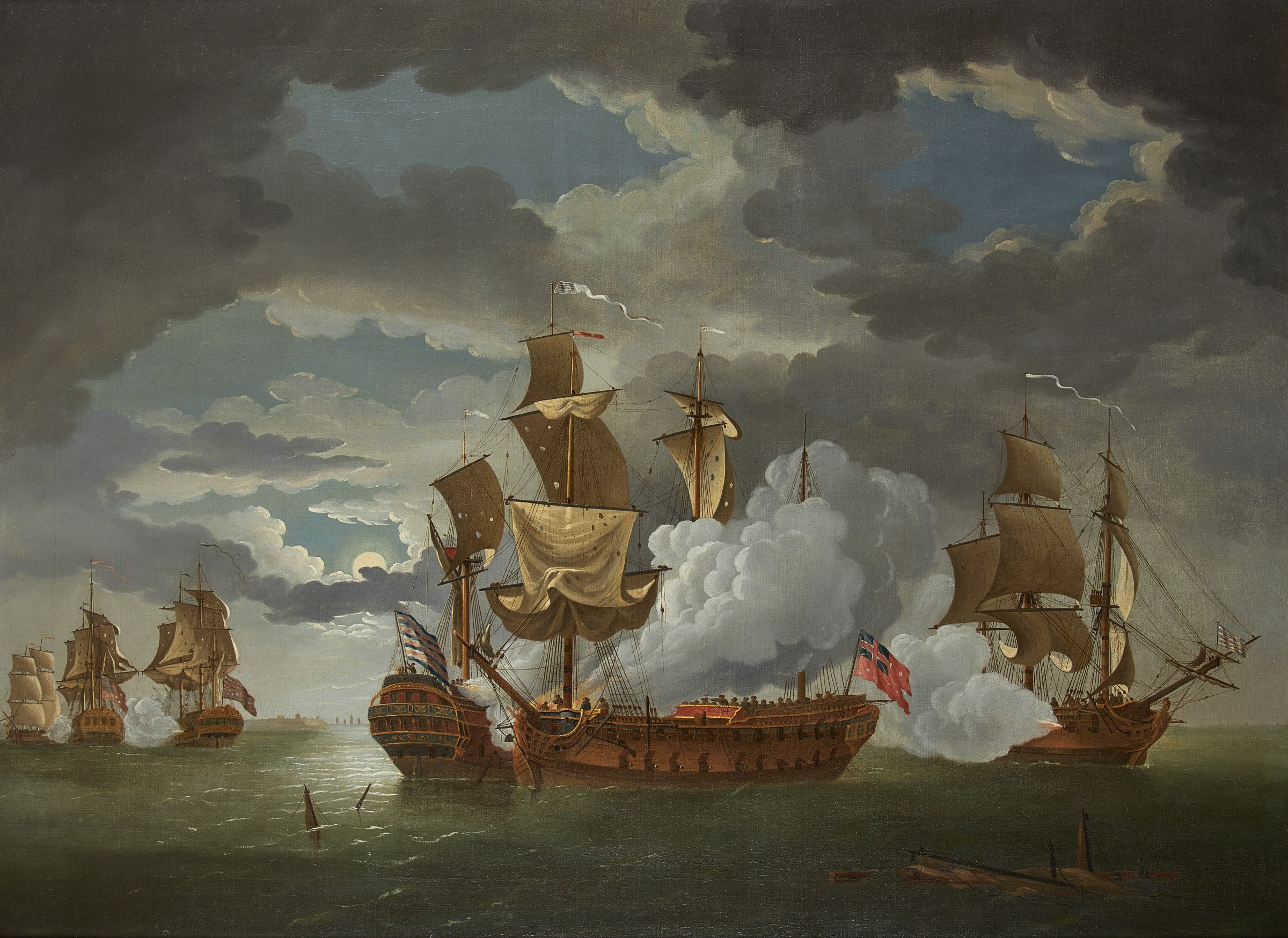
On the evening of 23 September 1779, the cliffs of Flamborough Head on the Yorkshire coast were crowded with spectators. Farmers, fishermen, and townspeople had gathered in the moonlight to watch something extraordinary unfolding on the North Sea below: two ships tearing each other apart in a battle that would last three and a half brutal hours and produce one of the most celebrated quotes in American military history.
The Night the Sea Turned to Fire off Yorkshire
The two vessels at the centre of that inferno were the American Bonhomme Richard and the British Royal Navy frigate HMS Serapis. By the time the guns fell silent, both ships were ablaze, hundreds of men lay dead or dying, and the outcome was a paradox that defied easy explanation: the winning ship was sinking, and the losing ship had surrendered.
At the heart of it all stood Captain John Paul Jones — Scottish-born, ferociously ambitious, and absolutely unwilling to lower his flag without a fight. The words he reportedly hurled back at his British adversary that night would echo through American naval history for the next two and a half centuries.
Who Was John Paul Jones? The Scotsman Who Became America's First Naval Hero
He was born simply John Paul on 6 July 1747 in Kirkbean, Galloway, on the southwest coast of Scotland — the son of a gardener, with no obvious path to greatness. He went to sea at thirteen, beginning a maritime apprenticeship in Whitehaven, Cumbria, and later sailed on vessels involved in the Atlantic slave trade, a chapter of his life he would quietly distance himself from in later years.
Around 1773, while in Tobago, he killed a sailor during what he maintained was an act of self-defence after a mutinous confrontation. To avoid prosecution, he fled to colonial Virginia and added "Jones" to his name — effectively reinventing himself entirely. It was a pivotal moment: John Paul the Scottish mariner became John Paul Jones, American revolutionary.
When the Revolutionary War broke out in 1775, Jones secured a commission as First Lieutenant in the newly formed Continental Navy. His rise was rapid and his instincts were aggressive. By 1778 he was audaciously raiding British home ports, including a daring incursion into Whitehaven itself — the very harbour where he had learned to sail — spiking cannons and setting fire to a coal ship, causing outrage across Britain.
The French, now formally allied with the American cause, were impressed. They gave Jones command of a converted French merchant vessel. He renamed her Bonhomme Richard — a tribute to Benjamin Franklin's Poor Richard's Almanack, a gesture that endeared him to Franklin, then serving as American Minister to France.
The Ships: A Battered Merchant Vessel vs a Royal Navy Frigate
Bonhomme Richard was originally built in 1765 as Duc de Duras, a French East Indiaman. By 1779 she was ageing, slow, and re-armed with a mismatched battery of 40 guns of varying calibre. Her most dangerous weakness sat on her lower gun deck: six old 18-pounder cannons that were so unreliable they were considered a serious hazard even before the battle began.
HMS Serapis, by contrast, was everything Bonhomme Richard was not. Launched in 1779, she was a brand-new, purpose-built Royal Navy 44-gun copper-bottomed frigate — fast, powerful, and crewed by trained professionals. Her commander, Captain Richard Pearson, was an experienced Royal Navy officer with a clear and important mission: safely escort a convoy of 41 merchant vessels carrying vital Baltic naval stores southward to British ports.
Jones commanded a small squadron including the American frigate Alliance, plus the Pallas and the Vengeance. On paper it looked like a reasonable fighting force. In practice, the coordination between those ships would prove catastrophic — with consequences that nearly cost Jones his life.
The Battle Begins: Everything Goes Wrong for Jones
At around 7:15 pm on 23 September 1779, Jones intercepted Serapis and her convoy in the waters off Flamborough Head, roughly 25 miles from the Yorkshire coast. The two ships exchanged formal identifications, and then the guns opened up.
Almost immediately, disaster struck. Two of Bonhomme Richard's old 18-pounders exploded on the lower gun deck, killing their crews instantly and blowing out sections of the hull. Within minutes of the battle's opening, Jones had lost his most powerful guns — the very weapons he needed to punch through Serapis's sturdy hull at a distance.
Serapis's superior gunnery was relentless. Her disciplined gun crews tore into Bonhomme Richard below the waterline; the American ship began taking on water and burning in multiple locations within the first hour. Seeing the carnage through the smoke, Captain Pearson hailed Jones across the water, asking whether he had struck his colours — the formal question of surrender.
Jones's reply became immortal. The exact words are genuinely disputed among historians — contemporary accounts differ significantly — but the version later popularised by the naval historian Samuel Eliot Morison, and now embedded in American folklore, is: "I have not yet begun to fight." Whatever the precise phrasing, the meaning was unmistakable: Jones was not done.
Lashing the Ships Together: Jones Changes the Rules
Outgunned at a distance, Jones made the one tactical decision that could still win him the battle. He ordered Bonhomme Richard brought directly alongside Serapis and the two ships lashed together with grappling hooks and ropes. If he couldn't out-shoot the British ship, he would make it impossible for her to manoeuvre away from him.
By roughly 8:00 pm, the two vessels were bound together so tightly that their gun barrels were almost touching. The naval engagement transformed into something resembling a medieval boarding action, fought at point-blank range in smoke and firelight while thousands of people watched from the cliffs above.
American and French Marine sharpshooters in Bonhomme Richard's rigging picked off British gun crews on Serapis's exposed upper decks with devastating effect, gradually silencing her topside resistance. Then came a moment that turned the battle decisively: a sailor crawled out along a yard arm suspended over the enemy ship and dropped hand grenades through an open hatch, triggering a catastrophic explosion below decks that killed or wounded nearly 20 British sailors in an instant.
Then came the episode that still provokes debate among historians. The American frigate Alliance, under the erratic command of Captain Pierre Landais, fired three separate broadsides — not into Serapis, but into Bonhomme Richard. American sailors died from American shot. Whether Landais was confused in the darkness, acting out of personal animosity toward Jones, or simply incompetent has never been definitively resolved. Jones was furious.
Serapis Surrenders — As Her Conqueror Sinks
By 10:30 pm, Captain Pearson had reached the limit of what his crew could endure. His lower decks were devastated, the grenade explosion had wrecked his remaining gunners, and there was no prospect of rescue or relief. He struck his colours — physically lowering the British flag — the formal and humiliating act of surrender.
Pearson later wrote that he surrendered only when his ship was "rendered incapable of further resistance." It was not cowardice. Serapis had fought hard for over three hours against an opponent who simply refused to stop fighting regardless of the cost.
The victory, however, was bittersweet almost immediately. Bonhomme Richard was beyond saving. Water was pouring in through her shattered hull, and fires still burned below decks. Jones was forced to transfer his flag from his sinking ship to the captured Serapis — a moment both triumphant and bitterly ironic. On 25 September 1779, two days after the battle, Bonhomme Richard slipped beneath the North Sea, taking an unknown number of her dead with her.
The human cost on both sides was appalling. Bonhomme Richard suffered approximately 150 killed and wounded from a crew of around 322. HMS Serapis lost roughly 117 killed and wounded from a crew of approximately 325. In a single night, nearly a third of the men on both ships had been killed or maimed.
The Aftermath: Heroes, Courts Martial, and Controversy
Jones sailed the prize Serapis to the neutral Dutch port of Texel, immediately sparking a diplomatic crisis. Britain furiously demanded the Netherlands hand over Jones as a pirate. The Dutch, reluctant to antagonise either side, eventually declined — but the incident strained Dutch-British relations at a sensitive moment in the wider war.
Back in Britain, Captain Pearson faced the standard court martial required after any surrender. He was honourably acquitted and, remarkably, knighted for his conduct. Jones's wry reported response was characteristically sharp: if Pearson had been knighted for losing, Jones said, he would make him a lord if they ever met again.
In France, Jones was treated as a conquering hero. King Louis XVI awarded him a gold sword and the Order of Military Merit. He was feted at Versailles and celebrated across the French court — a very different reception to the suspicion and political intrigue he encountered back in America.
Captain Landais of the Alliance was relieved of command and court-martialled. Benjamin Franklin, managing the diplomatic fallout from Paris, was deeply involved in the messy political aftermath. And in a grim strategic footnote, the 41 merchant vessels in the Baltic convoy — the ships Serapis had died protecting — reached their destination safely. Britain's naval supply chain remained uninterrupted, despite the sacrifice of her frigate.
John Paul Jones: The Later Years and a Forgotten Grave
The end of the Revolutionary War left Jones adrift. The young American republic had little appetite for a permanent navy, and the man who had risked everything for the cause found himself without a meaningful command. He grew increasingly frustrated, lobbying for recognition and employment that never fully materialised.
In 1788 he accepted a commission as a Rear Admiral in the Imperial Russian Navy under Empress Catherine the Great, commanding ships against the Ottoman Empire in the Black Sea. The campaign brought him mixed results and considerable controversy — accusations of personal misconduct in St Petersburg, later disputed, effectively ended his Russian career.
He retired to Paris in broken health and died there on 18 July 1792, aged just 45. He was buried in a lead-lined coffin in a small Paris cemetery reserved for foreign Protestants. As the city grew and changed around it, the cemetery was built over, and his grave was lost entirely.
For 113 years, the Father of the American Navy lay in an unmarked location beneath a Paris street. Then, in 1905, American Ambassador General Horace Porter launched a determined search and identified Jones's remarkably well-preserved remains. President Theodore Roosevelt dispatched four US Navy cruisers to escort the body home. Jones now lies in a magnificent marble sarcophagus beneath the chapel of the United States Naval Academy in Annapolis, Maryland — the honour that came more than a century too late.
Why Flamborough Head Still Matters: Legacy of the Battle
The Battle of Flamborough Head is recognised as the foundational moment of the United States Navy. Jones is officially honoured as "the Father of the American Navy," and his portrait and story are woven into the institutional identity of the US Naval Academy to this day.
His refusal to surrender — whatever his exact words — established an ethos of offensive defiance that the US Navy consciously cultivated for generations. The quote appeared on wartime posters, was reproduced on naval vessels, and became a touchstone of American patriotic literature throughout the 19th and 20th centuries.
For British historians, Flamborough Head is a useful corrective to any narrow view of the American Revolutionary War. The conflict was not confined to the fields and forests of the American colonies — it raged in the North Sea, the English Channel, and the Caribbean, and it touched the lives of ordinary people watching from Yorkshire clifftops on a September night in 1779.
The wreck of Bonhomme Richard has never been definitively located. Several North Sea search expeditions, including a significant effort in the 2000s using sonar technology, have narrowed the possible search area but produced no confirmed discovery. She remains lost — as dramatic an ending to her story as the battle itself.
If you found John Paul Jones's story as remarkable as we do, we'd love to hear your thoughts in the comments below. And if you know someone who loves the history of the Age of Sail or the American Revolution, share this article with them — these are stories that deserve to be remembered.
Further reading
- United States Naval Academy Museum, Annapolis, Maryland
- The National Maritime Museum, Greenwich, London
- The Library of Congress, Washington D.C. (American Revolutionary War collections)
- The National Archives, Kew, London (Royal Navy records and courts martial)
- The Smithsonian National Museum of American History, Washington D.C.