The Quiz Question
Which under-strength US Army unit, hastily deployed from occupation duty in Japan, fought the first American ground engagement of the Korean War near Osan in July 1950 and was quickly overwhelmed by North Korean tanks?
- A. Task Force Smith
- B. Task Force Faith
- C. Task Force Kean
- D. Task Force Baker
The answer is A. Task Force Smith. Here is the full story.
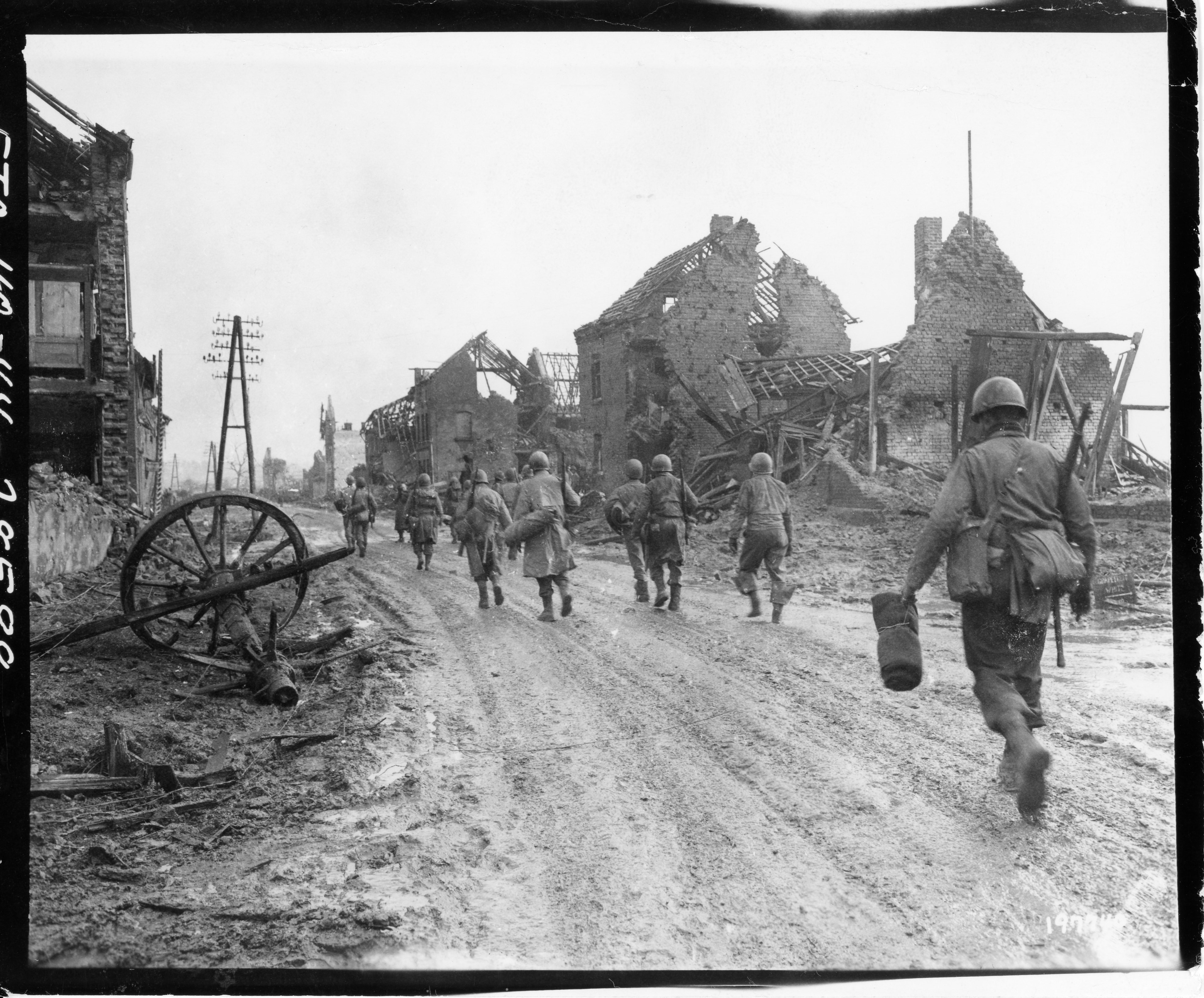
On the morning of July 5, 1950, a small group of American soldiers crouched in water-logged foxholes on a muddy ridge north of Osan, South Korea. They were outnumbered, outgunned, and about to face one of the most powerful armoured forces in Asia. What happened next shocked the United States Army to its core — and sent reverberations through American military doctrine that are still felt today.
A Rude Awakening: America's First Fight in Korea
Task Force Smith took its name from its commanding officer, Lieutenant Colonel Charles "Brad" Smith — a decorated World War II veteran who had been at Pearl Harbor on December 7, 1941, and had fought across the Pacific. He was experienced, capable, and professional. None of that would be enough.
The unit was drawn from the 1st Battalion, 21st Infantry Regiment, 24th Infantry Division — soldiers who had spent their recent months enjoying the relative comfort of occupation duty in Japan. Training had drifted. Readiness had eroded. And now, just ten days after North Korea launched its invasion of the South, these men were being rushed into combat.
Many were teenagers or barely into their twenties. Some had never fired a weapon in anger. Several had joined the Army expecting peacetime service and a steady paycheck. The engagement near Osan became a defining shock — not just for the men who fought it, but for an entire military establishment that had grown dangerously complacent since 1945.
From Victory to Complacency: The US Army in Occupied Japan
After Japan's surrender in August 1945, the US military pivoted rapidly from war-fighting to occupation. Units like the 24th Infantry Division, based at Camp Wood in Kumamoto, Japan, took on administrative, policing, and reconstruction roles. Soldiering, in the traditional sense, took a back seat.
The division was chronically under-strength — often operating at just 60 to 70 percent of authorised manpower. President Truman's post-war austerity drive had slashed the defence budget, leaving units short of men, equipment, spare parts, and modern weaponry. The Army that had crushed Nazi Germany and Imperial Japan was being quietly hollowed out.
Training had become lax in ways that would prove deadly. Live-fire exercises were rare. Physical standards had slipped. Anti-tank training was almost non-existent, even as Soviet T-34 tanks were proliferating across client states in Asia and Eastern Europe. General Douglas MacArthur, Supreme Commander of Allied Powers in Japan, would later face pointed criticism for allowing his occupation forces to deteriorate so badly.
North Korea Strikes: The Crisis That Demanded an Instant Response
At 4:00 a.m. on June 25, 1950, approximately 75,000 troops of the North Korean People's Army (NKPA) crossed the 38th Parallel in force, supported by around 150 Soviet-built T-34 tanks. The Republic of Korea (ROK) Army, poorly armed and caught off guard, crumbled within hours.
Seoul, South Korea's capital, fell on June 28 — just three days after the invasion began. The speed of the collapse was staggering. President Truman, acutely aware of the geopolitical stakes following the Communist takeover of China in 1949, committed US forces on June 27 without a formal declaration of war, framing the intervention as a "police action" under United Nations authority.
MacArthur flew to Korea on June 29 and witnessed the rout of ROK forces near the Han River first-hand. He immediately requested ground troops. The strategic thinking was dangerously optimistic: rush American soldiers to the front as quickly as possible, demonstrate resolve, buy time for reinforcements, and — it was hoped — bluff the North Koreans into halting their advance. It was a gamble built on assumptions that were about to be violently disproved.
Assembling Task Force Smith: Speed Over Strength
At 3:00 a.m. on July 1, 1950, Lieutenant Colonel Smith received his orders. He was to take the first available troops to Korea and delay the North Korean advance "as long as possible." The urgency was absolute; the resources were not.
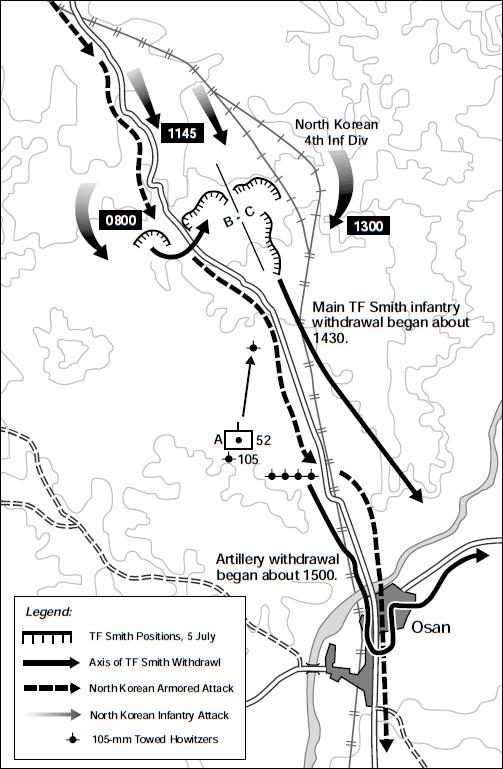
Smith's force numbered approximately 540 men: two rifle companies (B and C), a headquarters element, and a battery of artillery from the 52nd Field Artillery Battalion under Lieutenant Colonel Miller O. Perry. The artillery consisted of six 105mm howitzers — a solid weapon in conventional terms, but critically short on the one round that mattered most in this fight.
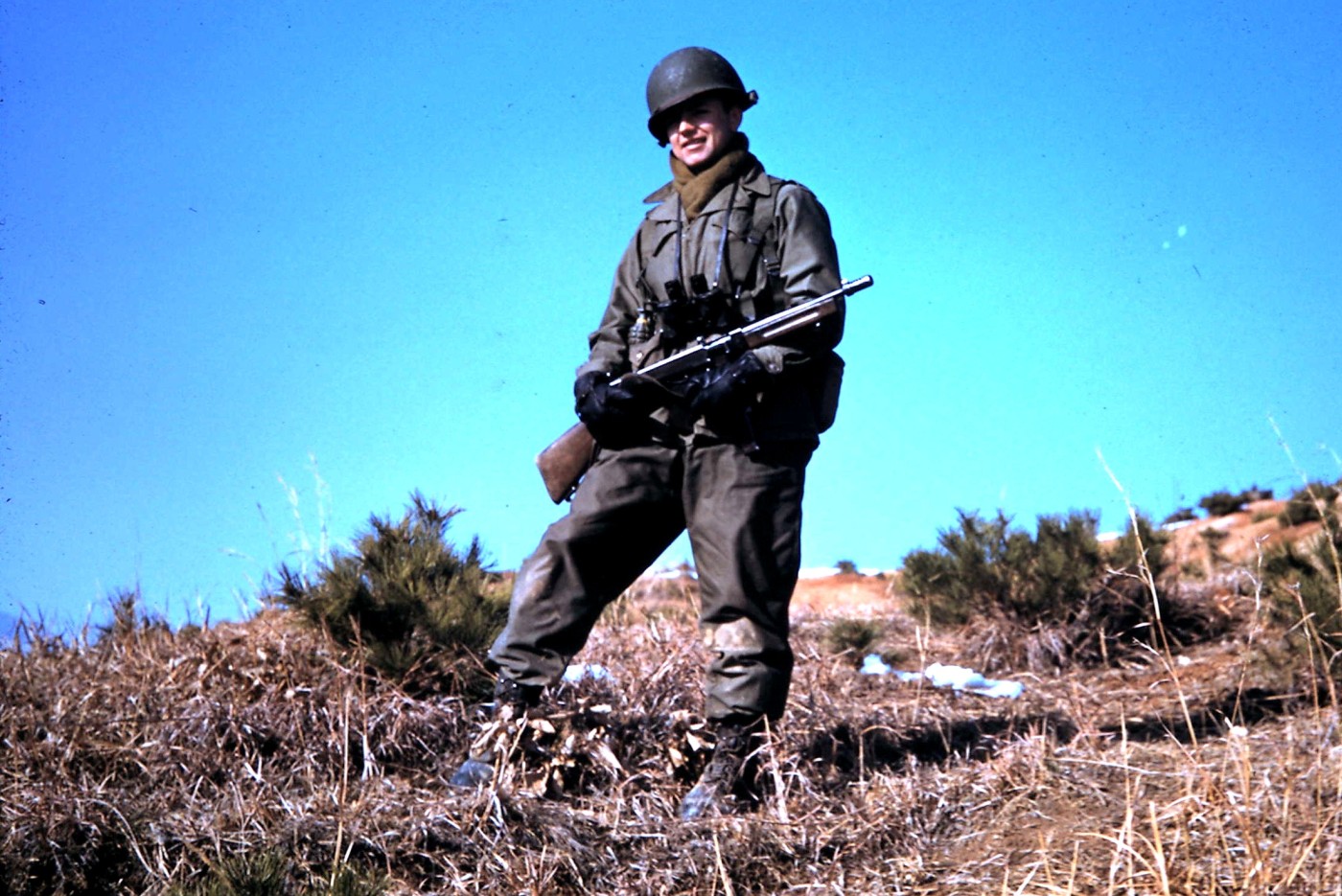
Only a handful of High Explosive Anti-Tank (HEAT) rounds were available — just six per gun. The rest of the ammunition was standard high explosive, largely ineffective against armour. The infantrymen carried M1 Garand rifles, .30-calibre machine guns, 60mm and 81mm mortars, and 2.36-inch bazookas — a weapon already proven inadequate against Soviet-era armour during World War II. Nobody had replaced it with something better.
The force was airlifted to Pusan on July 1 and 2, then moved north by rail toward Taejon before continuing by road in driving monsoon rain. They reached their position north of Osan on the evening of July 4 — exhausted, soaked, and about to spend a sleepless night preparing their defence.
The Battle of Osan: 5 July 1950
Smith positioned his men on a low ridge straddling Route 1, the main road running south from Seoul, approximately three miles north of Osan. It was a sound tactical choice — high ground commanding the road, with Perry's artillery set up a mile to the rear. On paper, it was a defensible blocking position. In practice, it was 540 men trying to stop an army.
At approximately 7:00 a.m., through the mist and rain, a column of 33 North Korean T-34 tanks appeared, rolling south in steady formation with no infantry support initially visible. The artillery opened fire with the precious HEAT rounds. Some struck the tanks squarely. They did not penetrate. The revelation was devastating — American anti-tank ammunition could not kill the T-34 at combat range.
Infantry soldiers fired 2.36-inch bazooka rounds at near point-blank range as the tanks reached the ridge. The rockets bounced off the armour plating. The T-34s rolled directly through the American position, machine-gunning foxholes as they passed, then continued south toward the artillery. Perry's gun crews fought back at close range, managing to disable two tanks and destroy two more with direct fire — a moment of genuine heroism under impossible circumstances — before the armoured column rolled past.
Then came the infantry. An estimated 5,000 soldiers from the NKPA's 4th Infantry Division followed the tanks, flanking Smith's position from multiple directions simultaneously. What had been a blocking position became an encirclement. Within hours, Task Force Smith was fighting not to delay the enemy but simply to survive.
Collapse and Retreat: The Human Cost
By early afternoon, with ammunition nearly exhausted and casualties mounting rapidly, Smith ordered a withdrawal. In the chaos of a broken perimeter under fire, the withdrawal became a rout — every man scrambling south across rice paddies, hills, and unfamiliar terrain in monsoon rain, with NKPA troops pressing from multiple directions.
The artillery had to be abandoned. Gun crews spiked what they could, but four of the six howitzers were left behind along with vehicles, supplies, and equipment — a painful material loss compounding the human one. Task Force Smith suffered approximately 180 casualties in a single day: around 60 killed in action, 21 wounded, and more than 80 taken prisoner. That was roughly one-third of the entire force.
Some men evaded capture for days, wandering through unfamiliar countryside without maps, food, or dry clothing. Others were killed while attempting to withdraw. The treatment of American prisoners by NKPA forces during this period was brutal — accounts gathered later by the US Army documented summary executions of wounded and surrendered soldiers in the opening weeks of the war.
Lieutenant Colonel Smith eventually reassembled scattered survivors near Taejon. His force had delayed the North Korean advance by only a matter of hours — not the days that MacArthur's headquarters had counted on.
The Men Behind the Mission: Smith, Perry, and Their Soldiers
Charles Bradford Smith, a West Point graduate from the class of 1939, was by any fair assessment handed an impossible task. He later said the battle haunted him for the rest of his life — particularly the memory of young men who trusted his orders and paid with their lives for a policy failure that originated far above his rank. His candour in later years helped shape the Army's honest reckoning with what had gone wrong.
Lieutenant Colonel Miller O. Perry was awarded the Distinguished Service Cross for his conduct during the battle. He continued fighting alongside the battered 24th Division through weeks of subsequent delaying actions — a sustained display of leadership under conditions of persistent crisis.
The enlisted men — most of them 18 to 20 years old, many of them draftees or volunteers expecting peacetime service — showed remarkable composure and courage given what they faced. Their bravery was real. Their preparation was not adequate to the task they were given, through no fault of their own.
Aftermath: The 'Bug-Out' Summer and the Pusan Perimeter
Osan set the pattern for six weeks of punishing retreat. The 24th Infantry Division and other hastily committed US units fought costly delaying actions across the Korean peninsula through July and August 1950 as the NKPA drove relentlessly south. Taejon fell on July 20. Major General William F. Dean, the 24th Division's commanding general, was captured during the city's fall — becoming the highest-ranking American prisoner of war of the entire Korean War.
By early August, US and ROK forces had been compressed into a small defensive perimeter around the port city of Pusan in the south-eastern corner of the peninsula. The "Pusan Perimeter" held — barely — through weeks of ferocious fighting. The Army rushed the 3.5-inch "Super Bazooka" to Korea as an emergency replacement for the useless 2.36-inch weapon. It could penetrate the T-34. Its late arrival underscored every procurement failure that Osan had exposed.
General MacArthur's amphibious landing at Inchon on September 15, 1950 dramatically reversed the course of the war, cutting NKPA supply lines and forcing a general retreat. But the bloody summer of 1950 — the "Bug-Out" summer, as soldiers grimly called it — left a permanent scar on the US Army's institutional memory.
Legacy: What Task Force Smith Taught the US Military
"Task Force Smith" has been a watchword in US Army doctrine and military education ever since. It is used in staff colleges and officer training programmes as a vivid, painful case study in the consequences of deploying under-prepared, under-equipped forces on the optimistic assumption that American resolve alone will deter a determined enemy. The lesson has had to be relearned more than once.
The engagement exposed failures at every level: post-war budget cuts that gutted readiness, training standards that had been allowed to collapse, equipment that had not kept pace with the evolving Soviet threat, and an intelligence picture that catastrophically underestimated NKPA armoured strength. None of those failures originated with the men on the ridge.
The Korean War claimed over 36,000 American lives in combat — a conflict sometimes called "The Forgotten War" precisely because it was overshadowed by World War II before it and Vietnam after it. Task Force Smith's stand on July 5, 1950 was its bloody opening chapter. The reforms that followed — investment in anti-armour weapons, rigorous training standards, force readiness programmes — shaped US Army and NATO strategy throughout the Cold War. They were bought at a terrible price.
A memorial to Task Force Smith stands today near Osan, South Korea. It is a quiet acknowledgement of young men sent to stop an army with whatever was at hand — and who fought with a courage that their equipment and preparation never deserved to demand of them.
If this story of sacrifice, unpreparedness, and hard-won lessons resonates with you, share it with a fellow history enthusiast or leave a comment below. These are the stories that deserve to be remembered — not just in military colleges, but by all of us.
Further Reading
- US Army Center of Military History — Washington, D.C.
- National Archives and Records Administration (NARA) — College Park, Maryland
- Korean War Veterans Memorial Foundation — Washington, D.C.
- National Museum of the United States Army — Fort Belvoir, Virginia
- MacArthur Memorial Archives and Library — Norfolk, Virginia