The Quiz Question
At the Battle of Buena Vista in February 1847, which U.S. general, outnumbered roughly three-to-one, refused Santa Anna's surrender demand and held the field, a victory that helped make him president?
- A. Zachary Taylor
- B. Winfield Scott
- C. Stephen Kearny
- D. John Wool
The answer is A. Zachary Taylor. Here is the full story.
On the morning of February 22, 1847 — George Washington's birthday, as it happened — a messenger rode under a flag of truce into the American camp at a narrow mountain pass in northern Mexico. He carried a written demand from General Antonio López de Santa Anna: surrender immediately, or face total destruction. The American commander's reply, delivered through his adjutant and accompanied by his own rather more colourful verbal commentary, amounted to a flat refusal. What followed over the next two days would become one of the most dramatic stands in American military history — and launch a rough-hewn old soldier toward the White House.
A General Who Refused to Blink: February 22–23, 1847
The Hacienda de Buena Vista and the narrow defile of Angostura, tucked into the Sierra Madre foothills south of Saltillo, seem an unlikely stage for a pivotal moment in American history. But geography made it perfect for a defender vastly outnumbered. Ravines and broken plateaus cut across the ground, squeezing the frontage any attacker could exploit.
Brigadier General Zachary Taylor commanded roughly 4,600 men — the majority of them raw, one-year volunteer regiments — against Santa Anna's professional army of approximately 15,000. The odds were somewhere around three to one. Taylor's adjutant, Brigadier General John Wool, drafted the formal written refusal to Santa Anna's surrender demand. Taylor's own verbal response to the Mexican messenger reportedly could not be printed in a family newspaper.
The battle raged across two brutal days. By the time the guns fell silent on the evening of February 23, Taylor still held the field. Within 18 months, he was President of the United States.
The Road to Buena Vista: How the Mexican-American War Began
The conflict had roots in the explosive politics of American expansion. The United States annexed Texas in 1845, a move Mexico refused to recognise, insisting the territory remained Mexican soil. When a disputed border skirmish along the Rio Grande provided the necessary spark, President James K. Polk asked Congress for a declaration of war in May 1846.
Taylor was already in theatre, and he moved quickly. He defeated Mexican forces at Palo Alto on May 8, 1846, and again at Resaca de la Palma on May 9 — two sharp victories that demonstrated American tactical competence and earned him early fame back home. By September 1846, after three days of brutal urban combat, he had captured the fortified city of Monterrey. The press took to calling him "Old Rough and Ready."
Then Washington undercut him. General Winfield Scott was given command of a new campaign aimed directly at Mexico City, and thousands of Taylor's best regular troops were transferred to Scott's force. Taylor was left holding northern Mexico with a skeleton army, stripped of his most experienced soldiers. It was a vulnerability Santa Anna was about to exploit.
Santa Anna: The Napoleon of the West Marches North
Antonio López de Santa Anna was one of the most complex and controversial figures in the history of the Western Hemisphere — soldier, politician, dictator, and survivor. He had crushed the Texan garrison at the Alamo in 1836 and had been fighting, scheming, and reinventing himself for decades by the time he assembled his army at San Luis Potosí in late 1846.
His intelligence was excellent: an intercepted letter revealed that Taylor's force had been gutted by troop transfers to Scott. Santa Anna saw an opportunity to destroy the weakened American army in the north and shifted his resources accordingly, mustering approximately 15,000 soldiers — cavalry, infantry, and artillery — into a formidable strike force.
The march north was itself a catastrophe in miniature. Roughly 300 miles of desert and mountain in the depths of a Mexican winter killed hundreds of men from cold, hunger, and thirst before a single shot was fired. The army that arrived at Buena Vista was exhausted and its supply lines were strained. Santa Anna pressed on anyway, supremely confident that Taylor's volunteers would break at the first serious blow.
Taylor's Army: Volunteers, Regulars, and Long Odds
Taylor's 4,600-man force was a patchwork force. Volunteer regiments from Illinois, Indiana, Kentucky, Mississippi, and Arkansas had enlisted in bursts of patriotic enthusiasm in 1846, but enthusiasm is not the same as training. Many had never been under fire. Against Santa Anna's hardened professionals, the disparity in experience was alarming.
His regular troops — the 1st and 2nd U.S. Artillery and small units of dragoons — were fewer in number but would prove decisive at critical moments. Among his volunteer units, the Mississippi Rifles stood out: an elite regiment commanded by Colonel Jefferson Davis, a West Point graduate and Mexican-American War veteran who would later serve as President of the Confederate States of America. History had not yet written that irony.
Taylor's greatest tactical asset was his artillery. American guns were lighter, faster to deploy, and served by better-trained crews than their Mexican counterparts. In the broken terrain of Angostura, where cavalry charges and massed infantry assaults could be channelled and punished, artillery would prove to be the great equaliser across both days of fighting.
Day One: February 22, 1847 — The Storm Gathers
Santa Anna's vanguard appeared on the afternoon of February 22. Almost immediately, he sent his formal surrender demand forward. Taylor's rejection — delivered with what his contemporaries described as characteristic bluntness — set the tone for what followed.
The afternoon brought probing skirmishes as Mexican cavalry tested the American left flank along the plateau. Taylor's men held the high ground but were spread dangerously thin across a wide frontage. The terrain helped, but it could not entirely compensate for the raw numbers pressing against them.
The night of February 22 was bitterly cold. Both armies camped within earshot of one another in the mountain pass, their fires flickering across the darkness. It was George Washington's birthday — a detail the American press would later work for every ounce of patriotic symbolism it was worth. Santa Anna spent those hours manoeuvring large infantry columns around the American left, preparing the hammer blow he intended to deliver at first light.
Day Two: February 23 — The Battle Reaches Its Crisis
At dawn, Santa Anna unleashed his assault. Thousands of Mexican infantry hit the American left with overwhelming force. The 2nd Indiana Volunteer Regiment, poorly positioned and caught by a sweeping flanking movement, broke and fled in near-panic. A dangerous gap opened in the American line. For a desperate hour or more, it genuinely appeared that the entire position might collapse.
Jefferson Davis responded with one of the battle's defining moments. He led the Mississippi Rifles in a bold flanking movement, joining with Indiana cavalry to form an oblique formation — later described as a V-shape — that concentrated fire on the surging Mexican columns with devastating effect. The advance was checked, but the pressure did not relent.
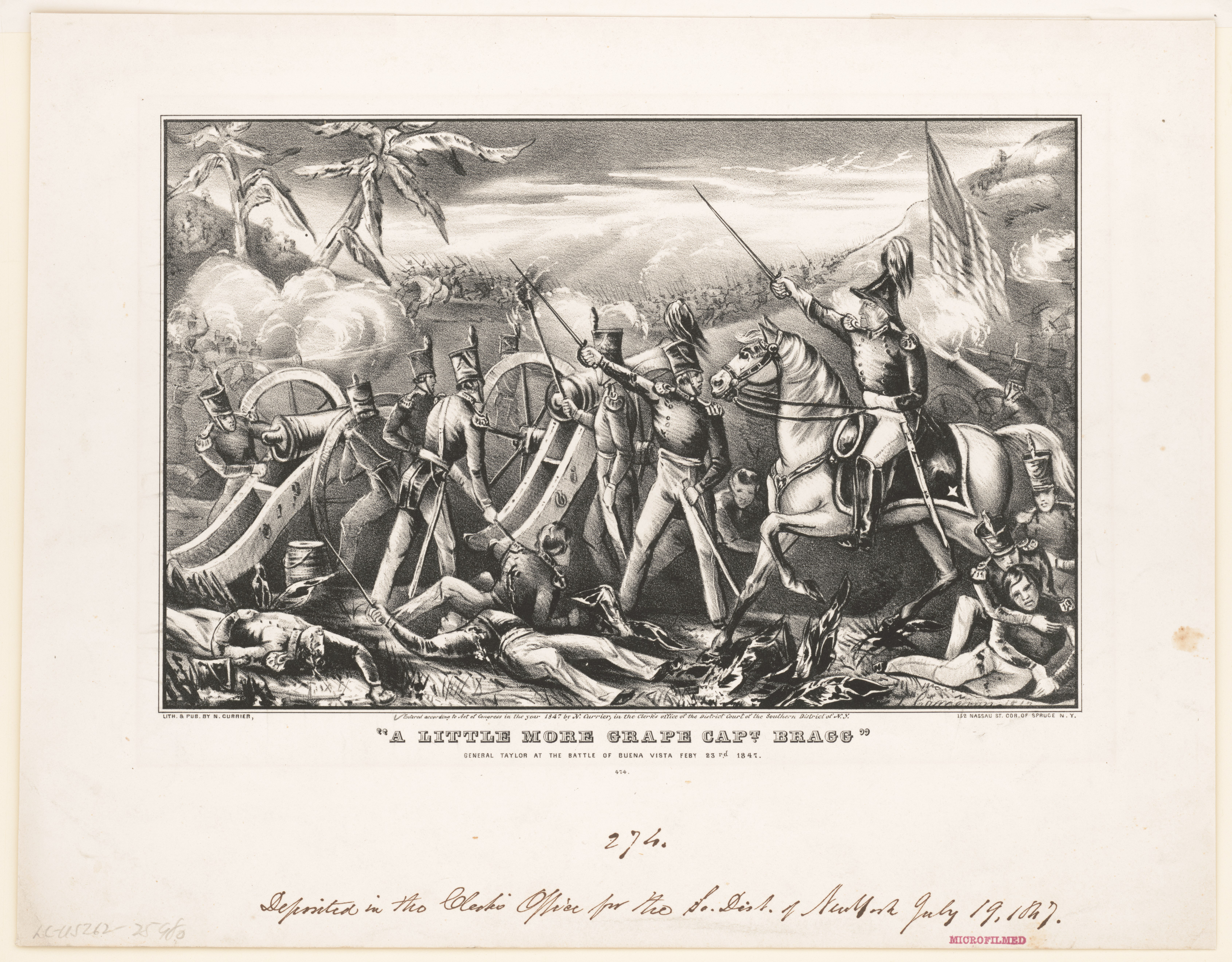
Captain Braxton Bragg — later a controversial and largely unsuccessful Confederate general — rushed his artillery battery forward to near point-blank range to plug another threatened breach. Taylor, riding across the battlefield under fire with the unhurried calm that had made him famous, reportedly told Bragg to "double-shot your guns and give 'em hell." The phrase became part of American military folklore. Whether the exact words are precisely accurate matters less than what they captured: a commander absolutely unbroken by the chaos around him.
By late afternoon, after repeated assaults that cost enormous casualties without breaking the American line, Santa Anna began withdrawing his battered army southward under cover of darkness. Taylor held the field. By the traditional measure of warfare, it was an American victory.
The Human Cost: Casualties on Both Sides
American losses were severe for such a small force: approximately 267 killed, 456 wounded, and 23 missing. Among the dead was Colonel Henry Clay Jr., son of the great Kentucky statesman Henry Clay — a personal loss that sent a wave of grief across the country and gave the battle an additional emotional resonance far beyond military statistics.
Mexican casualties are harder to pin down precisely. Estimates range from around 591 to as many as 1,800 killed and wounded, with significant additional losses from desertion during the night withdrawal. The plateau and the ravines of Angostura were littered with the dead of both sides; local civilians buried many of the fallen in the days that followed.
Santa Anna reported the battle to his government as a great Mexican victory — a propaganda effort the Mexican press initially supported. It eventually unravelled as the true picture emerged, but it speaks to the political pressures both commanders faced back home, where the story of the battle was as important as the battle itself.
Old Rough and Ready: From the Battlefield to the White House
News of Buena Vista reached the United States in March 1847 and ignited a national celebration. Taylor, already famous from Monterrey, was now a genuine popular hero — the man who had refused to surrender, who had held the line against impossible odds, who had delivered victory on George Washington's birthday. The Whig Party, which had been struggling to find a compelling presidential candidate, saw their answer clearly.
Taylor was nominated for president in June 1848, despite having never voted in a presidential election in his life. He had no party record to defend and no enemies in Congress to worry about — only a reputation for toughness, plain speaking, and winning against the odds. In November 1848, he defeated Democrat Lewis Cass and Free Soil candidate Martin Van Buren to become President-elect.
He was inaugurated on March 5, 1849 — the 4th having fallen on a Sunday — becoming the 12th President of the United States at the age of 64. The presidency was cut tragically short. Taylor died in office on July 9, 1850, just 16 months after taking the oath, almost certainly from acute gastroenteritis. Vice President Millard Fillmore succeeded him. The battlefield general who never blinked was gone before he could fully shape the nation he had helped create.
Why Buena Vista Still Matters: The Battle's Long Shadow
Buena Vista demonstrated something genuinely important about the nature of military power: that motivated, well-led troops supported by superior artillery could hold against a much larger professional force, provided the terrain was chosen wisely. It was a lesson that would echo through the coming decades, especially in the early engagements of the Civil War.
That war's shadow falls heavily over Buena Vista's roster of participants. Jefferson Davis and Braxton Bragg both fought for the United States at Angostura. Within 15 years, they would be leading Confederate forces against the Union. The battle that made them heroes in 1847 was fought alongside men they would try to kill in 1862.
The broader Mexican-American War reshaped the continent. The Treaty of Guadalupe Hidalgo, signed in February 1848, transferred to the United States the territories that now form California, Nevada, Utah, Arizona, New Mexico, and parts of Colorado and Wyoming — roughly half of Mexico's total land. The territorial prize was enormous. So was its cost. The immediate question of whether these new lands would permit slavery or not drove American politics toward crisis, helping ignite the Civil War just 13 years after Buena Vista.
For Mexico, the war remains a deep and genuine wound. The loss of nearly half the nation's territory still shapes Mexican national identity and colours the relationship between the two countries to this day. Buena Vista may have been a victory for Taylor's men, but the wider conflict left scars that have never fully healed on either side of the Rio Grande.
If this story resonated with you — the defiance at dawn, the ragged volunteers holding the line, the unlikely road from a mountain pass to the White House — we'd love to hear your thoughts in the comments below. Share this article with anyone who loves the real, human drama behind the history books.
Further Reading
- The Smithsonian Institution, Washington D.C. — collections and resources on the Mexican-American War era
- The Library of Congress, Washington D.C. — primary source archives including period newspapers, military correspondence, and maps from the 1846–1848 war
- The U.S. Army Center of Military History, Fort Lesley J. McNair — official histories and campaign studies of the Mexican-American War
- The Daughters of the Republic of Texas Library at the Alamo, San Antonio — archival holdings covering the Texas annexation period and Santa Anna's campaigns
- The National Archives and Records Administration (NARA), Washington D.C. — military service records, muster rolls, and official correspondence from the Mexican-American War