The Quiz Question
Which US Army long-range penetration unit, officially the 5307th Composite Unit and led by General Frank Merrill, fought deep behind Japanese lines in the Burma campaign of 1944?
- A. Merrill's Marauders
- B. Darby's Rangers
- C. Devil's Brigade
- D. Carlson's Raiders
The answer is A. Merrill's Marauders. Here is the full story.
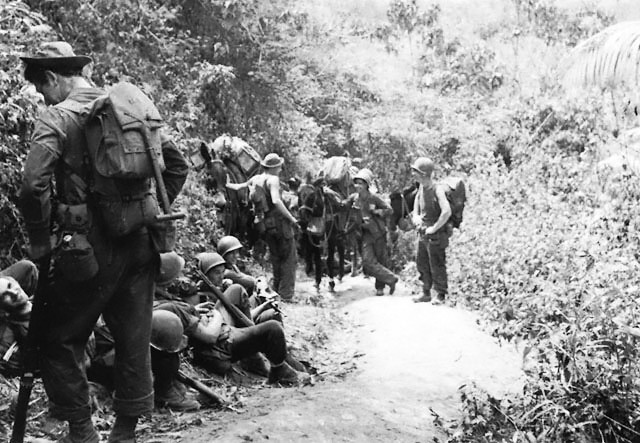
In early 1944, nearly 3,000 American soldiers disappeared into one of the most punishing landscapes on earth. They carried everything they needed on their backs and on the backs of mules. There were no fixed bases, no front lines in any conventional sense, and no easy way out. They were the 5307th Composite Unit (Provisional) — and the world would come to know them as Merrill's Marauders.
Behind Enemy Lines in the Burmese Jungle: The Men Nobody Forgot
The Marauders were a volunteer force of around 2,997 men, assembled for a single brutal purpose: to strike deep behind Japanese lines in northern Burma, destroy supply routes, and clear the way for a broader Allied advance. They were named after their commander, Brigadier General Frank Merrill, though the men themselves had no say in that particular honour.
Their mission demanded they operate without a fixed base, surviving on air-dropped supplies in terrain that seemed designed to kill them before the Japanese could. By the time the campaign ended in August 1944, fewer than 200 of the original volunteers were fit for duty. The casualty rate shocked even hardened military planners.
Their story is one of extraordinary endurance — men pushed far beyond any reasonable limit, fighting in a theatre the Allied high command treated as secondary, in a war the American public barely knew was happening.
Why Burma Mattered: The Strategic Picture in 1943–44
Japan had seized Burma in 1942, severing the Burma Road — the critical overland supply route carrying Allied matériel to Nationalist China under Chiang Kai-shek. Without those supplies, China risked collapse, freeing Japanese divisions to redeploy across Asia and threatening British India from the east.
Admiral Lord Louis Mountbatten, Allied Supreme Commander South East Asia, needed forces capable of operating deep in terrain where conventional armies simply could not function. British Brigadier Orde Wingate had demonstrated the concept was viable with his Chindits in 1943, proving that long-range penetration units could survive and fight behind Japanese lines.
The American answer was the 5307th. Their ultimate objective was to help reopen a land corridor to China — what became the Ledo Road — a project that was both a logistical necessity and a political symbol of Allied commitment to keeping China in the war.
Volunteers for Hazardous Duty: Who Were the Marauders?
Recruitment began in late 1943 with a call for volunteers willing to undertake a mission described only as "dangerous and hazardous." The deliberate vagueness did nothing to deter applicants — men from across the Caribbean, Pacific, and stateside commands stepped forward in their thousands.
The 2,997 selected were among the most experienced combat soldiers the US Army had available: veterans of Guadalcanal, the Aleutian Islands campaign, and the Caribbean Defence Command. These were men already tested by extreme conditions, not fresh recruits.
Three battalions were formed — 1st, 2nd, and 3rd — each divided into two combat teams carrying colour designations: Red, White, Khaki, Green, Orange, and Blue. This structure gave the unit tactical flexibility, allowing teams to operate independently when terrain or mission demanded it.
Among their ranks were Nisei soldiers — Japanese-Americans, many drawn from the broader pool that fed the celebrated 442nd Infantry — who served as translators and signals intelligence specialists. Their ability to intercept and interpret Japanese communications in real time gave the Marauders a battlefield advantage that proved repeatedly decisive.
Training took place at Deogarh, India, in late 1943, focusing on jungle survival, mule handling, infiltration tactics, and ambush. The mules were not an afterthought — they were the operational backbone of a unit that had no trucks, no armour, and no roads worth the name.
Frank Merrill: The General Who Marched with His Men
Brigadier General Frank Merrill was an unusual choice to lead a combat unit. Born in 1903, he was an intelligence officer by training, had served in Japan, and spoke Japanese — a rare qualification that gave him genuine insight into enemy thinking and tactics.
He had personal experience of Burma's unforgiving nature. During the chaotic Allied retreat of 1942, Merrill was one of the officers who walked out with General Joseph Stilwell — a 140-mile march on foot through dense jungle that would have broken most men.
Merrill led from the front and shared his soldiers' conditions, but his health was a persistent crisis. He suffered two heart attacks during the campaign itself, each requiring evacuation. Command passed temporarily to Colonel Charles Hunter, a tough and capable officer who guided the unit through some of its most gruelling final operations.
Merrill answered to General Joseph "Vinegar Joe" Stilwell, the sharp-tongued US commander of the China-Burma-India theatre. Stilwell's demanding standards and notoriously difficult personality created constant friction — with British allies, with Chinese commanders, and ultimately with his own men.
Into the Jungle: The Three Major Engagements of 1944
The Marauders crossed the Patkai Mountains from India into Burma on 24 February 1944, beginning a campaign that would last five months and cover more than a thousand miles of some of the most hostile ground on the planet.
The first major engagement came at Walawbum between 3 and 7 March 1944. The Marauders blocked the retreat of elements of the Japanese 18th Division, fought a fierce three-day battle, and captured key supply depots. It was a significant tactical success that demonstrated the long-range penetration concept worked at scale.
The second phase, through March and April 1944, brought actions at Shaduzup and Inkangahtawng. The Marauders repeatedly outflanked Japanese positions, cutting supply lines and forcing the enemy to divert forces to deal with a threat materialising from directions they had considered secure.
The third and most consequential phase was the assault on Myitkyina airfield on 17 May 1944. The only all-weather airstrip in northern Burma, Myitkyina was the strategic prize of the entire campaign. The Marauders took the airfield in a stunning operation — but they achieved it with men already ravaged by months of disease and exhaustion, a detail that made the success all the more remarkable.
Capturing the airfield opened a vital aerial resupply corridor. But the subsequent siege of Myitkyina town, which the Japanese garrison held tenaciously, dragged on until 3 August 1944. By then, the Marauders had been broken as a coherent fighting force.
The Real Enemy: Disease, Exhaustion, and the Limits of Human Endurance
Combat was only one of the threats the Marauders faced. Scrub typhus, malaria, dysentery, and severe trench foot devastated the unit throughout the campaign. During the Myitkyina assault, hundreds of men went into action with fevers above 100°F because there was simply no one to replace them.
Resupply was conducted almost entirely by air drop — an imprecise science in mountainous jungle terrain. Supplies frequently missed their targets or fell into enemy hands. Men survived on half-rations or less for days at a stretch, losing body weight at rates their bodies could not sustain indefinitely.
The mules were irreplaceable. Each combat team depended on its pack animals to carry heavy weapons, medical supplies, and communications equipment across terrain impassable by any other means. The loss of a mule represented a genuine tactical setback, and handlers often formed bonds with their animals that veterans later described with genuine emotion.
By June 1944, effective combat strength had fallen to fewer than 200 men from the original 2,997. The rest were dead, evacuated with wounds, or hospitalised with disease — some of them sent back into the line directly from field hospitals on Stilwell's personal orders, a decision that would become deeply controversial.
Controversy and Conflict: Stilwell, the Men, and a Nation's Ingratitude
Stilwell's decision to keep driving the Marauders forward — past all medical advice and past any reasonable limit of service — generated fury that did not fade with time. Men who were genuinely too ill to walk were ordered back into combat. Some never recovered fully from what was done to them in those final weeks.
War correspondent James Shepley reported on the condition of the unit in 1944, and when the story reached the American public, it created significant embarrassment for the military establishment. The men had been volunteered for a specific mission of defined duration; instead they found themselves kept in the field indefinitely by a commander who regarded their suffering as a logistics problem rather than a human one.
The Burma theatre was chronically underreported and underfunded throughout the war. Compared to the high-profile campaigns in Europe and the central Pacific, the Marauders' extraordinary achievements received minimal public attention while the fighting was actually happening.
The unit was officially disbanded on 10 August 1944, just days after Myitkyina fell. The ceremony, such as it was, fell dramatically short of what the men believed — with considerable justification — that they had earned.
Aftermath: What the Marauders' Sacrifice Achieved
The fall of Myitkyina on 3 August 1944 was a turning point in the Burma campaign. It opened the way for the completion of the Ledo Road, which connected India to China by land when it was finally completed in January 1945 — the first overland supply route since the original Burma Road had been cut in 1942.
Increased Allied aid to Nationalist China tied down Japanese divisions that might otherwise have reinforced other theatres, contributing — indirectly but meaningfully — to the broader Pacific war. Northern Burma was cleared progressively through 1944–45 by British, Chinese, and Kachin Ranger forces, but the Marauders had provided the essential early momentum that made that advance possible.
The campaign also validated long-range penetration warfare at a scale and intensity that influenced US military thinking for decades. The doctrine the Marauders helped prove in the Burmese jungle fed directly into the development of US Army Special Forces in the years that followed.
Mercury, the mule adopted as mascot by one of the combat teams, became a minor celebrity after the war — one of those small, human details that helped the unit's story find a wider audience in a way that operational reports alone never could.
Legacy and Recognition: Remembering the Marauders Today
Each surviving Marauder received the Bronze Star in 1944 — a recognition that many felt was an insult given what they had endured and what they had accomplished. The debate over appropriate recognition continued for decades after the war ended.
The unit received the Distinguished Unit Citation — later redesignated the Presidential Unit Citation — as a collective honour, one of the highest awards a US military formation can receive. It was a recognition of group valour that could not fully address individual grievances, but it placed the Marauders formally among the most decorated units of the war.
In 1996, the US Congress awarded all surviving Marauders the Combat Infantryman Badge retroactively, correcting a long-standing administrative injustice that had denied them a distinction routinely awarded to soldiers in comparable roles elsewhere.
The 1962 film Merrill's Marauders, directed by Samuel Fuller — himself a decorated combat veteran of the Second World War — brought the story to a new generation. Jeff Chandler played Merrill in one of his final film roles before his death that same year.
The most enduring legacy, however, is institutional. The 75th Ranger Regiment — one of the US Army's elite special operations forces — traces its direct lineage to the 5307th Composite Unit, and carries the Marauders' history as part of its own regimental identity. The men who marched into the Burmese jungle in February 1944 are, in a very real sense, still marching.
If the story of Merrill's Marauders moved you, share this article with someone who loves military history — and tell us in the comments: which aspect of the Burma campaign do you think deserves more attention?
Further Reading
- National World War II Museum, New Orleans
- US National Archives and Records Administration
- Imperial War Museum, London
- 75th Ranger Regiment Association
- Library of Congress, Veterans History Project