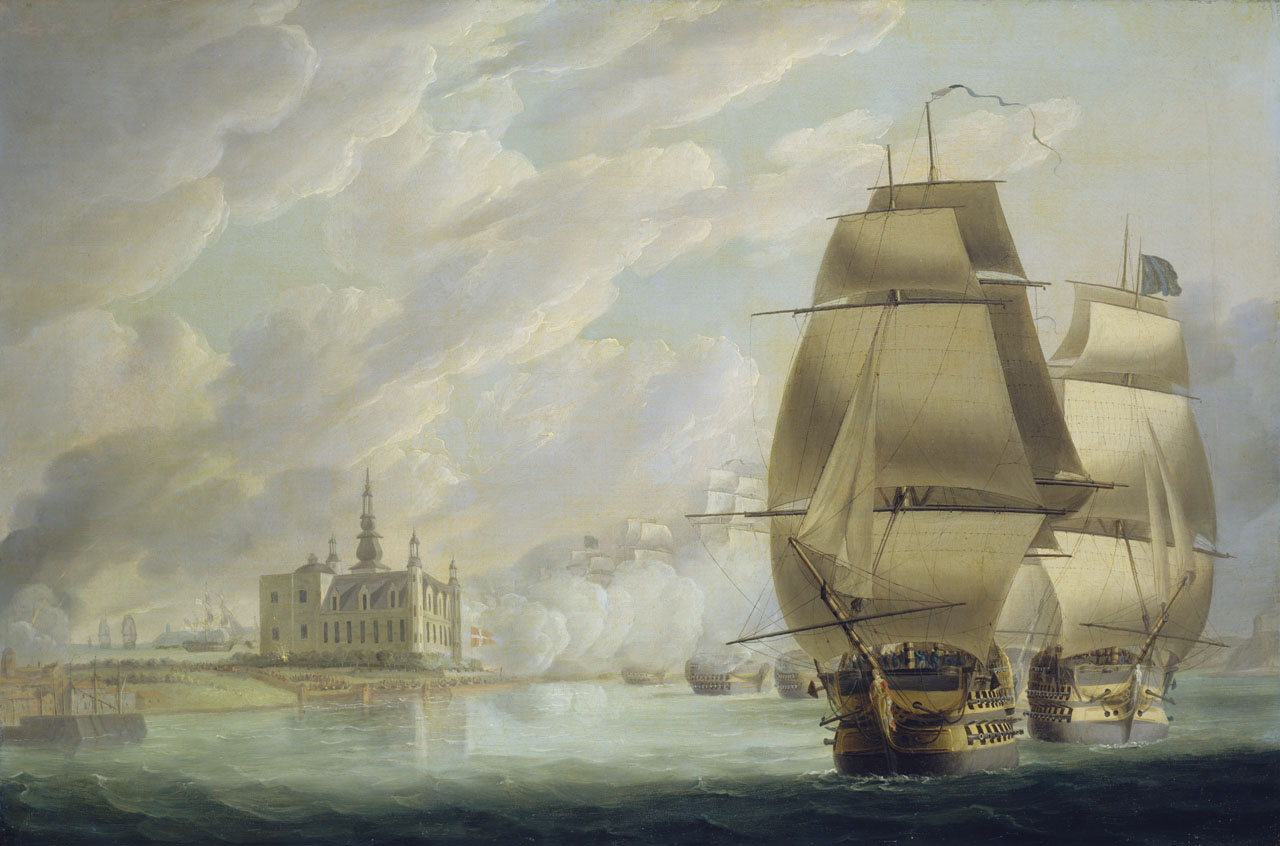
The Quiz Question
At the Battle of Copenhagen in 1801, Nelson ignored a signal to withdraw by putting his telescope to his blind eye and claiming he couldn't see it. Which eye had Nelson lost years earlier at the Siege of Calvi?
- A. His left eye
- B. His right eye
- C. Neither, he was blind in both
- D. He hadn't actually lost an eye
The answer is B. His right eye. Here is the full story.
On 2 April 1801, in the gun-smoke and chaos of the Battle of Copenhagen, Vice-Admiral Horatio Nelson raised his telescope to his blind right eye and arguably saved British naval supremacy in the Baltic. It was one of the most audacious acts of deliberate disobedience in the entire history of the Royal Navy — and it worked.
The Most Famous Act of Disobedience in Royal Navy History
Nelson's superior officer, Admiral Sir Hyde Parker, was watching the battle from a distance aboard HMS London and growing increasingly alarmed. At approximately 1:15 pm, he hoisted signal No. 39 — "Discontinue the Action" — across the fleet.
Nelson's flag captain, Thomas Foley, reported the signal. Nelson acknowledged it, then pressed his telescope deliberately to his blind right eye. "I have a right to be blind sometimes," he reportedly said. "I really do not see the signal."
His own signal for "Close Action" — signal No. 16 — stayed flying. The battle continued. Denmark was forced to negotiate an armistice. And a phrase was born that remains in everyday English use more than two centuries later. But to understand the full weight of that moment, we have to travel back seven years — to a sun-scorched hillside in Corsica.
Corsica, 1794: The Siege of Calvi and the Wound That Changed Nelson
In the summer of 1794, Commodore Horatio Nelson was serving ashore during British operations to seize French-held Corsica. It was active, dangerous work, and Nelson threw himself into it with characteristic energy.
On 12 July 1794, during the Siege of Calvi, an enemy shot — most likely a French cannon ball striking stony ground nearby — threw up a violent shower of sand, gravel and debris. Fragments struck Nelson directly in the face. The damage to his right eye was severe and permanent; he never regained useful sight in it.
Characteristically, Nelson said almost nothing publicly about the pain or the loss. He was back directing operations within days. Equally characteristically, the injury has been misrepresented by popular imagination ever since — Nelson did not wear an eye patch. His blind right eye retained a largely normal appearance, and many who met him had no idea it was sightless.
It is worth pausing on that detail, because it matters to the Copenhagen story. When Nelson raised his telescope to his right eye in 1801, anyone watching could easily have believed he was looking through it. The theatrical gesture was entirely plausible — and entirely calculated.
The Road to Copenhagen: Why Britain Was Fighting Denmark
By 1800, Napoleon Bonaparte had reshaped continental Europe and was tightening his grip on its coastlines. His instrument for strangling Britain economically was the Armed Neutrality of the North — a coalition of Denmark, Sweden, Russia and Prussia committed to keeping British warships out of their waters and their ports closed to British trade.
The Baltic trade route was not a luxury for the Royal Navy; it was a lifeline. Timber for masts, hemp for rope, tar for caulking — without Baltic supplies, British warships could not be maintained. Denmark, sitting astride the Sound at the entrance to the Baltic, held the key to that door.
Prime Minister William Pitt's government moved decisively. A fleet of 18 ships of the line was assembled and placed under the command of Admiral Sir Hyde Parker — an experienced officer, but by 1801 a cautious one, newly married and reportedly reluctant to leave England. Nelson, appointed second-in-command, was infuriated by Parker's hesitation and pushed relentlessly for immediate action.
Diplomatic talks in March 1801, led by British envoy Nicholas Vansittart, broke down completely. The Danish Crown Prince Frederick, serving as regent, would not yield. The path to battle was open.
The Danish Defence: A Formidable Floating Fortress
The Danes had not been idle. Along the eastern approach to Copenhagen — the King's Deep channel — they had assembled a defensive line of 18 vessels: blockships, floating batteries and armed hulks, moored in fixed positions stretching nearly two miles. At the northern end sat the powerful Trekroner, or Three Crowns, shore fortress.
These were not front-line warships, but in fixed defensive positions with shore support they represented a formidable obstacle. Crucially, they were crewed with fierce determination — many of the men were Copenhagen volunteers, fighting to defend their own city, their own streets.
The waters of the King's Deep added another layer of danger. Shoals were treacherous, British charts were unreliable, and a grounded ship of the line would become a helpless target. Parker, positioned in deeper water to the north with the heavier ships, surveyed the Danish line and privately doubted Nelson could overcome it. That doubt — not cowardice, but genuine professional caution — drove his decision to fly the recall signal when the fighting grew desperate.
2 April 1801: Nelson's Attack and the Heat of Battle
Nelson led 12 ships of the line into the King's Deep from the south, approaching through carefully reconnoitred channels. The previous evening he and Captain Thomas Hardy had conducted personal night-time soundings of the shoals — Nelson preparing meticulously for the audacity he was about to unleash.
The battle began badly. Almost immediately, three British ships — HMS Agamemnon, HMS Russell and HMS Belliqueux — ran hard aground on the Middle Ground Shoal before they could fire a single shot. It was a serious blow, stripping Nelson of a quarter of his attacking strength before the action had properly begun.
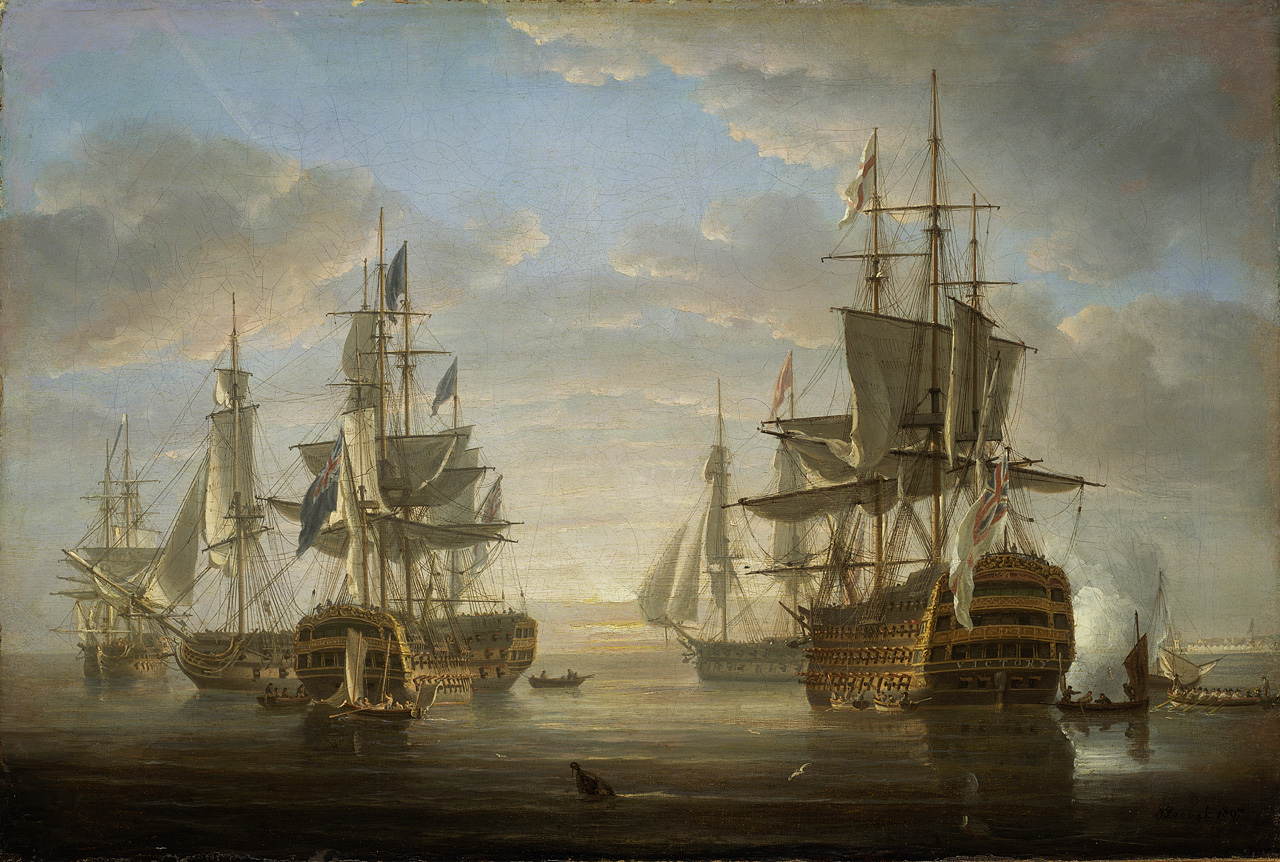
Nelson pressed on in his flagship HMS Elephant. What followed was a grinding, brutal engagement lasting more than three hours, with ships trading fire at ranges sometimes no greater than 200 yards. British casualties were severe: approximately 350 killed and 900 wounded — figures that exceeded British losses at Trafalgar four years later, a fact that alone speaks to the ferocity of the fight.
By early afternoon the Danish line was beginning to crack. Several vessels had struck their colours. Nelson sensed that victory, if he could just hold on, was minutes rather than hours away. It was precisely at this moment that Hyde Parker, watching from HMS London and seeing only the smoke and carnage, hoisted signal No. 39.
The Telescope Moment: Signal No. 39 and Nelson's Defiance
Parker's intention was arguably more nuanced than simple cowardice. The signal was intended, at least in Parker's mind, to give Nelson discretion — an escape route if he judged the situation hopeless. But a signal from a superior officer flies with authority, and Nelson knew that ignoring it carried real professional risk.
He ignored it anyway. Nelson kept signal No. 16 — "Close Action" — flying throughout. The telescope-to-the-blind-eye episode was witnessed and recorded by Colonel the Honourable William Stewart, a soldier serving aboard Nelson's flagship, whose account preserves the famous remark for posterity.
Even Rear-Admiral Thomas Graves, Nelson's second-in-command in the battle line, found a characteristically British compromise: he technically acknowledged Parker's signal but kept Nelson's "Close Action" signal flying simultaneously. It was a diplomatic hedge, but it revealed everything about where real authority lay that afternoon.
Parker's signal was not the act of a fool; it was the act of a man watching what looked like a potential catastrophe unfolding and trying to limit the damage. Nelson's defiance was not recklessness; it was the judgment of a commander close enough to the action to see what Parker, miles away, could not — that victory was genuinely within reach.
The Armistice and Its Aftermath: Victory on Nelson's Terms
By 3:00 pm the Danish fire was fading. Nelson then made a move as diplomatically bold as anything he had done militarily. Under a flag of truce, he sent a letter ashore addressed — with deliberate, generous humanity — to "the Brothers of Englishmen, the Danes," offering to spare Danish wounded and vessels if resistance ceased.
Crown Prince Frederick agreed to a 24-hour ceasefire, which was extended. A formal 14-week armistice followed, neutralising Danish naval power without the destruction of Copenhagen that many had feared. Nelson had won the battle and shaped the peace.
Then came extraordinary news. Tsar Paul I of Russia — the man whose personal obsession had held the Armed Neutrality together — had been assassinated on 23 March 1801, more than a week before the Battle of Copenhagen. The coalition was already dead before the first shot was fired; Nelson's victory administered the final blow.
Hyde Parker was recalled to England and never held an active command again. Nelson was appointed Commander-in-Chief of the Baltic Fleet. The verdict of the Admiralty, however reluctantly delivered, could not have been clearer.
Nelson the Man: Courage, Vanity and Calculated Risk
The blind eye moment is almost too perfect — a single gesture that distils an entire personality. Nelson was brave to the point of recklessness, but he was never stupid. His careful night-time reconnaissance of the Copenhagen shoals the evening before the battle is the act of a commander who does his homework before he takes his gamble.
By 1801 he had already lost his right arm at the Battle of Santa Cruz de Tenerife in 1797, the same year he had performed brilliantly at the Battle of Cape St Vincent. Copenhagen was fought by a man with one arm and one functioning eye — a detail that adds a layer of sheer physical determination to an already remarkable story.
His personal life was simultaneously a national scandal. His relationship with Lady Emma Hamilton, wife of the British envoy to Naples, had returned with him to England in 1800 and was the talk of London society. Nelson simultaneously craved public approval and seemed constitutionally incapable of doing anything to protect his reputation. His officers and sailors simply did not care; they would follow him anywhere.
Legacy: Why the Blind Eye Moment Still Matters
The phrase "turning a blind eye" entered the English language directly from the Copenhagen episode and remains in common use today — making it one of the most tangible linguistic legacies of any single battlefield moment in British history.
Copenhagen is habitually overshadowed by Trafalgar in public memory, yet many naval historians regard it as the more technically demanding engagement — fought in shallower, more treacherous waters, against a fixed defensive line, with less margin for error. The National Maritime Museum at Greenwich holds extensive records and artefacts relating to the campaign and provides vital context for understanding Nelson's Baltic operations.
The battle also shaped Nelson's command philosophy in measurable ways. His famous Trafalgar memorandum of 1805, which encouraged captains to use their own initiative rather than wait for orders, grew directly from his conviction — proved at Copenhagen — that bold junior judgment beats cautious senior hesitation. It was a doctrine the Royal Navy carried forward for generations.
Nelson died at Trafalgar on 21 October 1805, four and a half years after Copenhagen. He never entirely escaped the professional resentment of Hyde Parker's supporters within the Admiralty, men who never forgave the humiliation their admiral had suffered. History, however, has been considerably less ambivalent in its verdict.
If the Copenhagen story has caught your imagination, we'd love to hear your thoughts. Do you think Nelson was justified in defying his superior officer, or was it a gamble that could easily have ended in catastrophe? Share your view in the comments — and if you know a fellow history enthusiast who would enjoy this story, pass it along to them.
Further Reading
- National Maritime Museum, Greenwich (Royal Museums Greenwich)
- The National Archives, Kew
- Imperial War Museum, London
- Royal Naval Museum, Portsmouth Historic Dockyard
- British Library — Naval Historical Collections