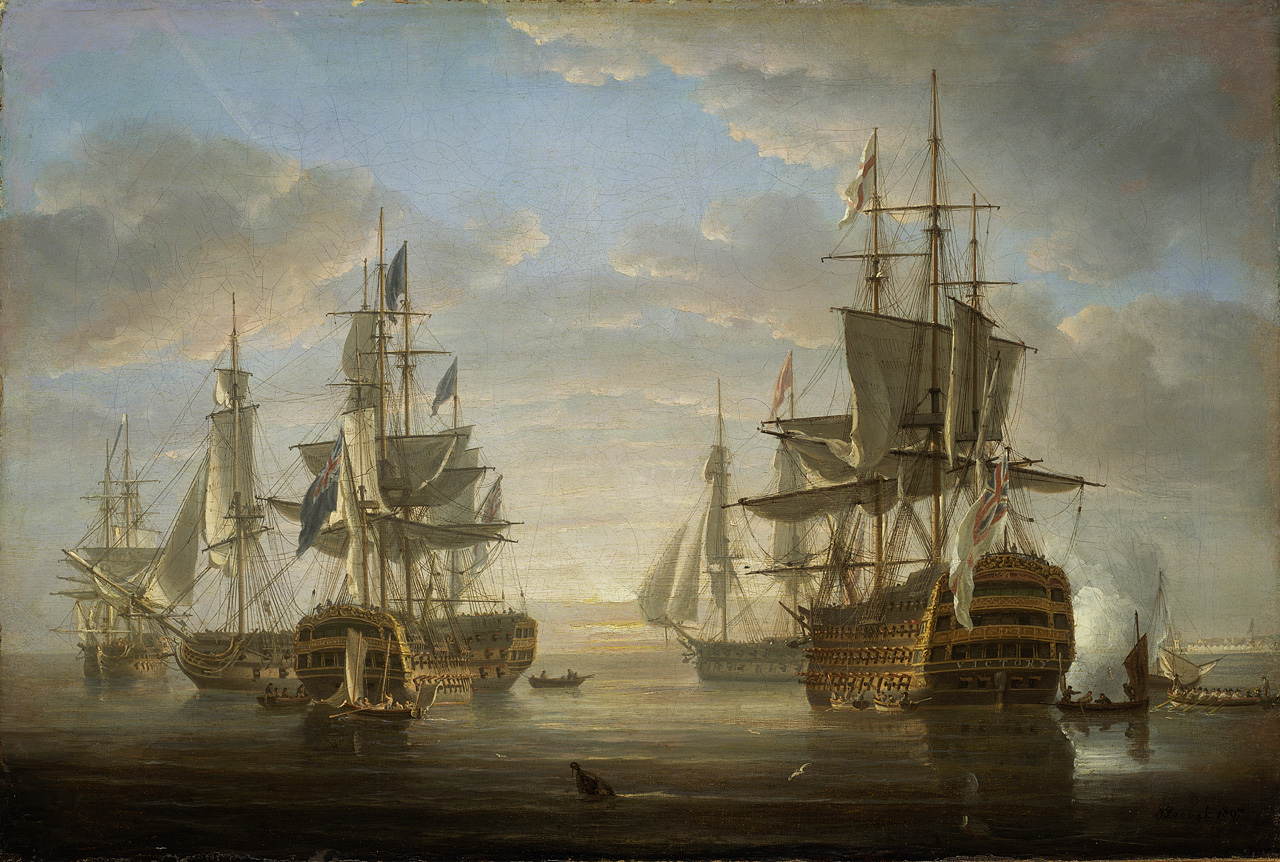
The Quiz Question
Nelson lost his right arm during a failed 1797 assault on which Spanish port in the Canary Islands?
- A. Cadiz
- B. Cartagena
- C. Santa Cruz de Tenerife
- D. Cape St Vincent
The answer is C. Santa Cruz de Tenerife. Here is the full story.
On the night of 24 July 1797, one of Britain's most celebrated naval officers stepped onto a Spanish harbour wall and, within seconds, his world changed forever. A single musket ball shattered his right elbow. The arm would be gone before morning. The man was Rear Admiral Horatio Nelson, aged 38, and the place was Santa Cruz de Tenerife — a defeat that history has sometimes struggled to accommodate alongside the legend.
The Night Nelson Met His Match: 24 July 1797
Nelson arrived at Tenerife already garlanded with glory. Just five months earlier, at the Battle of Cape St Vincent on 14 February 1797, he had boarded Spanish warships almost single-handedly and helped turn a hard-fought engagement into a resounding British victory. He was a national figure, a man seemingly touched by fate.
What fate delivered at Santa Cruz was rather different. As Nelson stepped onto the mole — the stone pier jutting into the harbour — Spanish defenders opened fire at close range. The musket ball struck his right arm just above the wrist, driving up into the elbow joint and shattering it beyond repair. He had been ashore for perhaps thirty seconds.
His stepson, nineteen-year-old Josiah Nisbet, was at his side. Nisbet tore cloth from his hat lining, fashioned a tourniquet, and half-carried Nelson back to the waiting boats through continuing fire. Naval historians credit Nisbet's quick thinking as the direct reason Nelson survived long enough to reach the surgeon. Without that tourniquet, he would almost certainly have bled to death on the mole.
Aboard HMS Theseus, surgeon Thomas Eshelby performed the amputation above the elbow. Speed was everything in 1797 — the faster the operation, the lower the risk of fatal shock or infection. Nelson, 38 years old and at the height of his powers, would never again fight with two arms.
Why Tenerife? Britain's Strategic Gamble in 1797
To understand Santa Cruz, you have to understand how desperate Britain's situation was in 1797. The French Revolutionary Wars were grinding on with no clear end in sight. Naval mutinies had erupted at Spithead and the Nore — the very ships of the fleet had briefly refused to sail. The government needed victories, and it needed money.
The Canary Islands sat directly astride Spain's Atlantic trade routes, the lifeline connecting the Spanish Empire to its colonial treasuries in the Americas and Asia. Intelligence — as it turned out, badly flawed intelligence — suggested that a treasure convoy from Manila was sheltering in Santa Cruz harbour. Capturing it would embarrass Spain, lift British morale, and fill the Admiralty's coffers.
Nelson commanded a squadron of seven vessels for the operation, including HMS Theseus (his flagship), HMS Zealous, HMS Seahorse, and HMS Terpsichore. It was a compact but capable force, and Nelson's confidence was high. He had, after all, just helped humiliate the Spanish fleet at Cape St Vincent. How different could a colonial port be?
Santa Cruz de Tenerife: A Fortress Hiding in Plain Sight
The honest answer was: considerably different. Santa Cruz de Tenerife was the principal port of the island and a well-prepared Spanish colonial stronghold. The town's military governor was General Antonio Gutiérrez, a 66-year-old veteran who had spent a career defending Spanish imperial interests and was not a man to be caught off guard.
Gutiérrez commanded approximately 1,700 soldiers — a mixture of regular infantry and local militia. The town was guarded by the Castillo de San Cristóbal on the seafront, with additional artillery batteries covering the mole itself. Any ship or boat approaching the harbour mouth would be sailing directly into layered fields of fire with almost no cover available.
Crucially, the geography of the harbour worked entirely in the defenders' favour. The mole was the only practical landing point for a large force; attackers had to funnel through a narrow approach while defenders could concentrate fire from multiple elevated positions. Gutiérrez understood this perfectly and had positioned his guns accordingly.
The First Attempt: Reconnaissance Turns to Repulse (22 July 1797)
Nelson's original plan was relatively sound in conception. On 22 July, he landed approximately 1,000 sailors and marines under Captain Thomas Troubridge north of the town, intending them to march overland and surprise the garrison from an unexpected direction.
It did not work. Spanish lookouts had spotted the British squadron long before any landing was attempted, and Gutiérrez had spent those hours reinforcing every position. Troubridge's force struggled across difficult volcanic terrain, failed to achieve surprise, and withdrew without ever threatening the town. They had accomplished nothing at the cost of alerting every defender on the island.
Nelson convened a council of war. Some officers urged caution — the element of surprise was gone, the defences were clearly strong, and the intelligence about the treasure convoy was unverified. Nelson listened, and then resolved to try a direct frontal assault on the mole. It was the kind of bold decision that had made him a hero at Cape St Vincent. At Santa Cruz, it would make him a casualty.
Midnight on the Mole: The Assault of 24–25 July 1797
At around 11 p.m. on 24 July, Nelson led roughly 700 men in boats from the anchored squadron toward the harbour. The plan required strict silence and precise timing — all boats were to converge on the mole simultaneously, overwhelming the defenders before they could concentrate their fire.
The Spanish were waiting. The moment the boats drew within range, the shore erupted. Cannon loaded with grapeshot swept the water; musket volleys lashed down from the castle walls and battery parapets. The darkness that was supposed to protect the attackers offered almost no cover against defenders firing into the confined approach channel.
Nelson was hit the moment he stepped onto the mole. Captain Richard Bowen of HMS Terpsichore, one of the most promising officers in the squadron, was killed there alongside him. Several of the landing boats were sunk or swamped in the approach, drowning their crews before they could fire a shot. The assault on the mole was, within minutes, a catastrophe.
Troubridge Ashore: Courage Without Rescue
Not everyone failed to land. Captain Troubridge, commanding a separate party of around 340 men, did manage to get ashore and fought his way into the streets of the town itself. It was a remarkable feat of determination in the chaos of that night.
But Troubridge's position was desperate. He had no artillery, no naval gunfire support, dwindling ammunition, and no communication with Nelson's shattered main assault. His men held their ground through the dark hours, isolated in the streets of a hostile town, waiting for a relief that was never coming.
At dawn on 25 July, Troubridge sent a message to General Gutiérrez that was audacious even by the standards of the age: surrender the town or he would burn it to the ground. It was an almost entirely empty threat — his men barely had enough powder to hold their position, let alone destroy a fortified port.
Gutiérrez, to his considerable credit, responded with a generosity that surprised everyone. He offered the British withdrawal on full honours of war: they could leave with their arms, their flags, and their wounded, unmolested. Troubridge accepted. The British had suffered around 226 killed and wounded — a punishing price for a harbour wall they had never held.
The Amputation: Nelson Under the Knife
While Troubridge negotiated in the streets of Santa Cruz, Nelson was already aboard HMS Theseus. Surgeon Thomas Eshelby amputated the arm above the elbow with the speed that 18th-century naval surgery demanded — the operation was completed within approximately thirty minutes of Nelson coming alongside. Every minute under the knife increased the risk of fatal shock.
The story that Nelson refused assistance getting aboard and insisted his men be treated before him has become a cornerstone of his legend. Like many such stories, it may be partly myth shaped by subsequent admiration, but it captures something genuine about how Nelson wished to be seen and how his men perceived him.
What is not disputed is that Nelson's recovery was painful and slow. He suffered severe phantom limb pain for the rest of his life — a poorly understood condition in 1797 that left him at times barely able to function. He wrote of it frequently in his letters, describing sensations in fingers he no longer possessed.
He was transported home to England and arrived in September 1797. The public reception was extraordinary. Britain in 1797 desperately needed heroes, and the sight of a wounded admiral — his empty sleeve pinned across his coat — proved more powerful than any victory dispatch. The defeat at Santa Cruz was all but forgotten in the narrative of the man who had bled for his country.
Aftermath: What the Defeat Meant for Britain and Spain
The Manila treasure convoy that had launched the entire enterprise had already sailed from Santa Cruz before Nelson's squadron ever appeared on the horizon. The intelligence underpinning the raid was worthless. Seven ships, hundreds of casualties, and a flag officer's arm had been spent chasing a ship that was already gone.
For Spain and the Canary Islands, the outcome was cause for genuine celebration. General Gutiérrez was honoured throughout the Spanish Empire as the man who had bloodied Britain's most celebrated naval officer. The defence of Tenerife remains a matter of fierce local pride, and 25 July — the Día de Santa Cruz — is still marked on the island as a day of victory.
For the Royal Navy, the lessons were quietly absorbed rather than publicly debated. The action exposed what would become a recurring problem in British amphibious operations: attacking prepared defences without reliable intelligence, adequate fire support, or a realistic fallback plan. It was a lesson the Navy would need to relearn more than once in the century that followed.
Nelson returned to the Mediterranean in early 1798. On 1 August that year, he found the French fleet at anchor in Aboukir Bay and destroyed it at the Battle of the Nile — one of the most complete naval victories in history. The man who had lost his arm in failure at Tenerife had become, within a year, the saviour of the Mediterranean.
Legacy: The Wound That Shaped a Legend
Nelson's adaptation to the loss of his arm was, by any measure, remarkable. He taught himself to write left-handed with sufficient fluency to maintain the vast correspondence that naval command required. He was back at sea and in active command within months. The physical limitations imposed by the amputation did not diminish his tactical aggression one degree.
The empty right sleeve, pinned across his coat, became one of the most recognisable images in British history. The portraits painted by Lemuel Francis Abbott, produced in the years after Tenerife, established the visual iconography of Nelson that has endured ever since — the slight figure, the decorations, the missing arm — instantly legible as the nation's naval champion.
Santa Cruz de Tenerife has never forgotten the battle either. A museum on the island preserves the history of Gutiérrez's defence, and local tradition holds that the cannon that wounded Nelson may have been fired by a young woman defender — a story that is probably embellished but speaks to the depth of local pride in the victory.
The defeat at Santa Cruz matters precisely because it complicates the legend. Nelson was not invincible. He could be wrong — about intelligence, about the wisdom of a frontal assault, about what audacity alone could achieve against prepared defences. His greatness lay not in being infallible but in learning, adapting, and returning.
From the mole at Santa Cruz in July 1797 to the quarterdeck of HMS Victory at Trafalgar in October 1805, the arc of Nelson's story runs through pain, failure, recovery, and ultimate sacrifice. He lost his arm in one harbour. He gave his life in another. In between, he changed the course of naval history — and the wound he carried from Tenerife was part of what made him the man who could.
If this story resonates with you, we'd love to hear your thoughts in the comments below — and if you know a fellow history enthusiast who'd find it compelling, please do share it with them.
Further Reading
- National Maritime Museum, Greenwich — holds the finest collection of Nelson-related artefacts, portraits and documents in the world, including items connected to the Tenerife campaign
- The National Archives, Kew — preserves original Admiralty records, ship logs and dispatches from Nelson's squadron in 1797
- Royal Naval Museum, Portsmouth (part of the National Museum of the Royal Navy) — dedicated galleries covering Nelson's life, wounds and campaigns
- Museo de la Naturaleza y de la Historia, Santa Cruz de Tenerife — holds records and exhibits relating to the Spanish defence of 1797 and General Gutiérrez's command
- Royal College of Surgeons of England — historical collections covering 18th-century naval surgery and amputation practice of the kind performed on Nelson aboard HMS Theseus