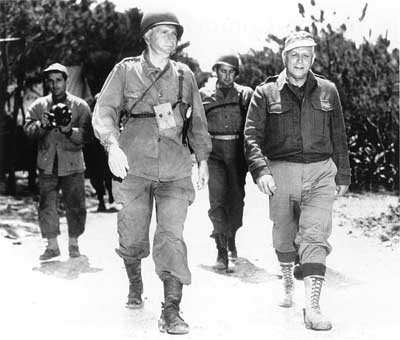
The Quiz Question
Which US lieutenant general, commander of the Tenth Army, was killed by enemy artillery on Okinawa in June 1945, the highest-ranking American officer lost to enemy fire in World War 2?
- A. Lesley McNair
- B. Simon Bolivar Buckner Jr.
- C. Joseph Stilwell
- D. Alexander Patch
The answer is B. Simon Bolivar Buckner Jr.. Here is the full story.
On the morning of 18 June 1945, with the battle of Okinawa all but won, one of America's most senior commanders walked to a forward observation post to watch his men deliver the final blow. He never walked back. Lieutenant General Simon Bolivar Buckner Jr. — commander of the US Tenth Army, son of a Confederate general, and one of the most formidable officers in the American military — was dead within minutes, killed by Japanese artillery fragments on a coral ridge in the southern tip of a small Pacific island. He remains the highest-ranking American officer killed by enemy fire in the Second World War.
The Day the General Died: Okinawa, 18 June 1945
Buckner had driven to the front line to observe the 8th Marine Regiment pushing through the last pockets of Japanese resistance. It was the kind of visit he made regularly — hands-on, present, leading from the front. What he found at the observation post on the ridge near Mezado was a panoramic view of the battle's dying hours.
Japanese gunners spotted the unusual concentration of senior officers and opened fire. A shell struck a coral outcrop just feet from where Buckner stood. The shell itself may not have touched him — it was the coral fragments, blasted outward at lethal velocity, that tore into his chest. Massive internal haemorrhage followed almost instantly. He was conscious for only a few minutes. Ten minutes after the strike, he was gone.
The battle of Okinawa effectively ended within 24 hours of his death. The bitter irony was not lost on the men who served under him. He had commanded 82 days of some of the most savage fighting the Pacific War had seen, only to fall in its final hours.
Who Was Simon Bolivar Buckner Jr.?
Born on 18 July 1886 in Munfordville, Kentucky, Buckner carried an extraordinary name — one inherited directly from his father, Confederate General Simon Bolivar Buckner Sr., the man who had surrendered Fort Donelson to Ulysses S. Grant in February 1862. The son grew up in the shadow of a defeated but celebrated military legacy, and he spent his career building something entirely his own.
He graduated from West Point in 1908 and served in the Philippines and along the Mexican border in the years before the First World War. By the time the United States entered the Second World War, he was commanding the Alaska Defense Command — a posting that proved far more consequential than it might sound. Under his leadership, American forces expelled the Japanese from the Aleutian Islands in 1943, a campaign that demonstrated both his logistical capability and his willingness to operate in brutal, unforgiving conditions.
Standing over six feet tall, physically imposing and relentlessly demanding of himself and those around him, Buckner was the model of a soldier's soldier. His appointment to command the Tenth Army for the invasion of Okinawa in 1945 was the pinnacle of nearly four decades of military service. It was also, as fate would have it, his final assignment.
Operation Iceberg: The Invasion of Okinawa
The assault on Okinawa, codenamed Operation Iceberg, launched on 1 April 1945 — Easter Sunday — with roughly 183,000 US Army and Marine troops going ashore in what was the largest amphibious operation of the Pacific War. Okinawa sat just 340 miles from the Japanese home islands. Taking it was not optional; it was essential. The island was to serve as the primary staging ground for Operation Downfall, the planned invasion of Japan itself.
Buckner's Tenth Army was a joint Army-Marine force of extraordinary scale. Facing him was a Japanese garrison of approximately 110,000 men under Lieutenant General Mitsuru Ushijima, a commander of considerable skill and cold determination. Ushijima made a deliberate choice: he would not contest the beaches. Instead, he drew the Americans inland, into the mountainous south of the island, where a deeply fortified defensive network — the Shuri Line — of caves, tunnels, interconnected bunkers and pre-registered artillery positions awaited.
It was a calculated strategy designed to bleed the Americans slowly, inflict maximum casualties, and buy time for Japan. It worked, up to a point. What it could not do, ultimately, was change the outcome.
Eighty-Two Days of Hell: The Okinawa Campaign in Detail
The fighting lasted from 1 April to 22 June 1945 — 82 days that became synonymous with attritional horror. American forces suffered over 12,000 killed and more than 36,000 wounded. The US Navy, subjected to relentless kamikaze attacks throughout the campaign, lost more men at Okinawa than in any other single naval engagement of the war.
The battles for Sugar Loaf Hill, Hacksaw Ridge, and the ancient Shuri Castle fortress each became grim landmarks of the campaign, places where men fought and died for ground measured in yards. The fighting was close, brutal, and often conducted in rain-soaked mud that made movement almost impossible.
Civilian casualties were catastrophic. Estimates suggest between 100,000 and 150,000 Okinawan civilians died — roughly a third of the island's pre-war population. Many were caught in the crossfire; others were killed by Japanese soldiers who feared they might assist the Americans; some were driven to suicide by Japanese propaganda warning of American atrocities. The suffering of Okinawa's people remains a wound that has never fully healed.
By mid-June, with Japanese resistance collapsing in the south, Buckner was pressing hard to finish the battle. His visit to the front line on 18 June was consistent with his entire command style. It was also his last decision.
The Moment of Impact: What Happened at That Observation Post
The observation post Buckner visited on 18 June belonged to the 1st Battalion, 8th Marines, positioned on a coral ridge with clear lines of sight to the fighting below. Present with Buckner were several other senior officers, including Marine General Roy Geiger. It was an unusually high concentration of brass in a forward position.
Japanese gunners identified the group and opened fire. The shell that killed Buckner struck a coral rock just feet from where he stood. Coral, when hit by high-explosive rounds, shatters into razor-edged fragments that behave like shrapnel — in some respects more dangerous than the shell casing itself. Several fragments tore into Buckner's chest. The wounds were unsurvivable.
He was conscious briefly, reportedly aware of what had happened. Within ten minutes he was dead. A Japanese news broadcast later claimed he had been killed by a sniper — a false account that American commanders swiftly and firmly refuted. The cause of death was Japanese artillery, and the American record is unambiguous on that point.
Roy Geiger assumed command of the Tenth Army on the spot, becoming the only Marine officer in history to command a US field army in combat — a distinction born entirely of tragic circumstance.
The Question of Command: Was Buckner Too Cautious — or Too Bold?
Even before 18 June, Buckner had his critics. Marine General Holland "Howlin' Mad" Smith — one of the most aggressive commanders in the Pacific — argued publicly that Buckner's grinding frontal assault was too slow and too costly. Smith and others advocated for a second amphibious landing behind Japanese lines, which they believed could have collapsed the Shuri Line more quickly and saved thousands of lives.
Buckner's counter-argument was rooted in logistics. His staff concluded that the supply chain could not support a second major amphibious operation while simultaneously sustaining the existing front. His Army superiors broadly accepted this reasoning. The terrain of southern Okinawa — a nightmare of ridges, draws, and fortified caves — also gave limited scope to the kind of manoeuvre warfare that might have cracked the defence more cleanly.
Historians remain divided. Some argue his methodical approach prolonged the campaign and contributed to the staggering civilian death toll. Others contend that the Japanese defensive genius under Ushijima left Buckner with few genuinely better options, and that his strategy, however costly, was sound. His personal courage was never the question. It was, in the end, that very courage — his insistence on being present at the sharp end — that killed him.
The End of the Battle — and the Enemy Commanders Who Followed Him in Death
The battle of Okinawa ended officially on 22 June 1945, four days after Buckner's death. Lieutenant General Mitsuru Ushijima and his chief of staff, Lieutenant General Isamu Cho, performed ritual suicide — seppuku — in a cave near the southern coast on that same day, choosing death over the dishonour of surrender.
Of the original Japanese garrison of approximately 110,000 men, fewer than 7,400 were taken prisoner. The rest were killed in combat or took their own lives. It was a rate of loss that stunned even seasoned Pacific veterans and powerfully shaped American thinking about what an invasion of the Japanese home islands would cost.
General Roy Geiger formally declared the island secured on 21 June. General Joseph Stilwell arrived shortly afterwards to assume permanent command of the Tenth Army. The campaign was over. The cost had been appalling on every side.
Buckner's Legacy: Remembered in Kentucky, Honoured on Okinawa
Congress posthumously promoted Simon Bolivar Buckner Jr. to full General — four stars — in recognition of both his rank and the significance of what he had given. He was buried at West Point, the academy where his military life had properly begun, among the long line of American soldiers who had served and sacrificed.
Fort Buckner on Okinawa, a US military installation, bore his name for decades of the post-war American presence on the island. A monument near the site of his death stands on Okinawa to this day, a quiet place that veterans and history travellers still visit. The memorials are modest by the standards of the man's achievement, but they are enduring.
His death, alongside that of Lieutenant General Lesley McNair — killed by American bombs during Operation Cobra in Normandy in July 1944 — prompted lasting reflection within the US military about how senior commanders should expose themselves at the front. Both men died because they led from close range. Both paid the ultimate price for it.
Why Okinawa Still Matters: The Battle That Shaped the End of WW2
The ferocity of Japanese resistance at Okinawa did more than claim 12,000 American lives. It reshaped the entire strategic calculus for ending the war. American planners studying the Okinawa casualty figures projected that Operation Downfall — the invasion of the Japanese home islands — could cost up to one million Allied casualties, alongside millions of Japanese dead.
Those projections were central to the reasoning cited by President Harry Truman and his senior advisers when authorising the use of atomic bombs against Hiroshima on 6 August 1945 and Nagasaki on 9 August 1945. Whether those projections were accurate, and whether the bombs were necessary, remains one of the most debated questions in modern history. But the experience of Okinawa was the lived reality that drove those calculations.
On Okinawa itself, the memory of the battle is complicated and painful. The island's people suffered out of all proportion to their part in the conflict, and resentment over the continued US military presence on Okinawa persists in Japanese domestic politics to this day. For American veterans of the Pacific, Okinawa stands as the defining battle of the war's final act — brutal, costly, decisive, and never forgotten.
Simon Bolivar Buckner Jr. did not live to see the victory his Tenth Army made possible. He did not see the Japanese surrender on the deck of USS Missouri in September 1945. He saw only the last morning of a battle he had commanded from its first day. His story is a reminder that in war, even the highest rank and the longest career offer no protection from a single shard of coral moving at speed. Randomness does not negotiate with rank.
If this story resonated with you, we'd love to hear your thoughts in the comments below — and if you know someone who'd appreciate the history of Okinawa and the remarkable men who fought there, please share this article with them.
Further Reading
- The National WWII Museum, New Orleans
- The United States Army Center of Military History
- The Marine Corps History Division, Quantico
- The Imperial War Museum, London
- The US National Archives and Records Administration