The Quiz Question
Which French marshal was taken prisoner by the Duke of Marlborough at the Battle of Blenheim in 1704?
- A. Marshal Villars
- B. Marshal Tallard
- C. Marshal Ney
- D. Marshal Vendome
The answer is B. Marshal Tallard. Here is the full story.
On the afternoon of 13 August 1704, near a small Bavarian village called Blindheim — anglicised to Blenheim — the most powerful army in Europe was broken in a matter of hours. For France, it was a humiliation without precedent in living memory. For Britain, it was the moment a general became a legend.
The Day Europe's Balance of Power Shifted
The Battle of Blenheim did not merely decide the outcome of a campaign — it reshaped the entire trajectory of the War of the Spanish Succession. France's military machine, which had rolled over opponents for more than four decades, suffered its first catastrophic defeat since the 1660s.
At the centre of that defeat was Marshal Camille de Tallard, commander of the Franco-Bavarian forces, who was taken prisoner before the sun had set on 13 August 1704. His capture was both a military and symbolic catastrophe for Louis XIV.
For Britain, it was the birth of a military reputation that would endure for generations. John Churchill, Duke of Marlborough, announced his triumph to his wife Sarah on a pencil-scrawled note written on the back of a tavern bill — one of the most celebrated battlefield dispatches in British history.
Europe at War: The Spanish Succession Crisis
The crisis had begun with a death. When the childless King Charles II of Spain died in November 1700, he left his throne to Philip of Anjou, grandson of Louis XIV — a bequest that threatened to merge the resources of France and Spain under a single Bourbon dynasty.
England, the Dutch Republic, and the Habsburg Empire formed the Grand Alliance in 1701, united by a shared determination to prevent French domination of the continent. The stakes were existential: if Louis XIV controlled both France and Spain, no coalition of remaining powers could easily resist him.
By 1704, France and Bavaria had formed a dangerous alliance and were threatening Vienna itself. If the Habsburg capital fell, the Grand Alliance would likely fracture — and Louis XIV's vision of European supremacy would be within reach. Marlborough understood that the war could be lost that summer if he failed to act.
Marlborough's Audacious March to the Danube
In May 1704, Marlborough executed one of the great strategic deceptions of the age. He feigned a march toward the Moselle valley, convincing French commanders he intended to strike into France — then pivoted sharply southeast toward the Danube, covering nearly 400 kilometres in five weeks.
The march was a logistical masterpiece. Roughly 40,000 troops were resupplied at pre-arranged depots along the route; fresh boots were issued at intervals; men arrived at the Danube in fighting condition rather than exhausted. For the era, this was a remarkable achievement in military administration.
Near Launsheim in late June, Marlborough linked up with Prince Eugene of Savoy and his Imperial forces — forming one of history's great battlefield partnerships. The two commanders trusted each other implicitly, their contrasting styles — Marlborough's political finesse, Eugene's aggressive energy — proving perfectly complementary.
Their first combined action came on 2 July 1704, when they stormed the Schellenberg heights above Donauwörth, seizing a vital Danube crossing at the cost of around 1,500 Allied dead and wounded. It was brutal, but it opened the road into Bavaria.
Marshal Tallard: The Man Who Rode Into History
Camille d'Hostun de la Baume, Marshal Tallard, was no ordinary soldier. He had served as Louis XIV's ambassador to England from 1698 to 1701, a posting that speaks to his standing at Versailles — he was a trusted diplomat as well as a military man.
Tallard had distinguished himself at the Battle of Speyerbach in November 1703, and his appointment to command French forces in Bavaria reflected genuine royal confidence in his abilities. He led a combined Franco-Bavarian force of approximately 56,000 men, alongside the Elector of Bavaria, Maximilian II Emanuel, and Marshal Marsin.
Yet Tallard faced a serious personal disadvantage that day. Contemporary accounts suggest he was suffering from severely impaired eyesight — a condition that almost certainly limited his ability to read a battlefield stretching across kilometres of rolling terrain.
His most consequential decision — whether driven by poor visibility, flawed judgement, or misplaced caution — was to pack the village of Blenheim with 27 battalions of elite French infantry and 12 cavalry squadrons. In attempting to hold the village at all costs, he effectively removed his best troops from the decisive fighting elsewhere on the field.
The Battle of Blenheim: Hour by Hour
The fighting began in earnest around 12:30 pm. Marlborough launched a feint attack directly at the heavily defended village of Blenheim, and Tallard's commanders — believing the main assault was upon them — poured reinforcements into its streets and gardens. Thousands of France's finest infantry were effectively locked away from the battle that mattered.
On the Allied right, Prince Eugene spent the afternoon in a brutal holding action against Marsin and the Elector of Bavaria near the village of Lutzingen. Eugene's attack made little ground, but that was never the point — his task was to pin the Franco-Bavarian right and prevent it from reinforcing the centre.
The decisive stroke fell in the centre. Marlborough personally led approximately 23,000 infantry and cavalry across the marshy Nebel stream — forming them into battle order under fire, in a feat of battlefield control that astonished observers on both sides.
By around 5:30 pm, French cavalry in the centre had broken under repeated Allied assaults. The French infantry, crowded together in a disorganised mass without adequate cavalry support, began collapsing toward the Danube. Thousands drowned attempting to cross in retreat; entire regiments surrendered without a fight.
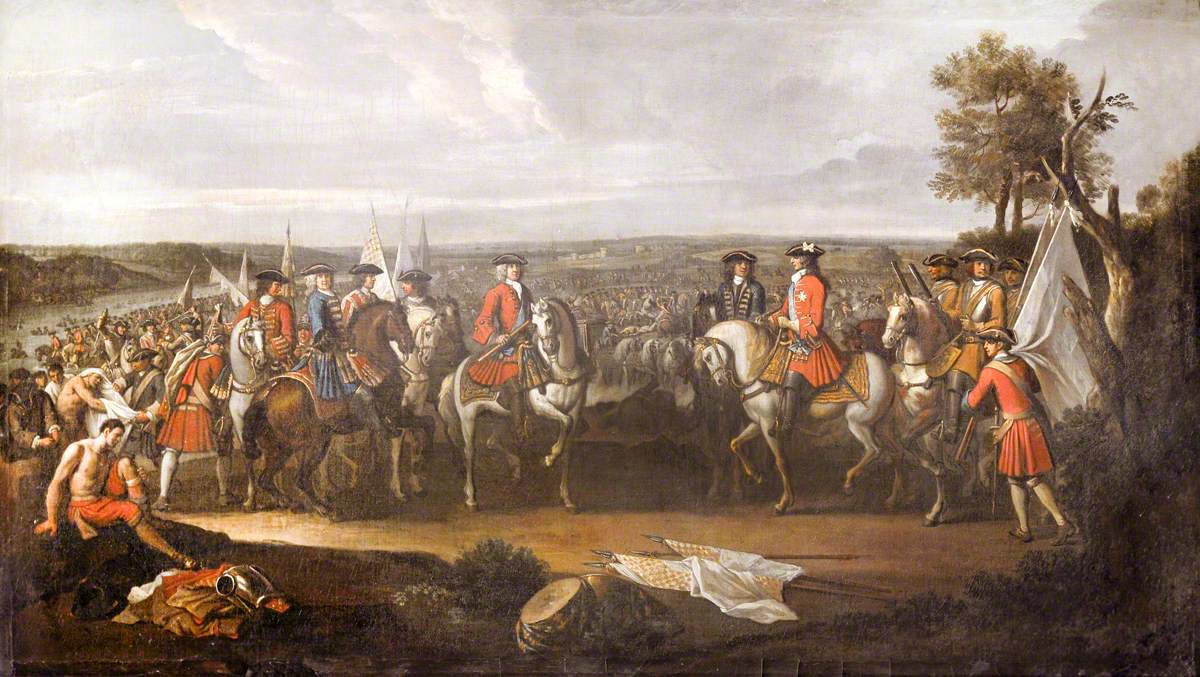
Marshal Tallard himself was surrounded by Hessian cavalry near the village of Sonderheim as the rout unfolded. He was taken prisoner — the commander of France's army in the field, captured on the battlefield as his army dissolved around him.
The Pencil Note That Shocked Versailles
As the fighting wound down that evening, Marlborough had no formal dispatch paper to hand. He found the back of a tavern bill and scrawled a brief message to his wife Sarah in pencil: 'I have not time to say more, but to beg you will give my duty to the Queen, and let her know Her army has had a glorious victory.'
Written around 9 pm on 13 August 1704, this note is preserved today and ranks among the most celebrated battlefield communications in British military history. Its unpolished urgency makes it all the more extraordinary — a world-changing victory announced on a scrap of paper.
The news reached London within days and triggered national jubilation. Queen Anne ordered a day of thanksgiving, and Parliament voted to build Marlborough a palace — Blenheim Palace — as the nation's gift to its greatest general.
At Versailles, the reaction was the opposite. Louis XIV was said to have wept on hearing of Tallard's capture and the destruction of his army. It was the gravest French military defeat in living memory, and no amount of diplomatic composure could disguise the shock at the French court.
The Reckoning: Casualties and Captives
The scale of the Franco-Bavarian disaster was staggering. Approximately 20,000 French and Bavarian soldiers were killed or wounded, and a further 14,000 taken prisoner — among them Marshal Tallard and more than 1,000 officers. Over 100 French regimental colours and 24 artillery pieces were captured.
Allied losses were severe but proportionally far lighter: around 12,000 killed and wounded. In the brutal arithmetic of 18th-century warfare, Blenheim was a lopsided Allied victory of the first order.
Tallard was transported to England and spent the next seven years as a prisoner on parole in Nottingham. He was treated with considerable courtesy — as befitted a man of his rank — and reportedly occupied himself with gardening. A pleasant tradition holds that he introduced the cultivation of celery to Britain during his stay, though historians treat this claim with gentle scepticism.
Bavaria, meanwhile, was occupied by Habsburg forces. The Elector Maximilian II Emanuel was driven into exile — a dramatic geopolitical consequence of a single afternoon's fighting on the banks of the Danube.
Why Blenheim Mattered: The Strategic Aftermath
The most immediate consequence was the salvation of Vienna. The threat of Habsburg collapse evaporated overnight, and the Grand Alliance — which had been straining under pressure — held together. The war would continue for nearly a decade, but the strategic initiative had shifted decisively to the Allies.
Blenheim also shattered something less tangible but equally important: the myth of French military invincibility. Since Louis XIV's early conquests in the 1660s and 1670s, French armies had been regarded across Europe as almost unstoppable. Blenheim proved otherwise — and that psychological shift had lasting consequences.
Marlborough built on the momentum with further crushing victories: Ramillies in 1706, Oudenarde in 1708, and the grinding bloodbath of Malplaquet in 1709. Together, these campaigns broke French military power in the field and forced Louis XIV toward a negotiated peace.
The War of the Spanish Succession ended with the Treaty of Utrecht in 1713. Philip of Anjou remained King of Spain, but France and Spain were formally prohibited from uniting under a single crown — precisely the outcome the Grand Alliance had gone to war to achieve, and precisely what Blenheim had helped make possible.
For Britain, the battle marked a historic turning point. No longer a secondary participant in continental affairs, Britain had demonstrated it could project decisive military power across Europe. That role — as a guarantor of the European balance of power — would define British foreign policy for the next two centuries.
Blenheim's Legacy: A Palace, a Name, a Memory
Blenheim Palace, built between 1705 and 1722 near Woodstock in Oxfordshire to designs by Sir John Vanbrugh, remains one of the grandest private houses ever constructed in Britain — a UNESCO World Heritage Site and a monument to a single afternoon's fighting more than three centuries ago.
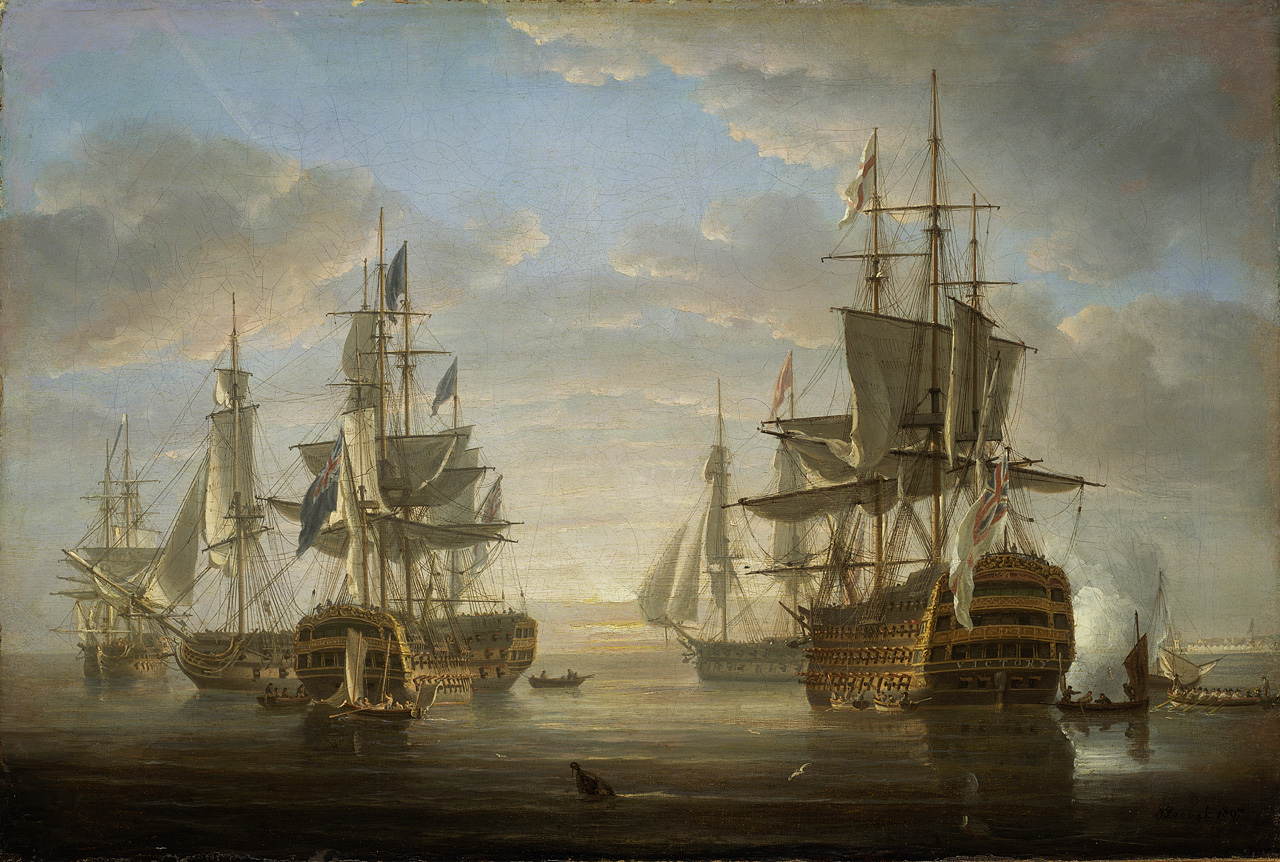
The name echoed through British history in remarkable ways. A Royal Navy warship carried the name Blenheim through the Napoleonic era. And in 1874, Winston Churchill — a direct descendant of the Duke of Marlborough — was born within those palace walls, a biographical detail that Churchill himself found deeply meaningful.
Churchill wrote a celebrated four-volume biography of his ancestor, Marlborough: His Life and Times (published between 1933 and 1938), in which the Battle of Blenheim is the centrepiece. It remains one of the finest pieces of historical biography in the English language.
Military historians consistently rank Blenheim among the most decisive battles in European history — comparable in continental impact to Waterloo and Trafalgar. It is a battle that repays careful attention not just as a military puzzle, but as a story of leadership, risk, and the moments when individual decisions reshape the fate of nations.
For those of us with a deep interest in British military tradition, Blenheim is a powerful reminder that Britain's role as a defender of European liberty did not begin in 1914 or 1939. It has roots stretching back centuries — and on 13 August 1704, those roots were planted in Bavarian soil.
If you found this story as gripping as we did, we'd love to hear your thoughts in the comments below. Which aspect of the Battle of Blenheim surprises you most — Marlborough's audacious march, Tallard's fatal mistake, or the sheer scale of the victory? Share this article with a fellow history lover and keep the conversation going.
Further Reading
- The National Army Museum, London — holds collections relating to Marlborough's campaigns and the War of the Spanish Succession
- The National Archives, Kew — primary documents from the early 18th century including campaign records and state papers from the period
- Blenheim Palace, Woodstock, Oxfordshire — the palace itself maintains historical displays and archives relating to the first Duke of Marlborough
- The British Library — holds extensive manuscript collections and published histories covering the War of the Spanish Succession
- The Rijksmuseum, Amsterdam — significant holdings relating to the Dutch Republic's role in the Grand Alliance and the wider conflict