The Quiz Question
On 8 June 1982, Argentine Skyhawks bombed RFA Sir Galahad at Fitzroy while troops were still aboard, killing 48 men. Which regiment suffered the heaviest losses?
- A. The Scots Guards
- B. The Welsh Guards
- C. The Parachute Regiment
- D. The Royal Marines
The answer is B. The Welsh Guards. Here is the full story.
On 8 June 1982, the Falklands War was almost over. British forces were within days of their final assault on Port Stanley, and the momentum was firmly with the Task Force. Then, in a matter of seconds, everything changed. A single Argentine air strike on a stationary ship in Fitzroy Cove killed 48 men — 32 of them Welsh Guardsmen — and left hundreds more burned, wounded and traumatised. It remains the single greatest British loss of life in any one action during the entire conflict, and for the Welsh Guards, it is a wound that has never fully healed.
A Day That Should Never Have Happened
By early June 1982, the British Task Force had fought its way ashore at San Carlos, crossed difficult terrain under fire, and was closing in on the Argentine garrison holding Port Stanley. Victory was close enough to taste. The final push needed troops positioned on the southern flank, and speed was everything.
RFA Sir Galahad sat stationary in Fitzroy Cove on the morning of 8 June, packed with Welsh Guardsmen and support personnel. The men should have been ashore hours earlier. Instead, a tangle of command delays, communication failures and logistical confusion kept them aboard a fully laden vessel in daylight, in a war zone, with inadequate air cover.
The Argentine Air Force spotted the opportunity and seized it. Within seconds of the attack beginning, the ship was ablaze. For the Welsh Guards, the Falklands War would forever be defined not by the liberation of the Islands, but by this one catastrophic morning at Fitzroy.
The Welsh Guards: Who Were They?
The Welsh Guards — formally the 1st Battalion Welsh Guards — are one of the five Foot Guards regiments of the Household Division. Founded in 1915 by royal warrant of King George V, they have served in both World Wars and a long list of post-war conflicts, carrying with them a deep identity rooted in Welsh communities, traditions and pride.
In 1982, the battalion was commanded by Lieutenant Colonel Johnny Rickett. Many of the Guardsmen aboard Sir Galahad were young soldiers, some experiencing their first operational deployment. These were not seasoned veterans hardened by years of active service — they were young men from Welsh towns and villages, and the losses would devastate communities the length and breadth of Wales.
The regiment's connection to its homeland made the grief particularly acute. News of the attack reached families at home before any official notification in some cases, spreading through tight-knit communities with terrible speed.
The Road to Fitzroy: How the Task Force Reached Bluff Cove
After the San Carlos landings on 21 May 1982, British commanders worked urgently to advance on Port Stanley before Argentine defences could consolidate. Brigadier Tony Wilson, commanding 5 Infantry Brigade, planned to move troops rapidly around the southern flank to the settlements at Bluff Cove and Fitzroy.
The 2nd Battalion Scots Guards had already been landed at Bluff Cove by HMS Fearless on the night of 5–6 June in a successful operation carried out under cover of darkness. The Welsh Guards were supposed to follow the same route. But a breakdown in orders meant their landing was repeatedly postponed, leaving them without a confirmed plan as the hours slipped by.
RFA Sir Galahad and RFA Sir Tristram were ultimately tasked with bringing the Guards and their equipment to Fitzroy by sea — a practical solution to a logistical problem that, in the event, placed hundreds of men directly in harm's way.
The Fatal Delays: Hours of Confusion in the Cove
Sir Galahad arrived at Fitzroy in the early hours of 8 June 1982 carrying approximately 400 Welsh Guardsmen along with other personnel and a substantial load of ammunition, fuel and equipment. The plan was straightforward: transfer the troops quickly to landing craft and get them ashore before daylight exposed the ships to air attack.
It didn't happen. A shortage of suitable landing craft created an immediate bottleneck. Then a dispute emerged at command level over which beach the troops should land at — Fitzroy or Bluff Cove — and that argument consumed precious time while the men waited below decks.
By mid-morning, the situation had become deeply dangerous. Hundreds of soldiers remained aboard a stationary, fully laden ship in broad daylight. The RAF Harrier patrols that should have been providing air cover over the anchorage were absent at the critical moment — a gap that Argentine reconnaissance had been watching for.
The Attack: Argentine Skyhawks Strike
At approximately 13:13 local time, five Argentine A-4B Skyhawks of Grupo 5 de Caza came in low and fast over Fitzroy Cove. They had been guided to the ships by an Argentine forward observation post positioned in the hills above the settlement — observers who had watched the stationary vessels for hours before calling in the strike.
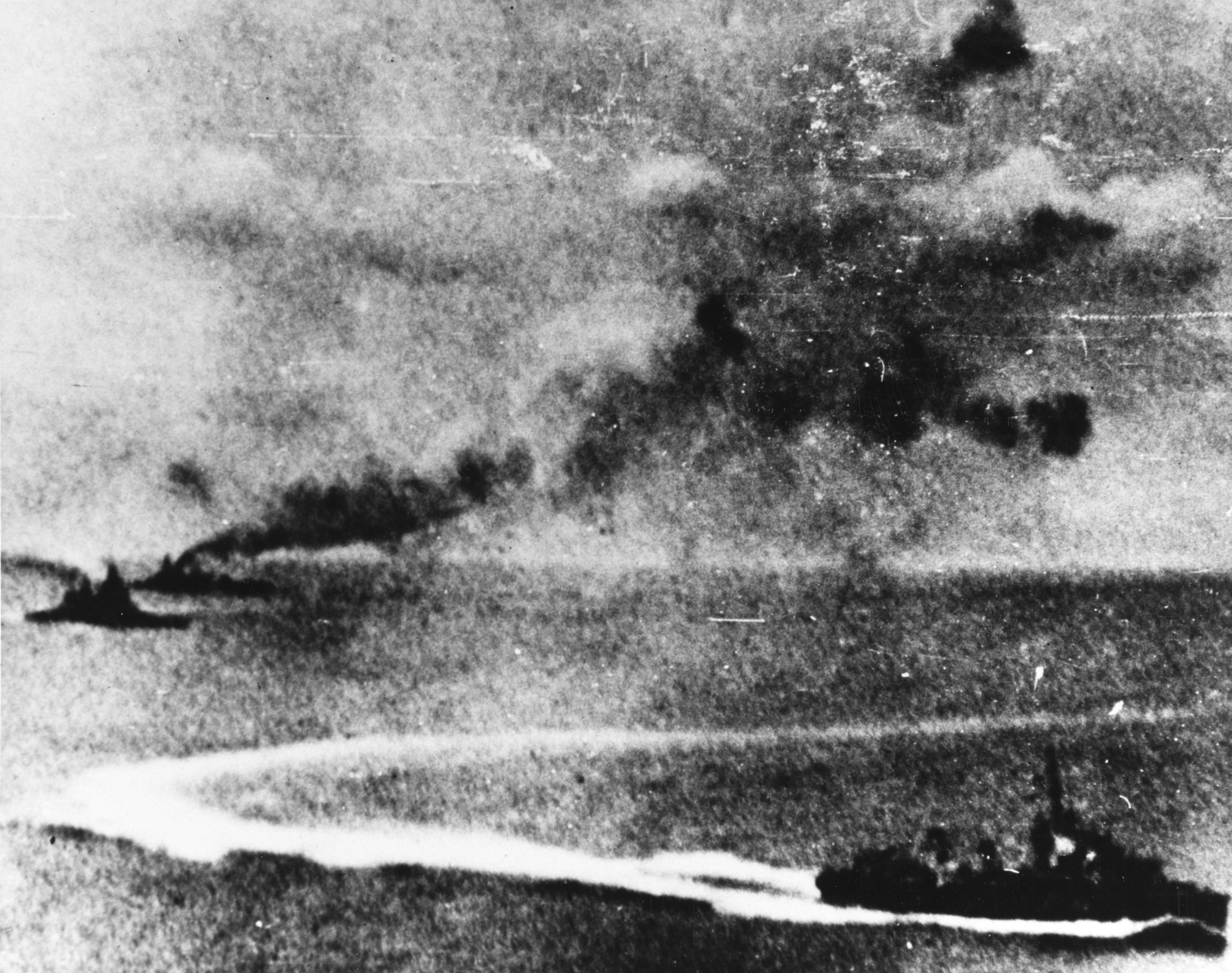
Sir Galahad was hit by at least two 500-lb bombs. The impacts detonated ammunition and ignited fuel stored on the tank deck almost instantly, sending a massive fireball through the ship. The speed and ferocity of the fire left men with almost no time to react.
RFA Sir Tristram, anchored nearby, was also struck and badly damaged — two Hong Kong Chinese civilian crew members were killed in that attack. But it was Sir Galahad that bore the catastrophic blow. The attack itself lasted only seconds. The suffering it caused would last lifetimes.
Fire, Chaos and Courage: The Rescue Operation
Survivors described a wall of flame erupting through the ship as fuel and ammunition cooked off in rapid succession. Men on the tank deck had almost no warning. Some jumped directly into the freezing South Atlantic; others were trapped below by fire and thick, choking black smoke that made navigation through the vessel almost impossible.
The response of Royal Navy helicopter crews was extraordinary. Flying through billowing smoke with ammunition still cooking off below them, pilots and aircrew made repeated sorties to winch survivors to safety. Sergeant Peter Naya and his Sea King crew flew multiple rescue runs directly over the burning ship, work for which he was awarded the Distinguished Flying Medal.
Guardsman Simon Weston, then 21 years old, survived the attack with severe burns to over 46% of his body. His long, agonising recovery — and his eventual decision to speak publicly about the attack and its aftermath — made him one of the most recognised faces of the entire Falklands War. Local civilians at Fitzroy Settlement, including members of the Chartres family, opened their homes to survivors who came ashore in shock and badly burned, providing what comfort they could in the immediate aftermath.
The Toll: 48 Dead, 32 of Them Welsh Guardsmen
A total of 48 men were killed in the attack on Sir Galahad. Thirty-two were Welsh Guardsmen. The remaining dead included six crew members and personnel from other units, among them soldiers of the Royal Army Medical Corps who had been aboard to support the landing. A further 150 men were wounded, many with severe burns requiring prolonged treatment at specialist facilities including the burns unit at RAF Halton.
The 32 Welsh Guards dead represented the single greatest regimental loss in any one action during the Falklands War — a figure that stands as a stark measure of what the delays at Fitzroy truly cost. Some of the dead were recovered and are buried in the Falkland Islands; others were buried at sea. Some remain entombed within the wreck of Sir Galahad, which was designated a war grave under the Protection of Military Remains Act 1986.
On 25 June 1982, following the end of hostilities, RFA Sir Galahad was sunk as a war grave by HMS Onyx in a formal naval ceremony. Those who remained aboard were honoured before she went under. She rests today in Fitzroy Cove, a permanent memorial to the men lost within her.
Accountability and Controversy: Who Was to Blame?
The question of responsibility for the disaster at Fitzroy has been debated by veterans, historians and politicians for more than four decades. Official histories and subsequent analyses have identified multiple overlapping failures: unclear orders, poor inter-unit communication, inadequate air defence arrangements and a critical absence of Harrier cover at the moment of the attack.
Brigadier Tony Wilson's decision to push forward so rapidly without securing proper air defence has attracted criticism in a number of historical accounts. The pressure from London to end the war quickly — to avoid prolonged fighting and mounting casualties — is also cited as a factor that led commanders at every level to accept risks that, with hindsight, were unacceptable.
Later historical analyses, including work drawing on the official records held at The National Archives at Kew, have generally concluded that the delay in disembarkation was a systemic failure rather than the fault of any single officer. That conclusion, however carefully worded, has offered little comfort to the families of the dead, many of whom felt that the full truth took far too long to emerge.
Some survivors and bereaved families have expressed frustration that the lessons of Fitzroy were not learned as publicly or as urgently as the scale of the disaster warranted. The attack remains a standing case study in British military doctrine on the dangers of logistical delay and inadequate inter-service coordination.
Legacy: Remembering the Welsh Guards and Sir Galahad
Simon Weston's recovery from his burns was long, painful and very public. He has spoken about the attack, its aftermath and his own psychological journey for over four decades, and his charitable work has benefited countless other veterans. His name is inseparable from the story of Sir Galahad — not as a symbol of defeat, but of resilience and the possibility of rebuilding a life shattered by war.
The Welsh Guards hold annual commemorations on 8 June, and the regiment's association with Fitzroy remains a defining part of its modern identity. The memorial to those who died on Sir Galahad, which stands at Fitzroy Settlement in the Falkland Islands, is visited every year by veterans, family members and others who make the long journey to the South Atlantic to pay their respects.
The wreck of Sir Galahad is a legally protected war grave. Diving on or near her is prohibited under the Protection of Military Remains Act 1986. She lies where she was laid to rest in 1982, and she is not disturbed.
For those who want to understand the human cost of the Falklands War — beyond the maps and the military manoeuvres — Fitzroy is where that understanding begins. Forty-eight men died because the system that was supposed to protect them failed. Their names deserve to be known.
If this article moved you, please share it with someone who might not know the full story of Sir Galahad and the Welsh Guards. And if you have a personal connection to the Falklands — whether as a veteran, a family member or someone who remembers those weeks in 1982 — we'd be honoured to hear from you in the comments below.
Further Reading
- Imperial War Museum — holds extensive Falklands War collections including personal testimonies, photographs and regimental records
- The National Archives, Kew — official government and military records from the Falklands conflict, including operational reports and inquiry documents
- National Army Museum, London — regimental histories and material relating to the Welsh Guards and the 1982 campaign
- The Falklands Islands Museum and National Trust, Stanley — local archives, memorials and records relating to the conflict and the communities affected by it
- Welsh Guards Regimental Association — the regiment's own archive and commemorative programme, including annual Fitzroy remembrance events