The Quiz Question
After crossing the ice-choked Delaware River on the night of December 25-26, 1776, George Washington's army captured nearly 900 enemy soldiers in a surprise attack on which town?
- A. Trenton
- B. Princeton
- C. Monmouth
- D. Brandywine
The answer is A. Trenton. Here is the full story.
On the night of December 25, 1776, George Washington led a ragged, half-frozen army across an ice-choked river in the middle of a nor'easter storm. What happened in the hours that followed would save the American Revolution — and change the course of history.
A Revolution on the Brink: The Crisis of December 1776
By mid-December 1776, the Continental Army was barely an army at all. What had been a force of 20,000 men in the summer had shrunk to fewer than 3,000 fit for duty, battered by a string of crushing defeats in New York and driven across New Jersey by General Lord Cornwallis's relentless pursuit.
Fort Washington fell on November 16, and Fort Lee on November 20 — two blows in quick succession that stripped Washington of men, supplies, and credibility. The British seemed unstoppable. Philadelphia, the rebel capital, was in a panic, and Congress had already fled to Baltimore fearing imminent occupation.
Thomas Paine, marching with the retreating army, wrote The American Crisis on a drumhead during the withdrawal. Its opening line — "These are the times that try men's souls" — captured the mood with devastating precision. Washington had the pamphlet read aloud to his troops.
The most terrifying detail was this: the enlistment contracts of most remaining soldiers were due to expire on December 31, 1776. Without a decisive morale boost, the Continental Army would simply cease to exist in a matter of days. Washington had perhaps one chance left.
The Hessians at Trenton: Who Were Washington's Targets?
Guarding the town of Trenton, New Jersey, was a garrison of approximately 1,500 Hessian soldiers — German mercenaries hired by King George III from the Landgrave of Hesse-Kassel. Britain employed roughly 30,000 Hessian troops over the course of the war; they were considered among the most professional soldiers in the world.
The Trenton garrison was commanded by Colonel Johann Rall, a veteran officer who had distinguished himself at the Battle of White Plains in October 1776. He was experienced and capable — but dangerously complacent about his enemy.
Rall was reportedly dismissive of the Continental Army, allegedly describing Washington's men as "country clowns" unworthy of serious defensive preparations. He had ignored explicit orders to construct defensive earthworks around Trenton, a decision that would prove fatal.
Adding to the Hessians' vulnerability, Washington had been deliberately staging small raids and skirmishing attacks on the garrison for weeks — not to inflict casualties, but to exhaust the defenders with constant false alarms. By Christmas, the Hessians were tired, stretched, and had begun to lower their guard.
Washington's Plan: A Three-Pronged Gamble
Washington's plan was audacious to the point of recklessness. Three separate columns would cross the Delaware River simultaneously and converge on Trenton from different directions, cutting off any Hessian escape.
Washington himself would lead the main force of 2,400 men across at McKonkey's Ferry, nine miles north of Trenton. Brigadier General James Ewing was to cross further south at Trenton Ferry, blocking the Assunpink Creek bridge to prevent the Hessians retreating southward. Colonel John Cadwalader would cross at Bristol with a third force to threaten the Hessian garrison at Bordentown and prevent reinforcements arriving.
In the end, both Ewing and Cadwalader were defeated by the ice and failed to cross at all. Washington's column would go it entirely alone — though he would not learn this until it was already too late to turn back.
The plan called for the attack to begin at midnight and be completed before dawn. Speed and total surprise were everything. Washington understood that a daylight engagement against professional Hessian soldiers, with his exhausted and outnumbered men, would almost certainly end in catastrophe.
Crossing the Delaware: Christmas Night, 1776
The crossing began at around 11 p.m. on Christmas night. Washington's 2,400 men, 18 artillery pieces, and dozens of horses had to be ferried across a river running fast and thick with jagged ice floes in the middle of a fierce nor'easter storm. Sleet, snow, and freezing rain drove into the men's faces as they waited their turn.
The operation was managed by Colonel John Glover's 14th Continental Regiment — known as the Marblehead Mariners, experienced fishermen and sailors from Massachusetts who had already saved the army once before, during the desperate retreat from Long Island in August 1776. Without them, the crossing would have been impossible.
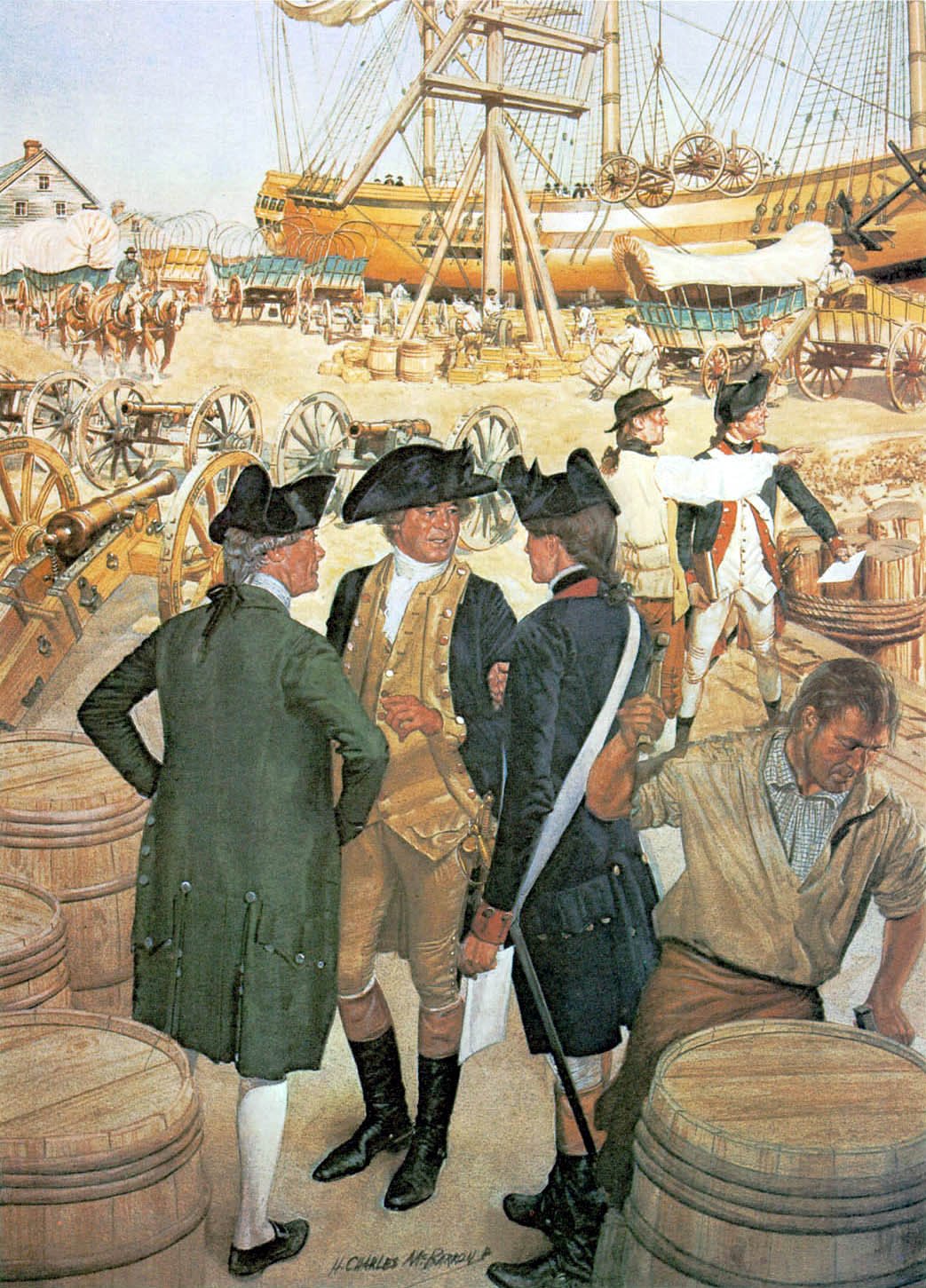
The Durham boats used for the crossing were heavy, flat-bottomed cargo vessels normally used to haul iron ore along the river. Getting the cannon across — heaving each piece onto the pitching boats in the dark — was a feat of extraordinary determination organised by 26-year-old Henry Knox, a former Boston bookseller turned artillery commander.
The last soldiers reached the New Jersey shore at around 3 a.m. on December 26 — already three hours behind schedule, with dawn approaching. When officers urged Washington to abort the mission, he is reported to have been resolute. The password for the operation that night said everything about his intentions: Victory or Death.
The Attack on Trenton: Chaos Before Dawn
Washington's force split into two columns for the final nine-mile march south to Trenton. General Nathanael Greene led one column down the Pennington Road to strike the northern end of town. General John Sullivan led the other down the River Road to attack from the west.
The columns reached Trenton at approximately 8 a.m. on December 26 — in broad daylight, not the covering darkness Washington had planned for. But the storm had kept Hessian sentries off the streets, and the howling wind had masked the sound of the advancing army. Surprise, against all odds, was still intact.
Knox's 18 cannon were immediately positioned at the heads of Trenton's main streets — King Street and Queen Street. Raking the town with artillery fire, they shredded any attempt by the Hessians to form up in the disciplined ranks that made professional European infantry so lethal. Without the space to manoeuvre, the Hessians were in chaos from the first moments.
Colonel Rall, reportedly caught off guard after an evening of cards and celebration, rushed into the street to rally his men and was shot twice — once in each side — while attempting to lead a counterattack into an orchard east of town. He was carried from the field mortally wounded.
The fighting lasted no more than 45 minutes to an hour. Twenty-one Hessians were killed and roughly 90 wounded. Approximately 900 were taken prisoner. American losses in combat: zero. Two men had frozen to death on the march — the only American fatalities of the entire operation.
The Men Who Made It Happen: Key Figures at Trenton
George Washington, 44 years old, directed the battle from horseback throughout the fighting. His visible calm under fire — rallying units, directing artillery, keeping exhausted men moving — was as decisive as any tactical order he gave. His physical presence mattered as much as his plan.
Nathanael Greene, a self-taught Quaker from Rhode Island who had been refused membership of his local militia because of his limp, would go on to become Washington's most trusted general. His performance at Trenton helped cement that reputation.
Henry Knox, just 26 years old, pulled off one of the most remarkable logistical feats of the entire war in getting 18 artillery pieces across the Delaware and into action at the critical moment. He had learned his craft almost entirely from reading books in his Boston shop.
Among the young officers charging into Trenton that morning was 18-year-old Lieutenant James Monroe — the future fifth President of the United States. Monroe was seriously wounded leading a charge to seize the Hessian cannon, taking a musket ball that nearly cost him his life.
Colonel Johann Rall died of his wounds on the evening of December 26, 1776. According to a story long repeated in historical accounts, a note warning him of the American attack was discovered, unread, in his coat pocket. Whether entirely accurate or not, it has become one of the most haunting details of the battle.
Aftermath: Washington Strikes Again at Princeton
Flushed with success but acutely aware that his position in Trenton was dangerously exposed, Washington recrossed the Delaware with his nearly 900 prisoners on the night of December 26–27. He was not finished.
He crossed back into New Jersey on December 30. On January 2, 1777, Cornwallis arrived with 8,000 men and had Washington apparently cornered at Trenton. But Washington kept his campfires burning through the night, then slipped the entire army away in silence — appearing the next morning behind the British lines.
On January 3, 1777, Washington struck at Princeton, defeating three British regiments and inflicting serious losses on a force under Lieutenant Colonel Charles Mawhood. It was a second stunning blow in less than ten days. The twin victories at Trenton and Princeton forced the British to abandon much of New Jersey, pulling back to a defensive cordon around New Brunswick and Amboy.
Washington reportedly rode among his men in tears, personally imploring those whose enlistments had already expired to stay on for six more weeks. Enough of them agreed. The army did not dissolve. The Revolution survived.
Why Trenton Mattered: The Turning Point Nobody Expected
By Christmas 1776, British and Hessian commanders had genuinely concluded the rebellion was nearly finished. Trenton shattered that assumption overnight and forced a wholesale reassessment of the war's prospects. A professional garrison had been destroyed in under an hour by men the British had publicly dismissed as amateurs.
The propaganda value was immense. News spread through the colonies like fire. Recruiting improved. Wavering Patriots reconsidered. The Loyalist narrative — that resistance was hopeless — suddenly had a powerful counter-argument.
France, watching events from across the Atlantic with calculating interest, took careful note. The Continental Army was not finished. Historians widely recognise that the victories at Trenton and Princeton contributed meaningfully to France's eventual decision to enter the war as an American ally in 1778 — a decision that ultimately proved decisive.
Trenton also revealed something important about Washington as a commander. His genius did not lie in the set-piece battles of European tradition — he lost many of those. It lay in strategic boldness, the exploitation of terrain and weather, and an almost uncanny ability to inspire broken men to perform beyond what anyone, including themselves, believed possible.
Legacy: How Trenton Is Remembered Today
Emanuel Leutze's iconic 1851 painting Washington Crossing the Delaware — now housed at the Metropolitan Museum of Art in New York — has made the scene one of the most recognisable images in all of American history. Historians note that it contains numerous inaccuracies: the flag shown did not yet exist, the boats are the wrong type, and the ice is dramatically exaggerated. But as a piece of national mythology, it is without equal.
The Old Barracks Museum in Trenton, New Jersey, stands on the very ground where the Hessians were quartered and brings the story to life through one of the few surviving French and Indian War-era barracks buildings in the United States.
Every Christmas Day, historical re-enactors cross the Delaware River at Washington Crossing Historic Park in Pennsylvania — a tradition that draws thousands of spectators and keeps the memory of that frozen night vividly alive.
At military academies around the world, Trenton is studied as a masterclass in the use of surprise, speed, and psychological momentum to overcome a materially superior enemy. For students of leadership, it remains one of history's most compelling examples of what a determined commander can achieve when the odds seem impossible.
If the story of Washington's Christmas crossing has gripped you, we'd love to hear your thoughts — drop a comment below, share this article with a fellow history lover, and let us know which aspect of the battle you find most remarkable. Was it the audacity of the plan, the courage of the men, or the sheer improbability of the outcome?
Further Reading
- The Smithsonian Institution, Washington D.C. — American Revolution collections and resources
- The Library of Congress — Revolutionary War era manuscripts, maps, and primary sources
- The National Archives (United States) — Continental Army records and founding-era documents
- The Old Barracks Museum, Trenton, New Jersey — dedicated to the Hessian and Revolutionary War history of the Trenton battlefield
- Washington Crossing Historic Park, Pennsylvania — site of the December 1776 crossing, with interpretive historical programming