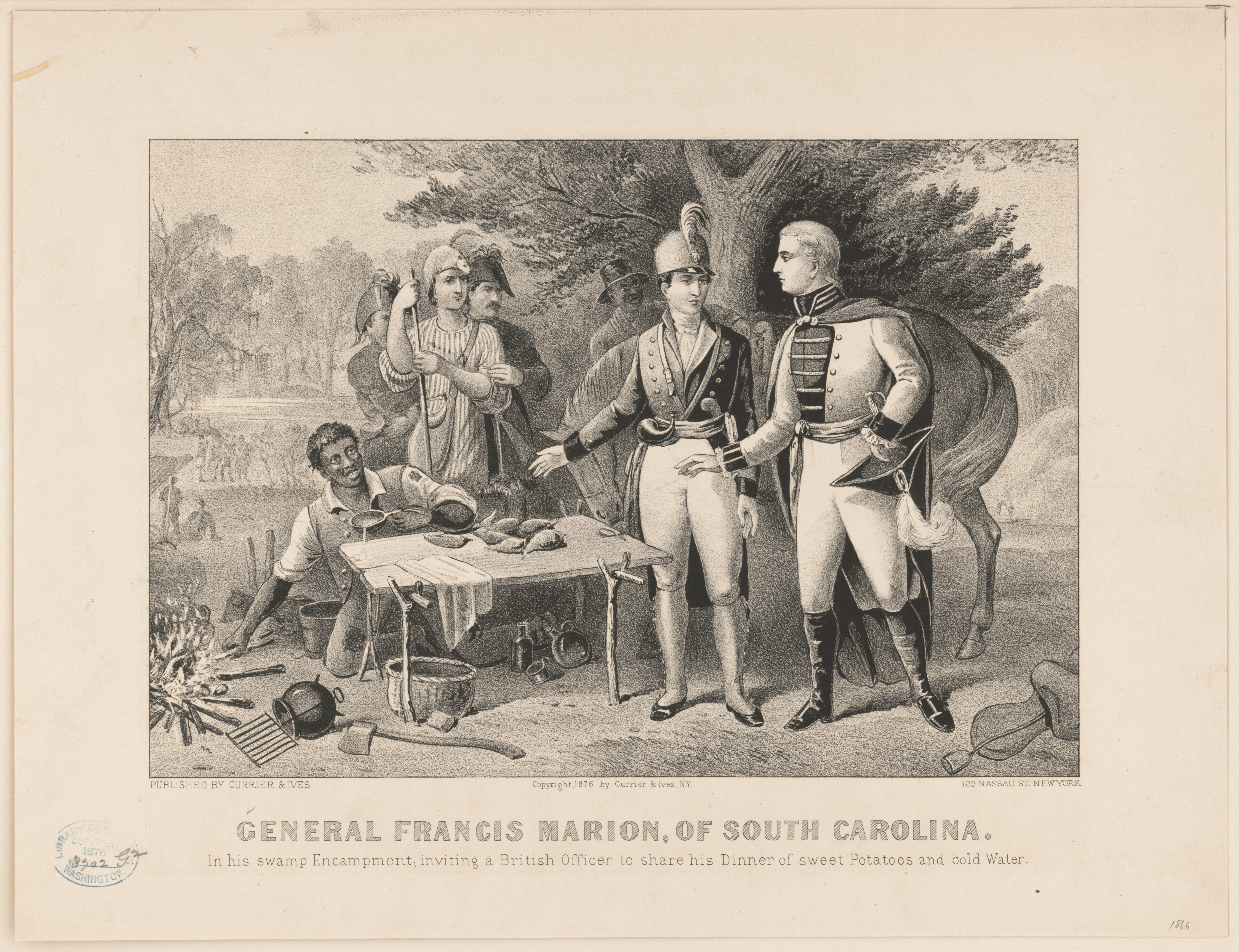
The Quiz Question
Which American militia commander earned the nickname 'the Swamp Fox' for his hit-and-run guerrilla raids against British forces in the South Carolina backcountry?
- A. Francis Marion
- B. Nathanael Greene
- C. Daniel Morgan
- D. Thomas Sumter
The answer is A. Francis Marion. Here is the full story.
He commanded no regular army. He wore no grand uniform. He had no supply chain, no artillery, and rarely more than a few hundred ragged volunteers at his side. And yet Francis Marion — the Swamp Fox of South Carolina — helped break the back of British power in the American South, one midnight raid at a time.
The Ghost of the Carolina Swamps
Between 1780 and 1781, Marion and his militia paralysed British supply lines across a 150-mile stretch of South Carolina Low Country. His men could vanish into the Pee Dee River swamps within hours of striking a target, making conventional British pursuit tactics almost entirely useless.
Marion never commanded more than a few hundred men at any one time, yet he tied down thousands of British and Loyalist troops who were desperately needed elsewhere. His campaign is considered one of the earliest and most effective examples of guerrilla warfare in American military history — a template that military strategists have returned to again and again in the centuries since.
It was the feared British cavalry commander Colonel Banastre Tarleton who, in a moment of pure frustration, gave Marion the nickname that would define him. After an exhausting and fruitless chase through South Carolina swampland, Tarleton reportedly declared that he could not catch "the Swamp Fox" — and the name stuck forever.
Who Was Francis Marion? The Man Behind the Legend
Francis Marion was born around 1732 on a small plantation in Berkeley County, South Carolina, to a Huguenot French family. That heritage — of a people who had survived persecution and displacement — shaped his tenacity and fierce independence in ways that would only become apparent decades later.
As a young man, he survived a shipwreck in the Caribbean that killed several of his crewmates. It was an early and brutal lesson in endurance — one that hardened a constitution already shaped by the demands of Low Country plantation life. He gained his first military experience fighting the Cherokee Nation during the French and Indian War between 1759 and 1761, serving under Colonel James Grant in campaigns through difficult backcountry terrain that would later prove invaluable.
By the outbreak of the Revolution he was a respected planter and a member of the South Carolina Provincial Congress, choosing the Patriot cause without hesitation. A small, wiry man — reportedly only 5ft 2in tall — he suffered a broken ankle at a party in Charleston in early 1780. That injury, humiliating at the time, almost certainly saved his life: it forced him to leave the city before British forces under Sir Henry Clinton closed the trap and captured its garrison.
The Fall of the South: Why Marion's War Became Necessary
On 12 May 1780, Charleston fell to the British — the largest American defeat of the entire Revolutionary War. More than 5,000 Continental soldiers and militia were captured in a single blow, stripping the South of its organised military defence almost overnight.
The catastrophe deepened on 16 August 1780 at the Battle of Camden, where General Horatio Gates's newly assembled Continental Army was routed by Lord Cornwallis's forces. Gates himself fled so fast that he covered 180 miles in three days. There was now no organised Patriot force left in the Carolinas.
Cornwallis moved to pacify the region, garrisoning towns like Camden, Georgetown, and Ninety-Six with Loyalist militia and regular troops. Loyalist units — particularly Tarleton's British Legion and Major Patrick Ferguson's corps — carried out brutal reprisals against Patriot families across the backcountry. The effect was the opposite of pacification: neutral settlers, their farms burned and their families terrorised, began filtering toward Marion's banner.
With no army to fight alongside, Marion understood his only viable strategy was relentless, mobile harassment. Deny the British control of the countryside. Cut their supply lines. Keep them off-balance, exhausted, and afraid of shadows.
Tactics of a Ghost: How Marion Fought and Won
Marion operated from hidden base camps deep in the swamps. The most famous was Snow's Island, at the confluence of the Pee Dee and Lynches rivers, which he used from late 1780 into early 1781. It was difficult to approach by land and almost impossible to find without a local guide.
His standard tactic was brutally simple and consistently effective: strike a British post or supply column at dawn, inflict maximum damage, then scatter into the swamp before reinforcements could arrive — often covering thirty miles in a single night. His men were largely self-sufficient, living off the land, supplying their own horses, and armed with their personal weapons. The Continental Army had nothing left to give them.
He struck British posts at Black Mingo Creek on 28 September 1780, and at Tearcoat Swamp on 25 October 1780, destroying Loyalist militia units and capturing vital supplies on both occasions. His intelligence network was equally remarkable — a web of sympathetic local farmers and enslaved people who monitored British troop movements across the Low Country and fed information back to Snow's Island.
Cat and Mouse: Marion vs. Tarleton and the British Command
Colonel Banastre Tarleton was the most aggressive cavalry commander the British had in the South, and in November 1780 he was dispatched specifically to hunt Marion down. He gave up after a 26-mile chase through swampland that left his horses exhausted and his men no closer to their quarry.
It was after this humiliating pursuit that Tarleton reportedly said: "Come, my boys! Let us go back. We will find the Gamecock, but as for this damned old fox, the devil himself could not catch him." The "Gamecock" was fellow guerrilla leader Thomas Sumter. The Swamp Fox — and the legend — was born in that moment of frustration.
Lord Rawdon, commanding the Camden district, wrote to Cornwallis expressing serious concern about Marion's ability to disrupt operations. Marion's raids forced the British to divert troops to escort even small supply convoys, dramatically increasing the cost and difficulty of maintaining their occupation of South Carolina.
In winter 1781, Loyalist Colonel Welbore Ellis Doyle led an operation that temporarily overran and destroyed Snow's Island base. Marion simply established a new camp and resumed operations within days. Destroying his headquarters achieved nothing — his army lived in the men's minds, not in any fixed location.
Key Battles and Raids: The Swamp Fox in Action
At the Battle of Black Mingo Creek on 28 September 1780, Marion's 52 men ambushed a Loyalist force under Captain John Coming Ball, killing or wounding 24 and capturing 13 — a stunning result against a well-armed, prepared unit holding a defended position.
In January 1781, Marion briefly seized the port town of Georgetown, capturing the garrison commander Colonel George Campbell and demonstrating he could strike British-held towns as well as supply columns and isolated outposts. It was a bold signal that no position in the Low Country was truly safe.
Working with Continental General Henry "Light-Horse Harry" Lee in April 1781, Marion's men stormed the British stockade at Fort Watson using a rapidly constructed Maham Tower — a log platform built high enough to allow riflemen to fire down into the fort over its walls. The garrison surrendered. It was an improvised solution to a tactical problem that became a standard technique in subsequent operations.
At Fort Motte on 12 May 1781 — the first anniversary of Charleston's fall — Marion and Lee used flaming arrows to ignite the roof of a captured plantation house being used as a British fort, forcing the garrison's surrender. The date was almost certainly not a coincidence. At the Battle of Eutaw Springs on 8 September 1781, Marion commanded a brigade in the last major engagement fought in South Carolina, where American forces fought the British to a tactical draw but secured a significant strategic advantage, compelling a British withdrawal toward Charleston.
The Men Who Rode with the Swamp Fox
Lieutenant Colonel Peter Horry was one of Marion's most trusted officers, leading cavalry raids and later collaborating on one of the first biographies of Marion — though the published version was heavily fictionalised by the writer Mason Weems, who had a habit of embroidering heroic stories.
Colonel Hugh Horry and Captain John James were veteran Low Country men who provided Marion with intimate local knowledge of every creek, trail, and swamp crossing in the region. That knowledge was worth more than any weapon. Many of Marion's fighters were Scots-Irish backcountry settlers with deep personal grievances — men whose farms had been burned and whose families had been harassed by Loyalist forces.
Enslaved African Americans played a complex and largely unacknowledged role in the campaign. Some served as scouts and intelligence sources for Marion, monitoring British movements and reporting back through networks invisible to British eyes. The broader picture was deeply contradictory: Marion was himself an enslaver, and the war touched enslaved people on all sides, with freedom sometimes promised as a reward by both British and Patriot commanders.
The militia's lack of pay, uniforms, or regular rations meant loyalty was always personal. Men came and went according to harvest seasons and family necessity. Marion held them together not through military authority but through force of character — they followed the man, not the rank.
Aftermath: The Collapse of British Power in the South
Cornwallis surrendered at Yorktown on 19 October 1781, effectively ending major combat operations. But Marion continued active campaigning in South Carolina well into 1782, unwilling to leave the field while British forces still occupied Charleston.
Historians credit guerrilla leaders like Marion, Thomas Sumter, and Andrew Pickens with making British Southern strategy ultimately untenable. Cornwallis had needed a pacified South Carolina as his base. Marion, almost single-handedly, ensured he never had it.
After the war, Marion served in the South Carolina State Senate and was a delegate to the 1790 state constitutional convention. Remarkably for his time, he advocated for leniency toward former Loyalists — a measure of the man's character that his battlefield reputation sometimes overshadows. He married Mary Esther Videau in 1786 and returned to plantation life at Pond Bluff on the Santee River. He died on 27 February 1795, aged approximately 63, having lived just long enough to see the republic he had helped create begin to find its feet.
Legacy: Why the Swamp Fox Still Matters
Military strategists from the twentieth century onwards have studied Marion's campaigns as foundational texts in guerrilla warfare doctrine. His principles — mobility over firepower, local knowledge over numbers, avoiding pitched battle against a superior force — have influenced irregular resistance movements worldwide.
A 1959 Disney television series starring Leslie Nielsen as Francis Marion brought the Swamp Fox legend to a new generation of Americans. Mel Gibson's 2000 film The Patriot drew heavily on Marion's story for its central character Benjamin Martin, though it fictionalised and dramatised events considerably. Marion County in South Carolina and the city of Marion are named in his honour, and his statue stands in the United States Capitol's National Statuary Hall.
For British military historians, his campaign offers a sobering case study in how a determined, locally-supported irregular force can neutralise a conventionally superior army — a lesson painfully relearned in conflicts throughout the following two centuries, from the American Civil War's partisan rangers to twentieth-century insurgencies across the globe.
Francis Marion won no single great battle. He captured no British general in a decisive engagement. But in the swamps and creeks of South Carolina, with a handful of hungry volunteers and an encyclopaedic knowledge of the land, he helped deny the most powerful military force of his age the one thing it could not afford to lose: control of the countryside.
Do you have a favourite story from the guerrilla war in the South? Or a question about Marion's campaigns we haven't covered? Share your thoughts in the comments below — and if you found this article worth reading, pass it on to someone who loves the real stories behind American history.
Further Reading
- Smithsonian Institution, Washington D.C.
- The National Archives, Washington D.C. (including Revolutionary War pension records and military service files)
- South Carolina Department of Archives and History, Columbia, South Carolina
- The Museum of the American Revolution, Philadelphia, Pennsylvania
- Library of Congress, American Memory Collection — Revolutionary War era materials