The Quiz Question
British and French forces besieged the Russian naval base of Sevastopol during the Crimean War, unable to break through for want of heavy artillery. Roughly how long did the siege last?
- A. 6 weeks
- B. 3 months
- C. 349 days
- D. Two full years
The answer is C. 349 days. Here is the full story.
In the autumn of 1854, British and French soldiers dug into the rocky hillsides south of a Russian city they expected to take in weeks. They were still there almost a year later — frozen, starving, and fighting for every inch of ground. The Siege of Sevastopol lasted 349 days and became one of the defining military ordeals of the nineteenth century, reshaping armies, nursing, journalism, and the very nature of modern war.
A Port That Had to Fall: Why Sevastopol Mattered
Sevastopol was not simply a city — it was the beating heart of Russian naval power in the south. Home to the Imperial Black Sea Fleet and its deep-water anchorages, the port gave Russia the ability to project force toward the crumbling Ottoman Empire and, by extension, toward British interests in the Mediterranean and the overland route to India.
Tsar Nicholas I had spent decades fortifying the place. The city sat on a rocky peninsula cut by natural ravines and deep-water inlets, its landward approaches studded with artillery bastions and earthwork redoubts. In Russian strategic thinking, Sevastopol was the jewel of the south — and the Allies knew that destroying it meant breaking Russia's capacity to threaten the region for a generation.
The war aim was therefore not simply territorial. Britain and France wanted to neutralise Russian sea power in the Black Sea permanently, and that meant taking or wrecking the port, the dockyards, and the fleet sheltering within them.
How Britain and France Ended Up in Crimea
The crisis had been building for years. Russia's occupation of the Danubian Principalities — modern-day Romania — and the destruction of an Ottoman naval squadron at Sinop in November 1853 brought matters to a head. Britain and France declared war on Russia on 28 March 1854, pledging to defend Ottoman territorial integrity.
The original Allied strategy focused on the Danube region, but when Russia withdrew from the Principalities under Austrian diplomatic pressure, the Allies found themselves without a clear objective. An Allied council of war in late August 1854 made the fateful decision: land in Crimea and take Sevastopol.
It was a bold choice made on limited intelligence. The British force — roughly 27,000 men under Lord Raglan, a veteran who had lost his arm at Waterloo — and a French contingent of around 30,000 under Marshal Saint-Arnaud landed at Kalamita Bay on 14 September 1854. Neither commander fully understood what lay ahead of them.
The Opening Moves: Victory at the Alma, Then Hesitation
Six days after landing, on 20 September 1854, the Allies won the Battle of the Alma, driving Russian forces under Prince Menshikov off strong defensive positions above the Alma River. It was a genuine victory — but what followed was a fateful pause.
Rather than pressing immediately toward Sevastopol's relatively lightly defended northern side, the Allies hesitated for nearly a week. Saint-Arnaud was dying of cholera; command passed to General Canrobert. That week gave Russian military engineer Colonel Eduard Totleben the time he desperately needed.
Totleben worked through day and night, throwing up earthen parapets, digging rifle pits, and transforming a city with modest fixed defences into a formidable fortress. The Allies, meanwhile, chose to march around the city to establish supply bases at Balaclava for the British and Kamiesch Bay for the French — a sensible logistical decision that nonetheless ceded the initiative to the defenders.
The Russian fleet was scuttled across the harbour mouth on 22–23 September 1854, blocking any Allied naval assault. The guns and crews from those ships were transferred directly to the land defences, dramatically strengthening Totleben's growing network of bastions.
The Siege Begins: Guns, Mud and Misery
The formal siege opened on 17 October 1854 with a massive Allied bombardment — over a thousand guns firing for hours at Sevastopol's defences. The result was deeply discouraging. Totleben had deliberately built earthen parapets rather than stone walls. Cannonballs buried themselves harmlessly in the soil rather than shattering masonry into lethal fragments that could kill defenders by the dozen.
The bombardment had been intended as the prelude to an immediate infantry assault. Instead, the defences held, the assault was cancelled, and the pattern for the next eleven months was set: grinding attritional warfare, constant casualties, and no decisive breakthrough.
By the winter of 1854–55, the British Army was in a state of crisis that shocked the home public. Soldiers lacked adequate winter clothing. Food supplies were chaotic. Cholera — which had already devastated the force even before the siege began — continued to kill. The supply road from Balaclava to the siege lines turned into a notorious mud-choked nightmare after autumn rains.
The French, who were better organised and supplied, increasingly bore the heavier burden of the front lines as British strength collapsed through that terrible first winter. The disparity in capability between the two Allied armies became painfully apparent.
Blood on the Hills: Balaclava and Inkerman
The siege was punctuated by some of the most dramatic fighting of the entire Victorian era. On 25 October 1854, Russian forces struck at the Allied base at Balaclava, producing two moments that would pass into legend. The 93rd Highlanders — the 'Thin Red Line' — held off Russian cavalry in a thin two-deep formation that astonished observers. Then, through a catastrophic misreading of orders, the Light Brigade — 673 cavalry — charged directly into the muzzles of Russian artillery at the end of a valley.
Around 278 men were killed or wounded in minutes. The charge achieved nothing militarily and became a permanent byword for the courage of common soldiers undone by the blunders of their commanders. The story of the Light Brigade remains one of the most debated episodes in British military history.
On 5 November 1854, Russian forces launched a major assault on the Allied right flank at Inkerman, attacking in thick fog across broken terrain. British troops fought largely without coherent orders in desperate, close-quarters combat with bayonets and rifle butts. The battle cost the British over 2,500 casualties but ended serious Russian attempts to break the siege from outside. From this point, Sevastopol's fate would be settled by pure endurance.
The Men Who Defined the Siege
Eduard Totleben became the true hero of the Russian defence. His engineering genius — the constant repairs to battered earthworks, the network of rifle pits pushing outward to harass Allied trench-diggers, the intelligent use of available manpower — frustrated Allied planners for the better part of a year. Military historians have consistently ranked him among the finest military engineers of the nineteenth century.
Lord Raglan, worn down by the demands of coalition command, the horrors of that first winter, and the relentless criticism flowing back to London via newspaper reports, died of dysentery on 28 June 1855. He was 66 years old and had given the last of himself to the campaign.
Admiral Pavel Nakhimov, the Russian naval hero of Sinop, refused every suggestion that he leave the city. He commanded the harbour defences with conspicuous courage until a sniper's bullet struck him on the Malakhov bastion on 10 July 1855. He died two days later and became one of Russia's most venerated military figures.
Florence Nightingale arrived at the Barrack Hospital at Scutari, near Constantinople, in November 1854 with 38 nurses. The conditions she found were appalling — overcrowding, inadequate sanitation, and a death rate that killed more men than Russian bullets. Her systematic reforms of hospital administration, sanitation, and nursing practice saved thousands of lives and built the foundations of modern professional nursing. Her contribution to the Crimean War transformed how the world thought about medical care in wartime.
The Long Grind: 1855 and the Road to the Final Assault
The arrival of Sardinian troops — some 15,000 men — in early 1855 after Piedmont-Sardinia joined the Allied cause provided a welcome reinforcement. More transformative still was the completion of a narrow-gauge railway from Balaclava to the siege lines in the spring of 1855. Supplies that had once taken exhausted men and animals days to haul through mud now arrived in hours.
General Pélissier replaced the increasingly cautious Canrobert as French commander in May 1855 and immediately brought a more aggressive spirit to Allied planning. The key objective became clear: the Malakhov Tower and its surrounding complex of bastions, which anchored the entire eastern defensive line. Take the Malakhov, the reasoning went, and the whole Russian position would unravel.
A major Allied assault on 18 June 1855 — chosen with grim symbolism as the fortieth anniversary of Waterloo — was repulsed with heavy losses. The failure stung, but it sharpened Allied focus. Throughout the summer, both sides suffered relentless casualties from artillery duels, sniper fire, and brutal trench raids. The fighting never stopped, even between formal assaults.
The Fall of Sevastopol: 8 September 1855
After a devastating three-day preparatory bombardment, French troops stormed the Malakhov on the morning of 8 September 1855. The assault was brilliantly executed — carefully timed, launched from forward trenches dug close to the Russian parapet, and completed in a matter of minutes before the defenders could properly respond. The tricolour flew over the Malakhov before the Russians fully understood what had happened.
British attacks on the Great Redan fortification the same day were costly and ultimately repulsed. It was French success at the Malakhov, not British arms, that decided the battle. With the most critical point of the defence in Allied hands, Russian commanders concluded that Sevastopol was indefensible.
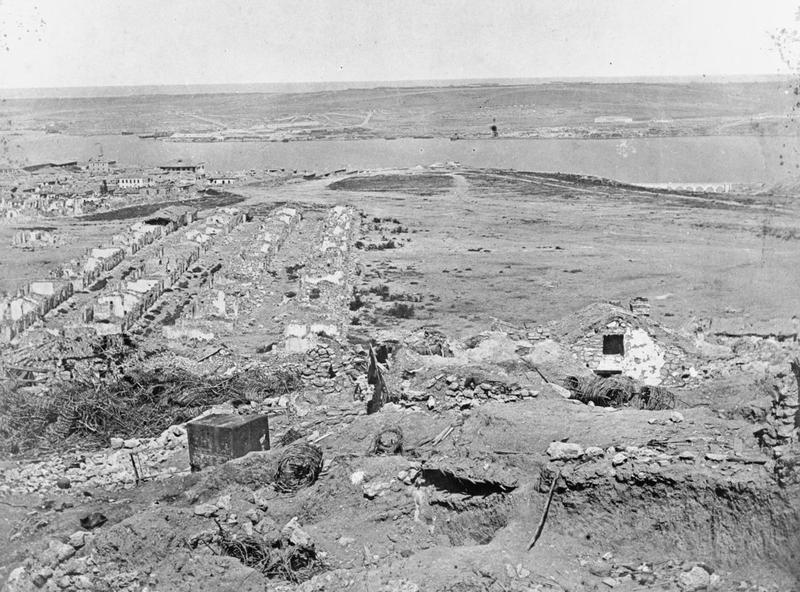
That night, Russian forces evacuated across a pontoon bridge to the north side of the harbour. Before they went, they demolished the dockyards, blew up the magazines, and sank the remaining ships — ensuring that whatever the Allies captured, it would not be a functioning naval base. Allied forces entered a shattered, burning city on 9 September 1855. The siege that had opened on 17 October 1854 was over after approximately 349 days.
Aftermath and Legacy: What 349 Days Changed
The Treaty of Paris, signed 30 March 1856, imposed a humiliating settlement on Russia. The Black Sea was neutralised — Russia could not base a war fleet there — and southern Bessarabia was ceded. The strategic aims for which Britain and France had fought were, on paper, achieved.
The war's exposure of catastrophic failures in British military supply, medical care, and high command triggered furious public debate at home and drove sweeping army reforms, culminating eventually in the Cardwell Reforms of the early 1870s that modernised the entire structure of the British Army.
The Victoria Cross was instituted by royal warrant on 29 January 1856, directly inspired by the gallantry witnessed throughout the campaign. The first 111 VCs were awarded to veterans of the Crimean War — a permanent acknowledgement that extraordinary courage deserved extraordinary recognition.
The war also introduced technologies and practices that foreshadowed modern warfare. The electric telegraph was used for military communication. The conflict was extensively photographed by Roger Fenton and reported in near-real time by journalists including William Howard Russell of The Times, whose dispatches on the suffering of British soldiers created the first great media-driven military scandal in British history.
And Sevastopol's story did not end in 1855. Almost exactly ninety years later, German and Romanian forces besieged the city from 1941 to 1942 during the Second World War, in an even longer and bloodier ordeal. The echo of 1854 runs through Soviet — and now Russian — memory of the city as a place of sacred, unbreakable resistance.
The 349-day siege remains a masterclass in the distance between strategic ambition and battlefield reality — and a monument to the endurance of ordinary soldiers on both sides who lived and died in the mud beneath those Crimean hills.
If this story resonated with you, we'd love to hear your thoughts in the comments below. Which aspect of the siege surprised you most — Totleben's engineering genius, the disasters at Balaclava, or the sheer scale of the suffering? Share this article with a fellow history lover and keep the conversation going.
Further Reading
- The National Archives, Kew — holds British military records, dispatches, and official correspondence from the Crimean War period
- The National Army Museum, London — collections covering British Army history including the Crimean War, the Victoria Cross, and the Charge of the Light Brigade
- The Florence Nightingale Museum, London — dedicated to Nightingale's life, her work at Scutari, and her lasting influence on nursing and public health
- The Imperial War Museum, London — broader collections on British conflicts, with contextual material linking the Crimean War to later Victorian and twentieth-century military history
- Bibliothèque nationale de France — holds French military archives, campaign records, and contemporary illustrated press coverage of the siege of Sevastopol