The Quiz Question
General Douglas MacArthur's risky September 1950 amphibious assault behind North Korean lines, which recaptured Seoul within two weeks, was codenamed Operation what?
- A. Chromite
- B. Overlord
- C. Rugged
- D. Killer
The answer is A. Chromite. Here is the full story.
In the summer of 1950, the Korean War looked like it might end in catastrophe for the United Nations. Communist North Korean forces had swept the length of the peninsula in weeks, and American and South Korean troops were clinging to a tiny corner of southeast Korea with their backs to the sea. What happened next — a single bold stroke conceived by one of America's most controversial generals — would reverse the entire course of the war in less than a month.
A Gamble That Could Have Lost the War — or Won It
By August 1950, United Nations forces were compressed into the Pusan Perimeter, a narrow rectangle of Korean soil roughly 140 miles long and 50 miles wide. The North Korean People's Army had driven south with terrifying speed since June 25, capturing Seoul in just three days. The question was no longer whether the UN could win — it was whether it could survive.
General Douglas MacArthur's answer was audacious to the point of recklessness. Rather than reinforce the perimeter and push north, he proposed going around — striking 200 miles behind enemy lines at the port city of Inchon on Korea's west coast. The Joint Chiefs of Staff were alarmed. The tides at Inchon were among the most punishing in the world, the approach channels were mined, and the city itself was defended. They called the plan too risky.
MacArthur was unmoved. At a now-legendary briefing in Tokyo on August 23, 1950, he reportedly spoke for 45 minutes, dismantling every objection and closing with the declaration: "We shall land at Inchon, and I shall crush them." It remains one of the most audacious moments in modern military planning. The Joint Chiefs reluctantly approved the operation.
Korea in Crisis: How the War Reached Breaking Point
North Korea's invasion on June 25, 1950 was a sledgehammer blow. Some 135,000 troops poured south, spearheaded by Soviet-supplied T-34 tanks that the poorly equipped South Korean army could barely scratch. Seoul fell on June 28. The South Korean military was in danger of complete collapse within days.
The first American troops to engage — Task Force Smith, a cobbled-together force of around 540 soldiers — met the North Koreans at Osan on July 5, 1950, and were badly routed. It was a brutal introduction to a war many Americans had expected to end quickly. Reinforcements poured into the peninsula, but the fighting retreat continued for weeks.
Lieutenant General Walton Walker's Eighth Army fought desperately through August to hold the Pusan Perimeter against wave after wave of North Korean assaults. The line bent repeatedly but did not break. Without a dramatic change in strategy, however, the mathematics were grim. A fresh idea was not merely desirable — it was existential.
Why Inchon? The Method Behind the Madness
Inchon sits on Korea's west coast, just 25 miles from Seoul. Seizing it would sever the main supply artery feeding the 70,000 North Korean troops besieging Pusan — a logistical stranglehold that MacArthur believed would cause the entire enemy force to collapse. Strategically, the logic was sound.
MacArthur's most counter-intuitive argument was that Inchon's very difficulty made it ideal. The enemy would never expect an attack there. The tidal range reached 32 feet — among the most extreme on earth — meaning landing craft had windows of only a few hours, twice each day, before the mudflats became impassable. Miss the tide and troops would be stranded in the open.
The only autumn date with adequate tidal conditions was September 15, 1950. That gave planners barely six weeks to assemble one of the largest amphibious operations since the Second World War. Intelligence was gathered in extraordinary circumstances: a covert Navy team led by Lieutenant Eugene Clark spent two weeks on Yonghung-do island, secretly measuring tides, charting channels, and assessing North Korean defences under the enemy's nose.
The Forces Assembled: 75,000 Troops and 261 Ships
The assault force was designated X Corps, commanded by Major General Edward "Ned" Almond, MacArthur's chief of staff. Its core was the 1st Marine Division under Major General Oliver P. Smith — around 25,000 Marines who would lead the amphibious assault itself. The US 7th Infantry Division would follow ashore to drive inland toward Seoul.
In total, 261 naval vessels gathered for the operation, drawn from the navies of the United States, Britain, Canada, Australia, France, and New Zealand. This was emphatically a United Nations coalition at sea as well as on land. British warships HMS Jamaica and HMS Kenya participated directly in the pre-landing naval bombardment — a contribution that is frequently overlooked in American-centric accounts of the battle.
The logistical achievement of assembling this force in six weeks, across the Pacific, while a desperate battle raged at Pusan, remains remarkable. Supply ships, landing craft, ammunition, and vehicles all had to be sourced, loaded, and positioned with near-perfect coordination.
D-Day at Inchon: September 15, 1950
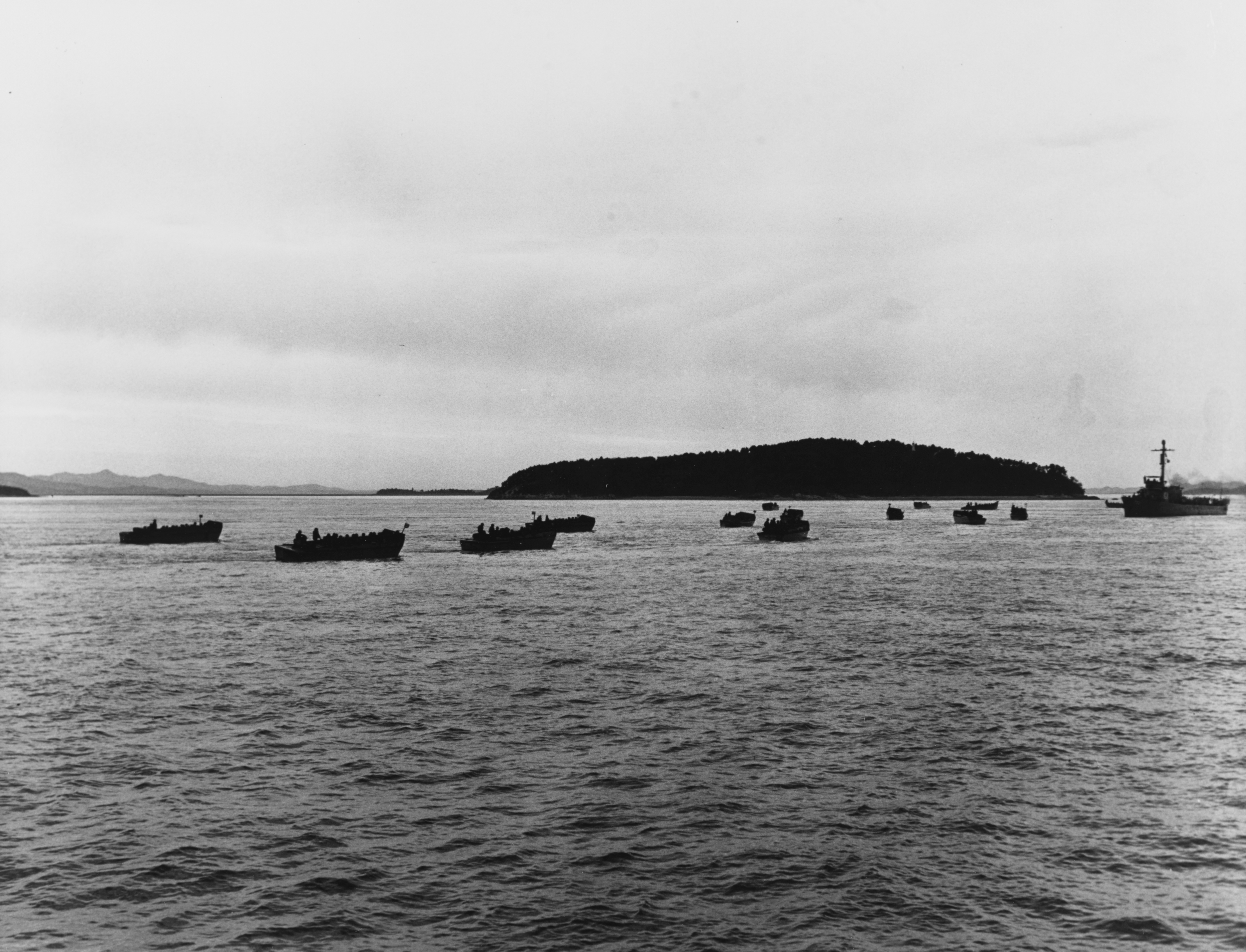
The assault opened at 06:33 on September 15, 1950, with Marines storming Wolmi-do, the small fortified island that commanded the entrance to Inchon harbour. It fell in just 45 minutes — a swift, sharp action that secured the approach before the tide retreated and forced a pause until evening.
The main landings at Red Beach and Blue Beach went in at 17:30, racing the falling tide and the fading light. Marines scaled 15-foot seawalls using ladders, fighting their way into the streets of Inchon itself as darkness closed around them. The conditions were brutal — urban combat, uncertain ground, and a timeline dictated by the sea rather than the battle.
North Korean resistance was fierce in places, but the garrison had been caught badly off-guard. The pre-landing bombardment and the speed of the assault had disrupted their defences. Within 24 hours, Inchon was largely in UN hands. Casualties on the first day — 20 Marines killed, 174 wounded — were remarkably light given the scale and complexity of the operation. MacArthur's gamble had cleared its first and most dangerous hurdle.
The Drive to Seoul: Eleven Days of Hard Fighting
Securing Inchon was only the beginning. X Corps now had to push 25 miles inland through contested terrain to reach Seoul — a city of roughly one million people that the North Koreans were determined to hold. The fighting that followed was some of the most intense of the entire Korean War.
Kimpo Airfield, South Korea's largest, was captured on September 17, just two days after the landing. It gave UN forces an immediate airbase close to the front, accelerating both logistics and close air support. Marines crossed the Han River and approached Seoul from the west and south.
The Battle of Seoul began in earnest around September 22 and lasted until September 25. North Korean defenders used every building, every alleyway, every rubble pile as a fighting position. Barricades of rice sacks and furniture blocked the main streets. The Marines cleared them block by block, in close-quarters combat that tested even veteran soldiers.
MacArthur formally announced Seoul's liberation on September 26, 1950 — eleven days after the first Marines went ashore, and just ninety days after the North Koreans had taken it. The speed was astonishing. South Korean President Syngman Rhee was returned to the capital in a ceremony designed to signal that the Republic of Korea had been restored.
MacArthur: The Commander Who Bet Everything
Douglas MacArthur was 70 years old in September 1950, already a figure of enormous legend — Pacific War hero, Supreme Commander in Japan, architect of that nation's postwar reconstruction. Inchon was his most dramatic throw of the dice, and he knew it.
He had overruled the combined scepticism of the Joint Chiefs almost single-handedly, relying on the force of his own reputation and reasoning. His decision to personally come ashore at Inchon on September 17, just two days after the assault, was seen by some as inspired leadership and by others as reckless theatre. MacArthur was rarely troubled by that distinction.
Operation Chromite would prove to be the high point of his Korean command. Within months, his public disagreements with President Truman over strategy — particularly his desire to expand the war against China — would see him relieved of command in April 1951, one of the most dramatic dismissals in American military history. Military historians continue to debate his legacy: was Inchon genius or a lucky gamble that happened to work? MacArthur's own view was characteristically unambiguous — "Inchon was won before the first shot was fired."
The Domino Effect: How Chromite Changed the Whole War
The strategic consequences of the landing were immediate and massive. With their supply lines cut at Inchon, the North Korean forces besieging Pusan suddenly found themselves in a trap. Lieutenant General Walker's Eighth Army broke out of the Pusan Perimeter on September 16 — the very day after the landings — and drove north. The NKPA, caught between two UN forces, collapsed with extraordinary speed.
By late September, an estimated 135,000 North Korean soldiers had been killed, captured, or scattered across the peninsula. Entire divisions simply disintegrated. The army that had seemed unstoppable in June was broken in a matter of weeks.
By October 1, 1950, UN forces had crossed the 38th Parallel — the original war aim of restoring South Korea's territory had been achieved in under two weeks from the Inchon landing. But the momentum carried MacArthur further. Pressing north toward the Chinese border at the Yalu River, he fatally underestimated the likelihood of Chinese intervention. In November 1950, China entered the war with hundreds of thousands of troops, transforming the conflict into a grinding stalemate that lasted another two and a half years.
Operation Chromite is today taught at staff colleges around the world alongside the Normandy landings and Gallipoli — as a study in both the transformative power of amphibious warfare and the dangers of overreach that can follow even the most brilliant victory.
Legacy: What Operation Chromite Means Today
Inchon is widely considered the last truly decisive large-scale amphibious assault in military history. Post-Falklands analysis, and subsequent studies of modern coastal operations, frequently return to it as a benchmark for what audacious planning combined with joint-force coordination can achieve.
The British contribution — naval firepower, diplomatic weight within the UN framework, and the Royal Navy's willingness to operate in difficult inshore waters — is an underappreciated part of the story. HMS Jamaica and HMS Kenya were part of a broader Commonwealth naval presence that gave the coalition genuine multinational credibility.
A permanent memorial stands at Inchon today, including a large statue of MacArthur overlooking the harbour where the Marines landed. For Koreans, the site carries the weight of national salvation. For veterans of the conflict — Americans, British, Australians, Canadians, and others — it is a place of deep significance, part of a war too often called the "Forgotten War" despite its enormous cost.
The numbers demand respect. Some 36,500 Americans died in the Korean War. The United Kingdom lost 1,078 service personnel. Total UN casualties ran into the hundreds of thousands, and Korean civilian losses were catastrophic. Operation Chromite, for all its brilliance, was one chapter in a brutal and unfinished conflict — the Korean War technically continues under an armistice, not a peace treaty, to this day.
September 2025 marks the 75th anniversary of the Inchon landing. It is a moment to remember not just the audacity of the plan, but the Marines who scaled those seawalls in the dark, the sailors who navigated treacherous tidal channels, and the soldiers who fought street by street through a shattered Seoul. They deserve to be remembered — not just as footnotes to MacArthur's legend, but as the men who held the line and turned the tide.
If this story of courage and strategic daring resonates with you, we'd love to hear your thoughts in the comments below. Did you have a family member who served in Korea? Share this article with someone who deserves to know this history — the Korean War generation have waited long enough for the recognition they earned.
Further Reading
- The National Archives (United Kingdom) — holds extensive records of British naval and ground forces in the Korean War
- The National Archives and Records Administration (NARA), United States — primary source documents on X Corps, the Inchon operation, and MacArthur's command
- The Imperial War Museum, London — collections covering British and Commonwealth involvement in the Korean War, including personal testimonies
- The Douglas MacArthur Memorial, Norfolk, Virginia — dedicated archive and museum covering MacArthur's full military career including the Korean War
- The Korean War Veterans Memorial Foundation, Washington D.C. — educational resources and oral history projects dedicated to Korean War commemoration