The Quiz Question
Six British regiments still wear roses each 1 August to mark which 1759 Seven Years' War victory, where they picked wild roses before the battle?
- A. The Battle of Dettingen
- B. The Battle of Quebec
- C. The Battle of Culloden
- D. The Battle of Fontenoy
The answer is E. The Battle of Minden -- fought on 1 August 1759, where six British regiments advanced through rose hedges and picked roses, still worn on Minden Day. Dettingen (1743), Fontenoy (1745) and Culloden (1746) predate it, and Quebec had no rose tradition.. Here is the full story.
Every 1 August, in barracks across Britain and wherever their battalions happen to be deployed, soldiers in six historic British regiments do something that sets them apart from almost every other unit in the world. They pin roses to their caps. It is not a modern PR gesture or a ceremonial novelty. It is a tradition that began without orders, without ceremony and without anyone intending to start something that would last nearly 270 years — on a summer morning on a German heath, when men marching to battle simply reached out and picked the flowers growing in the hedgerows beside them.
Roses Before Battle: The Tradition That Started on a Summer Morning
Minden Day falls on 1 August each year, marking the anniversary of the Battle of Minden fought in 1759 during the Seven Years' War. The six British infantry regiments at the heart of the battle — the 12th, 20th, 23rd, 25th, 37th and 51st Foot — advanced through hedgerows thick with wild roses on that August morning and, almost instinctively, plucked blooms and pinned them to their hats.
No order was ever issued. No general decreed it. Soldiers simply picked the flowers, and the regiments never stopped. Those original six units have since been reorganised and amalgamated through centuries of army reform, evolving into successor regiments including the Royal Anglian Regiment and the Princess of Wales's Royal Regiment, among others. But the rose tradition survived every reorganisation.
It is one of the very few 18th-century battlefield customs with a continuous, unbroken life in the modern British Army — a living thread connecting soldiers today to men who stood in a German rose hedge more than two and a half centuries ago.
The Seven Years' War: Britain, France and a World in Conflict
The Seven Years' War (1756–1763) was the first truly global conflict in history, fought simultaneously across Europe, North America, India, the Caribbean and West Africa. Britain and Prussia stood allied against a formidable coalition of France, Austria, Russia, Sweden and Saxony — a combination that dwarfed anything Europe had previously assembled.
For Britain, 1759 became known as the Annus Mirabilis — the Wonderful Year. Major victories at Quebec, Lagos, Quiberon Bay and Minden arrived in rapid succession, reshaping the strategic map of the world within a single calendar year. The historian Horace Walpole famously remarked that he had to ask every morning what new victory had arrived overnight.
France's strategic objective in Germany was straightforward: knock Prussia out of the war by seizing Hanover, whose Elector happened to be King George II of Britain. If Hanover fell, Britain would be forced to divert resources from the colonial theatres where she was steadily dismantling France's empire. Minden was therefore not a peripheral engagement — it sat at the hinge of British global strategy.
The Road to Minden: Armies, Commanders and the Stakes of 1 August
The Allied army at Minden was commanded by Prince Ferdinand of Brunswick, a Prussian general of considerable ability who had reorganised and revitalised Allied fortunes in Germany. His force numbered approximately 43,000 men drawn from British, Hanoverian, Brunswick and Prussian contingents.
Opposing him was the French army under Marshal the Marquis de Contades, numbering around 54,000 — a significant numerical advantage that gave France good reason for confidence. The battle would be fought on Minden Heath, a wide open plain in northwest Germany, crossed by hedgerows heavy with wild roses in the full bloom of high summer.
The British contingent's cavalry was commanded by Lieutenant-General Lord George Sackville, a politically connected officer whose name would become infamous before the day was out. The British infantry brigades were under Major-General William Kingsley, a steady veteran who had served since the War of the Austrian Succession. The contrast between these two men would define the battle's legacy.
The Advance Through the Roses: What Actually Happened on the Battlefield
Prince Ferdinand's battle plan called for a coordinated, sequential advance. What happened instead was a textbook example of how battlefield communications can go catastrophically wrong — and how soldiers can turn confusion into triumph through sheer steadiness.
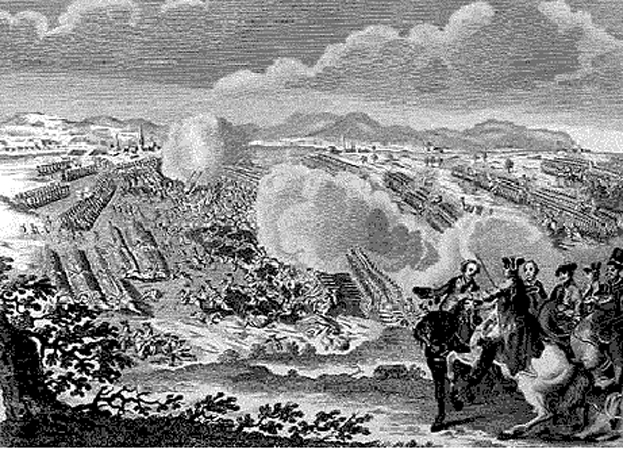
A mistranslation or misreading of Ferdinand's orders sent the six British infantry regiments and three Hanoverian battalions forward alone, well ahead of the rest of the army and without cavalry support. Roughly 4,500 British infantrymen — the 12th, 20th, 23rd, 25th, 37th and 51st Foot — marched out across open ground as the morning mist burned off the heath. As they moved up, they passed through the rose-laden hedgerows, and men reached out to pick flowers as they went.
The French, watching from the far side of the plain, saw something extraordinary: a line of British infantry advancing without cavalry, without support, in the open. Contades responded with the logical counter — he unleashed an overwhelming mass of French cavalry, somewhere in the region of 10,000 horsemen, in successive charges designed to ride the redcoats down before their own horse could come up.
What happened next has been studied in military academies ever since. The British infantry did not break. They formed tight lines, held their nerve and delivered controlled platoon volleys that cut down horses and riders at close range. Three successive French cavalry charges crashed against those red lines and broke apart. The roses were still in the men's hats.
Fire and Steadiness: The Tactics That Won the Day
Received 18th-century military wisdom held that infantry in the open was deeply vulnerable to cavalry — that without horse of their own to screen them, foot soldiers caught on a plain were effectively doomed. Minden demolished that assumption, at least when the infantry in question were disciplined enough to deliver effective fire.
The British regiments maintained near-continuous musketry through the platoon-firing system, in which different sections of each line fired in rotation, ensuring that no single volley left the entire formation temporarily unarmed. The effect on attacking cavalry was devastating: horses fell, formations broke, and the psychological shock of seeing a charge repulsed only deepened with each fresh attempt.
British artillery under Major William Phillips — who would later serve as a general in the American Revolutionary War — provided flanking fire that further disrupted the French cavalry as it manoeuvred. The combination of disciplined musketry and well-handled guns was lethal.
When the fighting ended, Allied casualties stood at approximately 2,762 killed and wounded. French casualties were around 7,000, and Contades lost much of his artillery — guns abandoned in the retreat. It was a decisive and humiliating defeat for one of Europe's great military powers.
The Cavalry Disgrace: Lord Sackville and the Court Martial That Shook Britain
At the moment when victory was most complete, Prince Ferdinand sent urgent orders for Lord George Sackville to advance the British cavalry and pursue the broken French army. Sackville did not move. The pursuit never happened, and the French retreated in reasonable order rather than facing annihilation.
Sackville later claimed the orders had been unclear. Ferdinand and virtually every witness at the subsequent inquiry disagreed. The failure to exploit Minden's success was one of the most damaging command failures of the entire war in Germany, allowing Contades to preserve a force that might otherwise have ceased to exist as a fighting entity.
Recalled to Britain, Sackville faced a court martial in 1760 and was found guilty of disobeying orders in the face of the enemy. The verdict went further than mere dismissal: he was declared unfit to serve His Majesty in any military capacity. King George II — furious — ordered the verdict read aloud to every regiment in the British Army, an extraordinary act of public humiliation intended as a permanent deterrent.
The story does not end there. Sackville later reinvented himself under the name Lord George Germain, entered politics and ultimately became Colonial Secretary during the American Revolution — the minister responsible for British strategy in that conflict. His career remains deeply controversial, and military historians have drawn a direct line between the command failures at Minden and the strategic muddle that characterised British operations in America.
The Commanders and Heroes: Men Who Made Minden
Prince Ferdinand of Brunswick (1721–1792) emerged from Minden as a celebrated figure across Protestant Europe. He continued to command Allied forces in Germany until the war's end in 1763, consistently outmanoeuvring larger French armies with limited resources.
Major-General William Kingsley led the British infantry with the calm authority that the situation demanded. His steady handling of the brigades during the cavalry charges was central to the outcome. He had been a soldier since the 1730s and knew exactly what disciplined fire could achieve.
Friedrich Wilhelm Ernst Graf zu Schaumburg-Lippe-Bückeburg commanded the Allied artillery with distinction, ensuring the guns maintained continuous pressure on the French flanks throughout the engagement. His contribution to the victory was widely acknowledged by Ferdinand in his subsequent dispatches.
Among the ordinary soldiers, men like the infantrymen of the 25th Foot whose steadiness under cavalry charge became the stuff of regimental legend. Their story was passed down not through official records alone but through the annual ritual of Minden Day itself — the roses a mnemonic for what those men had done.
Aftermath and the 'Wonderful Year': Minden in Its Wider Context
Minden was part of a cascade of British victories in 1759 that permanently altered the world's political geography. Quebec fell to General Wolfe in September. The French fleet was shattered at Lagos in August and again at Quiberon Bay in November. Together these victories confirmed British naval and colonial supremacy and effectively ended France's ambitions as a world power for a generation.
In Germany, Minden secured Hanover and kept Prussia viable at a critical moment. Frederick the Great later acknowledged that British financial subsidies and the military pressure maintained in the west — of which Minden was the centrepiece — had been essential to Prussia's survival in a war that came close to destroying his kingdom entirely.
The Treaty of Paris in 1763 formalised the consequences: Britain gained Canada, Florida, much of India and dominant influence across the Caribbean. The roots of that settlement reached back to a rose hedge on a German heath on 1 August 1759.
Minden is studied in military academies to this day as a case study in infantry fire discipline, the management of battlefield orders, and the catastrophic cost of failed cavalry cooperation. It sits alongside Blenheim and Waterloo as one of the defining British tactical victories of the 18th century.
Minden Day: A Living Tradition in the Modern British Army
The successor regiments of the original six Minden units observe 1 August each year with parades, regimental dinners and commemorative services — in British barracks, in Germany, and wherever their battalions happen to be serving around the world. Soldiers wear roses in their berets or caps, with scarlet roses traditional for some regiments and white or yellow for others depending on their particular lineage.
Veterans of Minden-lineage regiments often gather on the day. For them, Minden Day is not a museum piece — it is a point of connection to a regimental identity that predates almost every institution in modern Britain. The tradition links a corporal adjusting a rose in his beret today to a private soldier reaching into a hedgerow on a summer morning in 1759, about to face cavalry charges that military doctrine said should have destroyed him.
No order was ever issued to start the tradition. And no order has ever been needed to keep it alive.
If the Battle of Minden or Minden Day is part of your family or regimental history, we'd love to hear your story — share it in the comments below, or pass this article on to someone who carries that rose each August.
Further Reading
- The National Army Museum, London — holds regimental histories, uniform collections and primary sources relating to the Seven Years' War and the Minden regiments
- The National Archives, Kew — holds British government and military records from the Seven Years' War period, including court martial proceedings
- The Imperial War Museum, London — maintains collections and research resources covering British military history from the 18th century onward
- The Royal Anglian Regiment Museum, Duxford — dedicated to the history of the East Anglian regiments with direct Minden lineage
- The British Library — holds contemporary pamphlets, newspapers and printed accounts from 1759 documenting the reactions to Minden and the Annus Mirabilis