The Quiz Question
In April 1917, all four divisions of a Commonwealth corps fought together for the first time to capture a heavily fortified German-held ridge in northern France, at a cost of over 10,000 casualties. Which unit made the assault?
- A. The Australian Corps
- B. The Canadian Corps
- C. The Indian Corps
- D. The New Zealand Division
The answer is B. The Canadian Corps. Here is the full story.
On Easter Monday morning, 9 April 1917, sleet drove horizontally across the ridgeline above the Douai Plain in northern France. Through it, 100,000 Canadian soldiers climbed out of their tunnels and trenches and walked forward into history. In four extraordinary days, they took a position the French and British had bled on for two years — and in doing so, forged something that had never quite existed before: a Canadian national identity, hammered out on a limestone ridge in a foreign country.
The Ridge That Nobody Could Take
Vimy Ridge is a seven-mile limestone escarpment rising roughly 60 metres above the Douai Plain in the Pas-de-Calais region of northern France. From its summit, German observers could watch Allied supply columns, count troop movements, and direct artillery fire across a vast stretch of the Western Front. The Germans had held it since October 1914, and they had no intention of giving it up.
The French tried first. In May and June 1915, General Philippe Pétain's forces launched repeated, ferocious assaults on the ridge. They suffered approximately 150,000 casualties without permanently dislodging the defenders. The British 3rd Army made further attempts in 1916 with no better result. By early 1917, Vimy Ridge had acquired a grim reputation — a place where offensives went to die.
The Germans had spent two years turning it into a fortress. Deep concrete bunkers, interconnected tunnel systems, layered machine gun nests, and three successive defensive lines made the ridge seem genuinely impregnable. German commanders said as much — openly. Losing it would strip them of observation over Allied operations across the entire sector, a catastrophic blow to their strategic position in northern France.
Canada Goes to War: The Corps That Built a Nation
The Canadian Expeditionary Force had been formed in August 1914, and by the spring of 1917 it had grown into a battle-hardened corps of four divisions numbering roughly 100,000 men. These were not professional soldiers. They were farmers from Saskatchewan, miners from Nova Scotia, loggers from British Columbia — men who had never left their home towns before the war pulled them across an ocean.
By April 1917, those men had already survived some of the worst the Western Front could throw at them. They had stood at Ypres in April 1915 when chlorine gas rolled across no man's land in the first large-scale poison gas attack in history. They had fought on the Somme in 1916 and clawed their way through the bloody shambles at Courcelette. They were, by any measure, seasoned veterans of industrial slaughter.
Lieutenant-General Julian Byng, a British officer assigned to command the Canadian Corps in May 1916, had transformed its culture of planning and preparation. His troops adored him — they called themselves the "Byng Boys" with genuine affection. Under Byng, the Corps began operating less like a collection of divisions and more like a single, coordinated organism. The assault on Vimy Ridge would be the test of everything he had built.
The Plan: Preparation Like Never Before
What made Vimy different from every previous assault on the ridge was not courage — the French and British had courage in abundance. What was different was preparation on a scale the Western Front had rarely seen.
Byng and his staff constructed a full-size replica of Vimy Ridge behind the lines and rehearsed the assault repeatedly. Crucially, every soldier — not just officers — was briefed on the objectives using large-scale maps and models. The ordinary private understood not just his own task but the whole plan. This was revolutionary in an era when infantry were typically told to follow the man in front and trust their officers.
The Canadians also dug an astonishing network of tunnels beneath no man's land — twelve main passages called "subways," some wide enough to walk through upright, carrying water, telephone cables, and ammunition forward. Troops could move to their assault positions without ever exposing themselves to German fire.
The artillery preparation was equally methodical. Over 1,000 guns and howitzers — one for approximately every nine metres of front — began a week-long bombardment on 20 March 1917, firing more than a million shells. Counter-battery work was led by Brigadier-General Andrew McNaughton, who used the innovative techniques of sound ranging and flash spotting to locate enemy gun positions with unprecedented accuracy. By the morning of the assault, Canadian gunners had neutralised an estimated 83% of the German artillery in the sector — a staggering figure that would prove decisive.
The creeping barrage tactic was refined and rehearsed until it was second nature. Artillery would advance 100 yards every three minutes; infantry were trained to follow just 30 yards behind the bursting shells, close enough to catch German defenders still in their dugouts before they could man their weapons.
Easter Monday, 9 April 1917: Zero Hour at 5:30 a.m.
At 5:30 a.m. on Easter Monday, all four Canadian divisions attacked simultaneously along a 6.4-kilometre front. It was the first time in the war that the entire Canadian Corps had fought as a single unified force. The barrage descended like a wall of steel, and the infantry followed it forward through driving sleet and snow.
The weather, miserable for the attackers, blew directly into the faces of the German defenders. Within 30 minutes, the 1st and 2nd Divisions had overrun the first German defensive line. German troops, stunned by the bombardment and caught in their dugouts, surrendered in large numbers. The creeping barrage had done its work.
The 3rd Division encountered fierce resistance near the village of Thelus but captured it by mid-morning. By noon on the first day — the first single day — three of the four main ridge objectives had been seized. It was a performance that stunned British high command, who had grown accustomed to measuring progress in yards rather than objectives.
The hardest fighting fell to the 4th Division on the left flank. Their objective was Hill 145, the highest point on the ridge at 145 metres, defended by troops of the German 79th Reserve Division who had survived the bombardment deep in their concrete shelters and emerged fighting.
Hill 145 and The Pimple: The Toughest Fights
The 4th Division's initial assault on Hill 145 on 9 April was repulsed with terrible losses. German machine guns raked the attackers in waves. The summit held.
On 10 April, the 85th Battalion — the Nova Scotia Highlanders, held in reserve and unblooded — launched a night attack and finally carried the summit. It was an act of ferocious determination by men fighting in conditions no training could fully prepare them for. Hill 145 became the ground on which Canada's national memorial would one day stand.
The last piece of the ridge, a knoll at its northern tip known as The Pimple, fell on 12 April 1917 when the 10th Canadian Brigade attacked at dawn through another fierce snowstorm. German counter-attacks were launched repeatedly, but the Canadians now held the high ground. Every German formation massing for a counter-attack could be observed from the ridge and shelled almost immediately. The advantage that had made Vimy so valuable to Germany now worked entirely against them.
By 12 April 1917, the entire ridge was in Canadian hands.
The Human Cost: 10,600 Casualties in Four Days
The Canadian Corps suffered 10,602 casualties during the four-day battle — 3,598 killed and 7,004 wounded. The 4th Division, which bore the brunt of the fighting on Hill 145, suffered the heaviest losses of any Canadian division during the operation.
Nine Victoria Crosses were awarded to Canadians during the Vimy fighting — the Commonwealth's highest decoration for valour. Among them was Private William Milne of the 16th Battalion, who single-handedly rushed and destroyed two German machine gun positions on 9 April, saving many of his comrades. He was killed shortly afterwards. His VC was awarded posthumously.
German losses are estimated at approximately 20,000 — killed, wounded, and around 4,000 taken prisoner. It was a significant blow to German defensive strength in the sector, one from which their position on the Douai Plain never fully recovered.
The Commanders: Byng, Currie, and the Architects of Victory
Julian Byng was promoted to command the British 3rd Army shortly after Vimy, a recognition of what the battle had demonstrated about his abilities as a planner. He later served as Governor-General of Canada from 1921 to 1926 — an appointment that reflected the genuine bond forged between a British general and a Canadian army.
Major-General Arthur Currie, who commanded the 1st Division at Vimy, succeeded Byng in command of the Canadian Corps in June 1917. He is widely regarded by military historians as one of the finest operational commanders produced by any Allied nation in the First World War. His insistence on thorough preparation, his practice of briefing every soldier on the full plan, and his willingness to challenge British high command when he disagreed with their methods marked him as a genuinely transformative leader.
Andrew McNaughton's counter-battery methods — sound ranging, flash spotting, precise gun registration — were adopted across the entire British Expeditionary Force after Vimy. The ridge had become a proving ground for the tactics that would eventually crack the Western Front open.
Aftermath: What Vimy Meant for the War
The capture of Vimy Ridge was part of the wider Battle of Arras, which ran from 9 April to 16 May 1917. The broader offensive achieved significant early gains before grinding into the familiar stalemate, but the Canadian success at Vimy stood as its clearest and most complete triumph.
Holding the ridge denied Germany its observation advantage over the Douai Plain and forced a significant redeployment of German reserves, easing pressure on other sections of the Allied line. Strategically, it was an important prize.
But the true significance of Vimy lay in what it proved was possible. The creeping barrage, counter-battery suppression, decentralised infantry command, and exhaustive rehearsal became the blueprint for British and Commonwealth offensive operations in 1917 and 1918. The Hundred Days Offensive of 1918, which broke the German Army and ended the war, was led in large part by the Canadian Corps under Currie — directly inheriting the culture of professional preparation born at Vimy.
Germany's High Command took note. The Canadian Corps was subsequently identified as an elite "shock troop" formation; the appearance of Canadian units on any section of the front was treated by German intelligence as a reliable indicator of an impending major offensive.
Vimy's Lasting Legacy: A Nation's Sacred Ground
France gave Canada the land on which the battle was fought — in perpetuity, in recognition of the sacrifice made there. On Hill 145, the very ground where the 85th Battalion finally broke German resistance, stands the Canadian National Vimy Memorial, designed by sculptor Walter Seymour Allward. It is one of the most powerful war memorials on earth.
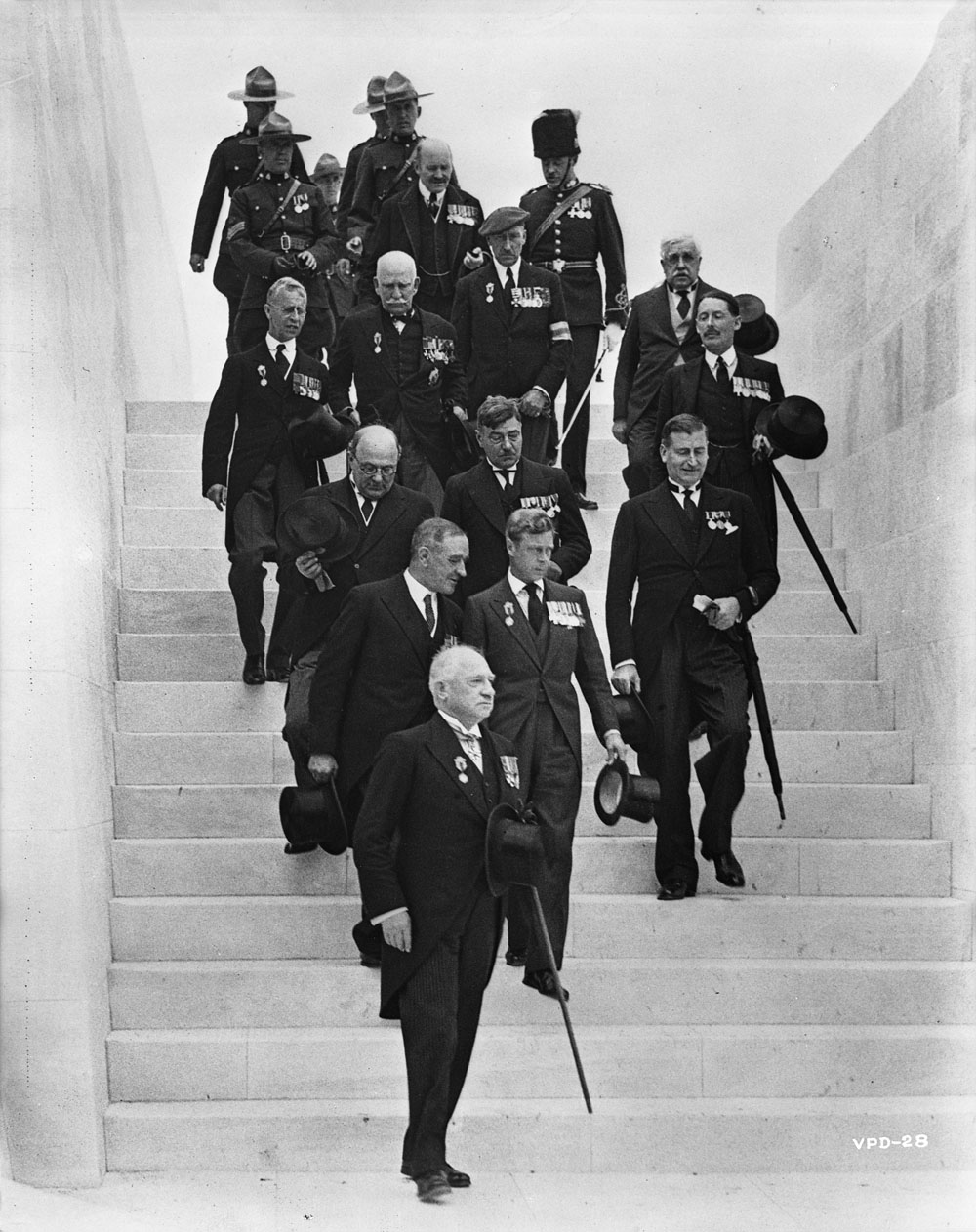
King Edward VIII unveiled the memorial on 26 July 1936 before an estimated crowd of 50,000 Canadian veterans and their families who had made the journey to France. Carved into its walls are the names of 11,285 Canadians killed in France with no known grave — men who simply vanished into the mud and are remembered here, on the ridge where Canada found itself.
Many Canadians regard Vimy Ridge as the moment their nation came of age. Not because war is glorious — no one who has studied those four April days could think that — but because something unmistakably Canadian emerged from them. Four divisions of men from every corner of a young country achieving together what no other force had managed, under their own commanders, with their own methods, on their own terms.
Every year on 9 April, Vimy Ridge Day is marked across Canada. In 2017, the centenary brought Prime Minister Justin Trudeau and tens of thousands of visitors to the memorial for national ceremonies. The battle is taught in Canadian schools, remembered in Canadian communities, and held as proof that a young nation could stand among the world's greatest fighting forces — and surpass them.
If this story moved you, we'd love to hear your thoughts in the comments below. Do you have a family connection to Vimy Ridge or the Canadian Corps? Share this article with anyone who deserves to know this remarkable story.
Further Reading
- Canadian War Museum, Ottawa — holds extensive collections on the Canadian Expeditionary Force and the Battle of Vimy Ridge
- Imperial War Museum, London — archives, photographs, and personal accounts from the Western Front including the Battle of Arras
- Library and Archives Canada — official records of the Canadian Expeditionary Force, unit war diaries, and casualty records
- Commonwealth War Graves Commission — records of Canadian casualties buried and commemorated at Vimy and across France
- Veterans Affairs Canada — official historical publications and the administration of the Canadian National Vimy Memorial