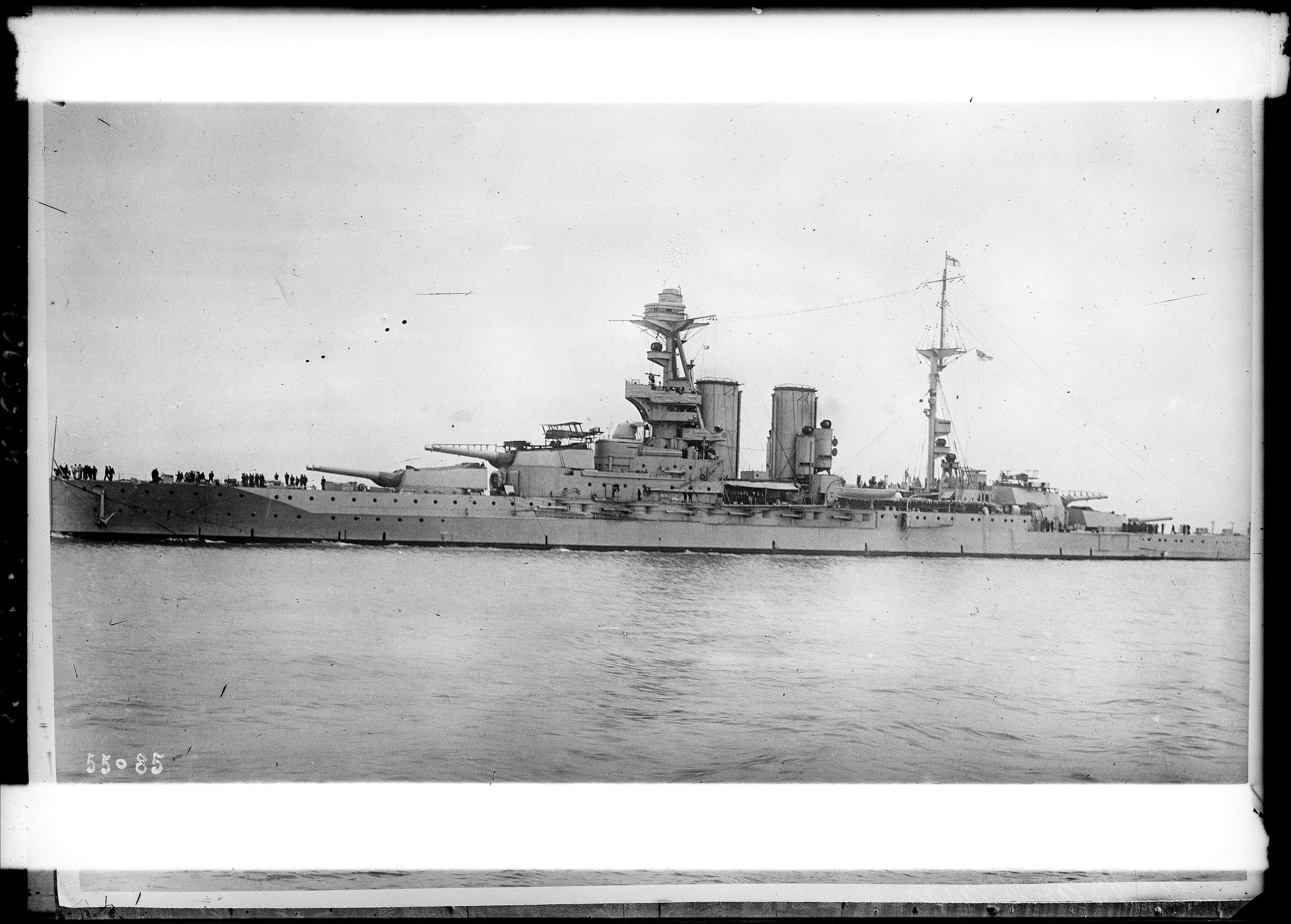
The Quiz Question
HMS Barham suffered a devastating magazine explosion in November 1941. What grim distinction does her loss hold?
- A. The only British carrier lost to a U-boat
- B. The only British battleship sunk at sea by a submarine in WW2
- C. The last British ship sunk at Jutland
- D. The largest British ship lost at Dunkirk
The answer is B. The only British battleship sunk at sea by a submarine in WW2. Here is the full story.
On the afternoon of 25 November 1941, a British Pathé cameraman stood on the deck of HMS Valiant and filmed something that would haunt naval history for decades. In less than four minutes, one of the Royal Navy's most celebrated battleships was gone — capsized, torn apart by a catastrophic magazine explosion, and swallowed by the Mediterranean. The footage he captured is among the most dramatic wartime film ever shot. And yet the British public would not see it, or even know the ship had been lost, for more than two months.
A Catastrophe Caught on Camera: The Sinking Nobody Could Hide
The destruction of HMS Barham unfolded in full view of her sister ships and their crews. The entire sequence — torpedo strikes, catastrophic list, and the final detonation — lasted barely four minutes. Veterans who witnessed it firsthand later described being rooted to the spot, unable to process the speed of what they were seeing.
Despite the existence of film evidence and hundreds of eyewitnesses, the British government suppressed all news of the sinking until 27 January 1942 — nearly nine weeks after the event. The stated justification was operational security: keeping the enemy in the dark about the loss of a capital ship. In reality, the Kriegsmarine already knew. U-331 had sent its victory signal almost immediately after the attack.
When families finally received official notification in January 1942, some had already pieced together the truth from unofficial sources — survivors who had quietly made contact, or the ominous silence of a husband or son who had stopped writing. The bitterness that followed never fully healed.
Who Was HMS Barham? A Proud Ship with a Long Record
HMS Barham was a Queen Elizabeth-class battleship, laid down at John Brown & Co.'s shipyard on the Clyde and launched on 31 October 1914. She was commissioned in October 1915, displacing around 31,000 tons and armed with eight 15-inch guns — among the most powerful armament of any warship then afloat.
She was named after Admiral Charles Middleton, 1st Baron Barham, the First Lord of the Admiralty who coordinated British naval strategy during the Napoleonic Wars. It was a name with considerable weight, and the ship did it justice. At the Battle of Jutland in May 1916, Barham sustained six hits from German shellfire but remained in the fight — emerging with a reputation as a hard-fighting, resilient vessel.
By 1941 she had undergone modernisation but remained one of the older capital ships in Royal Navy service. She was operating with the Mediterranean Fleet under Vice Admiral Henry Pridham-Wippell, part of a fleet under sustained and growing pressure from multiple directions.
The Mediterranean in 1941: A Deadly Theatre for the Royal Navy
The Mediterranean in late 1941 was arguably the most dangerous stretch of water on earth for British surface ships. The Royal Navy was fighting to keep Malta supplied, support Allied forces in North Africa, and contest control of the sea lanes against both the Italian Regia Marina and an increasingly active German Kriegsmarine.
Admiral Karl Dönitz had ordered U-boats into the Mediterranean from September 1941 to support Rommel's supply lines across the sea. U-331, a Type VIIC submarine under the command of Oberleutnant zur See Hans-Diedrich von Tiesenhausen, had passed through the Strait of Gibraltar in early November 1941 — a genuinely hazardous passage through waters patrolled by British forces.
The fleet had already absorbed a devastating blow just twelve days earlier. HMS Ark Royal, the aircraft carrier vital to Mediterranean operations, had been torpedoed by U-81 on 13 November and sank the following day. The loss was a profound shock. When Barham followed on the 25th, it confirmed that the Mediterranean had become a killing ground for British capital ships.
Force B — HMS Barham, HMS Queen Elizabeth, HMS Valiant and their destroyer escort — was conducting a routine patrol off the Egyptian coast near Sollum on 25 November when U-331 found them.
25 November 1941: The Attack That Took Four Minutes
At approximately 16:25 local time, U-331 penetrated the destroyer screen undetected and fired a salvo of three torpedoes at extremely close range — estimated at around 750 metres, well inside the standard firing distance for a submarine attack of this kind. All three struck HMS Barham on her port side in rapid succession, tearing open her hull amidships and triggering immediate, catastrophic flooding.
Men watching from the accompanying ships saw Barham begin listing heavily to port within moments of the strikes. Sailors scrambled across the ship's hull as she rolled over, some leaping into the sea, others caught by the speed of the capsize. There was almost no time to react.
At 16:29 — just four minutes after the first torpedo struck — Barham's magazines detonated. The explosion sent a towering column of black smoke thousands of feet into the air and scattered wreckage across a wide area of sea. The Pathé cameraman on Valiant captured it all. When the smoke cleared, there was nothing left to see.
Of approximately 1,184 officers and men aboard, 862 were killed — a casualty rate of nearly 73 percent. Just 337 survivors were pulled from the oil-blackened water by the escorting destroyers.
The Man Who Did It: Hans-Diedrich von Tiesenhausen and U-331
Oberleutnant zur See Hans-Diedrich von Tiesenhausen was 26 years old when he sank HMS Barham. What made the attack extraordinary was not just its result but its execution. Rather than firing from a safe distance, von Tiesenhausen had manoeuvred U-331 directly through the destroyer screen — a piece of seamanship that defied standard doctrine and carried enormous personal risk.
The Knight's Cross of the Iron Cross was awarded to him on 4 January 1942, recognising what the German naval command understood to be one of the most audacious individual submarine attacks of the war. Von Tiesenhausen had penetrated one of the best-protected formations in the Royal Navy and struck its most powerful unit.
U-331 itself survived until November 1942, when British aircraft caught and sank it in the Mediterranean. Von Tiesenhausen and most of his crew survived and were taken prisoner. After the war, he emigrated to Canada, where he lived until his death in 2000. In later interviews, he spoke of the sinking with evident solemnity — fully aware of the human cost of what he had accomplished.
The Human Cost: 862 Men and the Families Left Behind
Among those killed was Rear Admiral Geoffrey Arbuthnot, who was aboard Barham at the time and did not survive. Survivors described scenes of extraordinary violence and chaos: men blown into the sea by the magazine explosion, fires spreading across oil-covered water, and the terrifying speed of the ship's final moments leaving almost no opportunity for organised evacuation.
HMS Hotspur, HMAS Nizam of the Royal Australian Navy, and HMS Jackal carried out the rescue, pulling survivors from the water in the minutes following the explosion. The conditions were grim — oil, debris, and the shock of a blast that had killed hundreds of men in an instant.
The 862 men who died have no individual grave. Their remains lie on the seabed off the Egyptian coast, at a position approximately 32°34'N, 26°24'E. The Admiralty notified next-of-kin privately in January 1942 — but instructed grieving families not to discuss the circumstances of the loss, even with close relatives. Some families were effectively forbidden from mourning openly for weeks. It is a detail that remains deeply painful for descendants to this day.
The Cover-Up: Why Britain Kept the Sinking Secret Until 1942
The official announcement of Barham's loss came on 27 January 1942 — sixty-three days after the sinking. The British government's justification centred on denying the enemy confirmation of the ship's loss. But U-331 had reported the sinking immediately, and German naval intelligence was well aware of what had happened. The secrecy served morale management, not operational security.
The Pathé film footage was classified and withheld from public release until after the war. When it finally appeared, it became one of the most viewed pieces of wartime archive footage in existence — a stark, terrible visual record of a ship and her crew disappearing in real time.
For the families involved, the months of enforced silence compounded an already devastating loss. Survivors and bereaved relatives later expressed lasting bitterness that the men of HMS Barham had been denied public acknowledgement while the government calculated the impact on home front morale. The men had earned better.
A Grim Distinction: Why Barham's Loss Stands Alone in British Naval History
HMS Barham holds a unique and tragic place in the record of the Second World War: she is the only British battleship sunk at sea by a submarine during the entire conflict. The Royal Navy lost other capital ships — HMS Hood to German gunfire in May 1941, HMS Prince of Wales and HMS Repulse to Japanese air attack in December 1941 — but no other battleship was sent to the bottom by a U-boat.
The period around her loss represents what naval historians widely regard as the darkest weeks ever endured by the Royal Navy's Mediterranean Fleet. HMS Ark Royal was gone on 13 November. Barham followed on 25 November. Then, in a stunning Italian frogmen operation on 19 December 1941, HMS Queen Elizabeth and HMS Valiant were both severely damaged in Alexandria harbour, putting them out of action for months. In the space of five weeks, Britain's capital ship strength in the Mediterranean had been effectively destroyed.
The sinking of Barham accelerated British efforts to review anti-submarine screening doctrine and improve ASDIC sonar deployment around capital ship formations. Von Tiesenhausen had exposed a vulnerability that the Royal Navy could not afford to leave unaddressed. The lessons were painful and expensive.
Remembering HMS Barham: Legacy, Memorials and Living Memory
The 862 men who died when HMS Barham sank are commemorated on the Portsmouth Naval Memorial on Southsea Common, which records the names of all Royal Navy personnel lost at sea with no known grave. It is a place where descendants still come to find the name of a grandfather or great-uncle who never came home from the Mediterranean.
The wreck of HMS Barham lies in international waters off the Egyptian coast and is designated as an official war grave, protected under UK law. A survey conducted by divers in the 1990s found the wreck largely intact on the seabed — a finding that carries its own quiet weight, given how many men still rest inside her.
The Pathé footage continues to be widely viewed online and features regularly in documentary programmes about the naval war in the Mediterranean. A successor vessel — HMS Barham, a destroyer later reclassified as a frigate — carried the name forward in the postwar Royal Navy, maintaining the connection to the battleship in naval tradition.
Online communities of descendants and naval history enthusiasts continue to gather around the story of Barham each year as November approaches. The speed of her end, the scale of the loss, and the long silence imposed on grieving families give her story a particular emotional resonance that has never faded.
If the story of HMS Barham moved you, we'd love to hear your thoughts in the comments below. Do you have a family connection to the ship, or did something in this story surprise you? Share it with a friend who cares about naval history — these men deserve to be remembered.
Further Reading
- Imperial War Museum, London — holds documents, photographs, and personal accounts relating to HMS Barham and the Mediterranean Fleet
- The National Archives, Kew — official Admiralty records, casualty reports, and signals traffic from the Mediterranean campaign 1941
- National Museum of the Royal Navy, Portsmouth — collections covering Queen Elizabeth-class battleships and the naval war in the Mediterranean
- Commonwealth War Graves Commission — casualty records and memorial listings for the 862 men lost with HMS Barham
- Naval History and Heritage Command (United States) — broader context on Allied naval operations in the Mediterranean theatre, 1941–1942