The Quiz Question
Which US Marine, the most decorated in Marine Corps history, earned a record five Navy Crosses across three wars?
- A. John Basilone
- B. Chesty Puller
- C. Dan Daly
- D. Smedley Butler
The answer is B. Chesty Puller. Here is the full story.
Lewis Burwell Puller earned a nickname that suited him perfectly. Barrel-chested, compact, and built like a man who had never once considered backing down, he carried himself with a physical presence that made other Marines stand a little straighter. But it was not his posture that made "Chesty" Puller the most decorated Marine in the history of the United States Marine Corps. It was three decades of relentless, grinding combat across four conflicts on three continents — and a refusal, in every one of them, to lead from anywhere other than the front.
The Marine Who Became a Legend
Puller retired in 1955 as a Lieutenant General, holding a decoration record that has never been equalled. Five Navy Crosses. A Distinguished Service Cross. A Silver Star. The Legion of Merit. The list goes on at a length that feels almost fictional until you trace the actual history behind each award.
He was born on 26 June 1898 in West Point, Virginia, and grew up worshipping Stonewall Jackson with the fervour of a boy who had decided, very early, that military glory was the only life worth living. His father died when Chesty was just ten years old, and that loss seems to have sharpened rather than softened the hunger. The Marine Corps, when he eventually found it, became vocation, family, and identity all at once.
By the time he hung up his uniform, Puller had served in Haiti, Nicaragua, Guadalcanal, Cape Gloucester, Peleliu, and Korea. His enemies had included Caco rebels, Sandinista guerrillas, the Imperial Japanese Army, and Chinese People's Volunteer Forces. Very few soldiers in any nation's history have fought across that breadth of conflict and come out the other side still standing.
Early Life and the Long Road to a Commission
Puller enrolled at the Virginia Military Institute in 1917 but left after a single year when the United States entered World War I, enlisting as a private in the Marine Corps rather than wait for a commission that might arrive too late. The war ended before he could reach France — a frustration he apparently never fully forgave history for inflicting on him.
He was commissioned as a second lieutenant in 1919, only to be demoted back to corporal when post-war force reductions gutted the officer corps. For most men, that would have been the end. Puller treated it as a temporary administrative inconvenience. He served as an enlisted Marine, kept his head down, kept moving forward, and eventually earned a permanent commission in 1924.
That early experience of institutional humiliation — of being pushed down and choosing to climb back rather than walk away — forged something in Puller that proved remarkably durable. He never forgot what it felt like to be the man at the bottom of the hierarchy, and it showed in how he treated his troops for the rest of his career.
Haiti and Nicaragua: Earning His Spurs in the Banana Wars
Puller served in Haiti from 1919 to 1921 as an officer in the Haitian Gendarmerie, leading counter-insurgency operations against Caco rebels in the rugged interior of the island. It was unconventional warfare at its rawest — small units, no reliable supply lines, and an enemy who knew the terrain far better than he did.
He returned to Nicaragua between 1928 and 1932, fighting alongside the Guardia Nacional against Augusto Sandino's guerrillas in some of the most punishing jungle terrain in the Western Hemisphere. Over four years, Puller led more than forty combat patrols into hostile territory. The experience was a masterclass in improvised logistics, reading ground, keeping men focused under exhaustion, and projecting calm authority when everything around you is going wrong.
His first two Navy Crosses came from this period. The second was awarded for an action near Jinotega in September 1932, when his outnumbered patrol was ambushed by a significantly larger guerrilla force and fought its way through. The citation recognised his personal leadership under fire as the decisive factor in the engagement's outcome.
These so-called "Banana Wars" are often dismissed in popular history as sideshows, but for the officers who fought them, they were an education that classroom soldiering simply could not replicate. Puller arrived in the Pacific in 1942 already knowing things about small-unit leadership that most of his contemporaries had yet to learn.
Guadalcanal 1942: The Third Navy Cross and the Defence of Henderson Field
When the 1st Marine Division landed on Guadalcanal on 7 August 1942, Puller commanded the 1st Battalion, 7th Marines. The island campaign that followed was a savage, months-long struggle for control of Henderson Field — the airstrip that both sides understood was the strategic hinge of the entire South Pacific.
On the night of 24–25 October 1942, Imperial Japanese forces launched a massive coordinated assault on the American perimeter, throwing an estimated 2,000 to 3,000 troops against Puller's thin line of roughly 700 men holding nearly a mile of jungle front. The attack came in successive waves through darkness, rain, and dense vegetation.
Puller moved along the line under fire all night, repositioning men, redistributing ammunition, and calling artillery support down to within 200 yards of his own position to break the attacks. By dawn, Japanese losses exceeded 1,400 killed. His battalion held. His third Navy Cross followed, and his reputation as a combat commander of the first order was now beyond dispute.
Cape Gloucester and Peleliu 1944: A Fourth Cross and the Cost of Victory
Puller led the 1st Marines at Cape Gloucester, New Britain, in January 1944, earning his fourth Navy Cross for driving his regiment through ferocious Japanese resistance in conditions that can only be described as miserable — torrential tropical rain, near-impenetrable jungle, and an enemy dug into terrain that favoured the defender at every point.
Peleliu, in September and October 1944, was of a different order entirely. The 1st Marines assaulted a coral island that Japanese engineers had transformed into a fortress, with an interlocking network of caves, bunkers, and firing positions that conventional frontal tactics could barely dent. Puller's regiment suffered over 1,700 killed and wounded from a force of roughly 3,000 men — a casualty rate that appalled even hardened Marine Corps commanders.
The strategic necessity of Peleliu has been debated by military historians ever since, with significant scholarship questioning whether the island needed to be taken at all given the direction of the Pacific campaign. Puller, by all accounts, was privately furious about the human cost, though he maintained public discipline. What he never did — not once — was remove himself from the danger his men were facing. He was wounded multiple times on Peleliu and refused evacuation on each occasion, remaining on the line until the 1st Marines were finally relieved.
Korea 1950: The Frozen Chosin and a Fifth Navy Cross
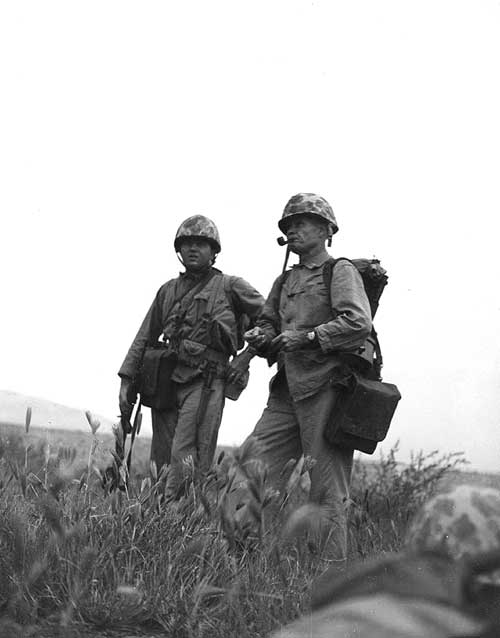
If Guadalcanal made Puller's name, the Chosin Reservoir cemented his legend. In late November 1950, Chinese People's Volunteer Forces entered the Korean War in overwhelming strength and surrounded the 1st Marine Division and attached Army and allied units at the Chosin Reservoir in the mountains of North Korea. Temperatures dropped to minus 35 degrees Celsius. Supply lines were cut. The situation, by any conventional military assessment, was catastrophic.
Puller commanded the 1st Marines during the breakout, coordinating the rearguard actions that allowed approximately 15,000 UN troops to fight their way seventy-eight miles south to the port of Hungnam. The division emerged battered but intact, bringing its dead and wounded with it — a feat of discipline and unit cohesion that military historians have consistently ranked among the finest fighting retreats in modern warfare.
The line most associated with Puller during the breakout — "We're surrounded. That simplifies our problem" — captures his ethos with such precision that it almost doesn't matter whether the exact wording is verbatim. The sentiment was entirely consistent with the man. His fifth Navy Cross, awarded for his leadership at Chosin, made him the only Marine in the Corps' entire history to receive the decoration five times.
The 1st Marine Division suffered over 4,000 battle casualties at Chosin, with thousands more evacuated for frostbite and exposure. That the division survived as a fighting force was widely attributed to the quality of its leadership at the regimental level — and Puller was foremost among them.
The Man Behind the Medals: Leadership Philosophy and Personal Character
Puller's entire philosophy of leadership rested on a single, non-negotiable principle: if your men are suffering it, you suffer it with them. He ate what they ate, slept where they slept, and could reliably be found at the most dangerous section of any line he was responsible for. His men knew this, and it produced a loyalty that went far beyond ordinary unit cohesion.
He had little patience for military bureaucracy, a feeling he apparently expressed in characteristically direct terms on numerous occasions. He was not a political animal and made little effort to become one, which may partly explain why a man of his combat record retired as a Lieutenant General rather than reaching the highest ranks of Marine Corps command.
He married Virginia Evans in 1937 and the couple had five children. His son, Lewis Puller Jr., served in Vietnam and lost both legs to a booby trap in 1968. Lewis Jr. later wrote Fortunate Son, a memoir of his experience that won the Pulitzer Prize in 1992 — one of the most honest accounts of the Vietnam generation's particular suffering ever published. The elder Puller lived long enough to see his son return from Vietnam catastrophically wounded, and those who knew him said it broke something in the old warrior that no enemy ever had.
The tradition of calling out "Good night, Chesty Puller, wherever you are!" during Marine Corps boot camp evening prayers began during his lifetime and continues to this day. No other individual in the Corps' history receives this nightly tribute.
Retirement, Decline, and the Grief of a Warrior at Peace
Puller was forced to retire in August 1955 following a stroke, a departure that he reportedly treated as a kind of bereavement. He returned to Saluda, Virginia, but civilian life sat badly on a man who had spent his entire adult existence in the structure and purpose of military service. He was restless, diminished, out of place in a world that had moved on.
A series of further strokes through the late 1960s and early 1970s progressively reduced his capacity, even as the Vietnam War claimed the health and limbs of a new generation of Marines — including his own son. Lewis "Chesty" Puller died on 11 October 1971 at the Naval Hospital in Portsmouth, Virginia. He was seventy-three years old.
More than 5,000 people attended his funeral, including senior military figures from across the armed services. It was, in its way, a final muster — the kind of turnout that reflected not institutional obligation but genuine, personal respect from men who understood exactly what the name meant.
Legacy: Why Chesty Puller Still Matters
Puller's five Navy Crosses remain an unmatched record in the two-and-a-half centuries of the United States Marine Corps. No other Marine has come close across any era, any conflict, or any theatre of war. The record stands not as a statistical curiosity but as the measurable residue of a career spent in near-continuous combat at the sharpest possible end.
His name and image remain embedded in Marine Corps recruit training, representing a specific and demanding ideal: the leader who is always forward, always present, and never asks his people to endure what he is unwilling to endure himself. That ideal is easier to describe than to live, which is perhaps why Puller's example retains its force decades after his death.
The USS Puller (ESB-3), a Mobile Landing Platform vessel commissioned in 2017, carries his name into the twenty-first century — a service branch's way of saying that certain standards do not expire.
For the generation of Americans who served in World War II and Korea, Chesty Puller was not mythology. He was a real man who had been present, under fire, on some of the worst ground of the twentieth century. The legend grew from the facts, not the other way around — and that, ultimately, is what makes him worth remembering.
If Chesty Puller's story resonates with you, we'd love to hear your thoughts in the comments below. Do you have a family connection to the Marines who fought at Guadalcanal or the Chosin Reservoir? Share this article with anyone who appreciates the real stories behind the medals.
Further Reading
- National Museum of the Marine Corps, Triangle, Virginia
- The National Archives and Records Administration (NARA), Washington D.C.
- The National WWII Museum, New Orleans
- The Korean War Veterans Memorial Foundation, Washington D.C.
- Smithsonian National Museum of American History, Washington D.C.