The Quiz Question
Which legless RAF fighter ace became a celebrated leader of the 'Big Wing' during the Battle of Britain?
- A. Douglas Bader
- B. Guy Gibson
- C. Adolph Malan
- D. Robert Stanford Tuck
The answer is A. Douglas Bader. Here is the full story.
Some stories refuse to stay within the boundaries of military history. Douglas Bader's story — of a man who lost both legs at 21, fought his way back into the cockpit, and led one of the most controversial fighter formations of the Second World War — is one of them. It is a story about courage, certainly. But it is also about obstinacy, controversy, and the very human cost of being brilliantly, stubbornly right about some things and fiercely, unapologetically wrong about others.
The Man Who Refused to Be Grounded
Douglas Robert Steuart Bader was born on 21 February 1910 in St John's Wood, London. From his earliest years he was a natural athlete — fast, competitive, and drawn instinctively to physical challenge. Rugby was his sport at school, and the same fearlessness that made him a useful flanker would later make him a lethal fighter pilot.
He earned a place at the RAF College Cranwell in 1928, graduating among its most promising pilots. His instructors noted his exceptional natural talent in the air — and his equally exceptional willingness to push the boundaries of what he had been told not to do.
On 14 December 1931, that instinct proved catastrophic. At Woodley Aerodrome near Reading, Bader attempted a low-level roll in his Bristol Bulldog biplane at the urging of fellow pilots — a manoeuvre explicitly banned by regulations. The aircraft clipped the ground. Both legs had to be amputated: the right above the knee, the left below. He was 21 years old. The doctors gave him little chance of surviving the night.
He survived. He always intended to.
Learning to Walk — and Fly — Again
Fitted with tin prosthetic legs, Bader was walking within months. By June 1932 he had passed his RAF medical flying test, demonstrating he could handle a Bulldog without any observable difficulty. His body had found a way; bureaucracy had not.
The Air Ministry discharged him in May 1933. The regulations simply had no category for a pilot without legs — and rather than create one, they showed him the door. For the next six years, Bader worked for the Asiatic Petroleum Company, flying light aircraft whenever he could and refusing, in every practical sense, to accept that his flying career was over.
When war was declared in September 1939, he applied again. This time, with the RAF desperately short of experienced pilots, the answer was yes. He was posted to 19 Squadron at Duxford in February 1940, requalifying on modern monoplane fighters including the Supermarine Spitfire. His instructors, who had perhaps expected to humour a determined invalid, were astonished by what they found.
Into Combat: Dunkirk and Early Victories
By June 1940, Bader had been given command of 242 Squadron — a Canadian unit badly mauled during the fall of France, low in morale and short of faith in the RAF's leadership. Bader turned them around within weeks. Not through careful man-management, but through sheer, unignorable force of personality.
He scored his first confirmed aerial victory on 11 June 1940, shooting down a Messerschmitt Bf 109 over Dunkirk during the evacuation operations. Flying Hawker Hurricanes, he had claimed five confirmed aerial victories by the end of August 1940, achieving 'ace' status by any measure.
His leadership style was blunt to the point of insubordination with senior officers, and intensely personal with his own men. His pilots called him 'The Boss.' Air Vice-Marshal Trafford Leigh-Mallory, commanding 12 Group, recognised Bader's aggressive tactical instincts early and began backing his ideas — a relationship that would shape one of the most debated strategic controversies of the entire Battle of Britain.
The Big Wing Controversy: A New Way to Fight
Bader's central tactical idea was straightforward in concept and deeply contentious in practice. Rather than scrambling individual squadrons piecemeal to intercept Luftwaffe raids, he proposed assembling three, four, or five squadrons into a concentrated mass formation — a 'Big Wing', sometimes called a Balbo after Italian air marshal Italo Balbo, who had pioneered large-formation flying in the 1930s.
This brought him into direct, bitter conflict with Air Vice-Marshal Keith Park of 11 Group, whose squadrons bore the brunt of defending southern England. Park's argument was practical and urgent: assembling a large formation took time — precious minutes during which Luftwaffe bombers were already over English soil and RAF airfields were being hit.
The Duxford Wing flew its first coordinated three-squadron formation on 7 September 1940 — the same day the Luftwaffe shifted its strategy from attacking RAF airfields to bombing London, a decision that would ultimately cost Germany the battle. On 15 September 1940, now commemorated as Battle of Britain Day, the Duxford Wing of five squadrons — approximately 60 aircraft — intercepted a massive Luftwaffe raid over London. Claims of 52 kills were made; post-war analysis revised those figures significantly downward, but the psychological impact on both sides was real.
The tactical debate between Park's 11 Group and Leigh-Mallory's 12 Group became one of the most argued controversies in RAF history. Air Chief Marshal Hugh Dowding, head of Fighter Command, ultimately sided with Park's approach — with consequences that neither man fully deserved.
Bader's Flying Style and the Pilots Who Flew With Him
There was something physically remarkable about how Bader flew. With his prosthetic legs locked in position, he could not experience the blood-pooling in the lower limbs that caused able-bodied pilots to black out in high-G turns. His torso and upper body absorbed the pressure instead, giving him an unexpected physiological advantage in tight combat manoeuvres.
His wingmen included future aces such as Denis Crowley-Milling, who later credited Bader's personal coaching as fundamental to his own survival and success in the air. Bader was an early and forceful advocate of the 'finger four' formation — four aircraft spread like the fingertips of an open hand — adapted from Luftwaffe tactics observed during the Spanish Civil War. He pushed hard to replace the RAF's outdated and dangerously rigid 'vic' of three aircraft, which left pilots unable to search effectively for the enemy.
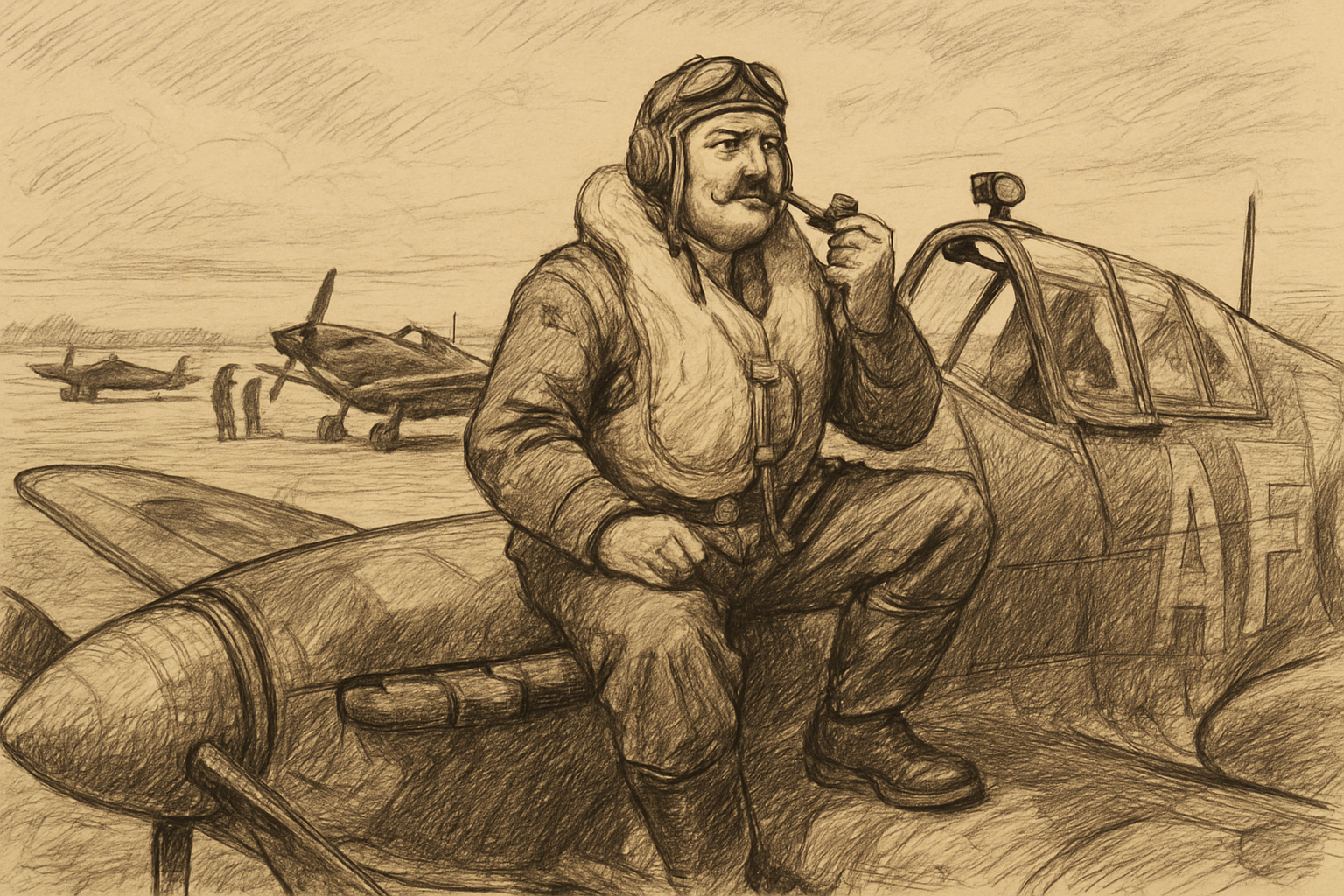
His personal aircraft were always marked 'D-B' on the fuselage. Pilots recalled that he taxied using the rudder pedals with the same ease as any other pilot — a detail that, more than any speech, made his presence on the flight line a permanent refutation of the Air Ministry officials who had once sent him home.
Shot Down Over France: The Mystery of August 1941
On 9 August 1941, Bader was flying a Spitfire Mk V with 616 Squadron over occupied France during an offensive sweep known as a 'Circus' operation — a tactic designed to draw the Luftwaffe into combat over their own territory. His aircraft was lost over St-Omer. The exact cause has never been definitively established.
Two theories have persisted ever since: that he was hit by a Messerschmitt Bf 109, or that he was struck by another RAF Spitfire in the chaos of a turning dogfight. His own wingmen could not agree on what they had seen. Bader bailed out but one of his prosthetic legs became trapped in the cockpit as the aircraft went down; the leg tore free under the force of the airstream, and he descended into France with one artificial limb missing.
What followed was, by any standard, extraordinary. Adolf Galland — the Luftwaffe's celebrated ace commander — invited Bader to sit in a Bf 109 and reportedly offered to arrange safe passage for the RAF to deliver a replacement leg. Churchill vetoed a dedicated mercy flight, but the replacement leg was eventually delivered via a standard RAF bombing raid drop. The Germans, it seems, respected Bader in ways that transcended the war.
That respect did not extend to keeping him contained. After multiple escape attempts from other camps, Bader was sent to Colditz Castle in 1942. His prosthetic legs were confiscated each night to prevent him absconding. He was still attempting escape on the day American forces liberated the castle in April 1945.
After the War: A Legend Builds His Legacy
On 15 September 1945 — exactly five years after Battle of Britain Day — Bader led a victory flypast of 300 aircraft over London. The symbolism was not lost on anyone watching from the streets below.
He retired from the RAF in 1946 with the rank of Group Captain, a record of 22 and a half confirmed aerial victories, 4 shared, 6 probable, and 11 damaged. He joined Shell Oil as an aviation executive, but his most significant post-war work was quieter and less publicised: visiting hospitals, rehabilitation centres, and disabled veterans, insisting with characteristic bluntness that a missing limb was an inconvenience, not a verdict.
Paul Brickhill's 1954 biography Reach for the Sky became a bestseller and was adapted into a 1956 film starring Kenneth More. It made Bader a household name for a generation of British children who had no direct memory of the war. He was knighted in 1976 — for services to disabled people, an honour he reportedly considered more meaningful than any of his military decorations. He died of a heart attack on 5 September 1982 in London, aged 72.
The Big Wing Debate: Who Was Right?
Post-war analysis has not been kind to the Big Wing's tactical record. Declassified documents and serious historical research — including John Ray's The Battle of Britain: New Perspectives, published in 1994 — found that the Wing took an average of around 17 minutes to assemble, during which Luftwaffe bombers could reach London from the Kent coast. Kill claims made in the chaos of mass formation combat were frequently counted multiple times by different pilots.
The political aftermath was uglier still. Dowding and Park — the two men most responsible for winning the Battle of Britain — were quietly removed from their commands in November 1940, in circumstances that owed much to the lobbying of Leigh-Mallory and his allies, Bader among them. It is one of the most uncomfortable footnotes in RAF history.
In the 1990s, the RAF formally recognised that Park and Dowding had been treated unjustly. Memorials were unveiled and honours belatedly awarded. Bader himself never wavered. He defended the Big Wing concept until his death, arguing that concentrated force was simply the correct tactical answer — and the debate continues to divide aviation historians today.
Why Douglas Bader Still Matters Today
Bader's story has outlasted the controversies precisely because it operates on multiple levels at once. As military history, it offers a genuine window into the tactical arguments that shaped Fighter Command's battle for survival in 1940. As personal history, it is one of the most remarkable accounts of physical and psychological determination ever recorded in British public life.
The Douglas Bader Foundation, established after his death, continues to support amputees and people with limb loss across the UK, funding prosthetics and rehabilitation programmes in ways that reflect exactly the practical, unsentimental approach Bader himself favoured. His name is carried by a parade ground at RAF Cranwell — the college where his story began in 1928 — and a pub near RAF Martlesham Heath in Suffolk.
In an era when the Battle of Britain is sometimes reduced to aircraft comparisons and sortie statistics, Bader's story pulls the focus back to where it belongs: to the individuals of extraordinary and flawed character who flew the aircraft, argued about the tactics, and refused, in every sense that mattered, to be brought down.
Further Reading
- Imperial War Museum — collections and research on the Battle of Britain and RAF Fighter Command
- The National Archives, Kew — RAF operational records, 12 Group and 11 Group papers from 1940
- RAF Museum, Hendon and Cosford — aircraft, personal effects, and archive material relating to Douglas Bader and the Battle of Britain
- Cranwell Aviation Heritage Centre — records relating to RAF College Cranwell and its graduates
- The Churchill Archives Centre, Cambridge — wartime correspondence relevant to RAF strategy and senior command decisions in 1940