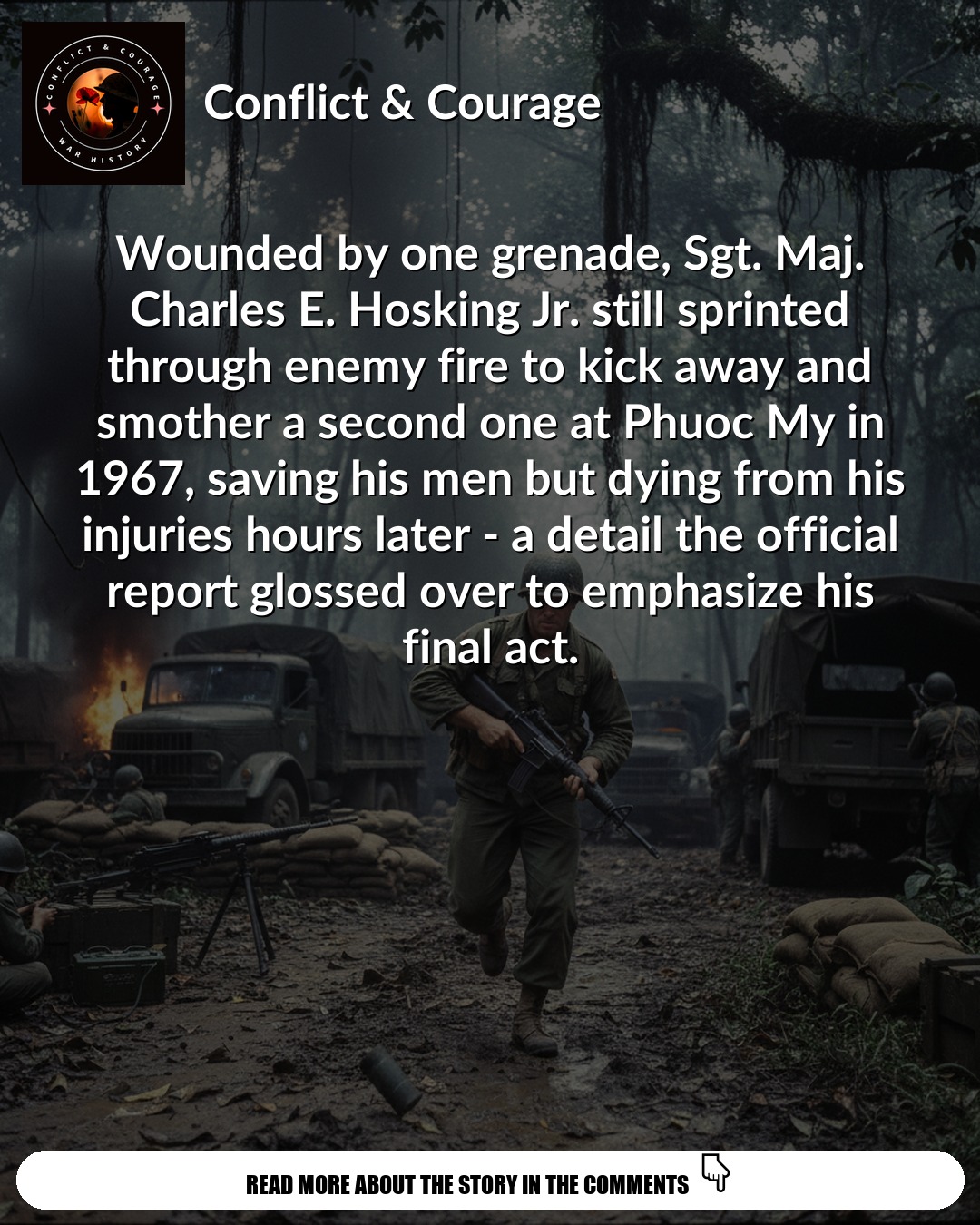
Master Sergeant Charles Ernest Hosking Jr. was a U.S. Army Special Forces soldier, a veteran of the Second World War who had been wounded at the Battle of the Bulge, and by 1967 an experienced adviser serving in Vietnam. He received the Medal of Honor posthumously for a single decisive act on 21 March 1967 in Don Luan District, Phuoc Long Province, Republic of Vietnam. That location matters: the action did not take place at a village called "Phuoc My." The official record, Department of the Army General Orders No. 39 of 13 June 1969, names Don Luan District as the place, and that is where the events described below occurred.
Adviser in the Field
Hosking was assigned to Detachment A-302, Company A, 5th Special Forces Group (Airborne), 1st Special Forces. On the day in question he was serving as a company adviser with a III Corps Civilian Irregular Defense Group reaction battalion during combat operations. His unit apprehended a suspect who was identified as a Viet Cong sniper. The prisoner was to be taken back to the base camp, and Hosking was preparing him for the move.
A Sudden Threat
According to the citation, the prisoner suddenly seized a hand grenade from Hosking's belt, armed it, and began running toward the company command group. That group consisted of four men — two Americans and two Vietnamese — standing only a few feet away. The prisoner clearly intended to kill them. There was no time for a considered decision. An armed fragmentation grenade gives only seconds before it detonates, and the men it was aimed at had no cover between themselves and the running prisoner.
Hosking reacted at once. He leaped onto the man's back, grasped him in what the citation describes as a "bear hug," and forced the armed grenade against the prisoner's chest. He then wrestled the man to the ground and covered his body with his own until the grenade detonated. The blast killed both Hosking and the prisoner instantly. By absorbing the full force of the explosion with his own body and that of the enemy soldier, he saved the other members of the command group from death or serious injury.
Setting the Record Straight
There is a persistent but false embellishment attached to some retellings of this story — the idea that Hosking had earlier concealed a grenade wound, a "first grenade" that was hidden from the record. No such episode appears in the official documentation. The citation and the general orders describe one action: the grenade seized from his own belt by a prisoner on 21 March 1967, and Hosking's decision to smother it. Inventing an earlier incident adds nothing and misrepresents the man. The documented act stands on its own.
Charles Hosking Jr. was born on 12 May 1924 and was from Ramsey, New Jersey. By the time of his death he had already served through the Second World War, where he was wounded in action at the Battle of the Bulge, and had returned to soldiering with the Special Forces in a very different war. He was posthumously advanced and honored as a Master Sergeant (the citation records his rank as Sergeant Major, then Sergeant First Class), and his Medal of Honor recognized a deliberate, split-second choice to trade his own life for those of four men standing beside him. He is buried at Valleau Cemetery in Ridgewood, New Jersey.
Stories like this one tend to gather embroidery over the years, and it is the plain citation that keeps the account honest. What Hosking did was extraordinary enough without addition: recognizing in an instant that a prisoner meant to kill his comrades, and choosing to smother the blast with his own body rather than dive for cover himself.