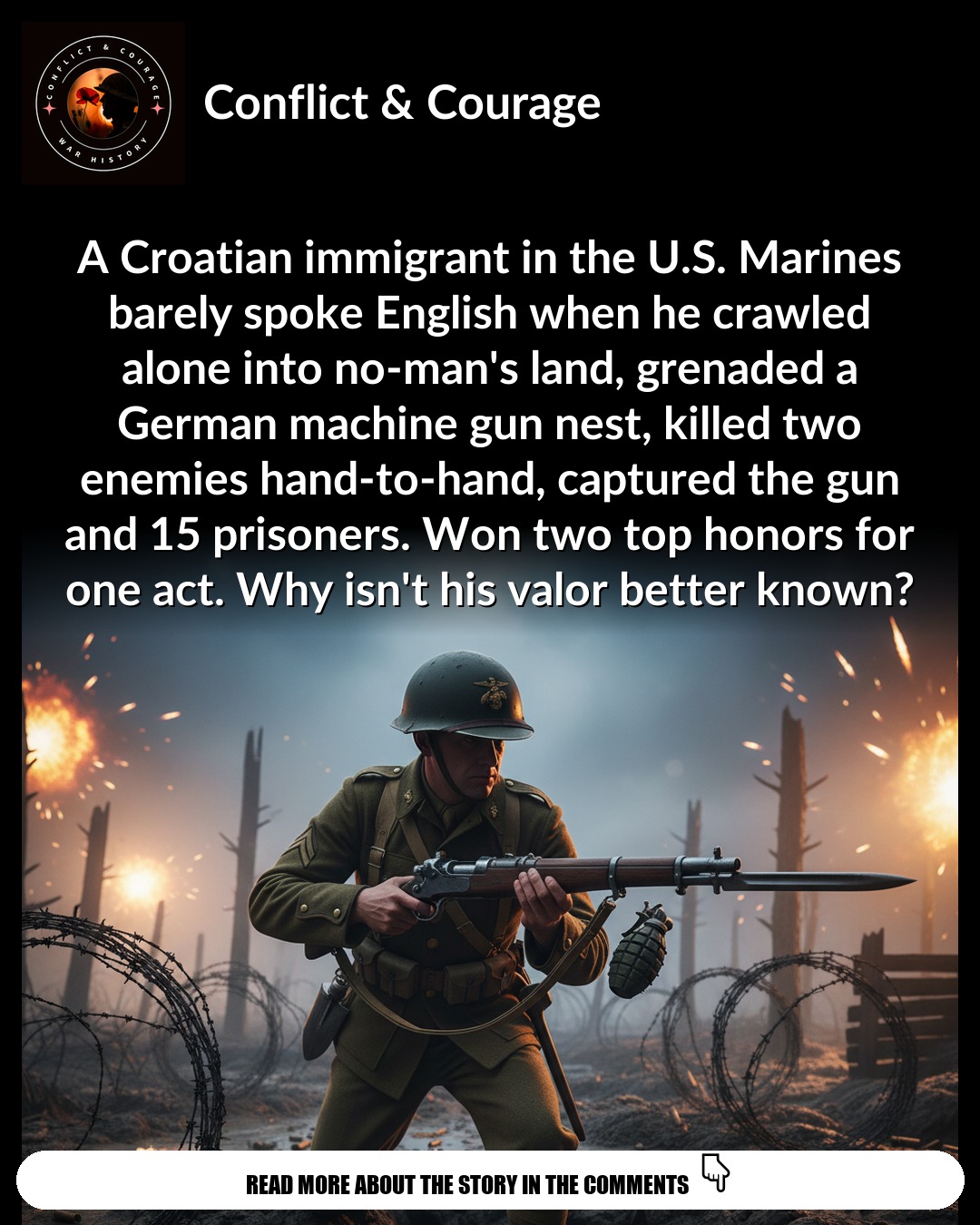
On the morning of 18 July 1918, in the Foret de Retz near Villers-Cotterets, France, a Croatian-born United States Marine named Louis Cukela crawled out alone against a German strongpoint that had halted his company's advance. He took the position with bayonet and captured grenades, and for that single action he was awarded both the Army and the Navy Medals of Honor. The battle was the Soissons offensive of the Aisne-Marne campaign, not the Meuse-Argonne, which came months later.
An Immigrant Who Enlisted Twice
Louis Cukela was born on 1 May 1888 in Sebenico, then part of Austria-Hungary and today the city of Sibenik, Croatia. He was educated there before emigrating to the United States in 1913, settling with his brother in Minneapolis, Minnesota. He first enlisted in the U.S. Army in September 1914, serving as a corporal until his discharge in 1916. In January 1917, with war raging in Europe, he enlisted again – this time in the Marine Corps. He was sent to France and fought with the 5th Marine Regiment in all its major engagements.
The Foret de Retz, 18 July 1918
The Soissons offensive opened on 18 July 1918 as part of the Allied counterattack along the Aisne-Marne front. Cukela's unit, the 66th Company of the 5th Regiment, was advancing through the dense Foret de Retz when it was stopped by a German machine-gun strongpoint. Ignoring the warnings of the men around him, Cukela crawled out from the flank and worked his way forward alone toward the German lines.
Getting beyond the strongpoint under heavy fire, he rushed the first gun and bayoneted its crew. He then picked up German hand grenades left in the position and used them to destroy the remainder of the strongpoint from the shelter of a nearby gun pit. When it was over, Cukela had taken four prisoners and captured two undamaged machine guns, breaking the obstacle that had pinned his company.
Two Medals for One Act
The action was recognized twice over. In the era before the awards systems of the two services were unified, Cukela received both the Army Medal of Honor and the Navy Medal of Honor for the same deed – one of only a small number of service members ever to be so honored. The same act also brought him decorations from France, including the Medaille Militaire and the Croix de Guerre, as well as awards from Italy and his native homeland.
Cukela's Medal of Honor citations list his rank as major, but that reflects a later promotion; at the time of the action he was a gunnery sergeant, having been promoted to that rank on 1 July 1918, though his warrant did not reach him in the field until August. He was wounded twice later in 1918, near Jaulny during the St. Mihiel offensive and again in the Champagne sector, though neither wound was serious.
A Long Career in Uniform
Cukela received a field commission as a second lieutenant in September 1918 and was selected for a regular Marine Corps commission the following year. Over the next two decades he served at posts in Haiti, Santo Domingo, the Philippines, and China, as well as at bases across the United States. He retired as a major on 30 June 1940, was recalled to active duty for World War II, and finally returned to the retired list in 1946 after nearly 32 years of combined Army and Marine service.
Louis Cukela died on 19 March 1956 at the U.S. Naval Hospital in Bethesda, Maryland, and was buried with full military honors in Arlington National Cemetery. He remains one of the most decorated immigrants ever to serve in the American armed forces, and a lasting example of the debt the nation owes to those who chose it as their own.