On the night of 16 April 1952, near Panmunjom in Korea, Corporal Duane Edgar Dewey was already wounded. A machine gunner in the weapons platoon of Company E, 2nd Battalion, 5th Marines, he had been hit during a fierce night attack by a numerically superior enemy force. As a Navy corpsman worked to treat his wounds and those of his assistant gunner, an enemy grenade landed close to his position.
Dewey did not have the luxury of time to think. According to his Medal of Honor citation, he pulled the corpsman to the ground, shouted a warning to the Marines around him, and smothered the grenade with his own body, absorbing the full force of the explosion to shield his comrades. The grenade was live. It detonated beneath him, and it gravely wounded him.
He Lived
The remarkable part of Dewey's story is not that the grenade failed to go off. It went off. The remarkable part is that he survived it. Grievously injured, he was evacuated and treated, and he recovered. That survival is what set his case apart, and it is what makes the popular retellings of a "dud grenade" both inaccurate and, in a sense, a diminishment of what actually happened.
Born on 16 November 1931 in Grand Rapids, Michigan, and accredited to Muskegon, Dewey was a corporal in the Marine Corps Reserve serving with the 1st Marine Division. His action took place in the static, brutal fighting of the war's later phase, when the front had largely stabilized near the 38th parallel and the two sides fought over hills and outposts while armistice talks dragged on at Panmunjom.
"A Body of Steel"
On 12 March 1953, President Dwight D. Eisenhower presented Dewey with the Medal of Honor in the Oval Office of the White House. Dewey was the first Marine to receive the medal from Eisenhower. According to widely reported accounts of the ceremony, the President looked at the young Marine who had taken a grenade blast to the body and survived, and remarked, "You must have a body of steel." The phrase followed Dewey for the rest of his life.
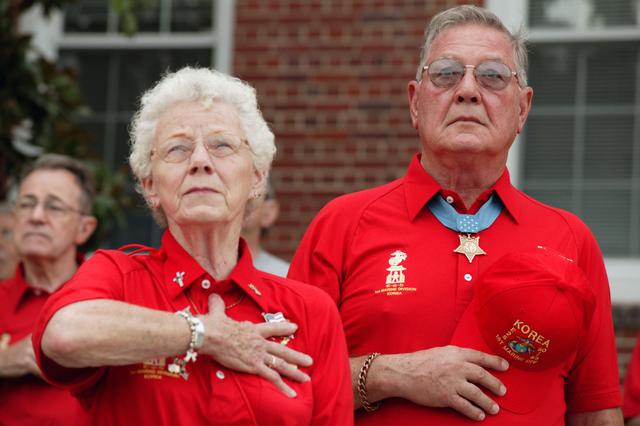
Nothing about the award or the action was classified or hidden. Dewey's citation was published, his ceremony was a public White House event, and his story was told openly for decades. He returned to Michigan, raised a family, and lived a long life, becoming a familiar figure at veterans' gatherings and Medal of Honor Society events.
Later Years
Duane Dewey died on 11 October 2021 in St. Augustine, Florida, at the age of 89. He is buried at Florida National Cemetery in Bushnell. At the time of his death he was among the last surviving Medal of Honor recipients from the Korean War, and tributes from fellow recipients and veterans' organizations noted both his valor and the quiet decency of the man who had spent almost seventy years living under the weight of that Oval Office honor.
His story needs no embellishment. A wounded Marine, lying under a corpsman's hands, pulled a live grenade against his own body to save the men around him, and lived to be told by a president that he must be made of steel.