The Quiz Question
Which Luftwaffe pilot, flying almost entirely on the Eastern Front, ended the Second World War with 352 confirmed aerial victories, making him the highest scoring fighter ace in aviation history?
- A. Gunther Rall
- B. Erich Hartmann
- C. Werner Molders
- D. Adolf Galland
The answer is B. Erich Hartmann. Here is the full story.
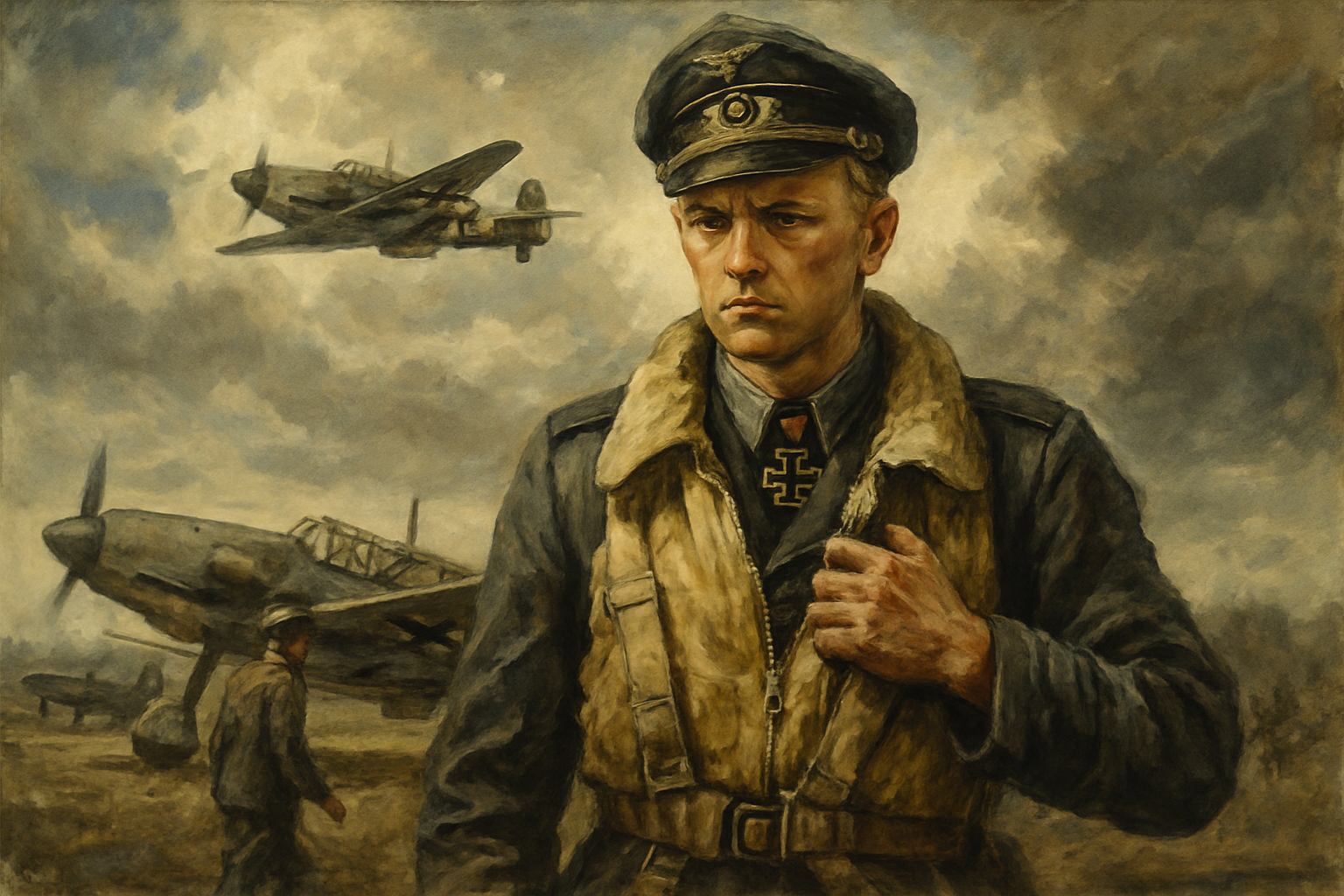
Erich Hartmann ended the Second World War with 352 confirmed aerial victories. That number is so large it almost defies comprehension — and yet it has never been seriously overturned in the eight decades since the guns fell silent. He is, by any measure, the greatest fighter ace in the history of aviation, and his story is one of extraordinary skill, extraordinary luck, and a war of a scale most Western readers can barely imagine.
The Man Who Defied Belief: 352 Kills and Counting
To understand how remarkable Hartmann's record is, consider the comparison. Marmaduke 'Pat' Pattle, the top British Commonwealth ace of the Second World War, is credited with around 50 aerial victories — itself a staggering achievement by any normal standard. Hartmann scored more than seven times that number.
He flew 1,404 combat missions between 1942 and 1945, almost exclusively on the Eastern Front against Soviet forces. He was shot down or forced to crash-land 16 times and walked away from every single one. His story raises a question that still sparks genuine debate among historians: how does one man achieve something so statistically overwhelming — and what kind of war made it possible?
Born to Fly: Hartmann's Early Life and Path to the Luftwaffe
Erich Alfred Hartmann was born on 19 April 1922 in Weissach, Württemberg, Germany. His mother, Elisabeth, was a passionate amateur pilot, and she taught young Erich to fly a glider when he was just 14 years old — an unusually early start even in an era when Germany was actively encouraging aviation among its youth.
He joined the Hitler Youth flying programme and earned his glider pilot's certificate in 1936, progressing steadily to powered aircraft. In October 1940, aged 18, he was accepted into the Luftwaffe as a cadet, training at flying schools in Berlin-Gatow and Zerbst. He graduated as a fully qualified fighter pilot in August 1942 and was posted to Jagdgeschwader 52 — JG 52 — on the Eastern Front. It was a posting that would define his life.
JG 52 and the Eastern Front: A War Like No Other
Jagdgeschwader 52 was the most successful fighter wing in aviation history. Based across the southern sectors of the Eastern Front, JG 52 ultimately claimed over 10,000 aerial victories — a figure that strains credibility until you understand the sheer volume of air combat being fought in the East.
The Soviet air forces fielded enormous numbers of aircraft, and in the early years of the war, many of their pilots had dangerously limited training. Hartmann arrived at JG 52's III Gruppe in October 1942, initially flying as wingman to veteran ace Sergeant Edmund 'Paule' Rossmann, who drilled into him the unit's aggressive hunting tactics. It was an apprenticeship that shaped everything that followed.
His primary aircraft throughout his career was the Messerschmitt Bf 109 G — the 'Gustav' — a machine he mastered to a degree few pilots ever matched. Operating from forward airstrips in Ukraine, the Crimea, and later Romania, JG 52 pilots flew four or five sorties per day, giving Hartmann the sheer accumulation of contact time that made his tally arithmetically possible.
Hartmann's Tactics: Why He Was So Devastatingly Effective
Hartmann's philosophy was brutally simple: get close, then get closer. He preferred to open fire from 50 metres or less — distances at which missing was almost impossible and a short burst was almost always decisive. Where other pilots engaged in swirling, extended dogfights, Hartmann refused to be drawn in.
He described his method as 'See — Decide — Attack — Break': a four-step loop he could execute faster than most opponents could react. He would dive from altitude, often out of the sun or cloud cover, fire a precise, concentrated burst, and immediately disengage before the enemy formation could respond. It was ambush hunting, not brawling.
He later estimated that roughly 80% of the pilots he shot down never saw him coming — they were already on fire before they understood they were under attack. His personal Bf 109 bore a distinctive black tulip design on its nose, and his reputation grew so fearsome that Soviet pilots were reportedly said to break formation and scatter when they identified his aircraft approaching.
The Road to 352: Key Milestones in a Remarkable Career
Hartmann scored his first aerial victory on 5 November 1942, destroying a Soviet Ilyushin Il-2 ground-attack aircraft over the Caucasus. The mission nearly ended his career before it began: he was briefly captured by Soviet forces on the same day but escaped — a foreshadowing of the remarkable luck that would follow him for three years.
By the summer of 1943 he had reached 50 victories and earned the Iron Cross First Class. By the end of that year he had 148 kills and was awarded the Knight's Cross. The pace of his scoring was accelerating as his experience deepened and his reputation grew.
On 25 August 1944, Hartmann shot down his 301st enemy aircraft, becoming the first pilot in history to surpass 300 confirmed aerial victories. For this achievement he was awarded the Knight's Cross with Oak Leaves, Swords and Diamonds — Germany's highest military decoration, personally presented by Adolf Hitler, though Hartmann's relationship with the regime remained purely professional.
His final two victories — numbers 351 and 352 — came on 8 May 1945, the very last day of the war in Europe, when he shot down two Soviet Yak-9 fighters over Czechoslovakia. Of his total, an estimated 345 victories were scored against Soviet aircraft, with the remainder against American fighters encountered during Allied strategic bombing raids.
Capture, Soviet Imprisonment and a Decade Behind Bars
When Germany surrendered, Hartmann turned himself in to American forces in Czechoslovakia — a deliberate choice, knowing what Soviet captivity might mean. His fears proved entirely justified. Under the terms of post-war Allied agreements, he and his comrades were handed over to the Soviets, a transfer the pilots had desperately tried to avoid.
The charges the Soviets brought against him were a grotesque inversion of justice. They accused Hartmann of war crimes — specifically the destruction of 345 Soviet aircraft, which was framed as criminal damage to Soviet state property. The proceedings were widely regarded by Western observers as a show trial with no legitimate legal foundation.
He was convicted by a Soviet military tribunal in 1952 and sentenced to 25 years in a labour camp. Throughout his imprisonment, Soviet authorities repeatedly pressured him to fly for East Germany's nascent air force. He refused every approach. He is reported to have told his captors that a man who betrays his comrades will betray anyone — and they ultimately believed him, because the offers kept coming and he kept refusing.
He was finally released in October 1955, as part of West German Chancellor Konrad Adenauer's negotiations with Moscow — the same diplomatic process that secured the release of thousands of German prisoners. He returned to his wife Ursula — 'Usch' — whom he had married in 1944 and to whom he had written throughout a decade of captivity.
Return to the Cockpit: Hartmann and the New West German Air Force
Hartmann was welcomed into the newly formed Bundesluftwaffe in 1956, commissioned as a Major and later promoted to Oberst — Colonel. He was given command of Jagdgeschwader 71 'Richthofen', named after the famous First World War ace Manfred von Richthofen, and widely considered the most prestigious fighter wing in the new German air force.
His second career in uniform, however, brought him into sharp conflict with military and political authorities over the Lockheed F-104 Starfighter. Hartmann was deeply critical of the aircraft, arguing it was dangerously unsuitable for the pilots of his generation and that the training programmes accompanying its introduction were inadequate. He lobbied loudly against its adoption — and was largely ignored.
The consequences were tragic. Between 1961 and 1989, West Germany lost 292 F-104s and 116 pilots. The aircraft acquired the grim nickname 'the Widowmaker' in the German press. Hartmann's warnings had been entirely correct, and he never stopped saying so. He retired from the Bundesluftwaffe in 1970 after years of clashes with the hierarchy over the Starfighter issue, closing a flying career that had spanned four decades.
The Controversy: Were the Numbers Real?
Western military historians have periodically questioned whether Hartmann's score — and the extraordinary tallies of other top Luftwaffe Eastern Front aces — can be taken at face value, given that they dwarf anything achieved in Western theatres. It is a reasonable question that deserves a serious answer.
The essential context is volume. The Eastern Front saw an estimated 1.5 to 2 million air sorties by both sides during the war. The density of Soviet aircraft in theatre meant kill opportunities arose at a frequency simply unimaginable in the skies over Britain or the Mediterranean. A pilot flying five sorties a day in that environment faced vastly more potential engagements than his Western counterpart flying one or two.
German confirmation procedures required independent witnesses or gun-camera evidence for each victory claim — they were not, as sometimes implied, self-reported. Crucially, surviving Soviet records have confirmed losses broadly consistent with German claims, lending significant external corroboration to the tallies. The quality gap between Luftwaffe and Soviet pilots, particularly in 1942 and 1943, was also enormous; early Soviet training programmes reportedly produced pilots with as little as 20 hours of flight time before combat posting.
Modern historians who have studied the Eastern air war in depth, including John Weal in his work on JG 52, largely accept the high scores as genuine, arguing that Western scepticism reflects a fundamental misunderstanding of how different the air war in the East actually was. The numbers are extraordinary — but the conditions that produced them were extraordinary too.
Legacy: What Erich Hartmann's Story Means Today
Erich Hartmann died on 20 September 1993 in Weil im Schönbuch, Germany, aged 71. His record of 352 confirmed aerial victories remains unbroken, and given the nature of modern air warfare — where beyond-visual-range missiles and network-centric combat dominate — it almost certainly always will be. No jet-age pilot has come remotely close.
His biography, The Blond Knight of Germany, written by Raymond Toliver and Trevor Constable and first published in 1970, remains one of the most widely read accounts of Second World War aerial combat ever written, introducing his story to generations of aviation enthusiasts around the world.
Hartmann's legacy sits at an uncomfortable but important intersection. He was undeniably a product of Nazi Germany's war machine, trained and decorated by a criminal regime. Yet by all available evidence he was never an ideological true believer, was not known to have committed atrocities, and consistently framed his motivation in terms of protecting his wingmen rather than serving the state. That distinction matters — though it does not, and should not, erase the broader context of the war he fought in.
For aviation historians and military enthusiasts, he represents something simpler and more primal: the absolute outer limit of what individual human skill, experience, and nerve can achieve in aerial combat. His record is a benchmark against which the entire history of fighter warfare is measured — and nothing has come close to touching it in more than eight decades.
If Hartmann's story has captured your imagination, we'd love to hear your thoughts in the comments below. Do you think his record will ever be broken? Share this article with a fellow aviation enthusiast and keep the conversation going.
Further Reading
- Imperial War Museum (IWM), London — collections and research resources on Luftwaffe operations and the air war on the Eastern Front
- The National Archives, Kew — Second World War air operations records and captured German military documents
- National World War II Museum, New Orleans — research and educational resources on all theatres of the Second World War
- Smithsonian National Air and Space Museum, Washington D.C. — aviation history collections covering German and Allied fighter aircraft of the Second World War
- Bundesarchiv-Militärarchiv, Freiburg im Breisgau — the German Federal Military Archive, holding original Luftwaffe unit records and personnel files