The Quiz Question
General Ludendorff called 8 August 1918, the opening day of the Battle of Amiens, the 'black day of the German Army'. Which two Dominion forces spearheaded the attack alongside British troops?
- A. Australian and Canadian divisions
- B. New Zealand and Newfoundland units
- C. Rhodesian and Irish divisions
- D. Indian and South African divisions
The answer is A. Australian and Canadian divisions. Here is the full story.
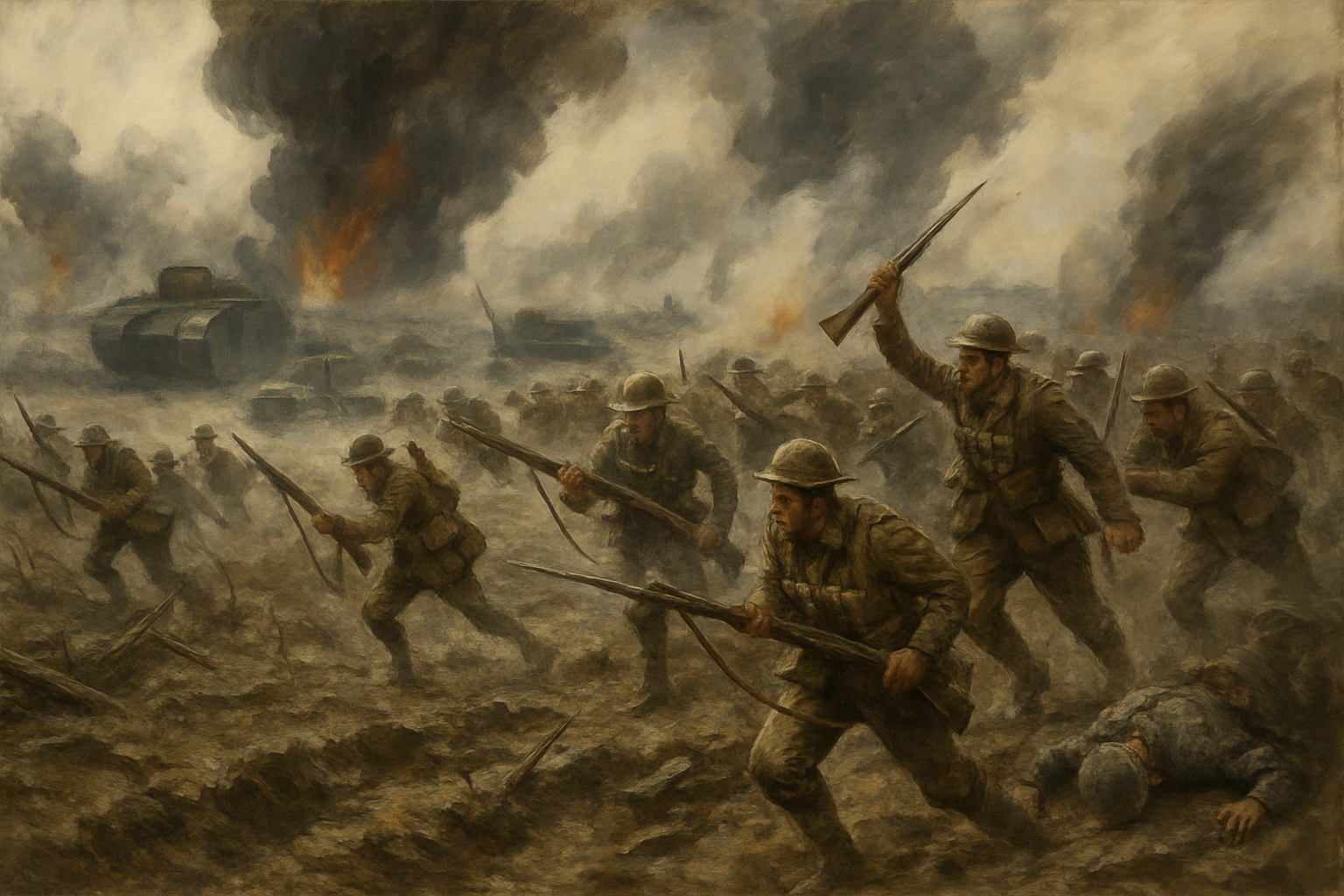
At 4:20 in the morning on 8 August 1918, over 400 Allied tanks rolled out of a thick ground mist near the French city of Amiens. Within hours, the Western Front would never be the same. General Erich Ludendorff, Germany's effective supreme commander, later wrote in his memoirs that it was "the black day of the German Army in the history of this war." He was not wrong. What unfolded that morning was not just a battlefield victory — it was the moment the tide of the First World War broke, finally and irreversibly, against Imperial Germany.
And at the sharp end of that assault were soldiers from Australia and Canada — men who had crossed oceans to fight in a war far from home, and who proved themselves among the finest combat troops of the entire conflict.
The Western Front in Mid-1918: A War at a Turning Point
To understand why Amiens was so decisive, you have to understand how desperate the situation had been just months earlier. Between March and July 1918, Germany had launched five massive offensives — Operation Michael, Georgette, Gneisenau, Blücher-Yorck, and Marneschutz-Reims — pushing Allied lines back in places to depths not seen since 1914.
But these offensives had bled Germany white. More than 800,000 German casualties had been suffered since March, and the elite storm-trooper divisions that led those attacks were exhausted or destroyed. Meanwhile, American troops were arriving in France at a rate of 300,000 men per month, tipping the strategic balance firmly toward the Allies.
Field Marshal Sir Douglas Haig and the newly appointed Supreme Allied Commander, French General Ferdinand Foch, saw their opportunity. East of Amiens, the German Second Army under General Georg von der Marwitz held a dangerously overextended line. Its troops were tired, poorly supplied, and — crucially — completely unaware of what was being prepared against them.
The Plan: Surprise, Speed, and Overwhelming Force
General Sir Henry Rawlinson's British Fourth Army was chosen to lead the assault. The plan was built around two extraordinary formations: the Canadian Corps on the right flank and the Australian Corps in the centre. These were the most battle-hardened, professionally capable units in the entire British Expeditionary Force.
Secrecy was absolutely paramount. Canadian units were moved to the Amiens sector only at night, with elaborate deception operations — including fake radio traffic — designed to convince German intelligence that the Canadians were still elsewhere on the front. The Royal Air Force flew continuous patrols to prevent German reconnaissance aircraft from spotting the build-up of more than 500 tanks, 2,000 artillery pieces, and 120,000 troops massing behind Allied lines.
Crucially, there would be no long preliminary bombardment — the hallmark of disastrous earlier battles like the Somme. Instead, the assault would open with a short, intense "hurricane" barrage timed to coincide precisely with the tanks going forward. Surprise, not prolonged punishment, was the weapon. It was a genuinely modern approach to warfare: tanks, infantry, cavalry, and aircraft working together in a co-ordinated combined-arms assault.
The Canadian Corps: Shock Troops from the Dominion
The Canadian Corps, commanded by General Sir Arthur Currie, was a force of roughly 100,000 men drawn from all four Canadian divisions. Currie — a former real estate agent from Victoria, British Columbia, who had never attended staff college — had transformed the Corps into one of the most effective military organisations in the world, drawing hard lessons from Vimy Ridge in April 1917 and every action since.
On 8 August, the Canadians attacked on a front of approximately 14,000 yards south of the Amiens–Roye road. The 1st and 2nd Canadian Divisions led the initial assault, with the 3rd and 4th Divisions ready to pass through and exploit the breakthrough as the advance gathered momentum.
By the end of that first day, Canadian forces had advanced up to eight miles — one of the greatest single-day advances recorded on the Western Front. They had captured more than 5,000 prisoners and over 100 German guns, at a cost of around 3,500 casualties. Those numbers, set against what had been achieved, were remarkable.
The Australian Corps: Monash's Masterpiece
North of the Canadians, in the centre of the Allied line, the Australian Corps under General Sir John Monash attacked with all five of its divisions committed to the battle. Monash — a civil engineer by profession — was perhaps the most methodical and innovative battlefield commander in the BEF.
His philosophy was clear: infantry should "advance in the shadow of the barrage and of the tanks" rather than lead exposed attacks unsupported. Every detail of the assault was planned, rehearsed, and co-ordinated in writing. The 2nd and 3rd Australian Divisions led the first wave, with the 4th and 5th ready to exploit success behind them.
Australian troops advanced up to seven miles on 8 August, capturing the village of Harbonnières and reaching objectives that planners had privately considered optimistic even for a three-day operation. Monash later called 8 August "the most brilliant" day in Australian military history. It is a bold claim — but very few serious historians have ever challenged it.
The Tanks, the Mist, and the Collapse of German Resistance
The Mark V tank, deployed in large numbers for the first time at Amiens, represented a genuine leap forward. It could cross wider trenches than its predecessors and was capable of carrying six soldiers inside — meaning infantry could be delivered directly into a breakthrough rather than having to follow on foot through no man's land under fire.
The thick morning mist was an unexpected gift. German defenders in their forward positions had almost no warning before tanks and infantry materialised out of the grey dawn and were upon them. Entire German regiments surrendered en masse. One British officer reported capturing more than 600 prisoners with a handful of men and a single tank — scenes almost unimaginable by the standards of 1916 or 1917.
The Royal Air Force played a new and decisive role, flying at low altitude to bomb and strafe retreating German columns and suppress artillery positions. It was close air support in something close to the modern sense — terrifying, disruptive, and deeply demoralising for troops already at the edge of their endurance. German soldiers, many of them hungry and exhausted after months of failed offensives, reportedly jeered at their own retreating comrades passing through French villages, shouting that they were "prolonging the war." Ludendorff found this collapse in fighting spirit more alarming than any map he studied.
Ludendorff's Crisis and the German High Command's Reckoning
Ludendorff's own words in his memoirs leave no ambiguity: "August 8th was the black day of the German Army in the history of this war. This was my worst experience of the war." What shook him most was not the ground lost — significant as that was — but the psychological collapse of veteran German divisions that had seemed unbreakable just months before.
On 14 August 1918, Ludendorff travelled to Spa in Belgium to meet Kaiser Wilhelm II. For the first time, he told his Emperor directly that Germany could no longer hope to win the war. The best they could now aim for was to negotiate a tolerable peace before the front collapsed entirely.
The Kaiser, by most accounts shaken to his core, reportedly responded: "I see that we must draw up the balance. We are at the limits of our endurance. The war must be ended." It would take three more months and further Allied offensives before the Armistice came — but the psychological foundations of German resistance had cracked at the very highest level on that August morning near Amiens.
The Hundred Days: Amiens as the Beginning of the End
The Battle of Amiens officially ran from 8 to 12 August 1918, with Allied forces advancing up to twelve miles in places. But Haig made a decision that historians have come to regard as a sign of real operational maturity: he halted the offensive before German resistance could harden into a new line of defence, and switched the axis of attack elsewhere along the front.
It was a lesson painfully learned from the Somme and Passchendaele — when the same ground had been fought over until men and momentum were both spent. This time, Haig refused to let Amiens become another attritional grinding match.
What followed was the Hundred Days Offensive: a rolling series of co-ordinated Allied attacks — by British, Dominion, French, and American forces — that kept the Germans perpetually off balance, unable to consolidate, unable to rest. Total Allied casualties at Amiens were approximately 22,000. German casualties, including prisoners, exceeded 75,000, with 400 guns captured. The war ended on 11 November 1918.
For the Australian and Canadian Corps, Amiens was the crowning operational achievement of the war — proof that citizen soldiers from the Dominions, shaped by their own national experiences and led by commanders who trusted them, had become among the most effective fighting forces on earth.
Why Amiens Still Matters: Legacy and Memory
The Australian National Memorial at Villers-Bretonneux, just south of Amiens, bears the names of 10,982 Australian soldiers who died in France and have no known grave. It stands as a quiet, powerful reminder that the Australian contribution to the Western Front was paid for in full, in blood.
In Canada, Amiens is remembered as part of the Hundred Days — a period of national pride that sits alongside Vimy Ridge as evidence of a distinct Canadian identity forged on European battlefields. The town of Villers-Bretonneux itself maintains a remarkable bond with Australia to this day. Its school, rebuilt with Australian donations after the war, carries the inscription: "Do Not Forget Australia." The town has not.
Military historians now broadly regard Amiens as a landmark moment in the development of modern combined-arms warfare — the integration of tanks, infantry, artillery, and air power in a way that genuinely foreshadowed the tactics that would dominate the next world war. The Imperial War Museum identifies Amiens as one of the most significant British military achievements of the entire conflict.
For anyone travelling through the Somme region today, the memorials around Amiens tell a story of courage, ingenuity, and ultimate victory that deserves to be far better known than it often is. These were not just battles on a map. They were the moments that shaped the modern world.
If this story resonates with you, we'd love to hear your thoughts in the comments below. Do you have a family connection to the Battle of Amiens or the Hundred Days? Share this article with a fellow history lover — these stories deserve to keep being told.
Further Reading
- Imperial War Museum (IWM), London — extensive collections on the Battle of Amiens, the Australian Corps, and the Canadian Corps on the Western Front
- The National Archives, Kew — British Fourth Army operational records, war diaries, and official despatches from August 1918
- Australian War Memorial, Canberra — official records, unit histories, and commemorative resources relating to the Australian Corps at Amiens
- Library and Archives Canada — Canadian Expeditionary Force records, the papers of General Sir Arthur Currie, and official histories of the Hundred Days Offensive
- Commonwealth War Graves Commission — registers and memorial records for those who fell at Amiens and are commemorated at Villers-Bretonneux