The Quiz Question
The Battle of Cambrai in November 1917 marked the first large-scale, coordinated use of tanks in warfare, taking German lines by surprise. Roughly how many British tanks took part in the initial assault?
- A. Around 50
- B. Around 150
- C. Around 380
- D. Around 800
The answer is C. Around 380. Here is the full story.
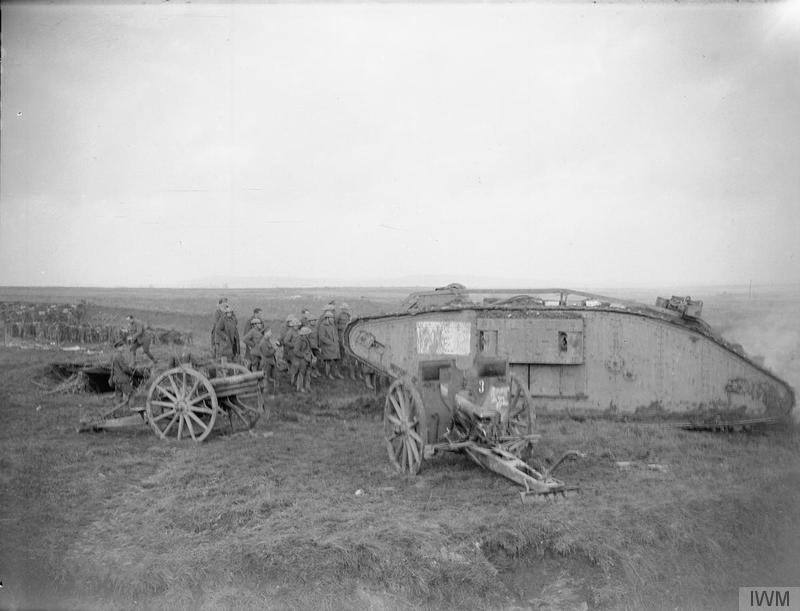
At 6:20 in the morning on 20 November 1917, the ground of northern France began to tremble. German soldiers in their trenches near the town of Cambrai heard a low, grinding rumble long before they saw anything. Then, out of the early-morning mist, nearly 380 British tanks lurched forward across the fields — no preliminary artillery barrage, no warning. Many German defenders simply ran. Nothing they had trained for had prepared them for this.
The Morning That Changed Everything
The assault covered a front of roughly ten kilometres, aimed squarely at the Hindenburg Line — the most formidable defensive system on the Western Front. Within hours, the British Third Army had punched deeper into German-held territory than weeks of fighting at Passchendaele had achieved. Church bells rang across London, something that had not happened since the war began. It felt, briefly, like a turning point.
Yet within ten days, German forces had clawed back almost everything the British had gained — and then some. Cambrai would go down in history as one of the war's most bittersweet moments: a genuine tactical revolution, and a missed opportunity, all at once.
Why Cambrai? The Strategic and Tactical Context
By the autumn of 1917, the Western Front had been grinding its men to dust for three years. The Third Battle of Ypres — better known as Passchendaele — had cost the British over 300,000 casualties for a gain measured in muddy kilometres. Morale, at home and at the front, was fragile.
The Hindenburg Line, constructed by the Germans over the winter of 1916–17, was a masterpiece of defensive engineering: deep concrete bunkers, overlapping fields of fire, and dense belts of barbed wire that conventional artillery bombardments seemed almost powerless to destroy. British commanders were looking for a way around the problem rather than through it.
Cambrai was chosen for practical reasons as well as strategic ones. The ground there was relatively firm and chalky — capable of supporting the weight of heavy tanks, unlike the waterlogged mud of Flanders. The sector had seen little recent activity, meaning the Germans were less vigilant. General Sir Julian Byng, commanding the Third Army, gave his backing to a bold plan championed by Brigadier-General Hugh Elles, commander of the Tank Corps, and his chief of staff, Lieutenant-Colonel J.F.C. Fuller.
The Tank Corps: Britain's Secret Weapon
The Tank Corps deployed 476 vehicles in total at Cambrai. Of these, 378 were fighting tanks, 54 were supply tanks, and 32 were specially fitted wire-pullers. The rest were various specialist machines, including communication and bridging vehicles. Nothing on this scale had ever been attempted before.
The primary fighting vehicle was the Mark IV tank — a 28-tonne steel giant that crawled along at just 6 kilometres per hour. It was noisy, unreliable, and brutally uncomfortable for its crew of eight. But it could crush barbed wire flat, cross a wide trench, and absorb small-arms fire that would have cut down infantry in seconds.
Mark IVs came in two configurations: 'Males', armed with two 6-pounder guns and four machine guns, and 'Females', carrying machine guns only. They were typically deployed in pairs, with a Male leading and a Female providing close-in protection against infantry. Inside, conditions were genuinely dangerous even before the enemy opened fire — temperatures regularly exceeded 50°C, carbon monoxide from the engine fumes built up quickly, and the noise was deafening enough to cause lasting hearing damage.
Brigadier-General Elles chose to lead the assault in person from his tank, named Hilda, of H Battalion. He flew the newly adopted Tank Corps colours — brown, red and green — from his commander's hatch. It was a calculated act of leadership as much as personal bravery; Elles knew his men needed to see that their commanders shared the risk.
The Plan: Tanks, Infantry and a New Kind of Battle
The tactical thinking behind Cambrai was genuinely revolutionary. Each tank carried a fascine — a tightly bound bundle of brushwood roughly 1.5 metres in diameter — which it would drop into a trench to bridge it, allowing the tank to cross without ditching. The tanks advanced in groups of three: the lead tank would crush the wire and turn parallel to the first trench, the second would drop its fascine and cross, and the third would follow.
Artillery used what was called a 'predicted barrage' — calculated mathematically from maps and survey data, rather than the usual practice of firing ranging shots over several days, which would have alerted the Germans. This was a significant technical achievement in itself, and it meant the attack came as a genuine surprise.
Six infantry divisions of the Third Army followed directly behind the tank waves to consolidate captured ground. The Royal Flying Corps provided air support, with aircraft strafing German positions and communications — an early and striking example of what would later be called combined-arms coordination. Five cavalry divisions waited in reserve, ready to pour through any gap and exploit a breakthrough. That exploitation never came.
20 November 1917: The Assault Unfolds
The tanks crossed the first trench lines of the Hindenburg system within the first hour — an achievement that would have seemed almost impossible just weeks earlier. By midday, British forces had advanced up to eight kilometres in several places, the deepest penetration of the Western Front since the war of movement had ended in 1914.
Not everything went to plan. The 51st (Highland) Division ran into fierce resistance at Flesquières, where German artillery crews — reportedly led by a single determined officer, though the details of that story remain debated by historians — knocked out a significant number of tanks. The delay at Flesquières had knock-on effects up and down the line.
Bourlon Wood and Bourlon Ridge, commanding high ground that overlooked the entire battlefield, proved impossible to capture cleanly on the first day. Fighting in and around the wood dragged on for days, consuming reserves and momentum. Around 65 tanks were knocked out or broke down mechanically on 20 November alone — a reminder that the Mark IV, for all its power, was still a machine in its infancy.
The Men Inside the Machines
Tank crews at Cambrai were volunteers, many drawn from infantry and cavalry regiments, who had trained at Bovington Camp in Dorset. For a significant number of them, Cambrai was their first experience of combat inside a tank. The physical ordeal they faced is difficult to overstate.
Heat exhaustion and carbon monoxide poisoning put as many men out of action on the first day as enemy fire did. Visibility inside a moving Mark IV was so poor that crews sometimes had to crack open a hatch under fire simply to see where they were going — a terrifying necessity on a battlefield swept by machine guns and artillery.
Lieutenant-Colonel John Hardress-Lloyd commanded D Battalion of the Tank Corps and led his men through some of the most intense fighting around Flesquières. His battalion's experience that day illustrated both the potential and the limitations of the new weapon: the tanks could break the line, but they could not hold ground, and without infantry support in the right place at the right time, even a successful tank assault could stall.
The German Counterattack: When the Tables Turned
On 30 November 1917 — just ten days after the British assault — General Erich Ludendorff launched a powerful counterattack. The Germans used their new Stosstruppen — stormtrooper — infiltration tactics: fast-moving infantry squads that bypassed strongpoints, avoided frontal assaults, and struck deep into British rear areas, disrupting communications and supply lines before defenders could react.
It worked with shocking efficiency. Within two days, the Germans had retaken most of the ground the British had captured and, in the southern part of the battlefield, pushed beyond the original British front line. The same surprise and momentum that had carried the British tanks forward on 20 November now worked against them.
The full Cambrai battle — from 20 November to 7 December 1917 — cost the British around 44,000 men killed, wounded or captured. German casualties were approximately 45,000. A War Office inquiry followed, examining why the hard-won gains had not been held. General Byng controversially attributed part of the blame to the performance of his own infantry, a claim that sparked anger among veterans and controversy among historians that has never fully subsided.
What Cambrai Proved: A Revolution in Warfare
Whatever its ultimate territorial outcome, Cambrai was a watershed. It demonstrated conclusively that massed tanks, deployed with surprise and properly coordinated with infantry and artillery, could break even the most formidable defensive lines. The months of preliminary bombardment that had preceded the Somme and Passchendaele — and which had sacrificed surprise entirely — were shown to be unnecessary.
German commanders studied the battle closely. They began developing anti-tank tactics and, over the following two decades, an armoured doctrine of their own — one that would eventually produce the Panzer divisions of the Second World War. The irony is painful: the lessons the British demonstrated at Cambrai were, in some respects, applied more thoroughly by their enemies in the next war.
For the Tank Corps itself, Cambrai was vindication after years of scepticism from senior commanders who had doubted whether armoured vehicles had a real future. Tank production was dramatically accelerated: by 1918, Britain had over 2,500 tanks in service. J.F.C. Fuller, who had helped plan Cambrai, went on to become one of the most influential military theorists of the 20th century, and his ideas — along with those of Basil Liddell Hart — shaped armoured doctrine on both sides of the Channel during the interwar years.
Many military historians regard Cambrai as the true birth of modern combined-arms warfare. The integration of tanks, infantry, artillery and air power into a single coordinated assault was not perfected there, but it was genuinely pioneered there. The template the Tank Corps and Third Army laid down in the fields of northern France in November 1917 is recognisable in how mechanised armies have fought ever since.
Cambrai's Legacy: Why It Still Matters Today
The Tank Corps memorial at Louverval, near Cambrai, was unveiled in 1928. It stands today as a quiet, moving tribute to the more than 1,000 Tank Corps men who died in the battle and have no known grave. The names carved there represent just a fraction of the human cost of that extraordinary ten-day struggle.
The Royal Tank Regiment — the direct descendant of the Tank Corps — still observes Cambrai Day on 20 November each year as its most important regimental occasion. It is a living tradition, connecting today's soldiers to men who went to war in steel boxes held together with rivets, breathing exhaust fumes, navigating by opening their hatches under fire.
The battlefield itself remains accessible to visitors. The area around Flesquières has yielded tank wrecks over the decades, and local preservation efforts have ensured that the story of the battle remains visible in the landscape. For anyone who wants to understand where the modern age of warfare began, Cambrai is not a footnote — it is the origin point.
If this story moved you, we'd love to hear your thoughts in the comments below. Do you have a family connection to the Tank Corps or the Cambrai battle? Share this article with a fellow history enthusiast and help keep these stories alive.
Further Reading
- Imperial War Museum (IWM), London — holds extensive Tank Corps records, personal diaries, photographs and oral history recordings from Cambrai veterans
- The National Archives, Kew — War Office papers and the official inquiry documents relating to the Battle of Cambrai are held in the WO series
- The Tank Museum, Bovington, Dorset — the national collection of British armoured fighting vehicles, including preserved Mark IV tanks and Cambrai-era artefacts
- Commonwealth War Graves Commission — records of all British and Commonwealth casualties at Cambrai, including Tank Corps men commemorated at the Louverval Memorial
- Royal Tank Regiment Museum Trust — holds regimental records, unit histories and Cambrai Day commemorative materials relating to the Tank Corps' founding battle