The Quiz Question
Which brutal, months-long 1944 battle along the German-Belgian border, fought in dense forest terrain that negated American armor and air power, is considered the longest single battle the US Army has ever fought?
- A. Battle of Hurtgen Forest
- B. Battle of the Bulge
- C. Battle of Aachen
- D. Battle of the Colmar Pocket
The answer is A. Battle of Hurtgen Forest. Here is the full story.
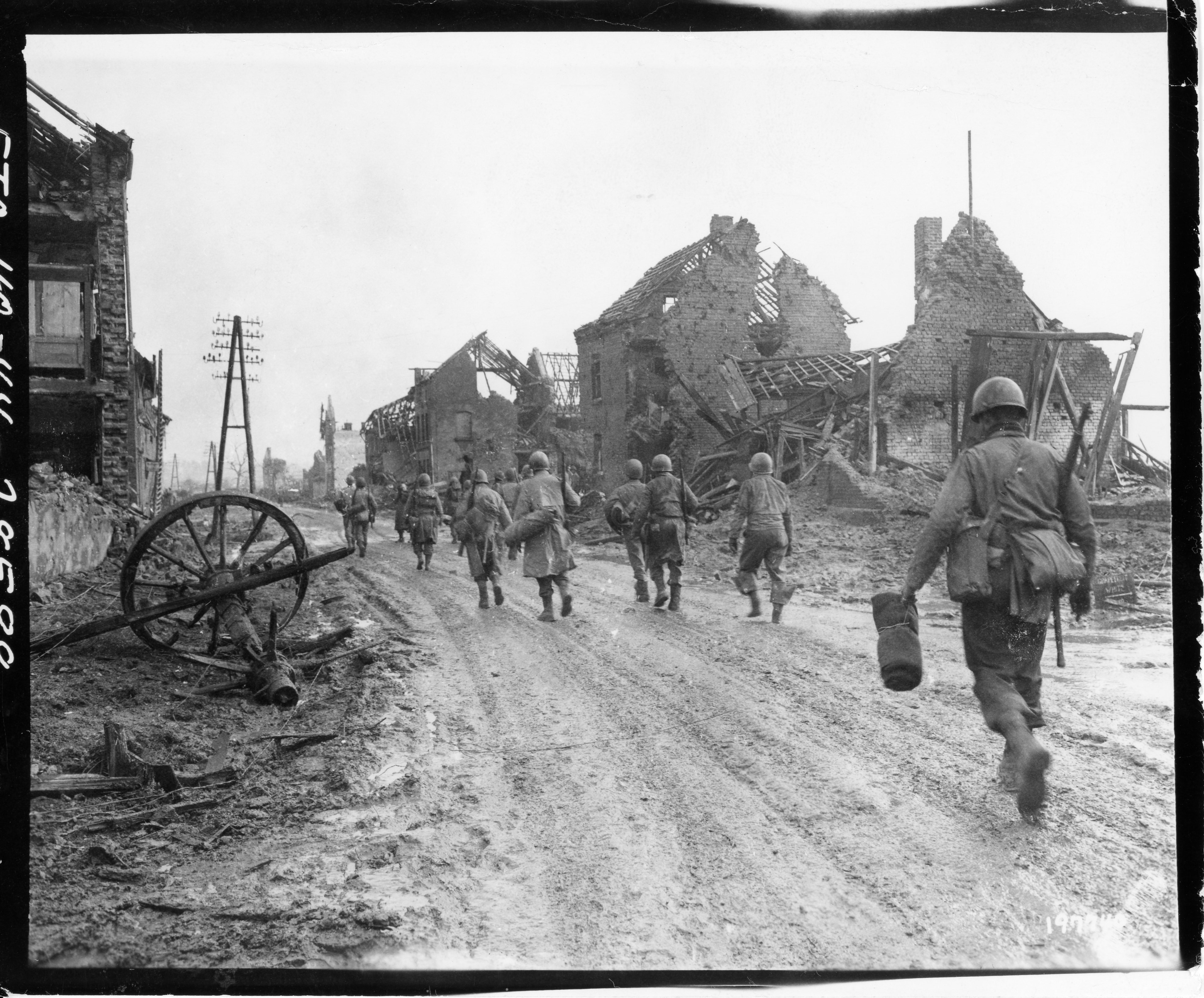
In the autumn of 1944, as Allied armies raced across France and Belgium in the euphoric weeks after Normandy, a dark and ancient woodland on the German-Belgian border was waiting. The Hürtgen Forest would stop the US Army dead in its tracks — and what followed was three months of misery, blood, and tactical catastrophe that soldiers who survived it called the worst experience of their lives.
A Forest That Swallowed an Army
The Hürtgen Forest stretches roughly 50 square miles of dense, dark pine woodland straddling the German-Belgian border, southeast of Aachen. It is old, thick, and claustrophobic — the kind of terrain that swallows daylight and deadens sound in unsettling ways.
Fighting lasted from 19 September to 16 December 1944, nearly three months of almost continuous combat, making it the longest single battle ever fought by the United States Army. More than 120,000 American soldiers rotated through that forest. Estimated US casualties range from 33,000 on the conservative end to as high as 55,000 when non-battle losses — combat exhaustion, trench foot, hypothermia, disease — are included.
Despite its scale, the Hürtgen has been largely overshadowed by the Normandy landings and the Battle of the Bulge. Yet veterans who came out of those trees consistently described it in terms that set it apart. Ernest Hemingway, who covered the battle as a war correspondent, called it "Passchendaele with tree bursts" — a reference to one of the First World War's most catastrophic slaughters. That comparison was not hyperbole.
Why Did the Americans Enter the Forest at All?
After the breakout from Normandy in August 1944, Allied commanders were operating under a dangerous wave of optimism. Germany, they believed, was on the verge of collapse. That assumption would prove catastrophically premature.
General Courtney Hodges, commanding the US First Army, needed to advance toward the Rhine and secure the city of Aachen. The Hürtgen Forest sat directly on the southern flank of that advance and could not simply be bypassed. More critically, the Roer River dams — particularly the massive Schwammenauel Dam — lay beyond the forest. If the Germans opened those dams, they could flood the Roer valley and trap any Allied forces that had already crossed the river downstream.
Clearing the forest was therefore framed as a strategic necessity. But Allied planners badly underestimated how the terrain would neutralise their greatest advantages: air power, artillery observation, and armoured mobility. Supreme Allied Commander Dwight D. Eisenhower approved the operation. Historians — including Charles B. MacDonald, who fought there as a company commander — have since questioned whether the forest needed to be entered in anything like the way it was.
The Terrain: Nature as the Enemy
The forest canopy, even in autumn, was thick enough to block air observation. Allied tactical aircraft — a war-winning asset in Normandy — were almost entirely neutralised. Pilots could not see targets; ground controllers could not communicate effectively through the trees.
The only routes for vehicles were narrow firebreaks and logging trails. German engineers had mined them methodically and pre-registered artillery and mortar coordinates on every junction and clearing. Moving anything larger than a squad meant running a gauntlet of pre-aimed fire.
The most feared hazard was the tree burst. Artillery shells detonating in the upper branches sent shrapnel and jagged timber splinters raining downward at lethal angles. Foxholes that would have saved lives on open ground offered little protection. Men died in their fighting positions from wounds entering from above.
As November came, autumn rain turned the forest floor to deep mud. Temperatures plummeted. Snow and ice followed. Trench foot and hypothermia began killing and disabling men by the hundreds. Running through all of it, the Siegfried Line — known to the Germans as the Westwall — bristled with concrete bunkers, dragon's teeth anti-tank obstacles, and interlocking fields of fire that handed defenders every possible advantage.
The Opening Moves: September–October 1944
The 9th Infantry Division was the first major American formation committed to the forest, entering on 19 September 1944 with orders to capture the village of Schmidt. It was an objective that would not fall for months. The 9th Division suffered around 4,500 casualties in three weeks and gained almost nothing measurable.
The 1st Infantry Division — the legendary "Big Red One" — was committed in October, grinding through the villages of Schevenhutte and Stolberg on the forest's northern edge. German defenders, primarily from the 275th Infantry Division and later reinforced by elements of several others, used the terrain with skill and patience. They pulled back to secondary positions at precisely the moment American units believed they had broken through, resetting the killing ground again and again.
By the end of October, US commanders were rotating divisions in and out of the line. The forest was consuming units at a rate that shocked battle-hardened senior officers. No one had a solution. The attacks continued anyway.
The Disaster at Schmidt: November 1944
The Battle of Schmidt, fought from 2 to 9 November 1944, stands as one of the worst American tactical defeats of the entire war in Europe. The 28th Infantry Division — the Pennsylvania National Guard's "Keystone Division," identifiable by the red keystone shoulder patch — was ordered to seize Schmidt, the village of Vossenack, and push on toward the Roer dams.
American troops briefly captured Schmidt on 3 November. The following morning, a German armoured counterattack using Panther tanks drove them back in near-rout. The Americans had no armour capable of operating on the narrow, muddy forest roads to meet the Panthers on equal terms.
The 112th Infantry Regiment was shattered as a fighting force. The 28th Division suffered approximately 6,184 casualties in eight days — one of the costliest single-division actions in US Army history. Schmidt itself would not be taken for months.
The disaster forced a painful institutional rethink. The forest could not be stormed; it would have to be reduced methodically, at enormous cost, yard by yard. That process would grind on through November and into December.
The Soldiers Who Fought There: Faces in the Trees
Ernest Hemingway embedded with the 22nd Infantry Regiment of the 4th Infantry Division in November 1944. His close friendship with the regiment's commander, Colonel Charles "Buck" Lanham, forged in those freezing woods, became one of the defining personal relationships of Hemingway's later years and left a clear mark on his postwar writing.
J.D. Salinger — who would go on to write The Catcher in the Rye — served with the 12th Infantry Regiment, also of the 4th Infantry Division, through the Hürtgen fighting. He later spoke of carrying an early draft of his novel through the campaign. The experience, by his own account, never left him.
The human cost was not only American. Captain Eugen Hollenbach of the German 275th Division later recounted that his men could hear American soldiers crying out in the dark and were under strict orders not to call back to them. The psychological toll of that forest fell on both sides of the line.
A particularly painful structural problem was the replacement system. Green soldiers arrived individually to replace casualties, with no bond to their units and no knowledge of local conditions. Many became casualties within days. Medics trying to evacuate the wounded faced extraordinary danger; moving a stretcher through mined, muddy, fire-swept forest tracks meant that men who might have survived with prompt treatment died of their wounds before they could be reached.
The Final Push and the Shadow of the Bulge
By early December 1944, the 2nd and 8th Infantry Divisions were making slow, grinding progress through the northern portion of the forest. The town of Hürtgen itself fell on 28 November. The 83rd Infantry Division and elements of the 5th Armored Division were preparing a major renewed push toward the Roer dams.
Then, on 16 December 1944, Germany launched Operation Wacht am Rhein — the Ardennes Offensive, which history would come to know as the Battle of the Bulge. The massive German assault tore through the Ardennes to the south, and the crisis it created immediately overshadowed everything happening in the forest.
The 28th Division — still recovering from the disaster at Schmidt — found itself directly in the path of the German advance. Divisions exhausted by weeks of forest fighting were suddenly facing an entirely new emergency with almost no rest in between.
The Battle of Hürtgen Forest is officially considered to have ended on 16 December when the Bulge began, though fighting in the area continued. The Roer dams were not seized until February 1945. When the Germans finally destroyed the Schwammenauel Dam rather than surrender it, they flooded the Roer valley for nearly two weeks — the precise catastrophe the entire Hürtgen campaign had supposedly been fought to prevent.
The Reckoning: Casualties, Controversy, and Command Failures
Conservative estimates place total US casualties at 33,000. Historians who include non-battle losses from exposure, disease, and combat fatigue push the figure toward 55,000. By any measure, it was an enormous price for ground of limited strategic value ultimately taken at enormous delay.
German losses were also severe, but proportionally more sustainable. The Wehrmacht was fighting on home ground, with prepared defences, interior supply lines, and terrain that negated nearly every American material advantage.
General Hodges and his First Army staff have faced sustained historical criticism for persisting in costly frontal assaults without adequately addressing the Roer dam problem through alternative means. The Royal Air Force had attempted to breach the Schwammenauel Dam by bombing in late 1944, but the dam's massive earthwork construction proved highly resistant to aerial attack. Whether more creative solutions — flanking routes, earlier focus on the dams themselves — could have shortened the campaign remains a live historical debate.
Charles B. MacDonald's 1963 official history, The Siegfried Line Campaign, written by a man who commanded a rifle company in those woods, remains the most clear-eyed account of where Allied command went wrong. MacDonald did not spare his own side.
Legacy: The Forgotten Battle That Shaped a Generation
The Hürtgen Forest battle is routinely called "the forgotten battle," sitting as it does in the long shadow of D-Day and the Bulge. But for the men who fought there, nothing in the war was more vivid or more terrible. Veterans consistently reported that the forest haunted them in ways that other combat did not — the darkness, the tree bursts, the invisible enemy, the cold that never lifted.
Post-war US Army analysis of the Hürtgen campaign contributed directly to changes in American doctrine around combined-arms operations in restricted terrain. The lesson — that terrain can neutralise technology, and that a determined defender on ground of his choosing extracts a price out of all proportion to the attacker's numerical strength — was written in the hardest possible ink.
Today the forest is peaceful German countryside. The German War Cemetery at Vossenack contains more than 2,000 graves, many of them the men who held those pine-dark ridges against American assaults. The Henri-Chapelle American Cemetery in Belgium holds 7,992 American war dead, a significant number of them from the Hürtgen fighting. Walking those rows of white crosses, it is hard to understand how a battle of this scale slipped so completely from public memory.
The Hürtgen Forest stands as one of history's starkest military lessons: underestimate the ground, underestimate a determined enemy, and the bill always comes due — in blood, in time, and in the long silence of men who came home and found no words adequate to what they had seen.
If you have a family connection to the Hürtgen Forest campaign — a grandfather who served in the 28th, 4th, or 9th Division, or any unit that rotated through those trees — we would love to hear your story in the comments below. And if this piece brought that forgotten battle a little closer to the light it deserves, please share it with someone who loves history.
Further Reading
- The National WWII Museum, New Orleans — extensive collections and research resources on the Western Front campaign of 1944–45
- The US Army Center of Military History, Washington D.C. — home to official campaign histories including MacDonald's The Siegfried Line Campaign
- The Imperial War Museum, London — holds Allied and German material relating to the autumn 1944 Western Front operations
- The National Archives, College Park, Maryland — primary source records of US Army unit after-action reports from the Hürtgen fighting
- The Henri-Chapelle American Cemetery and Memorial, Belgium — administered by the American Battle Monuments Commission, with records of those interred