The Quiz Question
Which April 1975 helicopter evacuation, the largest of its kind in history, airlifted thousands of American personnel and South Vietnamese allies from Saigon as North Vietnamese forces closed in on the capital?
- A. Operation Frequent Wind
- B. Operation Babylift
- C. Operation Homecoming
- D. Operation Eagle Pull
The answer is A. Operation Frequent Wind. Here is the full story.
On the morning of 29 April 1975, Saigon was dying. North Vietnamese Army divisions had encircled a city of three million people, artillery rounds were falling on Tan Son Nhut Air Base, and the United States was about to attempt the largest helicopter evacuation in military history. What followed over the next eighteen hours would be heroic, chaotic, heartbreaking — and defining.
The Last Hours of South Vietnam: A City on the Brink
By dawn on 29 April, NVA forces had closed off virtually every escape route from the capital. Rocket and artillery fire struck Tan Son Nhut in the early hours, killing two US Marines: Corporal Charles McMahon Jr. of Woburn, Massachusetts, and Lance Corporal Darwin Judge of Marshalltown, Iowa. They were the last Americans to die in the Vietnam War.
US Ambassador Graham Martin had spent weeks resisting calls for a full evacuation, fearing it would trigger a collapse of morale and a panicked exodus. He finally authorised the operation at around 10:51 a.m. The pre-arranged signal went out across Saigon — Armed Forces Radio broadcast Bing Crosby's 'White Christmas', telling Americans and allied personnel scattered across the city that the time had come to move to designated pickup points.
The signal was understood immediately by those who knew to listen for it. Within minutes, panic rippled through the streets. Crowds of South Vietnamese civilians surged toward the US Embassy on Thong Nhat Boulevard, scaling its fourteen-foot perimeter wall with bare hands, desperate to get inside before the gates closed forever.
How It Came to This: The Road to Saigon's Fall
The Paris Peace Accords of January 1973 had ended direct American military involvement, but they left a deeply unstable situation on the ground. Roughly 150,000 NVA troops remained in the South, and the agreement relied on both sides honouring commitments that neither fully intended to keep.
Congress progressively cut military aid to South Vietnam — from $1 billion in 1973 to $700 million in 1974, then down to just $300 million in 1975. The South Vietnamese Armed Forces, the ARVN, had been built around American-style firepower and logistics. Without the fuel, ammunition, and spare parts that aid funded, their capacity to fight collapsed with startling speed.
The NVA launched its final Ho Chi Minh Campaign on 4 March 1975. The Central Highlands fell within weeks. Da Nang — South Vietnam's second-largest city — was overrun on 29 March 1975 in scenes of extraordinary chaos, with soldiers and civilians fighting each other to board evacuation aircraft on the runway. By mid-April, President Nguyen Van Thieu had resigned and fled the country, leaving behind a government with no credible authority and an army with no clear chain of command.
Planning the Unthinkable: Operation Frequent Wind Takes Shape
Operation Frequent Wind was the fourth and final phase of a broader US evacuation plan. Earlier phases had used fixed-wing aircraft out of Tan Son Nhut, including Operation Babylift, which had evacuated thousands of South Vietnamese orphans earlier in April. By 29 April, the NVA's shelling had closed Tan Son Nhut to fixed-wing traffic entirely. Helicopters were the only option left.
The operation was co-ordinated by the US Seventh Air Force and Navy Task Force 76, which had pre-positioned a powerful fleet in the South China Sea — including the aircraft carriers USS Hancock, USS Midway, and USS Enterprise. The Marine Corps' 9th Marine Amphibious Brigade, commanded by Brigadier General Richard Carey, was placed on standby to provide ground security and assist the lifts from two primary evacuation points: the Defence Attaché Office compound at Tan Son Nhut and the US Embassy compound in central Saigon.
Approximately 81 helicopters were committed to the operation, including CH-46 Sea Knights and the larger CH-53 Sea Stallions. They would fly shuttle runs of roughly 80 kilometres between Saigon and the fleet offshore — relentlessly, through the night, until the job was done or the city fell, whichever came first.
The Lift Begins: 29 April 1975 — Hour by Hour
The first helicopter wave launched from the fleet at approximately 3:00 p.m. on 29 April. Marine CH-53s began lifting evacuees from the DAO compound at Tan Son Nhut, where thousands of South Vietnamese and third-country nationals had gathered under increasingly tense conditions. Pilots flew continuous sorties — some completing more than ten round trips in a single day.
At the Embassy, the scene was reaching breaking point. Thousands of South Vietnamese civilians pressed against the walls and gates. US Marines worked to maintain order as desperate people climbed over one another to reach the rooftop landing zones. Ambassador Martin refused to leave until he was almost physically compelled to board his helicopter, reportedly insisting on remaining until the last evacuees were out.
By midnight, the DAO compound evacuation was complete — approximately 5,000 people had been airlifted out. But the Embassy operation ground on through the small hours of 30 April, chaotic and exhausting, with pilots pushing through fatigue and fading fuel reserves to keep the shuttles running.
The People Who Made It Happen: Heroes of Frequent Wind
Brigadier General Richard Carey co-ordinated ground security and helicopter movements throughout the operation, making real-time decisions under conditions that no plan had fully anticipated. His Marines held landing zones under mounting pressure and maintained enough order to keep the lifts moving.
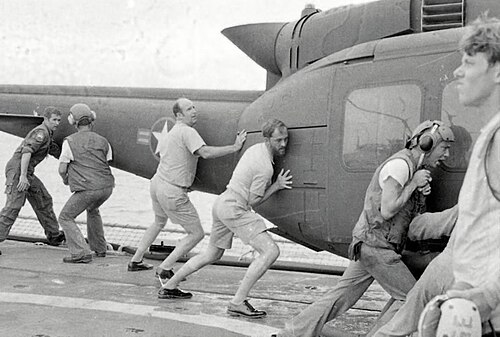
One of the operation's most remarkable moments came aboard USS Midway. Captain Lawrence Chambers made the extraordinary decision to push several South Vietnamese Air Force helicopters overboard into the sea — destroying millions of dollars of equipment — to clear deck space for a small Cessna flown by a South Vietnamese Air Force pilot who had taken off from a collapsing airfield with his family aboard and had nowhere else to land. Chambers let him land. The pilot and his family were saved.
Dozens of South Vietnamese Air Force pilots flew their own helicopters to the fleet, landing on carrier decks or ditching in the sea alongside the ships, their crews pulled from the water by US sailors. CIA officer Frank Snepp and his colleagues worked through the night trying to get South Vietnamese agents and employees out — men and women who faced grave danger if left behind. Many were not reached in time.
Master Sergeant Juan Valdez and a small team of Marines were among the very last to leave the Embassy rooftop, holding the perimeter until the final CH-46 lifted off at approximately 7:53 a.m. on 30 April.
The Ones Left Behind: The Hardest Part of the Story
For all its scale and urgency, Operation Frequent Wind could not save everyone. An estimated 420 South Vietnamese who had been promised evacuation were still inside the Embassy compound when the last helicopter departed. Ambassador Martin's delayed authorisation — driven in part by political pressure from Washington to avoid the appearance of defeat — had cost critical hours that could never be recovered.
Beyond the Embassy walls, tens of thousands of South Vietnamese who had worked alongside Americans — translators, intelligence assets, soldiers, civil servants — were left to face the incoming communist regime. Many were imprisoned in so-called re-education camps, some for years. Others were executed. CIA station chief Thomas Polgar sent a final cable from the Embassy before the last communications went dark: 'This will be the last message from Embassy Saigon… It has been a long hard fight and we have lost.'
The weight of that abandonment never fully left the people who were there. Veterans and diplomats carried it for the rest of their lives, and many campaigned for decades to secure recognition and resettlement rights for the allies they had been forced to leave behind.
Saigon Falls: 30 April 1975 and the End of South Vietnam
At 10:24 a.m. on 30 April 1975, North Vietnamese Tank No. 843 crashed through the gates of the Presidential Palace in Saigon — the moment captured in one of the most iconic photographs of the twentieth century. General Duong Van Minh, South Vietnam's last president, who had been in office for just three days, broadcast an unconditional surrender over Saigon Radio at 10:30 a.m.
NVA troops raised the flag over the palace. The last American helicopter had left the Embassy rooftop less than three hours earlier. The evacuation and the fall had overlapped by a matter of hours — the margin between escape and capture measured not in days, but in minutes.
Operation Frequent Wind officially evacuated approximately 7,000 people in 18 hours: 1,373 Americans and 5,595 South Vietnamese and third-country nationals. Given the conditions — enemy shelling, crowd disorder, failing communications, and an ever-narrowing window — the logistical achievement was extraordinary. The moral reckoning it left behind was harder to measure.
The Wider Exodus: The Boat People and the Refugee Crisis
For hundreds of thousands of Vietnamese, April 1975 was not an ending — it was the beginning of a desperate journey. In the years that followed the fall of Saigon, an estimated 800,000 to one million people fled Vietnam by sea. They became known internationally as the Boat People.
Many perished in the South China Sea, victims of storms, starvation, and pirates who preyed on overcrowded and defenceless vessels. International estimates suggest tens of thousands died during these crossings, though the full toll was never recorded. The United States resettled approximately 130,000 Vietnamese refugees in 1975 alone, processing them through Operation New Life at bases in Guam, the Philippines, and eventually on American soil.
The crisis eventually prompted major international co-ordination, including the UN's Comprehensive Plan of Action in 1989. The Vietnamese-American communities that exist today — particularly in California, Texas, and Virginia — were founded largely by those who escaped in 1975 and the years that followed. They carry the history of that evacuation in their own family stories.
Legacy and Lessons: What Operation Frequent Wind Means Today
Operation Frequent Wind remains the largest helicopter evacuation in military history — a record that still stands. When the United States withdrew from Kabul in August 2021, journalists and military historians reached almost immediately for the Saigon comparison. The parallels — the crowds at the gates, the desperate allies, the final helicopters — were impossible to ignore.
The fall of Saigon represented the first decisive military defeat the United States had suffered in a major war. It reshaped American foreign policy and military doctrine profoundly — contributing to the development of the Powell Doctrine, which insisted on clear objectives, overwhelming force, and defined exit strategies before committing American troops.
The image of crowds scaling the Embassy walls became one of the defining photographs of the twentieth century — not just as a record of military failure, but as a testament to what happens when geopolitical decisions leave ordinary people to face the consequences alone. For the US Marines and pilots who flew that day, for the South Vietnamese who made it out and for those who did not, 29 and 30 April 1975 are dates that have never faded.
If this story moved you — or if you have a personal connection to the events of April 1975 — share it with someone who should know this history. And leave a comment below: we read every one.
Further Reading
- The National Archives (United States) — holds declassified State Department and military cables from the fall of Saigon period
- The National Museum of the Marine Corps — holds records and artefacts relating to Marine operations including Frequent Wind
- The Vietnam Center and Sam Johnson Vietnam Archive, Texas Tech University — one of the most comprehensive collections of Vietnam War primary sources outside the National Archives
- The Smithsonian National Air and Space Museum — documents the helicopter operations and aircraft types used during the evacuation
- The UNHCR (United Nations High Commissioner for Refugees) — holds extensive records on the Vietnamese Boat People crisis and international resettlement efforts