The Quiz Question
Fought on January 8, 1815, after the war-ending treaty had already been signed but before news reached America, which battle made Andrew Jackson a national hero after his outnumbered force inflicted over 2,000 British casualties for minimal losses?
- A. Battle of New Orleans
- B. Battle of Baltimore
- C. Battle of Plattsburgh
- D. Battle of Bladensburg
The answer is A. Battle of New Orleans. Here is the full story.
On the morning of 8 January 1815, thousands of British soldiers stepped out of the Louisiana fog and marched toward a mud-and-timber wall held by a ragtag collection of frontiersmen, pirates, and militia volunteers. Within thirty minutes, it was over. The redcoats had suffered one of the most catastrophic defeats in their history — and not a single one of those men, on either side, knew the war had already ended.
A Battle That Should Never Have Been Fought
The Treaty of Ghent, formally ending the War of 1812, was signed on Christmas Eve, 24 December 1814, by British and American diplomats in the Belgian city of Ghent. The ink was barely dry when nearly 15,000 men prepared to fight one of the most one-sided land battles in American history.
News simply could not travel faster than a ship. With no telegraph and no wireless communication, word of the peace took weeks to cross the Atlantic. By the time it arrived, the battle had long since been fought, and the dead were already buried.
The result — over 2,000 British casualties against just 62 American losses — defied military logic. And rather than fading into a footnote about poor timing, the Battle of New Orleans became a defining legend, making Andrew Jackson a president and reshaping what Americans believed about themselves.
The War of 1812: Why Britain and America Were Fighting at All
The war had begun in June 1812, rooted in a tangle of grievances: Britain's trade restrictions strangling American commerce, the Royal Navy's arrogant practice of boarding American ships and "impressing" sailors into service, and simmering frontier disputes along the Canadian border.
By late 1814, neither side had landed a decisive blow. Britain had struck a humiliating symbolic wound in August 1814, when its forces marched into Washington D.C. and burned the White House and the Capitol to their shells. But that triumph hadn't broken American resistance.
Napoleon's defeat in April 1814 changed the strategic picture dramatically. Veteran British regiments, battle-hardened through years of savage fighting in Spain and Portugal under Wellington, were now available for service in North America. Britain's commanders saw an opportunity to end the American war with a decisive stroke — seizing New Orleans and strangling the young republic's most vital economic artery, the Mississippi River.
The British Plan: Seize the Jewel of the Gulf
Command of the Louisiana expedition fell to General Sir Edward Pakenham, just 37 years old, a decorated Peninsular War veteran and — an interesting footnote — the brother-in-law of the Duke of Wellington himself. He was given a force of between 8,000 and 11,000 British regulars, including the legendary 93rd Sutherland Highlanders and other units fresh from Wellington's campaigns.
Vice-Admiral Alexander Cochrane's fleet transported the army through Lake Borgne, following a sharp engagement on 14 December 1814 in which British forces overwhelmed a small American gunboat squadron to clear the approach. The army came ashore in difficult bayou country, struggling through marshes and waterways before consolidating south of New Orleans.
The operational plan centred on a frontal assault against Jackson's fortified line along the Rodriguez Canal, with a diversionary attack across the Mississippi's west bank intended to create confusion and split the American defence. Pakenham's senior generals — Samuel Gibbs and John Keane — fully expected their veterans to brush aside what they privately dismissed as frontier rabble. That confidence would cost them everything.
Andrew Jackson: The Unlikely Defender of New Orleans
Major General Andrew Jackson arrived in New Orleans on 1 December 1814 and immediately declared martial law. He had roughly six weeks to turn a chaotic, multilingual, fractious city into a fortress. By most accounts, his energy and force of personality were the difference between survival and catastrophe.
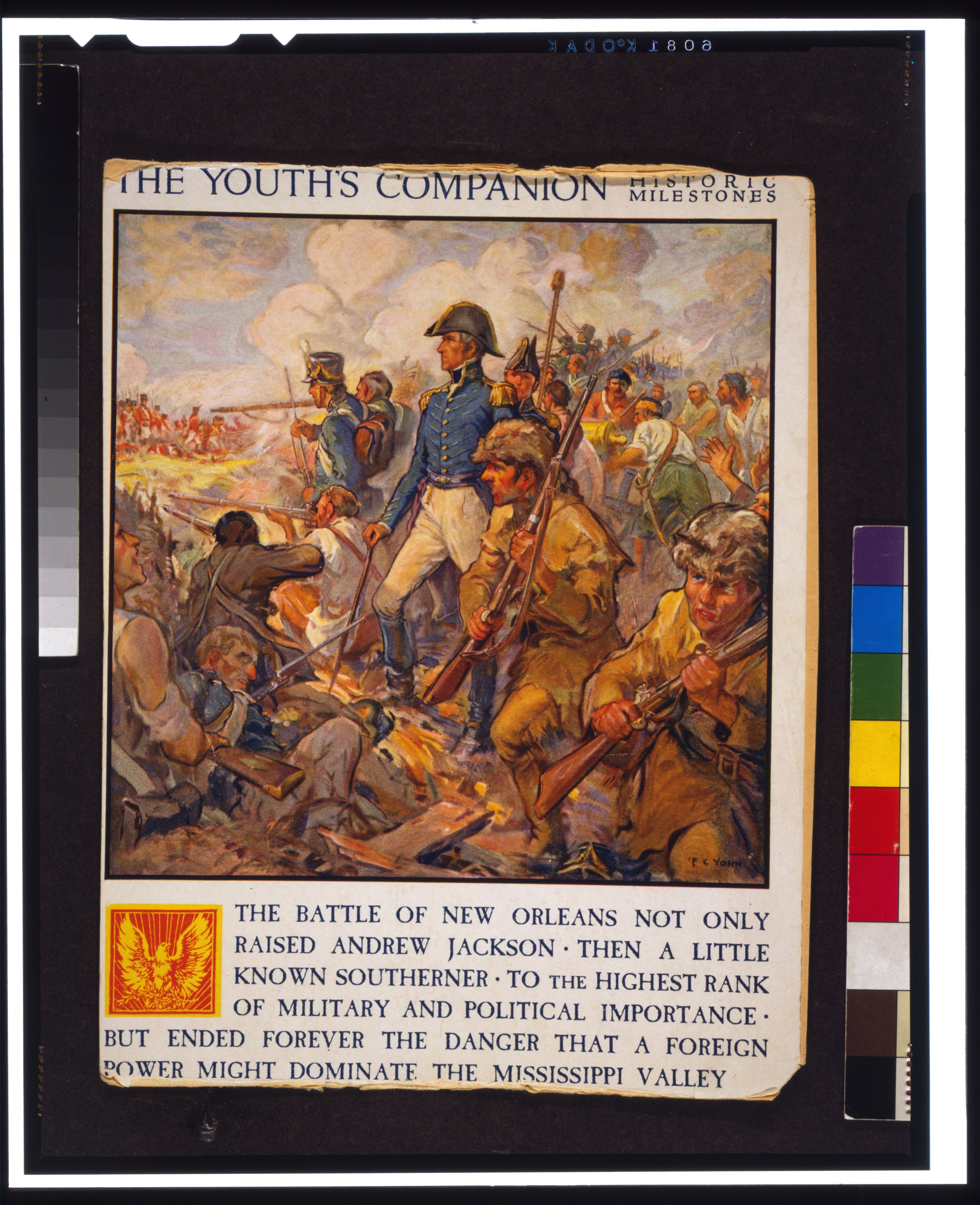
The force Jackson assembled was extraordinary in its diversity. Tennessee and Kentucky frontiersmen, experienced with long rifles and woodland fighting, formed its backbone. Louisiana Creole militia brought local knowledge. The Battalion of Free Men of Color — free Black soldiers from New Orleans — served with distinction on the line. Choctaw warriors provided intelligence and flanking capability. And then there were Jean Lafitte's Baratarian pirates, skilled artillerymen who knew the bayous intimately, whom Jackson pardoned and recruited after initially dismissing them as criminals.
Jackson's eye for terrain was decisive. He chose the Rodriguez Canal — a dry millrace running from the Mississippi River to an impassable cypress swamp — as his defensive anchor. His men constructed 'Line Jackson,' an earthwork rampart up to five feet high and nearly a mile long, reinforced with cotton bales and timber. It was not glamorous engineering, but it was brutally effective.
He had already shown his aggression on the night of 23 December 1814, launching a bold surprise attack on the British forward positions. The raid didn't destroy the British force, but it rattled their confidence and bought Jackson precious days to strengthen his defences. By the time Pakenham was ready to attack in earnest, Line Jackson had become a formidable obstacle.
8 January 1815: The Morning That Decided Everything
Pakenham launched his main assault at dawn, two British columns pushing through thick morning fog toward the American earthworks. General Gibbs commanded the main effort against the American right; General Keane led a secondary thrust on the left. It began to go wrong almost immediately.
A catastrophic logistical failure compounded the difficulty. The British troops assigned to carry scaling ladders and fascines — bundles of sticks needed to cross the canal — arrived late or without their equipment entirely. When the fog lifted and the columns emerged into the open, they found themselves exposed to withering fire with no means of getting over the wall.
Jackson's twelve cannon opened at close range, tearing through the tightly packed British formations. The riflemen of the 7th and 44th U.S. Infantry added their fire, and the combination was devastating. Men who had survived years of fighting in Spain were cut down in minutes on a Louisiana sugarcane field.
General Gibbs was mortally wounded leading the assault on the right. General Keane was seriously wounded on the left. Pakenham himself rode forward to rally his crumbling columns and was struck by grapeshot — he died on the field, in the same engagement he had ordered. Three senior commanders down, and the assault had lasted barely half an hour.
The 93rd Sutherland Highlanders suffered perhaps the most devastating single-regiment loss of the morning. Advancing in parade-ground formation with extraordinary discipline and courage, they were cut to pieces before they reached the American line. Of approximately 900 men who stepped forward that morning, around 700 became casualties. The regiment was effectively destroyed in a single engagement.
The Human Cost: What the Casualty Numbers Really Mean
Total British casualties on 8 January 1815 reached approximately 2,037: 291 killed, 1,267 wounded, and 484 captured or missing. American losses on the main east bank line numbered 13 killed and 39 wounded. The ratio is almost without parallel in the history of set-piece battle.
The British diversionary assault on the west bank of the Mississippi initially succeeded, overrunning American positions there. But with the main attack already shattered, it was strategically meaningless. The survivors withdrew, leaving the field entirely to Jackson.
Pakenham's body was preserved in a cask of rum for the voyage back to Britain — a grim detail that became part of the battle's enduring folklore. For the 93rd Highlanders, the catastrophe was so severe it took years to rebuild the regiment's strength. When news of their losses filtered back to Scotland, it shocked a public already weary of war.
The Treaty of Ghent: Peace That Arrived Too Late
The Treaty of Ghent had restored pre-war borders and resolved essentially none of the original disputes — there was no settlement on impressment, no agreement on trade rights. It was, at its core, both sides agreeing to stop fighting because neither could finish the other off.
News of the treaty reached Washington on 13 February 1815 — more than five weeks after the battle — and the U.S. Senate ratified it on 17 February. Under the international law of the time, all military actions taken before ratification were considered legally valid. The battle had been fought in wartime. It simply hadn't needed to happen.
That paradox — men dying for a peace already signed, a war already over — has given the Battle of New Orleans a peculiar, poignant place in history. It sits alongside the final skirmishes at Waterloo and the last actions of the First World War's Armistice Day as conflicts where the shooting continued past the point of meaning.
Jackson's Triumph and Its Political Aftershocks
News of the victory reached the eastern United States almost simultaneously with news of the peace, creating a wave of public euphoria that reframed a largely inconclusive war as an American triumph. Jackson became 'the Hero of New Orleans' overnight, his fame eclipsing every other American commander of the conflict.
He was promoted to Major General in the regular U.S. Army and spent the following years building a political identity rooted in that legend. In 1829, he became the seventh President of the United States, serving two terms and fundamentally transforming American democratic politics — the era became known as 'Jacksonian Democracy.'
The myth of the frontiersman and the rifleman defeating the professional European soldier embedded itself deeply in American national culture. It was reinforced as late as 1959 when Johnny Horton's song 'The Battle of New Orleans' topped the popular music charts, introducing the story to a new generation. The battle had become bigger than history — it had become legend.
Legacy: Why a Pointless Battle Still Matters
Military historians and war colleges have studied the Battle of New Orleans as a masterclass in defensive fortification, the intelligent use of terrain, and the catastrophic consequences of frontal assaults on prepared positions. The lessons Pakenham's veterans had absorbed in Spain — about cover, flexibility, and reconnaissance — seem to have evaporated in the Louisiana fog.
Wellington's reported comment on the plan — that he could have told his brother-in-law it would not do — suggests that even before the assault, experienced eyes doubted the approach. Whether that assessment is fully accurate is debated by historians, but the outcome certainly vindicates the scepticism.
The free Black soldiers of the Battalion of Free Men of Color represent perhaps the battle's most sobering legacy. They fought with courage for a republic that denied them full citizenship, in a battle that changed nothing about their legal status. Their story has been largely overlooked in the popular mythology that celebrates Jackson's triumph, and only in recent decades have historians begun to restore their place in the narrative.
Jean Lafitte and his pirates — smugglers turned patriots for the duration of a single desperate battle — add a dimension that no novelist could have invented. Pardoned by Jackson for their artillery skills and their knowledge of the bayou waterways, they contributed materially to the victory and then vanished back into the margins of history.
The Battle of New Orleans was unnecessary, technically redundant, and strategically irrelevant to the outcome of the war. It was also one of the most consequential military engagements in American history — producing a president, cementing a national mythology, and quietly drawing a line under serious Anglo-American military rivalry. Sometimes the battles that change the world are the ones that didn't need to happen at all.
If this story captured your imagination, we'd love to hear your thoughts in the comments below — and if you think a friend or fellow history enthusiast would enjoy it, please pass it along. These are the stories that deserve to be remembered.
Further Reading
- The Smithsonian Institution, Washington D.C.
- The National Archives and Records Administration (NARA), United States
- The Historic New Orleans Collection
- The National Army Museum, London
- The Library of Congress, American Memory Collection