The Quiz Question
Who became history's first official war photographer, producing 360 images of the Crimean War in 1855?
- A. Roger Fenton
- B. Julia Margaret Cameron
- C. William Howard Russell
- D. Felice Beato
The answer is A. Roger Fenton. Here is the full story.
In the spring of 1855, a former lawyer from Lancashire climbed into a converted wine merchant's wagon, pointed a large-format camera at the hills above Sevastopol, and changed the way humanity would understand war forever. His name was Roger Fenton, and the 360 photographs he produced during just three months in Crimea represent one of the most consequential bodies of work in the history of the medium.
Before the Camera: How War Was 'Seen' Before 1855
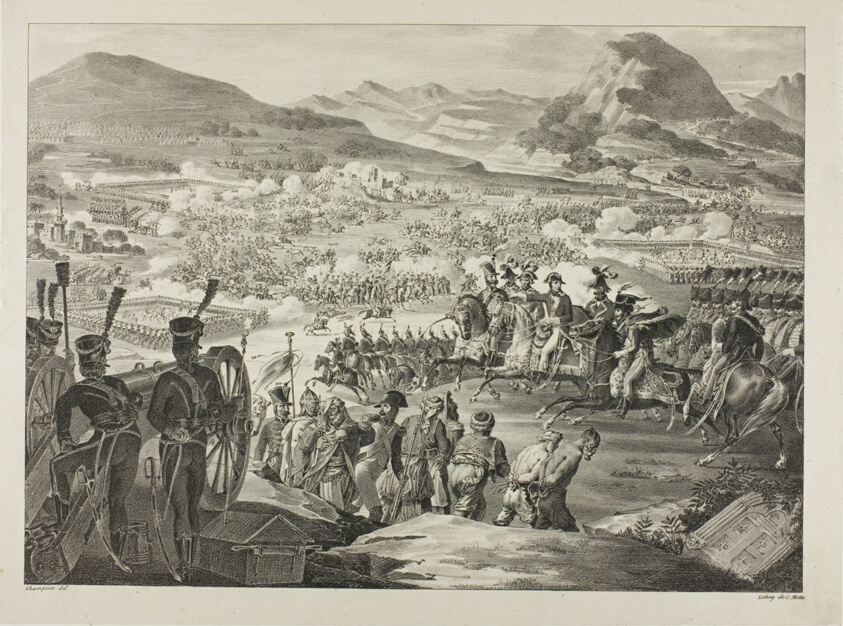
Before photography reached the battlefield, the British public understood war almost entirely through the work of painters, illustrators, and engravers — most of whom had never set foot anywhere near the fighting. Images were constructed, composed, and coloured to convey drama and national pride, not truth.
William Simpson, a Scottish artist dispatched to Crimea in 1854 by the London publisher Colnaghi, produced vivid lithographs that sold widely and shaped public imagination. They were stirring images. They were also romanticised to the point of fantasy, smoothing away the mud, the disease, and the staggering incompetence that was killing British soldiers by the thousand.
The Illustrated London News was the era's dominant visual news source, but its engravings were routinely embellished for maximum emotional impact. Accuracy was secondary to morale. As a result, the British public had almost no realistic conception of what conditions in Crimea actually looked like.
The daguerreotype had made photography commercially viable since 1839, but no government had yet thought — or dared — to deploy it officially on a battlefield. That was about to change.
Who Was Roger Fenton? The Man Behind the Mission
Roger Fenton was born in 1819 in Heywood, Lancashire, into a prosperous banking family. He trained first as a lawyer, then travelled to Paris to study painting under Paul Delaroche — the same artist who, upon seeing one of the first daguerreotypes, is said to have declared that painting was dead. The irony of that connection would define the rest of Fenton's life.
By the early 1850s, Fenton had turned his considerable energies toward photography. He was a founding member of the Royal Photographic Society in 1853 and quickly established himself as one of Britain's most technically accomplished early photographers. His portfolio was already impressive: architectural studies in Russia during a visit in 1852, photographs of the construction of the Oxford Museum, and — critically — portraits of the royal family.
Queen Victoria and Prince Albert were genuine photography enthusiasts, and Fenton's access to the palace gave him a direct line to establishment support. When the question arose of who should document the Crimean War officially, Fenton's name carried exactly the right combination of technical skill and social respectability.
There was also a political dimension to his selection. The journalist William Howard Russell had been filing devastating dispatches to The Times from Crimea, exposing the catastrophic mismanagement of the campaign — inadequate supplies, rampant disease, officers more concerned with protocol than with their men's survival. The government needed a counter-narrative, and Fenton was the man to provide it.
The Mission Is Authorised: Government, Press, and Purpose
The expedition was funded commercially by Thomas Agnew & Sons, the Manchester print publishers, who intended to sell Fenton's images to the British public at profit. The government, first under Lord Aberdeen and then Lord Palmerston, provided official backing — accreditation from the War Office and a letter of introduction to General Lord Raglan, Commander of British forces in Crimea.
Fenton departed England in late February 1855 and arrived at Balaclava Harbour — the main British supply port — in early March. His brief was never formally committed to paper, but its intent was understood by everyone involved: show the war in a way that conveyed British dignity, order, and heroism. Suffering, death, and squalor were not part of the commission.
It was, in essence, one of the first government-sponsored media management exercises in modern history. The fact that it was conducted through the lens of a camera, rather than a painter's brush, made it feel authoritative in an entirely new way.
The Photographic Van: A Darkroom on Wheels
Fenton's most ingenious piece of equipment wasn't his camera — it was his darkroom. He converted a wine merchant's wagon into a travelling laboratory, fitting it with ventilation slats, chemical trays, light-excluding curtains, and storage for his supplies. It was cramped, sweltering, and dangerous.
He used the wet collodion process, developed by Frederick Scott Archer in 1851, which required glass plates to be coated with collodion, sensitised in silver nitrate, exposed in the camera, and developed — all within ten to twelve minutes before the emulsion dried. In the Crimean summer heat, which regularly exceeded 30°C, Fenton had to move at a near sprint between camera and van.
Inside the van, temperatures reportedly climbed above 50°C. The chemicals he worked with — silver nitrate, potassium cyanide, ether-based collodion — were hazardous at the best of times. He had brought approximately 700 glass plates from England, each one representing a single, irreplaceable exposure.
His assistant, Marcus Sparling, drove the van and helped manage the chemical workflow. Sparling himself appears in at least one of Fenton's most recognised images, seated atop the wagon — an accidental piece of photographic self-documentation that gives the whole enterprise a warm, human quality.
In the Field: What Fenton Photographed — and What He Didn't
Between March and June 1855, Fenton produced approximately 360 surviving usable photographs — a remarkable output given the technical constraints, the hostile environment, and his own deteriorating health. He was struck down by cholera partway through the expedition and spent several weeks unable to work.
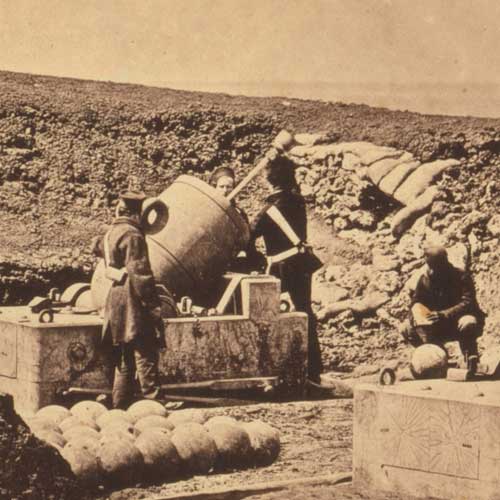
His subjects ranged widely: portraits of senior officers, views of the supply depots at Balaclava, camp life, fortifications, and the landscape around Sevastopol. They are meticulous, beautifully composed images that reveal a photographer of genuine artistic intelligence.
The most analysed image in the entire collection is 'The Valley of the Shadow of Death' — a bleak road littered with cannonballs, the name taken directly from the 23rd Psalm and applied by journalists to the route used during the Charge of the Light Brigade. It is a haunting photograph, and it exists in two versions: one with cannonballs scattered on the road, one without.
What Fenton did not photograph is, in some ways, more revealing than what he did. There are no dead bodies in his Crimean work. No wounded men. No depictions of the cholera wards that had killed far more British soldiers than Russian bullets. The sanitisation was deliberate, professional, and effective.
The People He Captured: Officers, Soldiers, and Allies
One of the most historically poignant aspects of Fenton's collection is who appears in it. Lord Raglan, the one-armed British commander who had lost his limb at Waterloo four decades earlier, sat for Fenton just weeks before his death on 28 June 1855. Fenton's portraits are among the last photographs of Raglan taken alive.
Survivors of the Light Brigade — men from the 8th Hussars, 11th Hussars, and 17th Lancers — were photographed in posed group portraits, giving human faces to the men whose charge had already become legend. These are not anonymous soldiers; they are individuals, staring back across 170 years with an immediacy that no engraving could match.
French and Ottoman allied commanders, including Omar Pasha, commander of the Ottoman forces, also appear, giving the collection a rare multinational scope. More unusually, cantinières — French female camp followers who provided food and practical support to troops — appear in several images, offering a glimpse of the war's human texture that goes beyond the officer class.
Ordinary British soldiers, listed simply as 'privates' in exhibition catalogues, were photographed in group portraits. For working-class men in the 1850s, being formally recorded for posterity was an extraordinary and entirely new experience.
Back in Britain: The Exhibition and the Public Reaction
Fenton returned to England in late June 1855, in poor health, carrying his glass plate negatives. The siege of Sevastopol would not end until September. Thomas Agnew & Sons moved quickly: 312 selected photographs were exhibited at the Water Colour Society gallery in Pall Mall, London, opening to the public in September 1855 and drawing enormous crowds.
The exhibition then toured to Manchester, Liverpool, and other major cities. Prints were sold individually at prices ranging from one shilling to several pounds, making them accessible to a broad public audience — not just the wealthy patrons who could afford paintings.
Critics praised the images as revelatory and authentic. Yet some observers, including those familiar with William Howard Russell's very different accounts in The Times, noticed the gap between Fenton's dignified, ordered scenes and Russell's descriptions of chaos and suffering. The question of what these photographs were actually showing — and what they were hiding — began almost immediately.
Queen Victoria personally viewed the photographs and purchased a set. Original Fenton Crimean prints remain in the Royal Collection at Windsor to this day.
The Controversy That Followed: Truth, Propaganda, and the Cannonballs
The two versions of 'The Valley of the Shadow of Death' have generated more scholarly debate than almost any other photograph of the 19th century. American filmmaker Errol Morris dedicated substantial analysis in his 2008 book Believing Is Seeing to the question of whether Fenton staged the more dramatic version by moving cannonballs onto the road.
Morris's investigation, combining photographic analysis with historical research, concluded that Fenton most likely did move the cannonballs — making it one of the earliest documented cases of photographic manipulation in a war context. The finding reframed Fenton not just as a propagandist by omission, but as an active constructor of imagery.
Susan Sontag, in her influential 2003 essay collection Regarding the Pain of Others, used Fenton's Crimean work to explore the fundamental ethics of war photography — the tension between the image as document and the image as argument. Her analysis placed Fenton at the origin point of a debate that has never been resolved.
The question Fenton embodied — whether a photographer embedded with official support can ever tell the full truth — is as live today as it was in 1855. Every discussion of embedded journalism in the Falklands, Iraq, or Afghanistan traces its roots, at least in part, back to that wine merchant's wagon on the hills above Sevastopol.
Legacy: How One Man's Lens Changed How We See War Forever
Within a decade of Fenton's Crimean expedition, Mathew Brady and Alexander Gardner were photographing the American Civil War with a directness Fenton had consciously avoided — including explicit images of battlefield dead that shocked the American public into a new understanding of war's cost. The trajectory from Fenton's careful omissions to Gardner's unflinching documentation at Antietam is short, and it is straight.
Fenton retired from photography entirely in 1862, just seven years after Crimea. He returned to law, apparently without sentiment about the medium he had helped define. He died in 1869, aged 50, and his photographs slipped into relative obscurity for decades before a 20th-century rediscovery restored his reputation.
The Royal Photographic Society, which Fenton helped found in 1853, continues to operate today. His legacy received formal institutional recognition with a major retrospective at the National Media Museum in Bradford in 2004, drawing renewed attention to the complexity and ambition of his Crimean work.
His 360 surviving Crimean photographs are held in collections including the Library of Congress, the British Library, and the Victoria & Albert Museum. They remain among the most studied images in the history of photography — proof that a single camera, aimed with intent and intelligence, could permanently alter how a nation understood the wars fought in its name.
If you found this story as compelling as we did, share it with a fellow history lover — or leave a comment below telling us which of Fenton's images you find most striking. We'd love to hear your thoughts.
Further reading
- Victoria and Albert Museum, London — holds original Fenton Crimean prints and related 19th-century photography collections
- The British Library, London — archives relating to the Crimean War and early British photography
- Library of Congress, Washington D.C. — major holding of Roger Fenton's Crimean War photographs
- Royal Photographic Society, Bristol — founded in part by Fenton; archives of early British photographic history
- National Media Museum, Bradford — site of the 2004 Fenton retrospective; collections covering the history of photography