The Quiz Question
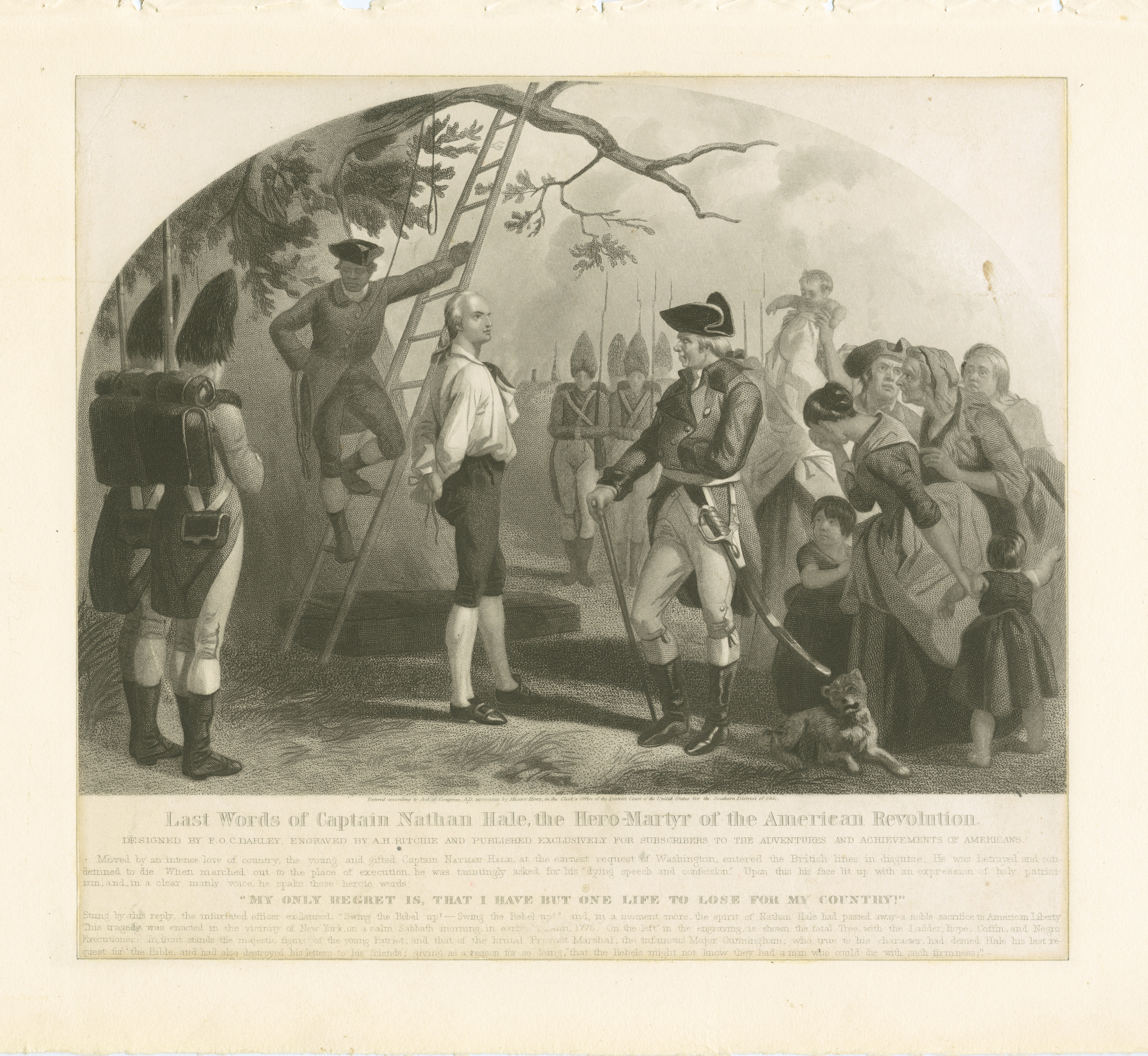
Which Continental Army officer was hanged by the British as a spy in September 1776 and is remembered for the line 'I only regret that I have but one life to lose for my country'?
- A. Benedict Arnold
- B. Nathan Hale
- C. John Andre
- D. Ethan Allen
The answer is B. Nathan Hale. Here is the full story.
He was twenty-one years old, a schoolteacher from Connecticut with no training in espionage and no extraction plan if things went wrong. In September 1776, Nathan Hale crossed behind British lines on a mission almost everyone around him thought was suicidal. He was caught, hanged without trial, and denied a Bible or a clergyman at the end. What he reportedly said before the noose tightened has echoed through American history ever since.
A Young Man Steps Forward: September 1776
By late August 1776, George Washington's Continental Army was in serious trouble. The Battle of Long Island on 27 August had been a crushing British victory — roughly 1,000 Americans killed, wounded, or captured in a single day's fighting. Washington had managed to slip his army off Long Island under cover of darkness, but the British under General William Howe now controlled the high ground and were preparing to advance on Manhattan.
Washington desperately needed intelligence: troop strengths, supply depot locations, fortification maps. He turned to Lieutenant Colonel Thomas Knowlton, whose Rangers were one of the first dedicated reconnaissance units in American military history. Knowlton asked for a volunteer to go behind enemy lines in disguise. According to accounts passed down through officers who were present, the room went quiet. Nobody stepped forward — until Nathan Hale did.
His friend and fellow officer Captain William Hull begged him not to go. Hull argued the mission was suicidal, that a gentleman couldn't honourably serve as a spy, and that Hale's distinctive appearance — he was reportedly tall and athletic, with a powder-burn scar on his face — made him easy to identify. Hale went anyway.
The World Nathan Hale Was Born Into
Nathan Hale was born on 6 June 1755 in Coventry, Connecticut, the sixth of twelve children. His father, Richard Hale, was a prosperous farmer and a Congregationalist deacon — a man of standing in his community. His mother, Elizabeth Strong, died when Nathan was still a boy. The family was educated, religious, and deeply rooted in New England's civic traditions.
Hale entered Yale College at fourteen and graduated in 1773 at just eighteen years old. He then took up schoolteaching in East Haddam and later New London, Connecticut. By all accounts he was an exceptional teacher — energetic, inventive, and notably progressive. He reportedly held early-morning classes specifically for working women who couldn't attend during regular hours, a practice that was genuinely unusual for the era.
His older brother Enoch kept a detailed diary, and that document remains one of the most valuable primary sources historians have for reconstructing Nathan's life. When news of the battles at Lexington and Concord reached Connecticut in April 1775, Nathan wasted no time. He joined a local militia company almost immediately, convinced the conflict was a cause worth fighting for.
From Schoolroom to Battlefield
Hale received his formal commission as a first lieutenant in Colonel Charles Webb's 7th Connecticut Regiment in July 1775. He served through the Siege of Boston from August 1775 to March 1776, as Washington's army tightened its grip on British-occupied Boston and ultimately forced Howe to evacuate the city by sea.
In January 1776, Hale was promoted to captain. He was subsequently attached to Knowlton's Rangers, the elite reconnaissance unit formed in September 1776 that would evolve into one of the Continental Army's most important intelligence assets. The Rangers were not a conventional fighting unit — their purpose was to observe, gather information, and operate where ordinary soldiers couldn't.
Even before the spy mission, Hale had shown real nerve. He reportedly took part in a daring August 1776 raid to seize a British supply sloop that lay under the guns of a Royal Navy man-of-war in the harbour. The mission succeeded. Hale was already proving himself someone willing to take calculated risks in service of the larger cause.
Behind Enemy Lines: The Spy Mission of September 1776
Hale crossed from Norwalk, Connecticut, into British-held Long Island around 12 September 1776, travelling by boat across Long Island Sound. He carried forged papers identifying him as a loyalist schoolteacher — a cover that at least fitted his genuine background and manner. His task was to sketch British fortifications, count troops, and locate supply depots ahead of what Washington expected to be a British push up Manhattan.
He spent approximately a week moving through occupied Long Island and then into Manhattan itself, making notes and sketching what he observed. The information was concealed on his person — accounts suggest notes were hidden in his shoe soles or written on papers tucked into his clothing. He was working entirely alone, with no handler, no support network, and no pre-arranged escape route.
On or around 21 September 1776, Hale was arrested. The exact circumstances remain genuinely disputed by historians. One persistent theory holds that he was betrayed by his Loyalist cousin, Samuel Hale, who was serving in the British administration in New York. Whether through betrayal or his own exposure, Hale was taken before General Howe at the Beekman Mansion, Howe's Manhattan headquarters. Howe ordered his execution without trial — legally permissible under the laws of war for a spy taken out of uniform, but brutal in its swiftness.
22 September 1776: The Hanging
Nathan Hale was hanged at approximately eleven o'clock in the morning on 22 September 1776. The site was near a British artillery park close to what is today the intersection of 66th Street and Third Avenue in Manhattan — then open ground on the edge of the city.
The British Provost Marshal, William Cunningham, oversaw the execution. Cunningham denied Hale a Bible and refused to allow a clergyman to attend him. He reportedly tore up letters Hale had written to his family overnight. No last letter from Hale to his mother or brother survives — Cunningham saw to that. His cruelty was not incidental; Cunningham's brutal treatment of American prisoners throughout the war would later make him one of the most despised British figures of the Revolution.
A witness to the hanging was British Captain John Montresor, General Howe's chief engineer. Montresor subsequently encountered American officers under a flag of truce — among them, accounts suggest, figures who later reported the conversation to William Hull and Alexander Hamilton. Montresor described Hale dying with composure and dignity, and reported that Hale had spoken words expressing regret that he had only one life to give for his country.
The Famous Last Words — and the Debate Around Them
The version of the quote most people know — "I only regret that I have but one life to lose for my country" — was not written down at the moment of execution. It appears in William Hull's memoirs, published in 1848, seventy-two years after the event. Hull was recounting what Montresor had told him, filtered through decades of memory.
Historians have long noted that the sentiment echoes a line from Joseph Addison's 1713 play Cato: "What pity is it that we can die but once to serve our country." Cato was enormously popular among Revolutionary-era Americans — Washington himself had it performed at Valley Forge to inspire his troops, and Hale, as a Yale-educated man, would almost certainly have known it well. The phrase may be a paraphrase of Addison filtered through a dying man's final moments, rather than a spontaneous original utterance.
Different accounts use slightly different wording — some say "lose," some say "give" — which suggests we are dealing with a paraphrase rather than a verbatim record. But the historical debate over precise wording somewhat misses the point. Every contemporary account agrees on the substance: Hale died bravely, without breaking down, expressing commitment to his cause. That fact, far more than any particular choice of words, is what made him a legend within weeks of his death.
The British Side: Howe, Cunningham, and John André
General William Howe (1729–1814) was acting within accepted laws of war in ordering Hale's execution — a spy caught out of uniform could legally be hanged. But the refusal to allow any last rites, the destruction of his letters, and the speed of the process drew criticism even from some British observers at the time.
The contrast with the later case of Major John André is historically striking. André, a British officer hanged as a spy by the Americans in October 1780 for his role in the Benedict Arnold treason plot, received strikingly different treatment. He was given a formal hearing, permitted to write letters home, and executed with what Washington explicitly described as every possible mark of respect given the circumstances. The Arnold affair became one of the war's most dramatic turning points — and André's dignified death became a deliberate piece of American propaganda, contrasting American honour against British barbarity in 1776.
William Cunningham, meanwhile, went down in history as one of the war's genuine villains. Responsible for the management of thousands of American prisoners in New York, he is believed by historians to have overseen conditions that killed far more men through deliberate starvation and neglect than died in battle.
Aftermath: What Hale's Death Changed
The story of Hale's execution spread rapidly through Continental Army camps in the days after 22 September 1776. It hit hard. Here was a young officer, educated and principled, hanged without ceremony and treated with contempt. The effect on morale was complex — grief and anger rather than despair, and the anger proved useful.
Washington, stung by both the intelligence failure and the manner of Hale's death, began working toward a more systematic approach to intelligence gathering. This eventually led to the Culper Ring, established in 1778, which operated a sophisticated spy network in British-occupied New York using compartmentalisation, dead drops, coded messages, and invisible ink. The amateurish nature of Hale's solo mission — no backup, no escape route, no cover story robust enough to survive scrutiny — directly informed the tradecraft that made the Culper Ring so much more effective.
Hale's brother Enoch rode to New York in October 1776, hoping to recover Nathan's body for a proper burial. He never found it. Nathan Hale's grave remains unknown to this day — another small cruelty layered onto the larger one.
Legacy: America's Patron Saint of Intelligence
Connecticut officially designated Nathan Hale as the state hero in 1985 — more than two centuries after his death, which tells you something about how long it took the full story to be formally honoured. Yale University unveiled a bronze statue of Hale on its campus in 1914, depicting him bound and defiant, captured but unbroken.
Most strikingly, a statue of Hale stands at CIA headquarters in Langley, Virginia. The American intelligence community has claimed him as its founding martyr — the first person to die in deliberate service of American strategic intelligence. It is a powerful piece of institutional identity, connecting the modern espionage apparatus back to a twenty-one-year-old schoolteacher who volunteered for a mission nobody else would take.
Much of what we know about Hale was preserved through oral tradition and regional Connecticut pride, then only formally documented in the 1840s and 1850s when the first serious biographers went looking. By then, critical details — the exact words, the precise route, the true identity of whoever betrayed him — were already lost.
For anyone who lived through the Cold War's spy stories, Hale represents something that transcends his particular moment in 1776. He is the ordinary person — the teacher, the neighbour's son, the young man who read plays and got up early to teach women who couldn't attend regular school — who steps into extraordinary danger out of pure conviction. No training, no backup, no guarantee of any kind. Just the belief that the cause was worth more than his own survival. That is a story that does not age.
If Nathan Hale's story moved you, or if you have a family connection to the American Revolution, we'd love to hear from you in the comments below. Share this article with someone who loves American history — these stories deserve to be remembered.
Further Reading
- Yale University Library — Manuscripts and Archives (holds material related to Hale family papers and the Connecticut Revolutionary era)
- Connecticut State Library and State Archives, Hartford — primary source collections on Connecticut's Revolutionary War history
- Library of Congress, Washington D.C. — Revolutionary War-era documents, including correspondence related to Washington's intelligence networks
- National Archives and Records Administration (NARA), Washington D.C. — Continental Army records and Revolutionary War pension files
- Museum of the American Revolution, Philadelphia — collections and scholarship on the Continental Army and the broader Revolutionary War period