The Quiz Question
Which January 1781 Revolutionary War battle in South Carolina saw Daniel Morgan destroy Banastre Tarleton's force using a double envelopment?
- A. Battle of Camden
- B. Battle of Guilford Court House
- C. Battle of Cowpens
- D. Battle of Kings Mountain
The answer is C. Battle of Cowpens. Here is the full story.
On the morning of 17 January 1781, a cattle grazing ground in the South Carolina backcountry became the site of one of the most brilliantly engineered military victories in American history. The Battle of Cowpens lasted barely fifty minutes. Its consequences echoed all the way to Yorktown.
The Battle That Changed the South in Under an Hour
Daniel Morgan's force of roughly 1,900 Continental regulars and militia shattered Lieutenant Colonel Banastre Tarleton's 1,100-strong British Legion — killing, wounding, or capturing more than 900 of them. It was a margin of destruction that stunned both sides of the Atlantic.
What made Cowpens extraordinary was not just the outcome but the method. Morgan achieved a double envelopment — encircling an enemy simultaneously on both flanks — a manoeuvre more associated with Hannibal at Cannae in 216 BC than with frontier skirmishes in the American backcountry. It remains the only successful double envelopment of the entire Revolutionary War.
The unglamorous name came from the site itself: a well-known open pasture where drovers grazed cattle before driving them to market. Morgan chose it deliberately, and his reasons for doing so tell you everything about the kind of commander he was.
The Southern Campaign: Why Cowpens Mattered So Much
By late 1780, Britain's strategic focus had shifted sharply southward. Charleston fell in May 1780, and the devastating Patriot defeat at Camden in August left South Carolina appearing firmly under British control. Lord Cornwallis believed loyalist support across the Carolinas could sustain a northward drive through Virginia to end the war on British terms.
That confidence had been building since the Waxhaws massacre in May 1780, where Tarleton's men killed Continental soldiers attempting to surrender. The atrocity handed Patriot recruiters a rallying cry — "Tarleton's Quarter" — that echoed through every backcountry farmhouse. Fury, it turned out, is a powerful recruiting sergeant.
General Nathanael Greene, appointed to command the Southern Department in December 1780, inherited a force too small to fight Cornwallis head-on. His response was audacious: he split his outnumbered army in two, sending Morgan westward with around 600 regulars and militia to threaten British outposts and keep Cornwallis permanently off-balance.
Cornwallis reacted exactly as Greene hoped — dispatching Tarleton with his elite British Legion to hunt Morgan down. The pursuit led directly to Cowpens, and to Tarleton's ruin.
The Two Commanders: Morgan and Tarleton Face to Face
Daniel Morgan, 45 years old in January 1781, was not a man produced by military academies. He was a Virginia frontiersman who had fought in the French and Indian War, hauled wagons for Braddock's ill-fated 1755 expedition, and carried the marks of empire on his own back. British military authorities ordered 499 lashes for striking a British officer — Morgan always joked they miscounted and owed him one.
At Saratoga in 1777, Morgan's Corps of Riflemen had played a decisive role in the Patriot victory, with his sharpshooters targeting British officers with devastating effect. That experience shaped his thinking at Cowpens four years later. He knew exactly what skilled riflemen could do to an enemy's command structure in the opening minutes of a fight.
Banastre Tarleton, just 26, was everything Morgan was not in terms of background: educated, fashionable, connected. His British Legion — a mixed force of Loyalist infantry and cavalry — had built a fearsome reputation for speed, aggression, and ruthlessness across South Carolina. Tarleton's fatal weakness was impatience. He routinely pushed his men hard on the march and attacked without adequate reconnaissance, assuming momentum and aggression would carry the day.
The evening before the battle, Morgan moved among his campfires in the January cold, rubbing the backs of nervous militiamen and explaining his plan personally to men at every level of command. Military historians still cite that night as a textbook example of pre-battle leadership — a general who understood that confidence, clearly communicated, is itself a combat multiplier.
Morgan's Masterstroke: A Plan Built Around Human Nature
Morgan's choice of the Cowpens site looked reckless on paper. Placing the Broad River at his back removed his army's escape route. In reality, it was a calculated decision: with nowhere to run, even the most skittish militia would have to stand and fight. Morgan understood his men's psychology better than Tarleton ever would.
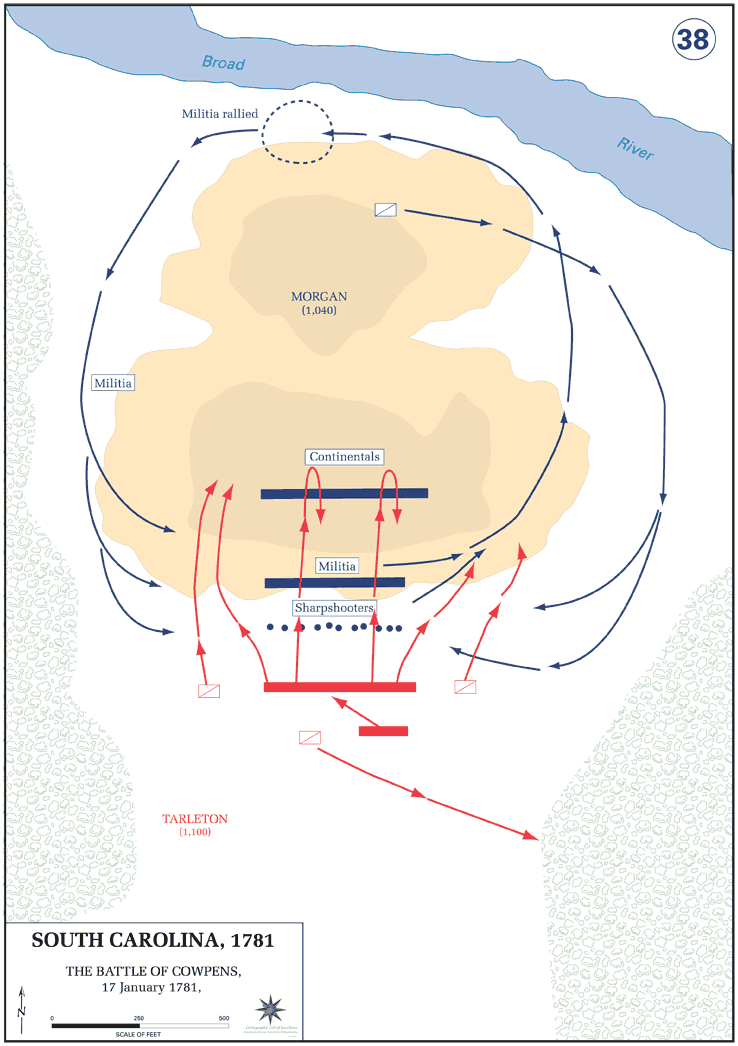
His battle plan had three distinct lines. The first was a forward skirmish screen of expert riflemen under Major John Cunningham, tasked with picking off British officers and NCOs before melting back. Behind them, Colonel Andrew Pickens commanded the main militia line. The third line — the backbone — was Lieutenant Colonel John Eager Howard's Continental regulars.
The genius lay in what Morgan asked of the militia. He did not demand they stand and exchange volleys with disciplined British infantry — a recipe for the panicked routs that had plagued the Southern Campaign. He asked for two volleys aimed deliberately at officers, then an orderly withdrawal around the American left flank to reform safely behind the Continentals. He was designing a plan around human nature rather than fighting against it.
Hidden behind a low hill, invisible to Tarleton, waited Lieutenant Colonel William Washington's 80 Continental dragoons and a mounted militia reserve — the blade of the trap, not yet drawn.
17 January 1781: The Battle Unfolds
Tarleton's column had been marching since 3 a.m. Intelligence suggested Morgan was about to slip away, and Tarleton refused to wait for dawn. His men arrived at Cowpens already tired, having covered eight miles through darkness — the kind of avoidable exhaustion that commanders pay for dearly when the shooting starts.
Morgan's skirmish line opened the engagement precisely as planned. Patriot riflemen targeted British officers with sniper accuracy, dropping men whose epaulettes made them easy marks, before withdrawing in good order. The psychological effect was immediate: Tarleton's advancing line was shaken before it even reached the main militia position.
Pickens's militia fired their two volleys — dropping dozens of redcoats — then began their planned retirement around the American left. Tarleton's officers, seeing men turning and moving rearward, made a catastrophic misreading: they believed the Patriot line was breaking. They urged their exhausted troops forward at the double, in uncoordinated, eager pursuit.
Then came the moment that decided everything. A misunderstood order caused Howard's Continental right flank to begin an unplanned withdrawal. Tarleton interpreted it as a general retreat and committed his last reserve — his cavalry — in a premature, all-or-nothing charge. He had nothing left to exploit success or recover from failure.
Howard wheeled his Continentals, steadied them, and delivered a devastating volley at point-blank range before ordering a bayonet charge. At that same moment, Pickens's reformed militia swept back onto the British right flank. William Washington's dragoons came thundering around the British left. The double envelopment snapped shut.
The Rout: Tarleton's Legion Destroyed
British resistance collapsed within minutes of the encirclement. When the firing stopped, 110 of Tarleton's men were dead, 229 wounded, and approximately 600 stood as prisoners — over 85% of the entire force he had brought to Cowpens. American losses were 25 killed and 124 wounded: a ratio of destruction that speaks to the completeness of Morgan's victory.
Tarleton himself tried to rally the 17th Light Dragoons for a counter-charge. William Washington rode out personally to meet him, and the two commanders exchanged sword strokes in a brief, chaotic melee before Tarleton broke away and fled the field — leaving his Legion behind him. He would spend years defending his conduct in print, which perhaps tells its own story.
Among the captured materials brought back to Patriot lines were two 3-pounder "grasshopper" artillery pieces, 800 muskets, 100 cavalry horses, and the British Legion's regimental colours. The Legion — one of Cornwallis's most feared and effective instruments — was destroyed as an operational fighting force. It never recovered its former strength or confidence.
Aftermath: Cornwallis's Desperate Pursuit
When news of Cowpens reached Cornwallis, he is reported to have leaned on his sword with such force that it snapped. Whether or not the detail is literally true, it captures something real: the loss rattled British confidence in the South to its foundations.
Cornwallis responded with characteristic energy but diminishing judgment. On 25 January 1781, at Ramsour's Mill, he burned his own army's baggage wagons — stripping his force to fighting essentials in a desperate bid to outmarch Morgan and recapture the Cowpens prisoners before they could be secured.
Morgan, hampered by illness and the logistical burden of hundreds of prisoners, raced northward in what history remembers as the Race to the Dan River. It was a gruelling 200-mile chase through the Carolina winter, with Cornwallis pressing close enough to make the outcome genuinely uncertain.
Greene reunited his divided force just in time, crossing the Dan River into Virginia on 14 February 1781, barely ahead of the pursuing British column. Cornwallis now found himself dangerously overextended in hostile territory, his supply lines stretched to breaking point, with nothing to show for the pursuit.
The stage was set for the Battle of Guilford Court House in March 1781. Cornwallis held the field at the end of the day, but his casualties were so severe — nearly a quarter of his force — that his army lost the ability to sustain further offensive operations. "Another such victory," as Charles James Fox reportedly observed in Parliament, "would ruin the British Army."
The Road to Yorktown: Cowpens as a Turning Point
Military historians consistently argue that Cowpens set in direct motion the chain of events that ended at Yorktown on 19 October 1781. The destruction of Tarleton's Legion stripped Cornwallis of his mobile strike force — his eyes, his foragers, his screen. The resulting tactical blindness would haunt the British commander through the entire Virginia campaign.
Congress recognised Morgan's achievement promptly and tangibly. In February 1781, he was promoted to Brigadier General and awarded a gold medal — one of only eight presented during the entire Revolutionary War — for the Cowpens victory. Colonel Andrew Pickens received a sword of honour from Congress, and the battle fundamentally rehabilitated the reputation of Southern militia, demonstrating what backcountry fighters could achieve under sound leadership.
The broader British strategy never recovered its footing. The "hold the South" plan that had looked so promising after the fall of Charleston died, in practical terms, on the fields of Cowpens.
Why Cowpens Still Fascinates Military Minds Today
The Battle of Cowpens is taught at West Point and at the Royal Military Academy Sandhurst as a case study in mission command — the art of briefing every level of your force clearly, then trusting them to execute under the fog of battle. Morgan delegated with precision, explained his intent personally, and designed a plan flexible enough to survive the unexpected withdrawal that Tarleton misread as a rout.
The double envelopment Morgan achieved with no formal military education mirrors the principles that Hannibal applied at Cannae and that German General Staff planners studied obsessively in the nineteenth and twentieth centuries. The self-taught Virginia frontiersman had intuited what professional soldiers spent careers trying to master.
Cowpens Battlefield is today preserved as a National Battlefield Park near Gaffney, South Carolina. The visitor centre houses one of the original grasshopper cannons captured from Tarleton's force — a tangible connection to the fifty minutes that changed the war. Each January, re-enactors gather near the anniversary date to walk the same open ground Morgan's men defended, keeping the memory of that morning alive for new generations.
Morgan's deepest lesson — that effective leadership means understanding your people's limitations and building your plan around them rather than demanding they transcend human nature — remains as relevant to commanders today as it was in the Carolina winter of 1781.
If the Battle of Cowpens caught your imagination, we'd love to hear from you. Which aspect of Morgan's plan do you find most remarkable — the psychological management of the militia, the hidden cavalry reserve, or the sheer audacity of placing his back against the river? Share your thoughts in the comments, and pass this article on to anyone who loves the real stories behind America's founding.
Further Reading
- National Park Service — Cowpens National Battlefield, Gaffney, South Carolina
- The Library of Congress, Washington D.C. — Revolutionary War collections
- The Smithsonian Institution — American history and military collections
- The National Archives, Washington D.C. — Continental Army records and pension files
- The American Battlefield Trust — preservation and education resources on Revolutionary War sites