The Quiz Question
Roughly how many Allied troops were evacuated from Dunkirk during Operation Dynamo in 1940?
- A. About 100,000
- B. About 338,000
- C. About 750,000
- D. About 50,000
The answer is B. About 338,000. Here is the full story.
In late May 1940, Britain stood on the edge of catastrophe. The entire British Expeditionary Force — roughly 400,000 men — had been cut off from the rest of the Allied armies and was being compressed into a shrinking coastal pocket around the French port of Dunkirk. Winston Churchill privately warned his Cabinet to prepare for what he called "the greatest military disaster in our history." The Admiralty's most optimistic planners thought perhaps 45,000 men could be saved before German forces sealed the trap shut.
What actually happened over the next nine days defied every calculation. By 4 June 1940, 338,226 Allied soldiers had been carried across the English Channel to safety. The word "Dunkirk" entered the English language as shorthand for snatching survival from the jaws of defeat — and understanding how that rescue was achieved requires going back to the catastrophic weeks that drove Britain to the water's edge.
How the BEF Ended Up Trapped: The Fall of France
Germany launched Fall Gelb — Case Yellow — on 10 May 1940, the same day Churchill became Prime Minister. The plan's masterstroke was General Erich von Manstein's decision to drive the main armoured thrust through the Ardennes forest, a route the Allied high command considered impassable for tanks. It wasn't. The Panzer divisions burst through into open country and raced for the Channel coast.
By 20 May, German armour had reached the sea near Abbeville, cutting the BEF off from the main French armies to the south and surrounding it — along with the French First Army and Belgian forces — in a vast coastal pocket. The Belgian Army surrendered on 28 May, ripping open the eastern flank of the perimeter and exposing British troops to immediate encirclement from that direction.
General Lord Gort, commanding the BEF, made a decision that was politically awkward but militarily sound: rather than attempting a breakout southward to rejoin the French, he ordered a withdrawal toward the coast. It was a controversial call, but it was the one that kept the army alive long enough to be evacuated.
The Halt Order: Hitler's Controversial Decision
On 24 May 1940, Hitler issued what became known as the Halt Order, stopping his Panzer divisions from advancing on Dunkirk for nearly 48 hours. The reasons have been debated by historians ever since — theories include a desire to preserve tanks for operations further south, deference to Army Group A commander Gerd von Rundstedt's concerns about overextended supply lines, and political calculation.
Hermann Göring seized the opportunity, persuading Hitler that the Luftwaffe alone could finish off the trapped Allied forces from the air. It was a boast built on overconfidence and proved catastrophically wrong. While the Panzers sat idle, British and French engineers and soldiers worked frantically to establish a defensive perimeter around Dunkirk.
Those 48 hours were arguably the single most decisive window of the entire operation. Without them, the perimeter might never have been secured, and the evacuation could not have begun in anything like the organised fashion it ultimately achieved.
Operation Dynamo: Nine Days That Changed History
Vice-Admiral Bertram Ramsay commanded Operation Dynamo from his headquarters tunnelled into the chalk cliffs beneath Dover Castle — a setting that felt almost as dramatic as the events unfolding across the Channel. The operation was formally launched on 26 May 1940, and it would run for nine days rather than the few desperate hours the Admiralty had first feared.
The opening was brutal. On the first day, only 7,669 men were lifted — the beaches were exposed, chaotic, and under relentless Luftwaffe attack. Three evacuation routes — designated X, Y, and Z — were used at different times depending on German coastal gun activity and air threat. Route Y, at 87 nautical miles, was the longest but offered the greatest shelter from enemy fire.
By 31 May, the operation reached its extraordinary peak: 68,014 men were evacuated in a single day under near-constant bombardment. The logistical achievement was staggering, requiring the coordination of hundreds of vessels, thousands of sailors, and military discipline on the beaches that had to be maintained in the face of dive-bombers, artillery, and rising fear.
The Little Ships: Myth and Reality
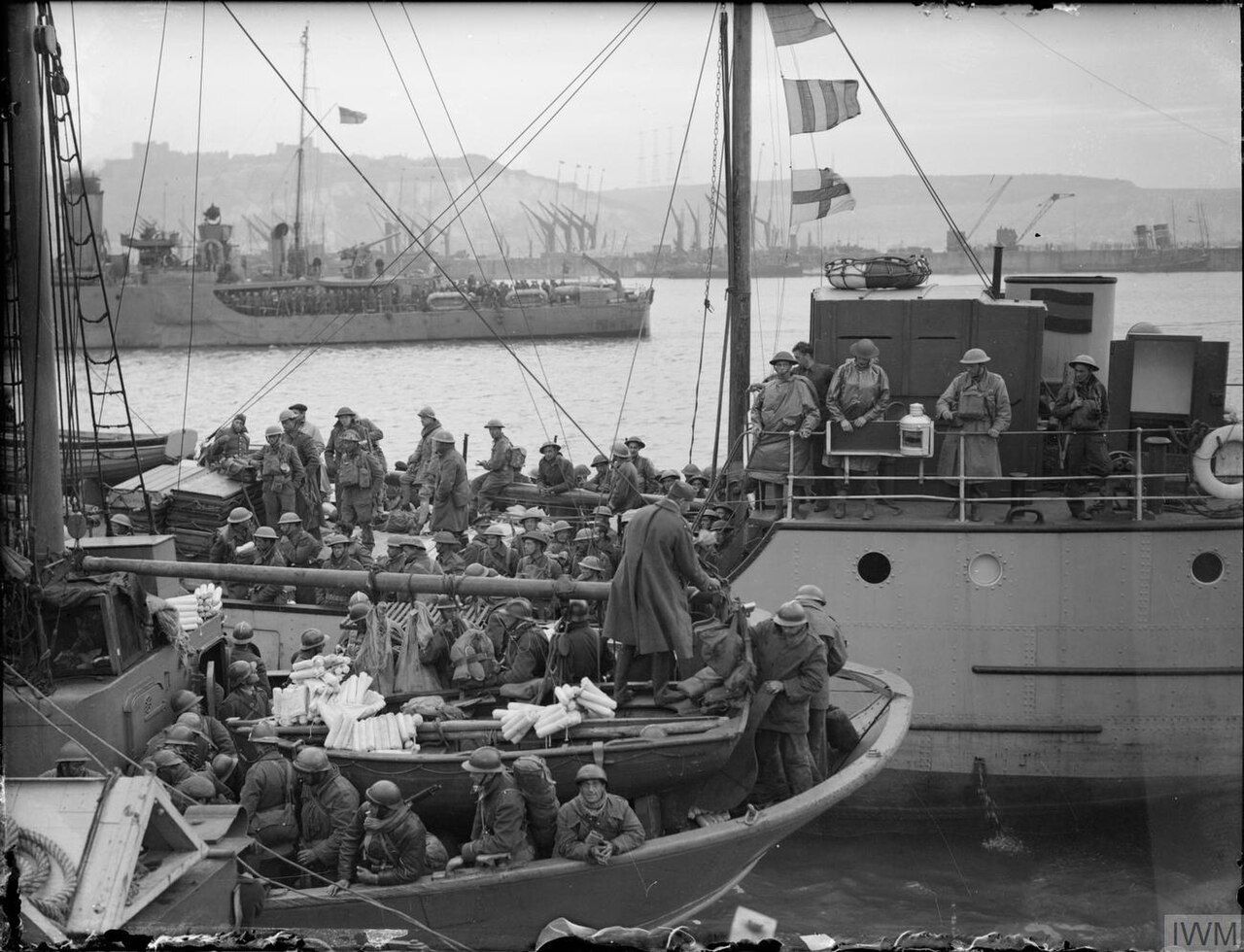
The "little ships" — the flotilla of pleasure cruisers, fishing boats, Thames ferries, and private motor launches that answered the Admiralty's call — have become the most enduring image of Dunkirk. Around 700 small civilian vessels participated, many sailed by their owners who navigated into an active war zone with no naval training and no guarantee of survival.
Among the most celebrated was the paddle steamer Medway Queen, which made seven return trips across the Channel and rescued more than 7,000 men, earning herself the nickname "the Heroine of Dunkirk." Her story captures the spirit of improvised, determined effort that the operation demanded.
The historical reality, though, is more nuanced than the legend. The majority of men were lifted directly from Dunkirk's East Mole — a long harbour breakwater — by Royal Navy destroyers, troopships, and larger transport vessels. The small boats' vital contribution was ferrying men from the shallow open beaches out to those larger ships waiting in deeper water. It was unglamorous, dangerous, and absolutely essential.
The Men on the Beaches: Soldiers' Stories
For the men waiting to be evacuated, the experience was one of organised endurance punctuated by sudden, violent terror. Troops formed remarkably orderly queues stretching for miles along the sand — a discipline that astonished observers at the time and became a lasting source of national pride.
Some waited neck-deep in the cold Channel water for hours, with Stukas screaming overhead and men being killed beside them. Around 100,000 French and Belgian troops were evacuated alongside British soldiers, though French forces were not prioritised equally until the final days of the operation — a source of friction that left bitter feelings in the alliance for some time afterward.
Every man who made it to the beach had abandoned almost everything he carried. The roads and dunes approaching Dunkirk were littered with 64,000 vehicles, 2,500 guns, and an estimated 400,000 tons of supplies. The 2nd Battalion, Royal Ulster Rifles, held a critical section of the defensive perimeter near Furnes, suffering severe casualties to buy the time the evacuation needed. The perimeter was held by soldiers who knew that their job was to stay behind so that others could leave.
The RAF Over Dunkirk: The Battle Soldiers Never Saw
One of the most painful ironies of Dunkirk was the fury that exhausted, frightened soldiers directed at the Royal Air Force, cursing them for being absent when German bombs were falling. The RAF was not absent — they were fighting, but the aerial combat was largely taking place further inland, above the cloud layer, invisible from the beaches below.
Fighter Command flew 4,822 sorties over Dunkirk during the nine-day operation. Spitfires and Hurricanes of 11 Group, commanded by Air Vice-Marshal Keith Park, rotated over the beachhead in continuous small formations rather than large massed sweeps, trading tactical flexibility for sustained presence. The RAF lost 145 aircraft and 99 pilots killed during those nine days — a serious toll that directly influenced the decision to preserve Fighter Command's remaining strength ahead of the Battle of Britain.
The Luftwaffe's failure to destroy the evacuation despite Göring's promises was a significant early signal of the limits of air power used alone against a determined naval operation. It was a lesson that would resonate through the air war that followed.
The Cost: What Was Lost and Who Was Left Behind
The rescue came at a heavy price. Six Royal Navy destroyers were sunk and 19 more were damaged; across all vessel types, around 200 ships were lost during the operation. The human cost among those who never reached the beaches was equally severe — approximately 68,000 British soldiers became casualties during the Battle of France as a whole, killed, wounded, or captured before evacuation was possible.
When Dunkirk fell on 4 June, between 35,000 and 40,000 French troops who had held the final perimeter were left behind and captured. Their sacrifice — covering the last British embarkations — and the perception that they had been treated as a lower priority for much of the operation created a wound in Franco-British relations that took years to fully heal.
Further south, the 51st Highland Division never reached Dunkirk at all. Fighting alongside French forces near Saint-Valery-en-Caux, the Division was cut off and forced to surrender on 12 June 1940 — a loss that hit Scotland with particular force. Meanwhile, the army that had returned to Britain arrived effectively disarmed, having left its entire heavy equipment on the beaches. It would take months of urgent re-armament before British forces could fight effectively again.
Churchill's Speech and the Lasting Legacy of Dynamo
On 4 June 1940 — the same day the last ships left Dunkirk — Churchill addressed the House of Commons. His "We shall fight on the beaches" speech is one of the most celebrated pieces of oratory in modern history, but Churchill himself inserted a note of deliberate caution that is often forgotten: "We must be very careful not to assign to this deliverance the attributes of a victory. Wars are not won by evacuations."
He was right. Dunkirk was a survival, not a triumph. But its psychological impact on British national morale was profound and lasting. The narrative of collective effort, civilian courage, and disciplined endurance gave a battered nation something to hold onto when the strategic picture remained desperately dark.
Operation Dynamo's most concrete legacy, however, was strategic rather than symbolic. Had the BEF been destroyed or captured, the political pressure on Churchill's government to seek a negotiated peace with Hitler — pressure that already existed within the War Cabinet — might have been overwhelming. The 338,226 men lifted from those beaches were the seed from which the eventual Allied victory grew.
Vice-Admiral Bertram Ramsay, the quiet, methodical naval genius who planned and executed Dynamo from his chalk-hewn headquarters beneath Dover, went on to plan the naval elements of the Normandy landings in June 1944. In a neat historical symmetry, the man who organised the escape from France in 1940 also organised the return to France four years later.
Further Reading
- Imperial War Museum — holds extensive collections of personal testimonies, photographs, and documents from Operation Dynamo and the Battle of France
- The National Archives (Kew, United Kingdom) — holds original Admiralty and War Office records relating to Operation Dynamo, including Vice-Admiral Ramsay's operational dispatches
- National Army Museum (London) — collections covering the British Expeditionary Force and the campaigns of 1940
- Dunkirk Memorial and the Commonwealth War Graves Commission — records of those who died during the evacuation and the Battle of France
- National Museum of the Royal Navy — holds material relating to the naval vessels and personnel involved in Operation Dynamo