The Quiz Question
At the Battle of Trafalgar in 1805, what was the name of Admiral Nelson's flagship?
- A. HMS Bellerophon
- B. HMS Victory
- C. HMS Temeraire
- D. HMS Royal Sovereign
The answer is B. HMS Victory. Here is the full story.
On the morning of 21 October 1805, a single ship led the British fleet into the mouth of one of the most consequential naval battles in history. She was old, she was massive, and she was flying the flag of Britain's greatest admiral. Her name was HMS Victory — and what happened that day off the coast of Spain changed the world.
The Ship That Changed History: An Opening Broadside
The Battle of Trafalgar was fought off Cape Trafalgar on Spain's Atlantic coast, and it lasted barely five hours. Yet its consequences echoed for more than a century. Admiral Lord Horatio Nelson flew his flag from Victory's mainmast — a signal to every man in the British fleet that their most celebrated commander was leading from the front.
Victory was already 40 years old at the time of Trafalgar. She was a veteran of earlier wars, worn by decades of sea service, yet still powerful enough to be placed at the very tip of the British attack. Today she rests in dry dock at Portsmouth Historic Dockyard — the oldest commissioned warship in the world, still flying the White Ensign of the Royal Navy.
Building a Giant: The Making of HMS Victory
HMS Victory was laid down at Chatham Dockyard on 23 July 1759, during the Seven Years' War, and launched on 7 May 1765. Her construction consumed approximately 6,000 oak trees, mostly drawn from the forests of southern England, and took over six years to complete. She is a first-rate ship of the line — the most powerful class of warship of her era.
She carried 104 guns across three gun decks, measured 227 feet in length, and displaced around 3,500 tons. A crew of approximately 850 men was required to sail and fight her — a floating city as much as a floating fortress. Before Nelson ever stepped aboard, Victory had already served in the American War of Independence and the French Revolutionary Wars, flying the flags of admirals Kempenfelt and Howe.
Napoleon's Grand Plan: Why Trafalgar Had to Be Fought
By the summer of 1805, Napoleon Bonaparte had assembled the Grande Armée at Boulogne — over 150,000 troops ready to cross the English Channel and invade Britain. It was the most serious invasion threat Britain had faced since the Spanish Armada. But Napoleon knew his army could not cross without naval protection, even for a matter of days.
French Admiral Pierre-Charles Villeneuve commanded the Combined Fleet of 33 ships of the line — 18 French and 15 Spanish — sailing from the port of Cadiz in early October 1805. Nelson, with 27 British ships of the line, was ordered to intercept and destroy them before they could clear the Channel. The stakes were absolute: a British defeat might have opened the door to a French landing and the collapse of British sovereignty.
Nelson's Masterstroke: The Tactics That Won the Day
Nelson rejected the conventional line-of-battle approach — two fleets sailing parallel and exchanging fire in a slow, grinding contest. Instead, he devised something audacious: split the British fleet into two columns and drive them perpendicularly through the enemy line, cutting it in three and creating close-quarters chaos.
Victory led the weather column, aimed directly at Villeneuve's flagship, Bucentaure. HMS Royal Sovereign led the second column under Vice-Admiral Cuthbert Collingwood. As Victory bore down under withering fire, Nelson hoisted his immortal signal: England expects that every man will do his duty — message number 16 in the telegraph code devised by Sir Home Popham. It was not a command but an expression of faith, and it was received with enormous feeling across the fleet.
The tactic was designed to exploit British strengths. Royal Navy gun crews were drilled to a standard that French and Spanish crews could not match — capable of firing three broadsides in the time it took the enemy to fire one. Close-quarters chaos would make that superiority devastating. Nelson knew exactly what he was doing — and he knew exactly where it placed him personally.
The Heat of Battle: HMS Victory Under Fire
Victory endured approximately 40 minutes of incoming fire before she could bring her own guns to bear. Approaching slowly in the light winds of that October morning, she was a vast, near-stationary target. Men fell. Rigging was shot away. The tension on her gun decks must have been almost unbearable.
When she finally broke through the enemy line — squeezing between Bucentaure and the 74-gun French ship Redoutable — Victory fired a single raking broadside through Bucentaure's stern. The effect was catastrophic: approximately 400 men killed or wounded in a single volley. Villeneuve's flagship was effectively neutralised in minutes.
Victory then became locked in a brutal, grinding close-quarters battle with Redoutable, whose captain, Jean-Jacques Lucas, had trained his crew as sharpshooters. Men in Redoutable's rigging raked Victory's upper decks with musket fire, targeting British officers who stood exposed in the open. Nelson, in his admiral's coat decorated with the stars of his four orders of chivalry, was a conspicuous figure.
At approximately 1:15 pm, a musket ball fired from Redoutable's mizzen top struck Nelson on his left shoulder. It passed through his chest and lodged in his spine — a wound that surgeon William Beatty, examining him below on the orlop deck, immediately recognised as fatal. Nelson died at approximately 4:30 pm. His last recorded words, spoken to those around him, confirmed what he already knew: "Thank God, I have done my duty."
The Men Behind the Glory: Key Figures at Trafalgar
Vice-Admiral Horatio Nelson, 1st Viscount Nelson, was 47 years old at Trafalgar. He was already one of the most celebrated officers in British history, having lost the sight in his right eye at the Siege of Calvi in Corsica in 1794 and his right arm at the Battle of Santa Cruz de Tenerife in 1797. He wore his wounds as a matter of simple fact, not complaint.
Captain Thomas Hardy commanded Victory at Trafalgar and was at Nelson's side as he lay dying below decks. Nelson's famous words — "Kiss me, Hardy" — were reportedly spoken to him in those final hours, a moment of extraordinary human intimacy in the middle of a world-shaking event. Hardy was deeply affected by the loss for the rest of his life.
Vice-Admiral Collingwood aboard HMS Royal Sovereign took command of the British fleet the moment Nelson fell and saw the battle through to its conclusion with equal resolution. French Admiral Villeneuve survived the battle as a prisoner; he died in Rennes, France, in April 1806 — a death officially recorded as suicide. The crew of Victory itself was a remarkably diverse assembly: records show sailors from at least 22 different nations serving aboard British ships at Trafalgar, a fact that sometimes surprises those who think of it as a purely British story.
The Aftermath: A Victory Shadowed by Grief
The British captured or destroyed 22 enemy ships of the line without losing a single vessel of their own. It was a tactical result without parallel in the age of sail. But triumph came wrapped in grief — Nelson's death cast a shadow over the celebrations that never entirely lifted.
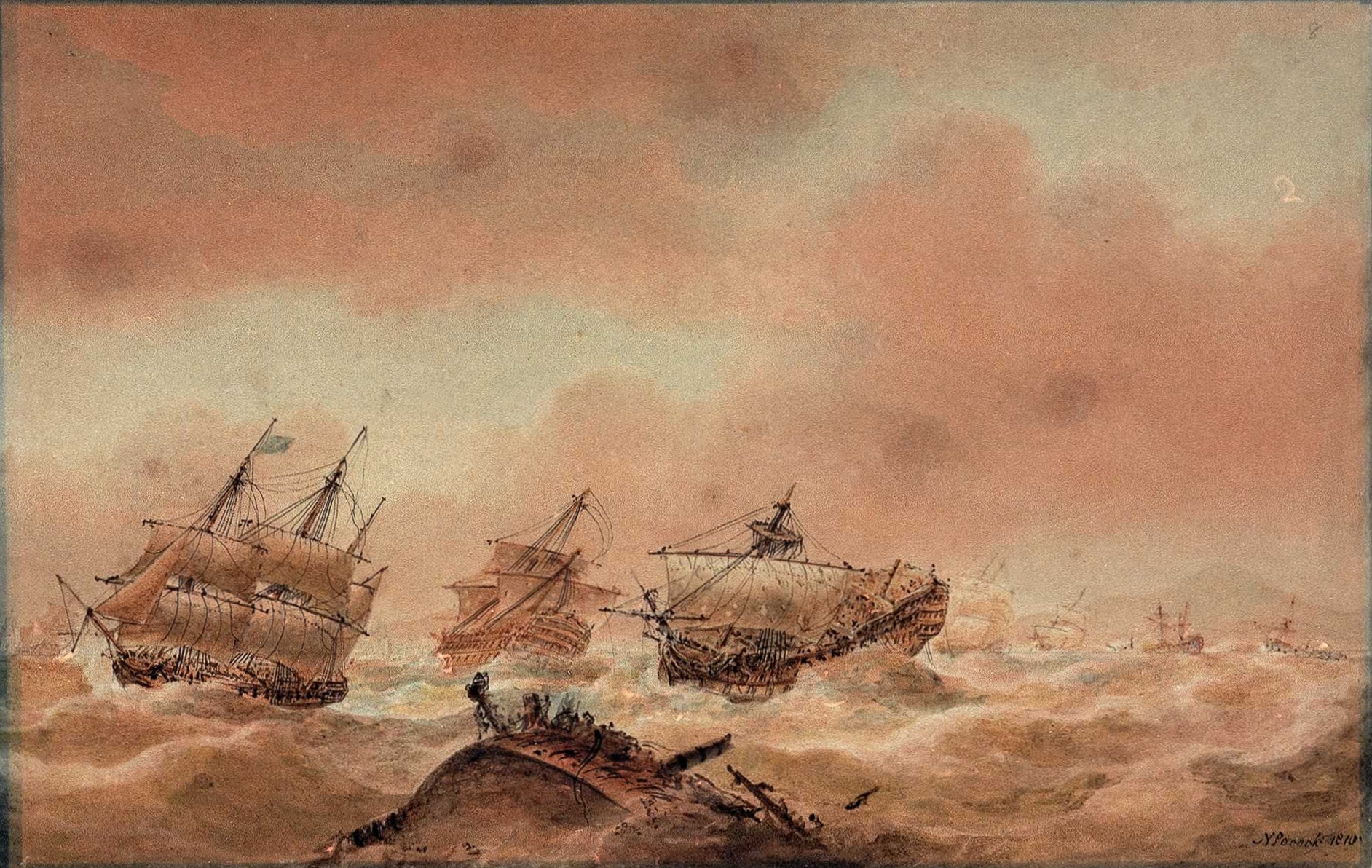
A ferocious Atlantic storm struck within days of the battle, wrecking many of the captured prizes and drowning thousands of men from both sides who had survived the fighting itself. The human cost of Trafalgar extended far beyond the battle. Nelson's body was preserved in a cask of brandy for the voyage home; he was given a state funeral at St Paul's Cathedral on 9 January 1806, attended by the nation in mourning.
Napoleon, recognising that Trafalgar had permanently closed the door on invasion, abandoned his plans for Britain and pivoted to a continental strategy — one that would ultimately lead him to Moscow and ruin. Britain emerged from Trafalgar as the unchallenged mistress of the seas, a position historians refer to as the foundation of Pax Britannica — British maritime dominance that lasted well over a century.
HMS Victory After Trafalgar: From Warship to Monument
After Trafalgar, Victory served as a troopship and later as a harbour flagship at Portsmouth. Her active fighting days were over, but her symbolic importance only grew. By the early twentieth century, however, she was in serious structural decay — neglect had taken a heavy toll on one of Britain's most precious artefacts.
A public campaign, strongly supported by the Society for Nautical Research, led to Victory being moved into dry dock No. 2 at Portsmouth Historic Dockyard in 1922. A sustained restoration programme, spanning several decades, returned her as closely as possible to her Trafalgar-era appearance. It was painstaking, expensive work — and entirely worth it.
Remarkably, Victory has never been decommissioned. She remains a commissioned warship of the Royal Navy to this day — the oldest such vessel in the world. A serving naval officer holds her as a flagship for official purposes, and she welcomes around 350,000 visitors per year. She is not a replica or a reconstruction; she is, in significant part, the actual ship that was at Trafalgar.
Why Trafalgar Still Matters: The Lasting Legacy of Victory
Trafalgar Square in London, completed in 1844 with Nelson's Column at its centre, stands as the nation's permanent physical tribute to the battle and its admiral. Every Londoner and every tourist who passes through it is, whether they know it or not, walking through a monument to 21 October 1805.
Nelson's leadership philosophy — leading from the front, trusting his captains as a "band of brothers," sharing the danger he asked others to face — became the model for British naval command in the century that followed. It was a style built on mutual confidence rather than rigid obedience, and it produced decisive results at the moment Britain needed them most.
Every year on Trafalgar Day, 21 October, the Royal Navy holds a formal dinner aboard HMS Victory at Portsmouth — officers in mess dress, the ship illuminated, the tradition unbroken. It is one of the most powerful continuities in British military life: today's sailors dining on the same decks where men bled and died two centuries ago. The ship does not merely represent history. She carries it, physically, in her timbers.
Further Reading
- National Museum of the Royal Navy, Portsmouth Historic Dockyard
- The National Archives, Kew, United Kingdom
- National Maritime Museum, Greenwich, London
- Society for Nautical Research
- Imperial War Museum, London