The Quiz Question
At which battle on 29 March 1879 did Colonel Evelyn Wood's fortified camp beat off roughly 20,000 Zulu warriors, marking the turning point of the war?
- A. Battle of Gingindlovu
- B. Battle of Ulundi
- C. Battle of Nyezane
- D. Battle of Khambula
The answer is D. Battle of Khambula. Here is the full story.
On the afternoon of 29 March 1879, somewhere in the sun-baked hills of northern Zululand, the fate of an entire kingdom was decided in the space of four ferocious hours. It wasn't the battle that started the Anglo-Zulu War, nor the one that ended it — but it was the one that determined the outcome of both.
The Battle That Saved Britain's War in Zululand
Just ten weeks before Khambula, the British Army had suffered one of the most humiliating defeats in its colonial history. At Isandlwana on 22 January 1879, Zulu warriors had overrun a British camp and killed over 1,300 soldiers in a single afternoon. The shock reverberated from South Africa to the halls of Westminster.
Khambula, fought on 29 March 1879 in the hills of what is now KwaZulu-Natal, delivered the answer Britain desperately needed. Roughly 20,000 Zulu warriors from King Cetshwayo's main impi were driven off by a garrison of fewer than 2,000 British and colonial troops — with devastating losses on the Zulu side.
Historians widely regard Khambula as the single most decisive engagement of the Anglo-Zulu War. It didn't just win a battle — it broke the Zulu army's offensive capacity for good.
How Britain Stumbled Into a Disastrous War
The Anglo-Zulu War began on 11 January 1879 when British forces under Lieutenant-General Lord Chelmsford invaded Zululand without a formal declaration of war. The invasion was the brainchild of Sir Henry Bartle Frere, Britain's High Commissioner in South Africa, who had issued King Cetshwayo kaMpande an ultimatum deliberately crafted to be rejected.
Frere wanted a pretext to dismantle the Zulu kingdom, which he saw as an obstacle to British confederation in southern Africa. Cetshwayo commanded a disciplined force of around 40,000 warriors organised into age-regiment groups called amabutho, each with its own distinctive shields, headgear, and battle honours.
On 22 January 1879, those warriors proved their terrifying effectiveness at Isandlwana. Chelmsford had split his force and left his camp fatally unfortified — the Zulu enveloping attack, a classic "chest and horns" formation, overwhelmed the defenders before they could react. The disaster forced a humiliating pause in British operations and kept surviving columns on the defensive for weeks.
Colonel Evelyn Wood and the Khambula Camp
Not every British commander in Zululand made Chelmsford's mistakes. Colonel Evelyn Wood VC commanded No. 4 Column in the north, operating around the Hlobane and Khambula hills near present-day Vryheid. Wood was an unusually gifted officer — a veteran of the Crimea, the Indian Mutiny, and the Ashanti War — who had earned his Victoria Cross in 1858 at the age of just 20.
After Isandlwana, Wood took no chances. He ordered the construction of a heavily fortified camp atop Khambula Ridge, sitting roughly 1,100 metres above sea level. The position consisted of a main wagon laager, a separate cattle kraal connected by a trench and palisade, and a small artillery redoubt — a carefully interlocking defensive system that Chelmsford had never thought to build at Isandlwana.
Wood's force included the 1st Battalion 13th (1st Somersetshire) Regiment of Foot, the 90th (Perthshire Volunteers) Light Infantry, Wood's Irregulars, and a Royal Artillery battery equipped with 7-pounder guns. Together they numbered fewer than 2,000 men — a fraction of the storm about to break over them.
The Disaster at Hlobane — the Day Before
The story of Khambula cannot be told without first telling what happened on the slopes of Hlobane Mountain the previous day. On 28 March 1879, Wood launched a cattle raid against the Zulu stronghold atop Hlobane, hoping to scatter forces sheltering there and strike a blow before the main Zulu impi arrived in the area.
It became a catastrophe. As British raiding parties scrambled across the mountain plateau, the main Zulu impi — some 20,000 strong and marching to assault Khambula — appeared on the plain below, cutting off the raiders' retreat. Lieutenant Colonel Redvers Buller led the cavalry in a desperate fighting withdrawal down the "Devil's Pass," a nearly vertical rock face swept by Zulu fire.
Around 15 officers and 79 men were killed at Hlobane — a sharp defeat that left Wood's column shaken the night before its greatest test. The Zulu force, now energised by their success at Hlobane and commanded by Ntshingwayo kaMahole — the same general who had directed the attack at Isandlwana — pressed on toward Khambula, confident that another British camp was about to fall.
29 March 1879: The Zulu Impi Descends on Khambula
The Zulu army came into sight of Khambula at around midday on 29 March. Their commanders had planned to rest and attack later — but Wood had other ideas. He sent Redvers Buller and a squadron of cavalry out to provoke the Zulu right horn, taunting them forward before they were ready.
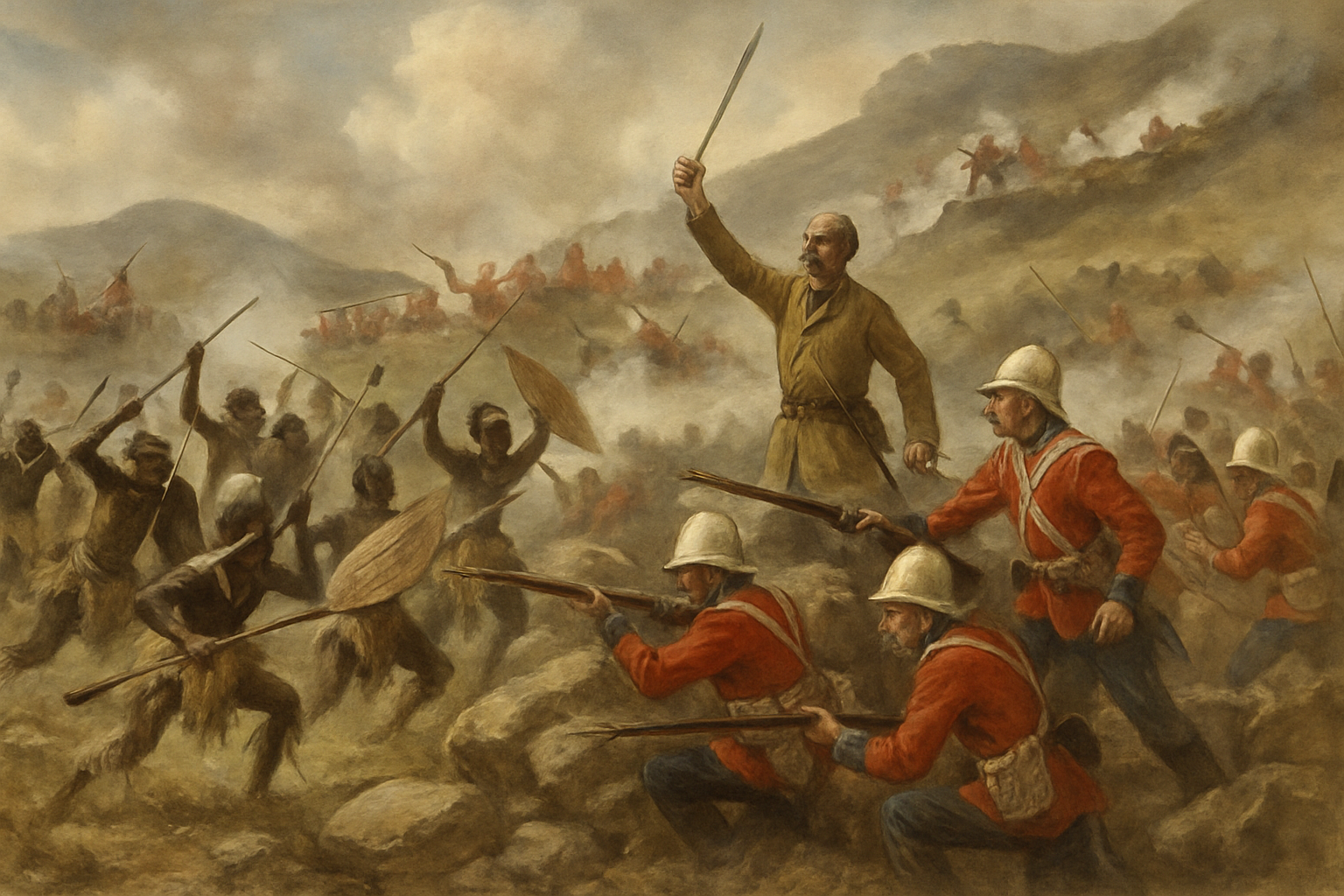
The tactic worked exactly as intended. Stung by the horsemen's harassment, the uKhandempemvu and iNgobamakhosi regiments launched a premature charge on the southern cattle kraal at approximately 1:30 pm, without waiting for the full impi to coordinate. The battle that followed lasted over four hours and attacked the British position from multiple directions simultaneously.
The Royal Artillery 7-pounders opened fire at long range, breaking up Zulu formations before they could mass at close quarters — a lesson brutally absent at Isandlwana. The Martini-Henry rifles of the 13th and 90th Regiments added a near-continuous wall of fire. But the Zulu warriors pressed on regardless, reaching within yards of the British perimeter in places, their courage under fire astonishing even the men shooting at them.
Inside the Laager: Courage Under Overwhelming Pressure
With roughly 1,800 defenders facing 20,000 attackers, the men inside Khambula's laager fought at an intensity that pushed both men and weapons to their limits. Martini-Henry rifle barrels became too hot to touch from sustained rapid fire. Ammunition carriers ran constantly between stockpiles and the firing line.
The cattle kraal briefly fell. The uKhandempemvu regiment poured in, and for a terrifying few minutes the southern perimeter was in Zulu hands. Companies of the 90th Light Infantry counter-attacked with the bayonet, retaking the kraal in close-quarters fighting — some of the most brutal hand-to-hand combat of the entire war.
Wood himself walked calmly along the parapet throughout the fighting, directing fire, speaking to his men, and refusing to take cover. Survivors' accounts consistently credit his composure as critical to maintaining discipline under what must have been almost unbearable pressure. Surgeon-Major P.J. Crealock and his small medical team worked under fire inside the laager, treating the wounded as the battle crashed around them.
By approximately 5:30 pm, after four hours of fighting, the Zulu assault began to visibly falter. Warriors who had marched through the night and fought without pause were exhausted, their ammunition — firearms and throwing spears alike — largely spent. The momentum that had carried them to the very walls of the camp began, irreversibly, to ebb.
The Pursuit: No Quarter on the Plains
Wood recognised the moment immediately. As the Zulu attack collapsed, he ordered Redvers Buller to take the mounted troops — cavalry and the Frontier Light Horse — out of the laager and pursue the retreating warriors across the open plain.
The pursuit was pitiless. Buller's horsemen covered several miles before nightfall, riding down exhausted men who had no realistic hope of escape. It was the kind of follow-up action that transformed a defensive victory into a strategic catastrophe for the defeated side, and it was conducted with professional ruthlessness.
British casualties at Khambula totalled 29 killed and 55 wounded — extraordinarily light given the ferocity and duration of the assault. Zulu losses were of an entirely different order. Official British counts recorded over 785 bodies on the field, but total Zulu dead — including those who died of wounds during the retreat — are estimated by historians at between 2,000 and 3,000 men. Among them were senior warriors of the elite iNgobamakhosi regiment, whose fighting strength was permanently shattered that afternoon.
Aftermath: The Road to Ulundi
Khambula broke the Zulu army's ability to take the offensive. King Cetshwayo attempted peace negotiations in April 1879, but Lord Chelmsford — now reinforced with fresh troops from Britain — was determined to press on and salvage his own reputation. There would be no negotiated settlement.
Remarkably, the same day as Khambula — 29 March 1879 — brought a second British victory at Gingindlovu in the south, where a relief column defeated another Zulu force and lifted the siege of the garrison at Eshowe. Two crushing blows in a single day, hundreds of miles apart, from which Cetshwayo's kingdom never recovered.
Chelmsford's reorganised second invasion culminated at the Battle of Ulundi on 4 July 1879. A British infantry square, bristling with Martini-Henry rifles and Gatling guns, shattered the last Zulu impi in open country and burned the royal capital to the ground. King Cetshwayo fled but was captured on 28 August 1879. In a remarkable postscript, he was eventually taken to London and received in audience by Queen Victoria in 1882.
The peace that followed was no gentle settlement. Britain deliberately fragmented the Zulu kingdom into 13 separate chieftainships, destroying the unified state that Shaka had built over half a century. It was a political dismemberment designed to ensure that Zulu military power could never again threaten British ambitions in southern Africa.
Why Khambula Still Matters: Legacy and Lessons
Khambula stands as a textbook demonstration of what Isandlwana was not: a prepared defensive position, well-sited for artillery, manned by disciplined troops under a commander who understood the ground and the enemy. Every advantage that Chelmsford had thrown away on 22 January, Wood had methodically built at Khambula over the weeks that followed.
Evelyn Wood went on to become a Field Marshal and one of the most celebrated soldiers of the Victorian era. Redvers Buller received the Victoria Cross for his conduct during the retreat at Hlobane the previous day — one of the most deserved awards of that conflict. Both men emerged from the Zulu War with reputations burnished by Khambula's fire.
The battle is still studied at British military staff colleges as a model of combined-arms defensive tactics — the coordination of infantry firepower, artillery, and mobile cavalry in a single coherent defensive and offensive plan. It is a lesson that cost thousands of lives to prove, on both sides of the wire.
For the Zulu people, Khambula carries a different and equally important meaning. The warriors who died there were not savages or an undifferentiated mass — they were men fighting with extraordinary bravery for their homeland, their king, and their way of life against industrialised firepower they could not match and political forces they had not chosen. That story deserves to be told with the same respect we give to the men inside the laager.
If this story of courage, tactics, and consequence has stayed with you, we'd love to hear your thoughts. Leave a comment below — did you know about Khambula before today? — and share this article with a fellow history lover who deserves to discover it.
Further Reading
- The National Army Museum, London — holds significant collections relating to the Anglo-Zulu War, including regimental records and personal accounts from officers who served at Khambula
- The National Archives, Kew — contains original War Office records, dispatches, and official correspondence from the 1879 Zululand campaign
- The Anglo-Zulu War Historical Society — a specialist body dedicated to the research and preservation of the history of the 1879 conflict, with resources covering all major engagements including Khambula
- KwaZulu-Natal Museum, Pietermaritzburg — houses extensive collections relating to Zulu history and the 1879 war, including Zulu material culture and battlefield archaeology
- The Royal Engineers Museum, Chatham — holds records and artefacts relating to the Victorian Army's campaigns in southern Africa, including the Zululand operations of 1879